
Home → Plays → Macbeth → Characters → Banquo
Character Analysis: Banquo
Character Profile – At a Glance
Role: A general in the King's army and Macbeth's close friend; later a ghost who haunts him.
Key Traits: Loyal, sceptical, noble, morally grounded, and suspicious.
The Core Conflict: He receives a prophecy of greatness (that his children will be kings) but refuses to force the issue, standing in direct contrast to Macbeth.
Key Actions: Witnesses the Witches' prophecy, suspects Macbeth of foul play, is murdered by hired assassins, and returns as a ghost to the banquet.
Famous Quote: "Thou hast it now: King, Cawdor, Glamis, all... and I fear / Thou play'dst most foully for't." (Act 3, Scene 1).
The Outcome: He is murdered in Act 3, but his son Fleance escapes, securing the prophecy that Banquo's line will eventually rule.
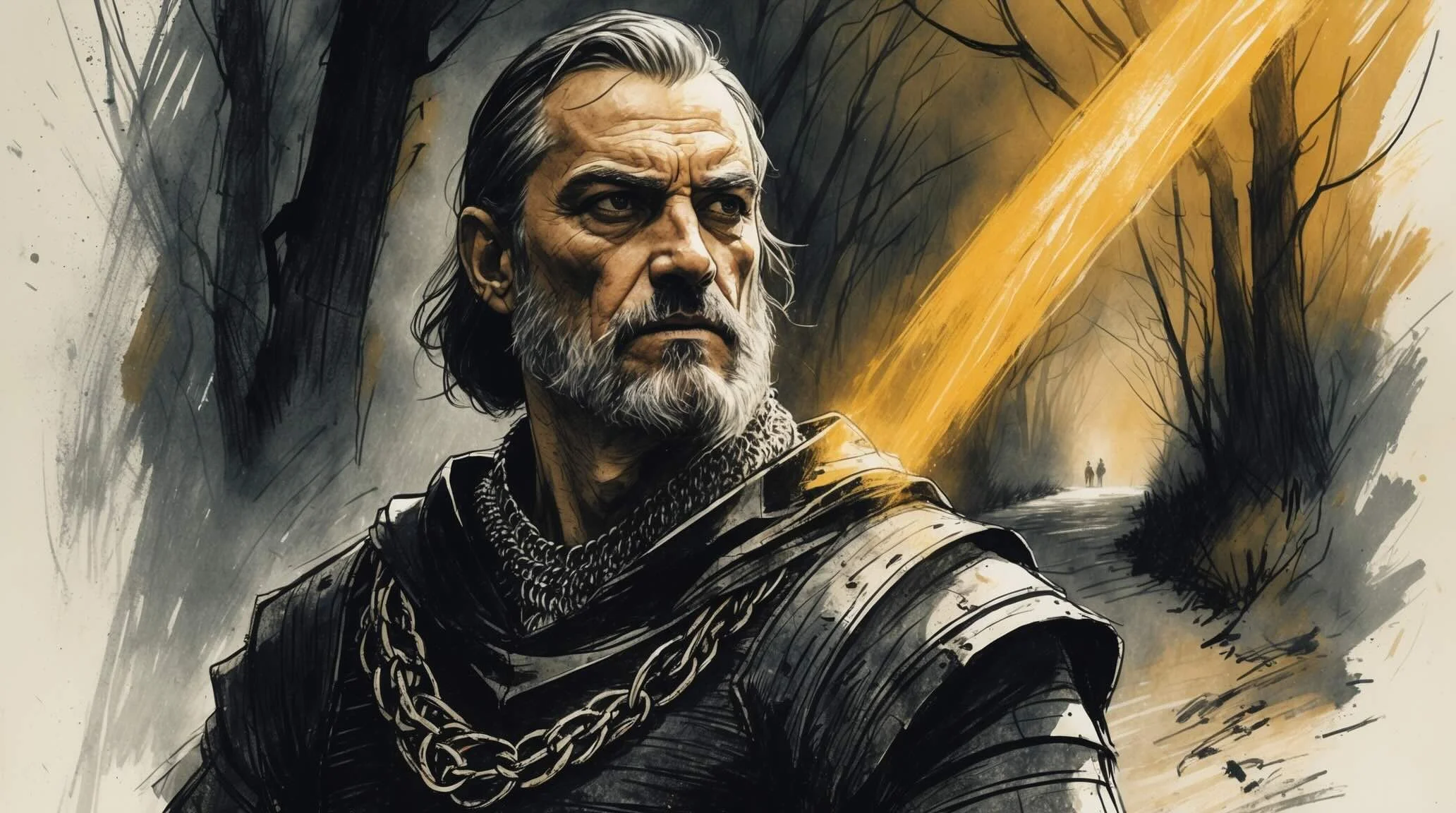
The Moral Compass: Banquo’s Psychology
Banquo serves as the foil to Macbeth. Both men are warriors, both are leaders, and both receive prophecies of greatness from the Witches. The crucial difference lies in how they react.
While Macbeth is immediately "rapt withal" and considers murder, Banquo remains sceptical. He questions the Witches' motives, warning Macbeth that evil often tells us truths "to win us to our harm." Banquo represents the path not taken: he possesses ambition (he hopes the prophecies for his children are true), but he refuses to compromise his honour to achieve it. He keeps his "bosom franchised and allegiance clear."
Original:
And oftentimes, to win us to our harm,
The instruments of darkness tell us truths,
Win us with honest trifles, to betray's
In deepest consequence. (Act 1, Scene 3)
Shakespeare Retold (Modern Verse):
And oftentimes, to get us into trouble,
Satanic forces feed us half the truth
To coax us with minutia, then betray us
With devastating impact.
The Skeptic and the Suspect
Banquo is the only person who knows about the Witches' prophecy, making him the greatest threat to Macbeth. He is arguably the smartest character in the play because he figures out the truth almost immediately. In his soliloquy in Act 3, he admits he fears Macbeth "played most foully" for the crown.
However, his inaction is his undoing. Instead of fleeing or exposing Macbeth immediately, he stays, perhaps hoping to see how his own prophecy plays out. This hesitation allows Macbeth time to plot his assassination.
The Ghost: Guilt Manifested
Banquo’s return as a ghost in Act 3, Scene 4 is the turning point of the play. It marks the moment Macbeth loses his composure in public. The ghost is a manifestation of Macbeth’s guilt—it appears only when Macbeth mentions Banquo’s name, and it is invisible to everyone else in the room.
The ghost sits in Macbeth’s chair, symbolisng that although Macbeth wears the crown, Banquo’s descendants are the true heirs to the throne. It is a silent accuser, denying Macbeth the peace and security he killed for.
The Arc: The Witness and the Haunting
Banquo’s role shifts from an active participant to a psychological tormentor.
Act 1 (The Witness): He stands beside Macbeth when the Witches appear. He is not afraid of them ("Speak then to me"), asking for his own fortune without begging for it.
Act 2 (The Loyalist): He is troubled by "cursed thoughts" (nightmares about the prophecy) but reaffirms his loyalty to the King. He is the first to vow to investigate Duncan's murder.
Act 3 (The Victim/The Ghost): He suspects Macbeth but attends the feast anyway. He is ambushed and killed, urging his son Fleance to "fly, good Fleance, fly!" His ghost returns to shatter Macbeth’s sanity.
“Banquo is the man Macbeth ought to have been.”
Key Quotes by Banquo
Quote 1:
Original:
What are these
So wither'd and so wild in their attire,
That look not like the inhabitants o' the earth,
And yet are on't? (Act 1, Scene 3)Shakespeare Retold (Modern Verse):
What are these
So haggard, dressed in scruffy, mangy clothes,
That do not look like they live here on earth,
But yet they’re here?
Quote 2:
Original:
If you can look into the seeds of time,
And say which grain will grow and which will not,
Speak then to me... (Act 1, Scene 3)Shakespeare Retold (Modern Verse):
If you can see what happens in the future
And know which crops will grow, and which will not,
Then speak to me…
Quote 3:
Original:
Thou hast it now: King, Cawdor, Glamis, all,
As the weird women promised, and I fear
Thou play'dst most foully for't. (Act 3, Scene 1)Shakespeare Retold (Modern Verse):
You’ve got it now: king, Cawdor, Glamis, all things
Those weird women promised, but, I fear
You cheated awfully for it.
Quote 4:
Original:
O, treachery! Fly, good Fleance, fly, fly, fly!
Thou mayst revenge. (Act 3, Scene 3)Shakespeare Retold (Modern Verse):
I’ve been betrayed! Run, Fleance, son! Run, run!
You might get our revenge!
Key Takeaways
Banquo is Macbeth's foil; he shows how a moral man responds to the temptation of power (with skepticism rather than obsession).
He is the only character who knows the Witches' prophecy, making him a dangerous liability to Macbeth.
His ghost represents Macbeth’s internal guilt and the inescapable reality that his crime has secured nothing (since Banquo’s heirs will rule).
His final act is saving his son, Fleance, ensuring the Witches' prophecy survives even if he does not.
Study Questions and Analysis
-
This is Banquo's most ambiguous trait. He suspects Macbeth of murder, yet keeps silent. It is possible he is waiting to see if his own prophecy (that his sons will be kings) comes true naturally. His silence makes him complicit in Macbeth's rise, though not in his crimes.
-
Shakespeare leaves this open to interpretation. Since no one else sees the ghost, it can be viewed as a psychological projection of Macbeth’s guilt (like the dagger). However, in Shakespearean theatre, ghosts were often treated as real supernatural entities. The fact that it appears exactly when Macbeth mentions Banquo suggests it is a direct response to his hypocrisy.
-
Macbeth fears Banquo for two reasons: his "royalty of nature" (Banquo is noble and wise) and the prophecy that Banquo’s children will be kings. Macbeth realises he has damned his soul only to build a legacy for Banquo’s family, calling his own crown "fruitless."
-
Fleance’s escape is the first time Macbeth’s plans fail. It proves that Macbeth cannot cheat fate. The Witches promised Banquo would "get kings," and by surviving, Fleance ensures that possibility remains. It marks the beginning of Macbeth’s loss of control.
-
Macbeth is "rapt" (entranced) and wants to know more. Banquo is calm and skeptical. He challenges them ("Speak then to me") but does not beg for their favour. He correctly identifies them as "instruments of darkness," whereas Macbeth chooses to believe them.
-
King James I of England (Shakespeare’s patron) claimed descent from the real-life Banquo. By portraying Banquo as a noble, moral ancestor who refuses to commit regicide, Shakespeare was flattering the King and validating his lineage.
-
In Act 3, Scene 3, a mysterious third murderer joins the two Macbeth hired. Some theories suggest it is Macbeth himself in disguise, ensuring the job is done. Others suggest it is a symbol of the chaos Macbeth has unleashed—violence multiplying beyond his control.