
Home → Plays → Macbeth → Characters → Duncan
Character Analysis: Duncan
Character Profile – At a Glance
Role: The King of Scotland; the victim of the regicide.
Key Traits: Benevolent, generous, gracious, trusting, and politically naive.
The Core Conflict: He represents the divinely appointed moral order, standing in direct contrast to Macbeth’s chaotic tyranny.
Key Actions: Pronounces Malcolm his heir, visits Macbeth’s castle to honour him, and is murdered in his sleep.
Famous Quote: "There's no art / To find the mind's construction in the face." (Act 1, Scene 4).
The Outcome: He is murdered by Macbeth, an act that triggers the collapse of the natural world and the play’s tragic events.
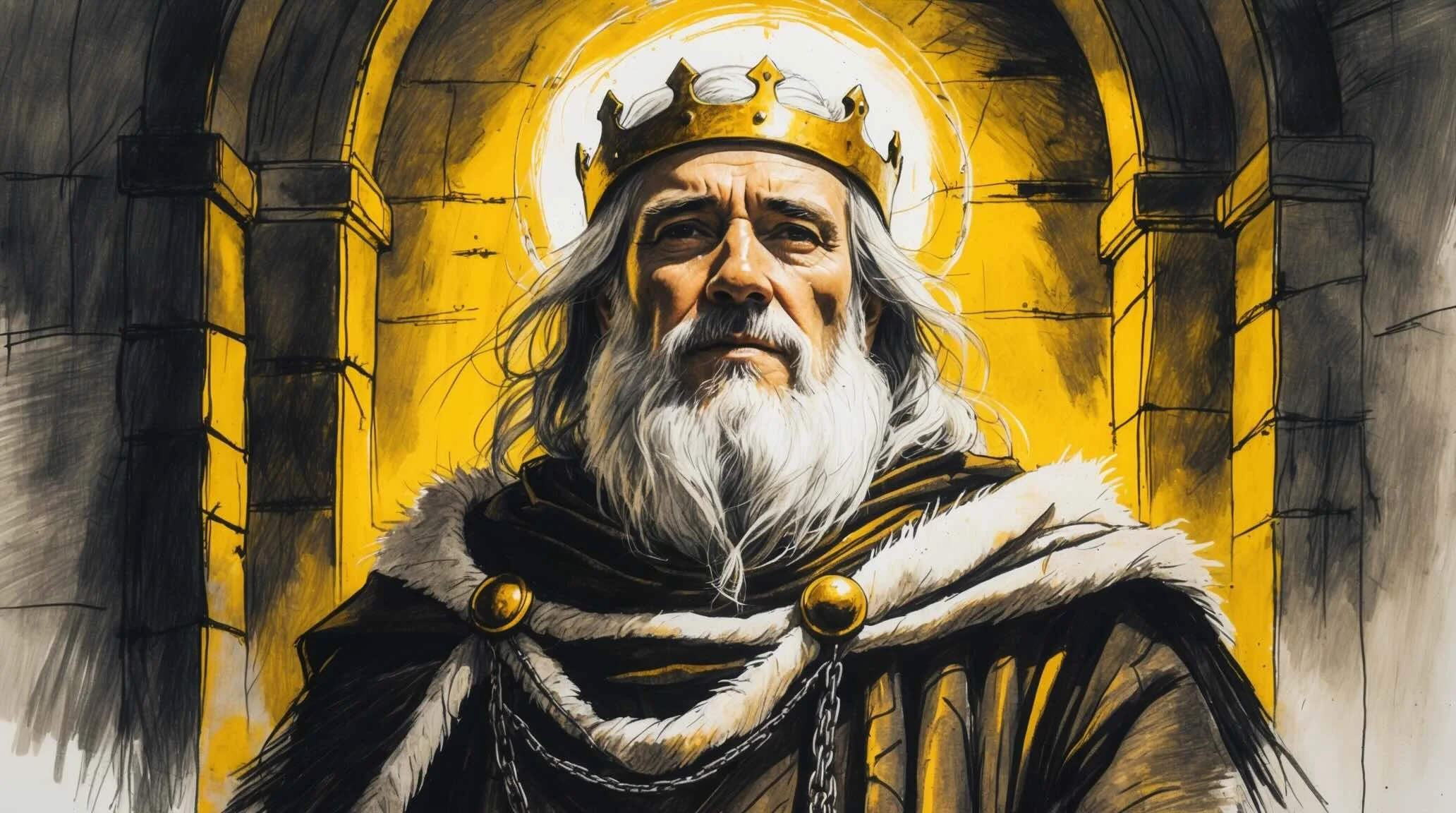
The Saintly King: Duncan’s Psychology
Duncan is unique in Shakespeare’s tragedies because he is a genuinely good man. Unlike other kings who are flawed or ambitious, Duncan is the archetype of a benevolent ruler. He represents the "Divine Right of Kings"—the idea that the King is God’s representative on earth.
However, his virtue is also his weakness. He is pathologically trusting. He admits he was completely deceived by the previous Thane of Cawdor, and moments later, he places his absolute trust in Macbeth—the man who will kill him. He judges people by their outward appearance, lacking the Machiavellian cynicism often required to survive in a violent political world.
Original:
There's no art
To find the mind's construction in the face:
He was a gentleman on whom I built
An absolute trust. (Act 1, Scene 4)Shakespeare Retold (Modern Verse):
One is unable
To know another's thoughts by how they look:
He was a gentleman in whom I'd built
An absolute trust.
Order vs. Chaos
Duncan is not just a character; he is a symbol of nature and order. He is associated with growth, planting, and fertility ("I have begun to plant thee, and will labour / To make thee full of growing" – Act 1, Scene 4).
When he is killed, it is not just a murder; it is a sacrilege. The natural world immediately revolts: horses eat each other, the sky turns dark during the day, and owls kill falcons. His death marks the transition from a nurturing, natural Scotland to a barren, unnatural one under Macbeth.
Duncan and Macbeth: The Father and the Son
The relationship between Duncan and Macbeth is framed as familial. Duncan refers to Macbeth as "O worthiest cousin!" and treats him like a son. This makes the murder a form of parricide (killing a father figure).
Duncan’s arrival at Inverness is marked by tragic irony. He describes the castle as having a "pleasant seat" (Act 1, Scene 6), completely unaware that he is walking into a slaughterhouse. His inability to see the evil in Macbeth highlights the tragedy of goodness in a corrupt world.
The Legacy: A Ghost in the Machine
Although he dies in Act 2, Duncan’s presence haunts the rest of the play. Macbeth is tortured not just by the act of murder, but by the specific goodness of the man he killed. He describes Duncan’s virtues "pleading like angels, trumpet-tongued."
Unlike Banquo, who returns as a literal ghost, Duncan returns as the moral standard against which Macbeth’s tyranny is judged. Macduff calls him a "sainted king," and his memory fuels the rebellion that eventually restores his son, Malcolm, to the throne.
“Duncan’s death is the death of the father, the death of the king, and the death of God’s deputy on earth.”
Key Quotes by King Duncan
Quote 1:
Original:
What he hath lost, noble Macbeth hath won. (Act 1, Scene 2)Shakespeare Retold (Modern Verse):
What he has lost, noble Macbeth has won.
Quote 2:
Original:
I have begun to plant thee, and will labour
To make thee full of growing. (Act 1, Scene 4)Shakespeare Retold (Modern Verse):
I gave you chance to grow, and now I'll work hard
To see your full potential bloom.
Quote 3:
Original:
This castle hath a pleasant seat; the air
Nimbly and sweetly recommends itself
Unto our gentle senses. (Act 1, Scene 6)Shakespeare Retold (Modern Verse):
This castle's in a lovely spot; the breeze
Is so delightful here, it leaves one feeling
Relaxed and mellow.
Quote 4:
Original:
See, see, our honoured hostess!
The love that follows us sometime is our trouble,
Which still we thank as love. (Act 1, Scene 6)Shakespeare Retold (Modern Verse):
Look, our gracious hostess!
The adulation I get often tires me,
Although I'm grateful for it.
Key Takeaways
Duncan represents the ideal, virtuous king, governing through love and generosity rather than fear.
His fatal flaw is his inability to "find the mind's construction in the face"—he is too trusting of those around him.
His murder is portrayed as a "breach in nature," causing the natural world to descend into chaos.
Even after death, his virtue serves as the moral anchor of the play, highlighting the horror of Macbeth’s actions.
Study Questions and Analysis
-
There is a debate here. Politically, his inability to detect treason (first the Thane of Cawdor, then Macbeth) suggests a dangerous naivety. However, Shakespeare presents him as morally strong. He is "clear in his great office." The play suggests that in a world of wolves, a sheep cannot lead safely, no matter how virtuous.
-
To heighten the horror of the crime. If Duncan were a tyrant, Macbeth’s actions might be justifiable as a coup. By making Duncan "sainted" and "meek," Shakespeare ensures that Macbeth’s ambition is purely selfish and evil.
-
In Act 1, Scene 6, Duncan praises the castle's "pleasant seat" and the "sweet" air. This is dramatic irony; the audience knows he is walking into his grave. It underscores his blindness to the evil awaiting him.
-
Lennox reports "lamentings heard i' the air" and "strange screams of death" (Act 2, Scene 3). Later, we learn that horses ate each other and an owl killed a falcon. This signifies that killing a divinely appointed king is an assault on nature itself.
-
This action accelerates the plot. By officially naming Malcolm his successor in Act 1, Scene 4, he unknowingly blocks Macbeth’s path to the crown ("That is a step / On which I must fall down, or else o'erleap"). It forces Macbeth to act rather than wait for "chance" to crown him.
-
Duncan is generative; he talks of "planting" and "growing" his subjects. Macbeth is destructive; he brings death and barrenness. Duncan leads by rewarding loyalty; Macbeth leads by eliminating threats.
-
Sleep represents innocence ("the innocent sleep"). Killing a sleeping man is the ultimate act of cowardice and violation. It emphasizes Duncan’s total vulnerability and trust in his kinsman.