
Home → Plays → Macbeth → Characters → Lady Macbeth
Character Analysis: Lady Macbeth
Character Profile – At a Glance
Role: Wife of Macbeth and later Queen of Scotland; the catalyst for the tragedy.
Key Traits: Manipulative, ambitious, ruthless (initially), fragile, and ultimately consumed by guilt.
The Core Conflict: She suppresses her humanity and femininity to empower her husband, but her repressed conscience eventually destroys her sanity.
Key Actions: Convinces Macbeth to kill Duncan, frames the guards, covers up the crime, and eventually commits suicide.
Famous Quote: "Out, damned spot! Out, I say!" (Act 5, Scene 1).
The Outcome: She descends into madness (sleepwalking) and dies by suicide off-stage in Act 5.
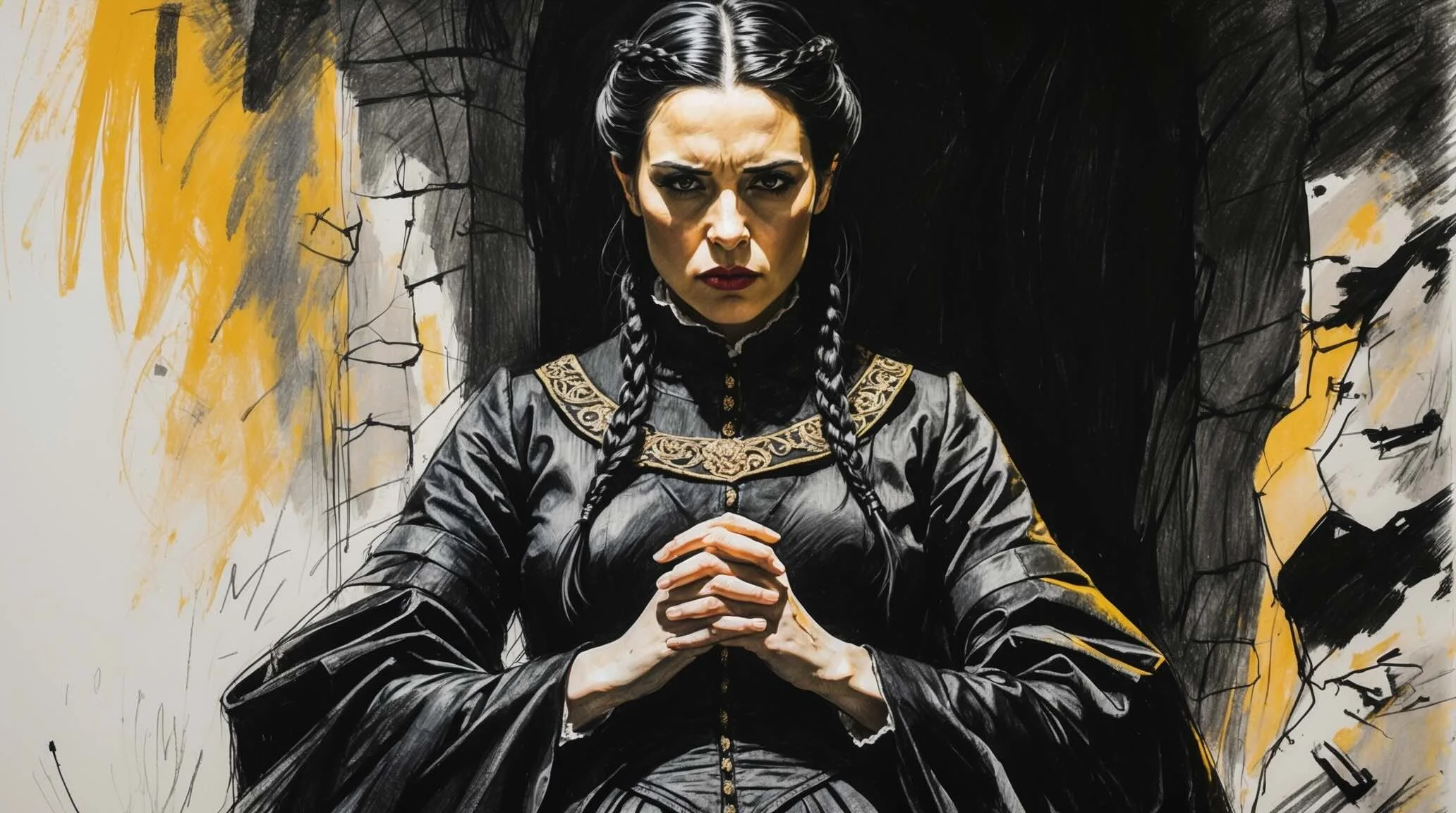
The Fourth Witch: Lady Macbeth’s Psychology
Lady Macbeth is often described as the "fourth witch" because she initiates the tragedy. While the Witches predict the crown, Lady Macbeth provides the roadmap to get it. Her psychology is defined by extreme suppression. She does not lack a conscience; she actively suppresses it.
Upon reading Macbeth’s letter, she immediately fears his nature is "too full o' the milk of human kindness." To compensate, she performs a ritualistic invocation to evil spirits, asking them to "unsex" her and fill her with "direst cruelty." This proves she is not naturally devoid of empathy; she must force herself to be cruel.
Original:
Come, you spirits
That tend on mortal thoughts, unsex me here,
And fill me from the crown to the toe top-full
Of direst cruelty! (Act 1, Scene 5)Shakespeare Retold (Modern Verse):
Come, evil spirits
That make me think of death, make me more manly,
And fill me from my head down to my toes
With awful cruelty!
The Cost of Repression: Madness and Guilt
Lady Macbeth represents the psychological concept of repression. In the early acts, she is the practical realist, telling Macbeth that "a little water clears us of this deed." She refuses to dwell on the horror.
However, the mind cannot be silenced forever. Because she cannot confess her guilt during the day (due to her status and safety), her conscience leaks out while she sleeps. The famous "Sleepwalking Scene" (Act 5, Scene 1) is a replay of her trauma. The "little water" she once boasted of becomes an ocean she cannot wash away ("all the perfumes of Arabia will not sweeten this little hand").
Lady Macbeth and Gender
Lady Macbeth equates masculinity with violence and femininity with weakness. To shame Macbeth into murder, she attacks his manhood ("When you durst do it, then you were a man" – Act 1, Scene 7).
Ironically, she fails because she cannot fully strip away her own femininity. She admits she could not kill Duncan herself because he "resembled my father as he slept" (Act 2, Scene 2). This small crack in her armour eventually widens into the mental breakdown that kills her.
The Arc: The Cracking of the Porcelain
Lady Macbeth’s arc is the inverse of her husband’s. As he grows colder and stronger, she grows weaker and more isolated.
Act 1 (The Catalyst): She is the dominant force, summoning spirits and bullying Macbeth into action. She appears invincible.
Act 2 (The Accomplice): She manages the crime scene, framing the guards when Macbeth is too terrified to return. She is the voice of cold reason.
Act 3 (The Fading Force): The distance begins. Macbeth plans Banquo’s murder without her. She tries to maintain appearances at the banquet but is clearly losing control over him.
Act 5 (The Victim): She is reduced to a shuffling, terrified figure, afraid of the dark. Her suicide is the final collapse of a mind that took on too much weight.
“She is the most commanding and perhaps the most awe-inspiring female character that Shakespeare ever drew... but her strength is the strength of nerve, not of character.”
Key Quotes by Lady Macbeth
Quote 1:
Original:
Look like the innocent flower,
But be the serpent under't. (Act 1, Scene 5)Shakespeare Retold (Modern Verse):
Look like a flower,
But be the snake below.
Quote 2:
Original:
I have given suck, and know
How tender 'tis to love the babe that milks me:
I would, while it was smiling in my face,
Have plucked my nipple from his boneless gums,
And dashed the brains out, had I so sworn as you... (Act 1, Scene 7)Shakespeare Retold (Modern Verse):
When a baby sucked my milk,
I know the tender love that feeling brought me;
But I know, as the baby smiled back at me,
I'd pluck my nipple from its toothless mouth
And smash its brains out, had I sworn as you have
To do it.
Quote 3:
Original:
Nought's had, all's spent,
Where our desire is got without content. (Act 3, Scene 2)Shakespeare Retold (Modern Verse):
If nothing’s gained when time’s expired,
Unhappy, though you’ve got what you desired,
Quote 4:
Original:
Here's the smell of the blood still: all the perfumes of Arabia will not sweeten this little hand. Oh, oh, oh! (Act 5, Scene 1)Shakespeare Retold (Modern Verse):
My hands still smell of blood. All the perfumes of Arabia won’t make my hand smell sweet. Oh, oh, oh!
Key Takeaways
Lady Macbeth acts as the catalyst for the play, but she is not a one-dimensional villain; her cruelty is a performance she forces upon herself.
She views femininity as a weakness and masculinity as the capacity for violence, a worldview that ultimately destroys her.
Her relationship with Macbeth devolves from a "partnership of greatness" to total estrangement.
Her madness demonstrates the power of the subconscious; guilt that is suppressed will eventually surface with destructive force.
Study Questions and Analysis
-
No. A purely evil character (like Iago) does not need to summon spirits to remove their conscience. The fact that she must ask to be "unsexed" and filled with cruelty suggests that compassion is her natural state, and she must violently suppress it. Her eventual madness confirms that her conscience was never gone, only buried.
-
When Macbeth describes killing the guards, Lady Macbeth faints. Analysis is divided: it may be a theatrical distraction to draw attention away from Macbeth’s erratic behaviour, or it may be a genuine physical reaction to realising that her husband has gone "off-script" and is now killing without her permission.
-
In the beginning, they are "partners in greatness." They share every thought. However, once the crown is won, the intimacy dies. Macbeth stops confiding in her ("Be innocent of the knowledge"), and she becomes isolated. By the end, they die separately, with Macbeth barely reacting to the news of her death.
-
It acts as a confession. In her sleep, she relives the murder of Duncan, the framing of the guards, and the death of Lady Macduff. It proves that while she controlled her actions during the day, she lost control of her mind. It also contrasts with her earlier claim that "a little water" clears them of the deed.
-
Her suicide is the result of total isolation and unbearable guilt. With Macbeth absent (mentally and physically) and her own mind torturing her with visions of blood, she sees no other escape. It serves as a final, tragic contrast to her earlier strength.
-
She weaponises his masculinity. She implies that if he does not kill the King, he is not a man. She contrasts his hesitation with her own hypothetical violence (the image of dashing a baby's brains out), effectively shaming him into action.
-
She claims, "Had he not resembled / My father as he slept, I had done't" (Act 2, Scene 2). This is the only moment of hesitation we see from her during the murder night. It reveals a lingering shred of familial love and humanity that she hasn't managed to "unsex" away.