
Home → Plays → Macbeth → Characters → The Witches
Character Analysis: The Witches
Character Profile – At a Glance
Role: Supernatural entities who prophesy Macbeth's rise and fall; agents of chaos.
Key Traits: Ambiguous, malevolent, manipulative, equivocal, and unnatural.
The Core Conflict: They represent the forces of darkness and chaos that seek to overturn the natural, moral order of the world.
Key Actions: Plant the seed of ambition in Macbeth, summon the apparitions to deceive him, and vanish once their destruction is ensured.
Famous Quote: "Fair is foul, and foul is fair." (Act 1, Scene 1).
The Outcome: They succeed in destroying Macbeth and disrupting Scotland, vanishing into the air leaving chaos in their wake.
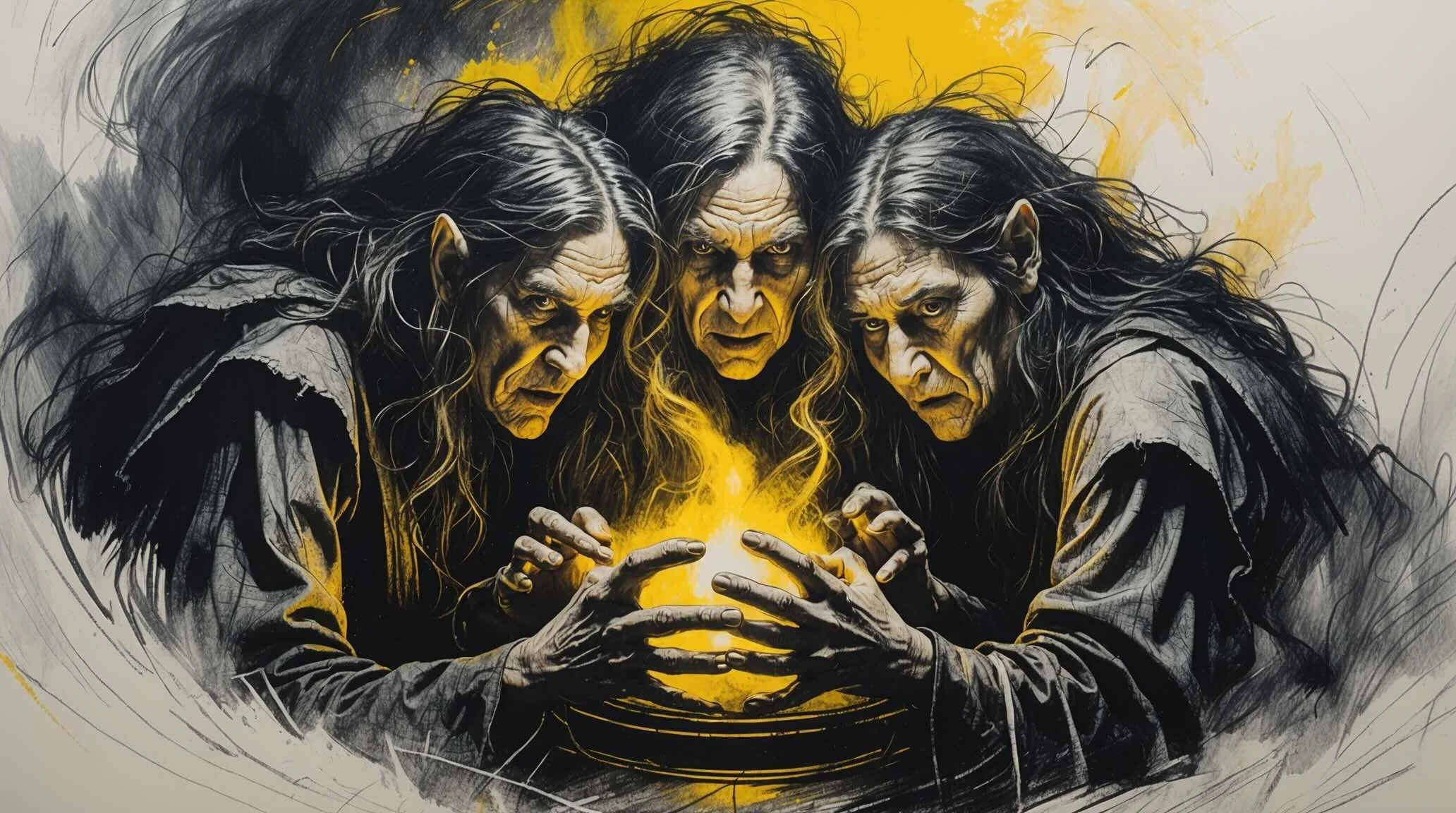
Agents of Chaos: The Witches' Psychology
The Witches are not human characters with traditional psychology; they are forces of nature (or anti-nature). They exist outside the moral universe of the play. Their motivation appears to be "pure malice" or "sport"—they destroy human lives simply because they can.
They are often referred to as the "Weird Sisters." This comes from the Old English word wyrd, meaning "fate." This suggests they are not just spell-casters, but the physical embodiment of Destiny itself. However, they never force Macbeth to act; they simply provide the temptation and let his own ambition do the rest.
Original:
Fair is foul, and foul is fair: H
over through the fog and filthy air. (Act 1, Scene 1)Shakespeare Retold (Modern Verse):
What’s fair is foul; what’s foul is fair;
Let’s fly through foggy, filthy air.
The Language of Evil: Trochaic Tetrameter
Shakespeare gives the Witches a unique sound. While the noble characters speak in Iambic Pentameter (di-DUM, di-DUM - a heartbeat rhythm), the Witches speak in Trochaic Tetrameter (DUM-di, DUM-di - a chanting rhythm).
This makes them sound unnatural, offensive to the ear, and hypnotic. They speak in riddles and paradoxes ("Lesser than Macbeth, and greater"), using language to confuse moral boundaries.
Masters of Equivocation
The Witches' primary weapon is equivocation—telling a truth that is intended to mislead.
They tell Macbeth he will be King (Truth), but hide the fact that it will cost him his soul.
They tell him "none of woman born" can harm him (Truth), hiding the fact that Macduff was born via Caesarean section.
They provide Macbeth with a false sense of security ("security is mortals' chiefest enemy"), leading him directly to his doom.
The Arc: The Trap is Set
Act 1 (The Hook): They appear in thunder and lightning, setting a tone of unease. They meet Macbeth and Banquo, offering three prophecies. This implants the idea of murder in Macbeth's mind.
Act 3 (The Complication): They meet with Hecate (the goddess of witchcraft), who scolds them for trading with Macbeth but agrees to help destroy him completely with new illusions.
Act 4 (The Trap): They summon three apparitions (an Armed Head, a Bloody Child, a Child Crowned). These visions convince Macbeth he is invincible, ensuring he will be reckless in his final battle.
“The Witches are not the Fates... they have no power to compel. They only have the power to tempt.”
Key Quotes by The Witches
Quote 1:
Original:
When shall we three meet again
In thunder, lightning, or in rain? (Act 1, Scene 1)Shakespeare Retold (Modern Verse):
When will we three meet again?
In thunder, lightning, or in rain?
Quote 2:
Original:
All hail, Macbeth, that shalt be king hereafter! (Act 1, Scene 3)Shakespeare Retold (Modern Verse):
All hail, Macbeth! You’ll be the king in future!
Quote 3:
Original:
By the pricking of my thumbs,
Something wicked this way comes. (Act 4, Scene 1)Shakespeare Retold (Modern Verse):
By the pain within my thumbs
I sense that something wicked comes.
Quote 4:
Original:
Double, double toil and trouble;
Fire burn and cauldron bubble. (Act 4, Scene 1)Shakespeare Retold (Modern Verse):
Double, double toil and trouble;
Fire burn, and cauldron bubble.
Key Takeaways
The Witches represent the externalisation of evil and the chaos of the supernatural world.
They do not control fate directly; they rely on human ambition and interpretation to make their prophecies come true.
Their speech pattern (chanting rhymes) sets them apart from the human characters, marking them as "other."
Their deception relies on equivocation: telling technical truths that lead to spiritual lies.
Study Questions and Analysis
-
This is the central question of the play. If they control fate, Macbeth is a victim. However, most analysis suggests they only know the future or suggest possible futures. Macbeth chooses to pick up the dagger. They are the catalyst, but Macbeth is the engine.
-
They speak in Trochaic Tetrameter (four beats, stress on the first: DUM-da, DUM-da). This creates a chanting, spell-like rhythm that sounds distinct from the Iambic Pentameter (natural speech) of the noble characters. It emphasizes their unnatural, magical nature.
-
The number three is significant in mythology (the three Fates of Greek myth who spin, measure, and cut the thread of life). It reinforces their connection to destiny. It is also an inversion of the Holy Trinity, suggesting they are a "dark trinity."
-
This paradox sets the theme for the entire play: appearances can be deceiving. What looks good (Macbeth, the hero) becomes evil; what looks safe (Inverness castle) becomes deadly. It represents the overturning of the moral order.
-
Banquo notes, "You should be women, / And yet your beards forbid me to interpret / That you are so." This physical ambiguity reflects their role in disrupting nature. Just as they blur the lines between good and evil, they blur the lines between male and female.
-
In Act 4, Scene 1, they say "Something wicked this way comes" before Macbeth enters. This is significant because even the embodiments of evil recognise that Macbeth has become one of them. He is no longer a man tempted by evil; he is the evil.
-
Hecate appears in Act 3 to scold the Witches. Many scholars believe these scenes were added later by Thomas Middleton (not Shakespeare) to add more spectacle (music and dance) to the play. However, narratively, she represents a higher tier of evil, ensuring Macbeth’s destruction is total.