Macbeth: Act 1, Scene 7 – Analysis
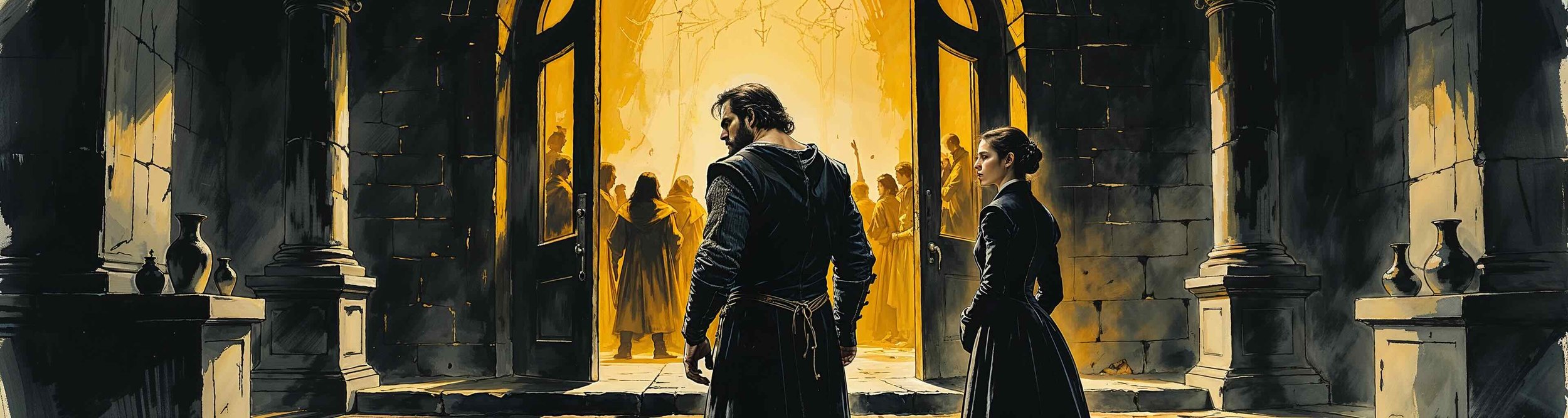
Scene Profile – At a Glance
- Location: Inside Macbeth's castle, during Duncan's welcome feast.
- What Happens: Alone, Macbeth weighs the murder of Duncan and decides against it. Lady Macbeth confronts him, attacks his manhood, and overwhelms his doubts. By the scene's end he is resolved to kill the king.
- Key Characters: Macbeth and Lady Macbeth.
- Dramatic Function: The decisive turning point of Act 1: Macbeth commits to the murder, and the marriage's balance of will is laid bare.
- Famous Quote:
I have no spur
To prick the sides of my intent, but only
Vaulting ambition, which o'erleaps itself...
(Macbeth, Act 1, Scene 7) - Why It Matters: Macbeth's conscience nearly wins. That Lady Macbeth talks him round shows the murder is a choice, made against his better judgement.
Scene Summary
As servants carry dishes to Duncan's feast, Macbeth slips away to think. In a long soliloquy he confronts the murder honestly and finds every reason against it. He fears the consequences in this life – that violence teaches violence and returns to "plague the inventor" – and he acknowledges the bonds he would break: he is Duncan's kinsman, subject and host, and Duncan has been a humble, virtuous king whose murder would cry out to heaven. He concludes that he has no real spur to act, only "vaulting ambition".
Lady Macbeth finds him and learns he has decided to "proceed no further". She rounds on him at once, accusing him of cowardice and of letting his ambition collapse like a drunkard's promise. When Macbeth protests that he dares do all that befits a man, she redefines manhood as the willingness to kill, and delivers her most shocking image: she would have dashed out the brains of her own nursing baby rather than break a vow as he is doing.
Macbeth's resistance crumbles. He asks what will happen if they fail, and she dismisses the fear, laying out her plan: drug Duncan's guards, kill the king while he sleeps, and frame the drunken servants. Macbeth, won over and even admiring, resolves to go through with it. The scene ends with his grim summary of the deceit required: "False face must hide what the false heart doth know."
"If It Were Done"
Macbeth's opening soliloquy is the moral centre of Act 1. Crucially, it is not really about whether the murder is wrong – Macbeth never doubts that – but about whether he can escape its consequences. He begins by wishing the deed could be over the instant it is done, with no aftermath in this world or the next, and then talks himself out of that fantasy.
Original
If it were done when 'tis done, then 'twere well
It were done quickly: if the assassination
Could trammel up the consequence, and catch
With his surcease success...
(Macbeth, Act 1, Scene 7)
Shakespeare Retold (Modern Verse)
If there's no retribution, it's as well
To do it quickly. If the assassination
Could catch all consequences in a net,
Concluding it successfully...
The tortured, hesitant rhythm of the speech – clause piling on clause, the repeated "done" – mirrors a mind circling its own dread. Macbeth recognises "even-handed justice": the poison you mix for others is returned to your own lips. By the time he reaches Duncan's virtues, he has built an overwhelming case against the deed. This is a man whose conscience and intelligence are fully alive to the horror, which makes his eventual surrender all the more tragic.
Vaulting Ambition
Having weighed everything, Macbeth reaches a clear verdict: there is no justification for the murder at all. He has no grievance, no spur, nothing driving him but ambition itself – and he sees that this ambition is dangerous, the kind that overreaches and destroys the one who feels it.
Original
I have no spur
To prick the sides of my intent, but only
Vaulting ambition, which o'erleaps itself
And falls on the other.
(Macbeth, Act 1, Scene 7)
Shakespeare Retold (Modern Verse)
There’s no more
That’s motivating me to act, except
Ambition, like a man mounting his horse
And falling off the other side.
The image of "vaulting ambition" is one of the play's defining metaphors: a rider so eager to mount that he leaps clean over the saddle and falls on the far side. It captures both the energy of Macbeth's desire and its self-defeating nature – ambition that overshoots will bring him down. The speech ends with Macbeth, in effect, deciding not to kill Duncan. Everything that follows is Lady Macbeth reversing this decision.
The Attack on His Manhood
Lady Macbeth's counter-attack is not an argument about politics or safety but an assault on Macbeth's sense of himself as a man. She reframes his moral hesitation as cowardice and broken nerve, and equates true manhood with the readiness to kill. It is the most effective pressure she could apply, because Macbeth's identity as a soldier is built on courage.
Original
I have given suck, and know
How tender 'tis to love the babe that milks me:
I would, while it was smiling in my face,
Have plucked my nipple from his boneless gums,
And dashed the brains out, had I so sworn as you
Have done to this.
(Lady Macbeth, Act 1, Scene 7)
Shakespeare Retold (Modern Verse)
When a baby sucked my milk,
I know the tender love that feeling brought me;
But I know, as the baby smiled back at me,
I’d pluck my nipple from its toothless mouth
And smash its brains out, had I sworn as you have
To do it.
This is the most violent image in the play, and Lady Macbeth deploys it deliberately. By imagining herself murdering her own nursing child rather than break a promise, she sets a standard of ruthless commitment that shames Macbeth's hesitation. It also completes the work of her "unsex me" speech: the tenderness she once felt is now invoked only to be overruled. The horror of the image is the measure of how far she will push, and Macbeth has no answer to it.
Language and Technique
- Soliloquy: Macbeth's opening speech lays his conscience bare, showing he understands and rejects the murder before his wife changes his mind.
- Metaphor of horsemanship: "Vaulting ambition, which o'erleaps itself" pictures desire overreaching and causing its own fall.
- Religious imagery: Duncan's virtues "plead like angels, trumpet-tongued" and pity is a "naked new-born babe" – the murder is framed as cosmic sacrilege.
- Goading and rhetorical questions: Lady Macbeth attacks through questions about courage and manhood, redefining masculinity as the will to kill.
- Antithesis: The closing couplet – "False face must hide what the false heart doth know" – restates the play's appearance-versus-reality theme as a rule for action.
Key Quotes from Act 1, Scene 7
Quote 1He's here in double trust;
First, as I am his kinsman and his subject,
Strong both against the deed; then, as his host,
Who should against his murderer shut the door,
Not bear the knife myself.
(Macbeth, Act 1, Scene 7)
Shakespeare Retold (Modern Verse)
He double trusts me:
First off, I am his cousin and a Scotsman,
Both reasons not to kill him; then, I host him
And should, therefore, keep evil from my home,
Not kill him here myself.
I dare do all that may become a man;
Who dares do more is none.
(Macbeth, Act 1, Scene 7)
Shakespeare Retold (Modern Verse)
I dare to do all things that make a good man;
Those who dare more aren’t men.
But screw your courage to the sticking-place,
And we'll not fail.
(Lady Macbeth, Act 1, Scene 7)
Shakespeare Retold (Modern Verse)
But if you keep your courage of conviction,
Then we won't fail.
Away, and mock the time with fairest show:
False face must hide what the false heart doth know.
(Macbeth, Act 1, Scene 7)
Shakespeare Retold (Modern Verse)
Go back and pass the time without a mention,
And smile to hide the source of our intention.
Key Takeaways
- Macbeth decides against murder: His soliloquy weighs the deed honestly and concludes he has no reason to do it but ambition.
- His conscience is alive: He fully understands the horror and the broken bonds – kinsman, subject, host – before he acts.
- Lady Macbeth attacks his manhood: She reframes his hesitation as cowardice and redefines being a man as the will to kill.
- The infanticide image: Her willingness to dash out her own baby's brains sets a standard of ruthlessness Macbeth cannot match.
- Macbeth commits: By the end he is resolved, vowing that a "false face must hide what the false heart doth know".
Study Questions and Analysis
What does Macbeth's soliloquy reveal about his state of mind?
The soliloquy shows a man whose conscience is fully functioning. Macbeth does not need anyone to tell him the murder is wrong; he works it out himself, in painful detail. He fears retribution in this world, recognises the sacred bonds of kinship, loyalty and hospitality he would shatter, and acknowledges that Duncan has been a good and humble king whose virtues would "plead like angels" against his killing.
Crucially, he ends by deciding against the deed: he can find no motive except "vaulting ambition", and he knows that is not enough. This matters for how we judge Macbeth. He is not a man blind to morality but one who sees it clearly and then acts against it. A. C. Bradley, in Shakespearean Tragedy (1904), emphasised this powerful moral imagination as central to Macbeth's tragedy: he is destroyed not by ignorance of good but by the failure to hold to the good he understands.
How does Lady Macbeth persuade Macbeth to commit the murder?
Lady Macbeth does not answer Macbeth's moral reasoning; she bypasses it entirely and attacks his pride. She accuses him of cowardice, compares his collapsed resolve to a drunkard sobering up, and questions whether he is a man at all. Her method is emotional and personal, aimed precisely at the soldier's self-image she knows he cannot bear to lose.
When you durst do it, then you were a man;
And, to be more than what you were, you would
Be so much more the man.
(Lady Macbeth, Act 1, Scene 7)
Shakespeare Retold (Modern Verse)
If you dared do it, then you'd be a man;
And if you did it, you'd be more a man
Than you have ever been.
By insisting that daring the murder would make him "so much more the man", she redefines masculinity as ruthless action and makes hesitation shameful. She follows this with the unforgettable image of killing her own nursing child rather than breaking a vow, setting a standard of commitment that leaves Macbeth no room to retreat without seeming weak. The persuasion works because it targets character rather than conscience.
How does the theme of masculinity work in this scene?
The scene stages a direct clash between two definitions of manhood. For Macbeth, to be a man is to observe moral limits: "I dare do all that may become a man; who dares do more is none." Manliness, in his view, includes restraint and decency. For Lady Macbeth, manhood means the courage to act without scruple, and she treats his hesitation as proof that he is less than a man.
Her view prevails, and that victory is one of the play's darkest ironies. The "masculine" course she urges is in fact monstrous – the murder of a sleeping, trusting king – and the play will go on to show that this version of manhood leads only to butchery and ruin. The scene thus plants a question the rest of the tragedy explores: whether the ruthless cruelty Lady Macbeth calls manliness is strength at all, or a terrible distortion of it.
Why is this scene the turning point of the play?
This scene decides the murder. At its start, Macbeth has genuinely resolved not to kill Duncan; by its end, he is fully committed. Everything in the tragedy that follows – the murder, the descent into tyranny, the bloodshed, the ruin of both Macbeths – flows from the reversal that happens here. It is the hinge on which the play turns.
It is also where responsibility is settled. Because Macbeth has already weighed and rejected the deed, his final decision cannot be blamed on the Witches or on ignorance; it is a choice made in full knowledge, under his wife's pressure but by his own will. The scene keeps the play firmly in the realm of human agency: the prophecy created the temptation, but it is in this room, in this argument, that the Macbeths choose to murder.
What is the significance of the "false face" couplet that ends the scene?
Macbeth's closing line – "False face must hide what the false heart doth know" – rounds off the scene and the act by restating the play's central theme of appearance versus reality. Having committed to the murder, he accepts that he must now mask his true intentions behind a show of loyal welcome, exactly as his wife instructed when she spoke of the "innocent flower" and the "serpent under't".
The couplet is significant because it marks how far Macbeth has travelled. The man who began the scene agonising over conscience now speaks the cool, calculating language of deceit, and he speaks it in his wife's idiom. The neat rhyme gives his decision a sense of grim finality. From this point, the Macbeths are joined in a deception that will demand more and more lies, and the "false face" he adopts here is the first of many he will be forced to wear.