
Macbeth
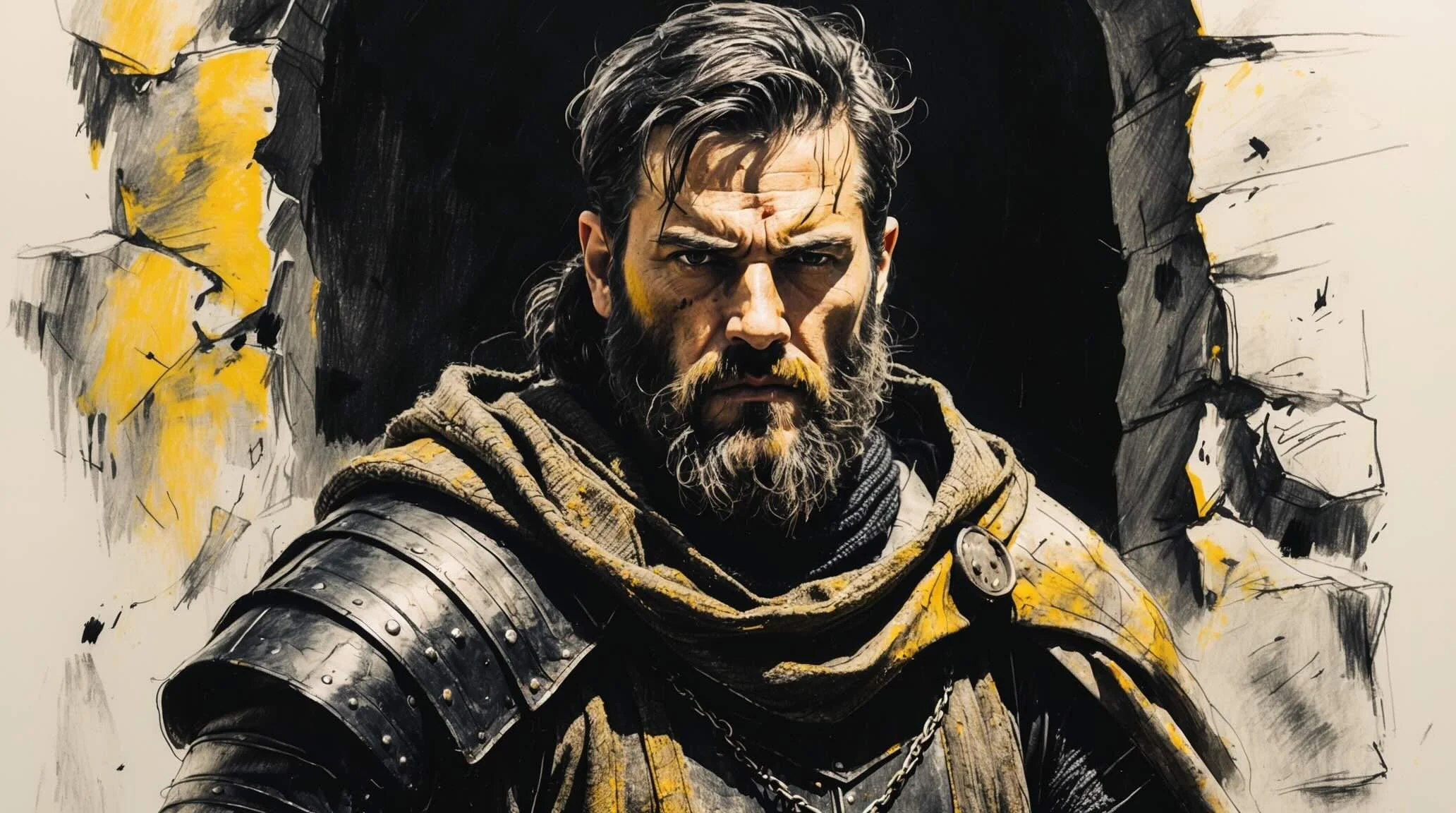
Character Profile – At a Glance
- Role: The protagonist and tragic hero; initially the Thane of Glamis, then Thane of Cawdor, and briefly the usurping King of Scotland.
- Key Traits: Courageous on the battlefield, highly imaginative, intensely ambitious, but plagued by a crippling moral conscience and paranoia.
- The Core Conflict: He is torn between his profound, terrifying ambition to be king and his acute awareness of the moral damnation that regicide will bring.
- Key Actions: Defeats Macdonwald in battle; meets The Witches; murders King Duncan; orchestrates the assassinations of Banquo and Lady Macduff’s family; is slain in combat by Macduff.
- Famous Quote:
"I am in blood
Stepped in so far that, should I wade no more,
Returning were as tedious as go o’er…"
(Act 3, Scene 4) - The Outcome: Having destroyed the natural order and alienated his allies, he is utterly isolated and killed in battle, with his severed head displayed as a symbol of the end of tyranny.
The Noble Warrior Corrupted
Before Macbeth is ever seen on stage, he is established through the dialogue of others as a figure of awe-inspiring military prowess. He is described as "brave Macbeth" and "Valour’s minion," a man who violently unseamed the traitor Macdonwald from the nave to the chaps. This early characterisation is crucial; it establishes that Macbeth is not inherently evil, nor is he a coward. He understands loyalty and honour, having risked his life to protect King Duncan and the Scottish state.
Original
My thought, whose murder yet is but fantastical,
Shakes so my single state of man that function
Is smothered in surmise, and nothing is
But what is not.
(Act 1, Scene 3)
Shakespeare Retold (Modern Verse)
My thought of murder, now just fantasy,
Is shaking me so much, I barely function
Through overwhelming thoughts, and nothing’s real
But my imagination.
His primary vulnerability lies in his incredibly vivid, poetic imagination, which makes him dangerously susceptible to the suggestive prophecies of the supernatural. Upon hearing the Witches’ prophecy, Macbeth does not immediately act, but his mind instantly leaps to the "fantastical" idea of murder. This intense internal conflict defines his early character arc: he possesses the ambition to seize the crown, but initially lacks the cold-blooded cruelty required to take it.
The Paralysis of Conscience
Unlike one-dimensional villains, Macbeth is acutely aware of the moral and spiritual consequences of his actions. He possesses a deep conscience that frequently paralyses him. In his early soliloquies, he meticulously lists the reasons why he should not kill the King, noting Duncan’s virtues, the laws of hospitality, and the inevitability of facing "deep damnation." He ultimately resolves to abandon the plot, realising he has "no spur" to prick the sides of his intent, save for his vaulting ambition.
Original
Is this a dagger which I see before me,
The handle toward my hand? Come, let me clutch thee.
I have thee not, and yet I see thee still.
(Act 2, Scene 1)
Shakespeare Retold (Modern Verse)
Is this a dagger that I see before me,
The handle pointing at my hand? I’ll hold it.
It isn’t really there, yet I can see it.
It requires the relentless psychological manipulation of Lady Macbeth to force him across the moral threshold. She weaponises the theme of gender, attacking his masculinity and framing the murder as the ultimate test of his manhood. The hallucinated dagger he sees before the murder is a physical manifestation of his fracturing psyche – a visual representation of the unbearable guilt that will haunt him for the remainder of his life.
Tyranny and the Illusion of Security
Once Macbeth crosses the moral event horizon by committing regicide, his character undergoes a dramatic and terrifying shift. He realises that seizing the crown is meaningless if his reign is not secure. Driven by his profound guilt and an ever-growing, corrosive paranoia, he transforms from a reluctant murderer into a hardened, ruthless tyrant.
Original
To be thus is nothing;
But to be safely thus. – Our fears in Banquo
Stick deep; and in his royalty of nature
Reigns that which would be feared…
(Act 3, Scene 1)
Shakespeare Retold (Modern Verse)
There’s no point being king
Unless a safe king. All my fears of Banquo
Run deep. His natural wish to be a king
Means that he should be feared.
He stops relying on his wife, independently ordering the assassination of his closest friend, Banquo, in a desperate attempt to thwart fate and prevent Banquo’s descendants from inheriting the throne. He embraces a reign of terror, establishing a network of spies and ruling through intimidation. However, every violent act he commits only serves to isolate him further, proving that the security he seeks is merely an illusion.
Descent into Nihilism
By the final act of the play, Macbeth has alienated the entire Scottish nobility and lost all remnants of his former humanity. His slaughter of Lady Macduff and her defenceless children is an act of pure, nihilistic spite that serves no strategic political purpose. He has become completely desensitised to the horrors he has created.
Original
I have supped full with horrors;
Direness, familiar to my slaughterous thoughts
Cannot once start me.
(Act 5, Scene 5)
Shakespeare Retold (Modern Verse)
I’ve seen such horror,
That gruesomeness caused by my thoughts of bloodshed
Don’t startle me.
When he receives the news of his wife’s suicide, he is incapable of feeling genuine grief. His ambition has stripped his life of all meaning, leaving him emotionally numb and entirely isolated. He clings desperately to the Witches’ deceptive prophecies regarding his invincibility. Yet, when confronting Macduff and realising he has been tricked by the forces of darkness, he refuses to surrender. In a brief flash of his former martial glory, he chooses to fight to the death, choosing a warrior’s end over public humiliation.
"Macbeth’s better nature… incorporates itself in images which alarm and horrify. His imagination is thus the best of him, something usually deeper and higher than his conscious thoughts; and if he had obeyed it he would have been safe."
— A. C. Bradley, Shakespearean Tragedy, 1904
Key Quotes
Quote 1Stars, hide your fires;
Let not light see my black and deep desires…
(Act 1, Scene 4)
Shakespeare Retold (Modern Verse)
Stars, do not shine,
So folk can’t see these dark desires of mine…
Will all great Neptune’s ocean wash this blood
Clean from my hand? No, this my hand will rather
The multitudinous seas incarnadine,
Making the green one red.
(Act 2, Scene 2)
Shakespeare Retold (Modern Verse)
Will all the oceans’ water wash this blood
Clean from my hands? No way! Instead, my hands
Will turn the seas the scarlet tint of flesh,
And make the green seas red.
To-morrow, and to-morrow, and to-morrow,
Creeps in this petty pace from day to day
To the last syllable of recorded time…
(Act 5, Scene 5)
Shakespeare Retold (Modern Verse)
Tomorrow or the next day or the next,
Each day creeps slowly by, from day to day
Until we reach the very end of time…
Key Takeaways
- The Tragic Hero: He begins as a loyal, celebrated warrior whose fatal flaw – vaulting ambition – leads him to destroy the very order he once fought to protect.
- Slave to Imagination: His incredibly vivid imagination is his greatest tormentor, causing him to hallucinate daggers and ghosts as manifestations of his internal guilt.
- Descent into Nihilism: His character arc moves from profound moral hesitation to senseless, unfeeling slaughter, culminating in a worldview where life signifies absolutely nothing.
- Destruction of Manhood: In attempting to prove his masculinity through violence, as urged by his wife, he ultimately destroys his own humanity and dies as an unpitied tyrant.
Study Questions and Analysis
Why is Macbeth introduced as a heroic and brutal warrior?
Shakespeare opens the play with Macbeth’s military glory, not with his moral fall. This is one of the most pointed decisions in the play, and it has shaped how readers interpret the character for over two centuries.
By the time Macbeth appears on stage in A1S3, we have already heard the bleeding Captain’s account of his battlefield prowess in A1S2. He is "brave Macbeth (well he deserves that name)," who carved his way through the rebel ranks and:
Till he unseamed him from the nave to the chaps,
And fixed his head upon our battlements.
(the Captain, Act 1, Scene 2)
Shakespeare Retold (Modern Verse)
Until he’d gutted him from neck to belly
And stuck his chopped-off head upon our fort.
The Captain’s language is exact. Macbeth is "Valour’s minion" – the personal favourite of valour itself. His violence is no different from the violence the Scottish state needs to survive.
This early framing matters. It places Macbeth within the Aristotelian tragic structure, not within the medieval Vice-tradition. He is not, like Richard III or Iago, a villain from his opening lines. He is a noble man whose capacity for evil lies dormant inside his existing capacity for sanctioned violence.
A. C. Bradley’s 1904 Shakespearean Tragedy, quoted on this page, captures this with precision. Macbeth’s "imagination is thus the best of him, something usually deeper and higher than his conscious thoughts." The warrior we meet in A1S2 is the same imaginative man whose conscience will, by A1S7, give him every reason to refuse the regicide he ultimately commits.
The deeper point is simple. Tragedy requires a fall from a great height. Shakespeare uses the first scene of the play to establish the height from which Macbeth will fall. The same hand that "unseamed" Macdonwald will, by A2S2, hold the daggers wet with Duncan’s blood. The continuity between these two acts is the play’s first piece of evidence that state violence and Macbeth’s later crimes sit on the same continuum, not in separate categories.
How do the Witches influence Macbeth’s choices?
The play’s evidence is specific. The Witches do not cast a spell that compels Macbeth to act. They make three predictions – that he will be Thane of Cawdor, that he will be king, and that Banquo’s descendants will be kings. They then leave Macbeth and Banquo to decide what those predictions mean.
The key piece of evidence for the limits of their power is Banquo himself. Banquo hears the same prophecies. He reflects on them in A2S1:
Merciful powers,
Restrain in me the cursed thoughts that nature
Gives way to in repose!
(Banquo, Act 2, Scene 1)
Shakespeare Retold (Modern Verse)
Oh, decent powers to rest,
Please stop me from the curse of having nightmares
And let me sleep instead!
He does not act on them. The contrast tells us something exact. The prophecies do not, by themselves, produce a murderous response. They produce it only when the listener already carries the disposition.
Harold Bloom’s 1998 Shakespeare: The Invention of the Human developed this as the "proleptic imagination" – Macbeth’s habit of thinking too much about future consequences, which makes him uniquely open to prophetic suggestion. This argument fits Bradley’s foundational reading. Macbeth’s "imagination is thus the best of him" – but the same imagination that lets him see right and wrong also lets him project himself in vivid detail into the future the Witches describe.
The deeper question – whether the Witches are real supernatural beings or projections of Macbeth’s own ambition – the play never finally resolves. They appear on a "blasted heath" in A1S3, under conditions that suggest they are real. Banquo sees them too, which rules out a purely internal reading. Their later appearance in A4S1, with Hecate and the apparitions, is clearly supernatural. But the choice to make them visible only to characters whose disposition matches their prophecies has carried most of the weight in modern criticism. Modern stagings – Roman Polanski’s 1971 film and Joel Coen’s 2021 The Tragedy of Macbeth – have both presented the Witches as ambiguous figures whose status is genuinely uncertain, a reading the text supports.
The most useful answer is therefore that the Witches work as a mechanism for revealing what Macbeth already carries inside himself. Whether they exist independently is, by the play’s design, left undecided.
What is the significance of the dagger soliloquy?
The A2S1 soliloquy – "Is this a dagger which I see before me, / The handle toward my hand?" – is one of the most-discussed pieces of writing in Shakespeare’s mature tragedies. Its function works at several levels.
At the level of plot, the soliloquy is the threshold-marker. Macbeth has not yet committed the regicide. But within the scene’s last twenty lines, he is on his way to Duncan’s chamber to commit it. The dagger appears at the exact moment of decision.
At the level of character, the soliloquy is the play’s clearest evidence that Macbeth’s imagination – what A. C. Bradley called "the best of him" – is in active conflict with his ambition. The hallucinated dagger is, on Bradley’s reading, the "protest of his deepest self" against the act he is about to perform.
The choice to make the protest visible matters. Macbeth can see the dagger. He can describe it in precise physical terms. He can ask whether he should "clutch" it. And yet the protest fails to stop him – he proceeds anyway. This is the play’s most economical piece of evidence for a hard truth: imaginative moral perception, on its own, is not enough to prevent moral action.
At the level of supernatural framework, the soliloquy is deliberately ambiguous. Macbeth asks the question himself:
Art thou but
A dagger of the mind, a false creation,
Proceeding from the heat-oppressed brain?
(Act 2, Scene 1)
Shakespeare Retold (Modern Verse)
Or is it merely
A dagger in my mind, that I’ve imagined,
A vision from my overactive brain?
The play, anywhere, does not supply the answer. The dagger could be a hallucination produced by Macbeth’s own mind. It could be a supernatural sign produced by the same forces that brought the Witches. The text supports both readings.
What the soliloquy commits to is one fact. Macbeth, at the moment of his crossing, is seen by the audience in a state of full moral consciousness. He knows what he is about to do. He understands its weight. And he proceeds. The dagger soliloquy is therefore the play’s principal piece of evidence that the murder is not the result of supernatural force or psychological breakdown; it is, in the play’s deepest analysis, a freely-chosen act, performed by a man whose imagination has shown him every reason not to perform it.
How does Macbeth’s relationship with his wife change over the play?
The arc of the marriage is one of Shakespeare’s most carefully constructed pieces of dramatic inversion. The relationship reverses across the play.
In A1S5, when Lady Macbeth reads Macbeth’s letter, the partnership is at full intensity. He addresses her as "my dearest partner of greatness." She speaks to him in the second person of intimate equality. Her resolve in his absence ("unsex me here") is built on the confidence that her plans will receive his agreement.
By A1S7, when Macbeth tries to abandon the regicide, Lady Macbeth’s response is the play’s most direct piece of gendered manipulation. The "I have given suck" speech – with its terrifying willingness to dash her own infant’s brains out as the proof of resolve – succeeds. The regicide proceeds. The partnership holds through A2S2 in the immediate aftermath, with Lady Macbeth taking the daggers back to Duncan’s chamber when Macbeth refuses.
The reversal begins in A3S2. Macbeth, now king, does not consult Lady Macbeth before ordering Banquo’s murder. He addresses her as "dearest chuck" – a diminutive that operates as exclusion rather than intimacy. He instructs her to "be innocent of the knowledge."
From this scene onwards, the partnership runs in reverse. Macbeth plans further murders alone. Lady Macbeth’s role becomes more and more that of the social manager – the banquet scene of A3S4 is her last sustained piece of agency – rather than the strategic equal. By A5S1, the sleepwalking scene, Lady Macbeth has become the figure she once mocked. She is overcome by the guilt she had insisted "a little water" would clear, condemned to wash invisible blood from her hands.
Janet Adelman’s 1992 Suffocating Mothers placed this inversion at the centre of the play’s gender-economy. Lady Macbeth begins by demanding the un-sexing that would make her capable of "direst cruelty." The un-sexing is granted. The cost is the dissolution of the partnership that the un-sexing was supposed to serve. By A5S5, when Macbeth receives the news of her death, the partnership has been so completely dissolved that he cannot produce a grief response that registers her as an individual. "She should have died hereafter" is the play’s most exposed piece of evidence. The marriage has, by its own logic, become the casualty of the violence that began with it.
Why does Macbeth order the murder of Banquo?
The answer is given by Macbeth himself in his A3S1 soliloquy. The Witches predicted that Banquo’s descendants will inherit the crown. This means that Macbeth, by murdering Duncan, has secured the throne not for his own line but for his closest friend’s:
Upon my head they placed a fruitless crown,
And put a barren sceptre in my gripe,
Thence to be wrenched with an unlineal hand,
No son of mine succeeding.
(Act 3, Scene 1)
Shakespeare Retold (Modern Verse)
They crowned me, but my children won’t succeed me.
They handed me a useless royal sceptre
That will be snatched for one not in my lineage,
Because my son won’t follow me.
The imagery of sterility names the exact problem. Macbeth has paid the full moral price of regicide. By the prophecy’s terms, he will receive none of the dynastic reward that would have made the price worth paying. The motive for Banquo’s murder is therefore, at one level, the same as for Duncan’s: to defeat the prophecy that the kingship will not, in the long term, belong to Macbeth’s line.
The deeper motive is more carefully built. Banquo is the only living person who heard the Witches’ prophecies alongside Macbeth. He is therefore the only person in Scotland who can link Duncan’s murder to the supernatural framework that made it possible. And Banquo’s "royalty of nature," named by Macbeth in the same soliloquy, makes him uniquely dangerous as a witness. The choice to order Banquo’s murder is also the moment of Macbeth’s full independence from Lady Macbeth: the Duncan murder required her active management at every step, while the Banquo murder is planned, contracted, and executed without her involvement.
The Jacobean political context adds a further layer. King James I, on the throne when the play was written and performed, claimed descent from Banquo through the Stuart line. Shakespeare’s deliberate change to his source matters: in Holinshed, Banquo is a co-conspirator in Duncan’s murder; in Shakespeare, he is innocent. The change flatters the reigning monarch by showing his ancestor as the victim of Macbeth’s tyranny rather than its accomplice. The ghost scene of A3S4 – Banquo’s reappearance at the banquet, visible only to Macbeth – reminds both Macbeth and the audience that the murder has not eliminated what it was designed to eliminate. Fleance has escaped. The prophecy holds.
How does Macbeth react to the news of Lady Macbeth’s death?
The A5S5 reception of Lady Macbeth’s death is one of the most-discussed single moments in Shakespearean tragedy. The question of what Macbeth’s response really reveals has been contested for over two centuries. The line that has carried the principal critical weight has been read in several incompatible ways:
She should have died hereafter;
There would have been a time for such a word.
(Act 5, Scene 5)
Shakespeare Retold (Modern Verse)
She would have died one day.
There’ll always be a day to hear that news.
The first reading, dominant in nineteenth-century criticism, treats the line as evidence of Macbeth’s complete emotional bankruptcy. He cannot produce grief because his own violence has destroyed the emotional capacity that would make grief possible. "She should have died hereafter" means "she should have died at some later time, when there would have been time to mourn her." The implicit acknowledgement is that no such time will come.
The second reading, increasingly dominant from L. C. Knights’ 1933 essay How Many Children Had Lady Macbeth? onward, treats the line as evidence of a different kind of recognition. Macbeth understands that there is no "hereafter" in which her death could be properly received, because his existence has been reduced to the meaningless succession of "tomorrow, and tomorrow, and tomorrow." The grief is real; the framework for expressing it has been destroyed by what Macbeth has done.
A third reading, developed in Jan Kott’s 1964 Shakespeare Our Contemporary, treats the response within an existentialist frame. Macbeth’s reaction is the recognition of a universe in which death is simply "a tale told by an idiot, full of sound and fury, signifying nothing." Here, grief is impossible to separate from the meaninglessness it confronts.
The play permits all three readings. What it commits to is one fact. Macbeth’s response does not produce the action that grief in tragedy usually produces. He does not weep. He does not vow revenge. Instead, he produces the most philosophically extended speech in the play – the "tomorrow" soliloquy – the play’s most direct evidence that the ambition that began the action has, by its own logic, removed the meaning that would have made the action worth pursuing.
Does Macbeth regain any of his former nobility at the end of the play?
The question has been one of the most-debated in twentieth-century criticism, and the play’s evidence is genuinely mixed.
The case for some restored nobility rests on the final combat in A5S7–A5S8. By the time of the combat, Macbeth has learned that Macduff was "from his mother’s womb / Untimely ripped." The prophetic protection against any man "of woman born" has been voided. He is therefore, on his own understanding, facing certain death. His choice in this position is exact:
I will not yield,
To kiss the ground before young Malcolm’s feet,
And to be baited with the rabble’s curse.
(Act 5, Scene 8)
Shakespeare Retold (Modern Verse)
I won’t give in,
To kiss the ground before young Malcolm’s feet,
And have an angry crowd attempt to bait me.
The refusal carries a register the rest of the late play has not produced. Macbeth is choosing the warrior’s death he had been capable of in A1S2. The choice acts as a kind of return to the figure he was before the regicide.
The case against is more pointed. The "nobility" of the refusal is, on close reading, mostly a refusal of humiliation rather than a recovery of moral purpose. Macbeth is not fighting for Scotland, for his honour, or for any cause beyond his own pride. He is fighting because he prefers death-in-combat to public shame. The argument is that the choice operates within the same egoism that produced the murders, not in opposition to it. The closest analogue is Richard III’s final stand, which Shakespeare’s earlier history play presents unambiguously as the last desperate gesture of a defeated villain rather than a restoration of nobility.
The most useful answer is probably that the question itself assumes a moral framework the play has, by its own logic, dissolved. Macbeth dies a warrior, which echoes his opening. He does not die a noble man, because the qualities that would have made nobility legible – loyalty, mercy, the recognition of the moral worth of others – have been destroyed by what he has done. The severed head Macduff carries in for the play’s closing image is the clearest evidence that nobility, in the sense the question requires, is not what the ending produces.
