Banquo
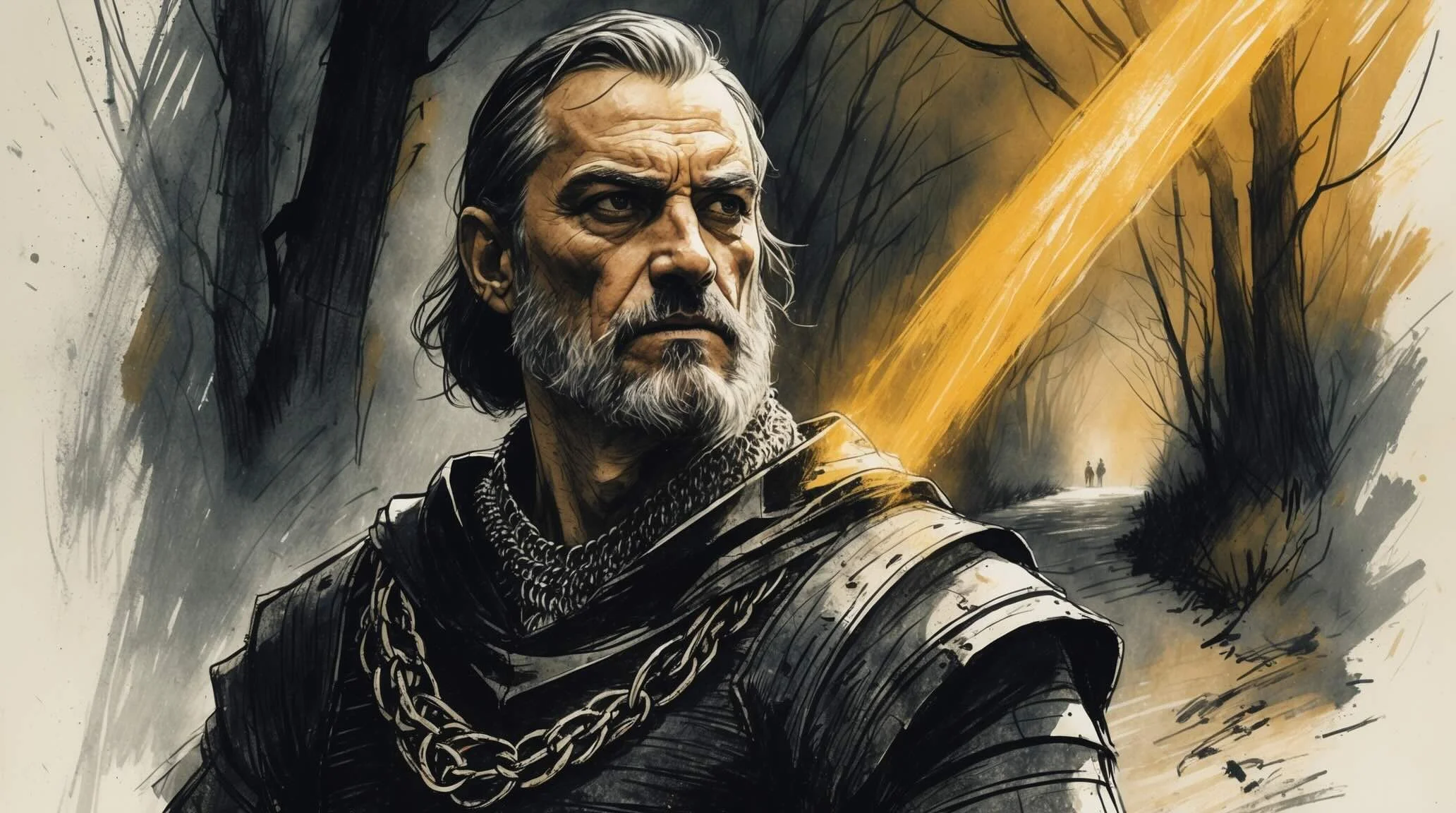
Character Profile – At a Glance
- Role: Noble general, loyal friend to Macbeth, and recipient of a rival prophecy.
- Key Traits: Brave, cautious, morally upright, and intellectually sceptical.
- The Core Conflict: Tempted by the same dark prophecies as his friend, Banquo must actively resist his own ambition to maintain his honour and loyalty to the crown.
- Key Actions: Fights valiantly for Scotland; witnesses the Witches’ prophecies; voices suspicion of Macbeth’s rise; is murdered by assassins; returns as a terrifying ghost at the royal banquet.
- Famous Quote:
"And oftentimes, to win us to our harm,
The instruments of darkness tell us truths…"
(Act 1, Scene 3) - The Outcome: Brutally murdered to secure Macbeth’s throne, but his son Fleance escapes, ensuring that Banquo’s bloodline will ultimately inherit the crown.
The Cautious Sceptic
From his very first encounter with The Witches, Banquo establishes himself as a voice of reason and moral caution. While Macbeth is immediately captivated and rendered physically spellbound ("rapt") by the prophecy of kingship, Banquo questions the origins and intentions of these supernatural beings. He recognises that appearance can be deceptive and that evil forces often use partial truths to engineer human destruction.
Original
But ’tis strange:
And oftentimes, to win us to our harm,
The instruments of darkness tell us truths,
Win us with honest trifles, to betray’s
In deepest consequence.
(Act 1, Scene 3)
Shakespeare Retold (Modern Verse)
But it’s strange:
And oftentimes, to get us into trouble,
Satanic forces feed us half the truth
To coax us with minutia, then betray us
With devastating impact.
Banquo serves as the crucial control group in Shakespeare’s psychological experiment. Because he hears a similarly alluring prophecy – that he will be the father to a line of kings – the audience knows that the Witches’ words do not inherently strip a man of his free will. Banquo’s restraint highlights Macbeth’s moral failure, proving that Macbeth’s descent into tyranny is a choice rather than an unavoidable fate.
The Moral Foil and the Compromised Silence
Despite his innate goodness, Banquo is not entirely immune to temptation. In A2S1 he admits to Fleance that "cursed thoughts" disturb his sleep, suggesting that he too is working on the prophecy’s implications. His response in that moment is exemplary: he prays for "merciful powers" to restrain those thoughts and continues to resist. But after Duncan is murdered and Macbeth ascends to the throne, Banquo’s position shifts. Alone on stage in A3S1, he names what he believes has happened, and what he intends to do about it.
Original
Thou hast it now: king, Cawdor, Glamis, all,
As the weird women promised, and, I fear,
Thou play’dst most foully for’t…
(Act 3, Scene 1)
Shakespeare Retold (Modern Verse)
You’ve got it now: king, Cawdor, Glamis, all things
Those weird women promised, but, I fear
You cheated awfully for it.
The soliloquy reveals Banquo’s sharp political intellect: he is the only character who pieces together the truth behind Duncan’s death. But the same soliloquy continues into more compromised territory. Reflecting that the prophecy regarding his own descendants might also come true through "the verities on thee made good," Banquo decides to remain at court and keep his suspicions to himself. That silence can be read as a gradual yielding to evil – not virtuous restraint but self-interested calculation. The play permits both readings: that Banquo’s silence is prudent self-preservation, or that it is the price of his hope for his line’s inheritance. What it commits to is one fact: the silence ends only when Macbeth’s daggers do.
The Murdered Friend
By A3S1, Macbeth has identified Banquo as the principal threat to his reign. The reasons are layered. Banquo is the only living witness to the Witches’ prophecies. He is, by Macbeth’s own phrase, possessed of a "royalty of nature" Macbeth himself does not have. And the prophecy regarding his descendants means that Macbeth has paid the full moral price of regicide only to secure the throne for his closest friend’s line rather than his own. The "fruitless crown" and "barren sceptre" Macbeth describes name the precise sterility of his position. The murder follows from the convergence of these registers.
In A3S3, the assassins ambush Banquo as he and Fleance return to the palace at dusk. The attack is well-prepared, but Banquo’s response – delivered in the moments of his own death – diverts the murder’s strategic purpose.
Original
O, treachery! Fly, good Fleance, fly, fly, fly!
Thou mayst revenge. O slave!
(Act 3, Scene 3)
Shakespeare Retold (Modern Verse)
I’ve been betrayed! Run, Fleance, son! Run, run!
You might get our revenge! You slave!
Banquo’s final words are not a curse on his murderers or a plea for his own life. They are a command to his son. By urging Fleance to flee, Banquo prioritises the survival of his bloodline – and therefore the survival of the prophecy regarding his descendants – over his own life. Fleance escapes. The murder succeeds in killing the man, but fails entirely in eliminating the future Macbeth had hoped to foreclose. Macbeth’s reaction when he learns of the escape ("Then comes my fit again: I had else been perfect, / Whole as the marble") confirms that the strategic purpose of the murder has not been achieved.
The Ghost and the Line of Kings
Banquo’s death does not end his role in the play. His ghost appears at the royal banquet in A3S4, visible only to Macbeth, and shatters the new king’s composure in front of the assembled Scottish nobility. The collapse converts the lords from passive subjects into active observers of Macbeth’s unfitness for the throne. By the time the scene ends, the political unravelling of the regime has begun. The ghost may or may not be metaphysically real – the play deliberately preserves the ambiguity – but its effect on Macbeth’s kingship is, in either reading, decisive.
The deeper consequence emerges in A4S1. When Macbeth returns to the Witches demanding to know whether Banquo’s descendants will inherit, they show him a procession of eight kings, the last carrying a glass that reveals "many more." The vision is not mere prophecy. It is the play’s most exposed piece of Jacobean political imagery.
Original
What, will the line stretch out to the crack of doom?
Another yet! A seventh! I’ll see no more:
And yet the eighth appears, who bears a glass
Which shows me many more…
(Act 4, Scene 1)
Shakespeare Retold (Modern Verse)
What, will this line of kings stretch out forever?
Another one! A seventh! I can’t look now;
And yet the eighth king comes, holding a mirror
Which shows me many more…
The eighth king’s "two-fold balls and treble sceptres" reference the coronation regalia of James I, on the throne when the play was first performed – the orbs of his joint English-and-Scottish kingship, the sceptres of his triple crown (England, Scotland, Ireland). Banquo, in the play’s metaphysical scheme, is the ancestor whose existence the entire prophecy was always pointing toward. The line of kings the Witches show Macbeth is the line that ultimately produces the reigning monarch in the audience watching the play. Banquo dies; his line proceeds. The murder, in this final accounting, has failed at every level that mattered.
"Banquo in fact may be described much more truly than Macbeth as the victim of the Witches."
— A. C. Bradley, Shakespearean Tragedy, 1904
Key Quotes
Quote 1If you can look into the seeds of time,
And say which grain will grow and which will not,
Speak then to me, who neither beg nor fear
Your favours nor your hate.
(Act 1, Scene 3)
Shakespeare Retold (Modern Verse)
If you can see what happens in the future
And know which crops will grow, and which will not,
Then speak to me, as I won’t beg, nor fear,
Your favours, nor your hate.
Lesser than Macbeth, and greater.
Not so happy, yet much happier.
Thou shalt get kings, though thou be none…
(the Witches, Act 1, Scene 3)
Shakespeare Retold (Modern Verse)
You’ll be less than Macbeth, but also greater.
You won’t be as happy, then much happier.
Your children will be kings, but you will not.
Hold, take my sword. There’s husbandry in heaven;
Their candles are all out.
(Act 2, Scene 1)
Shakespeare Retold (Modern Verse)
Wait, hold my sword. The stars aren’t being generous,
For they’re not shining now.
Key Takeaways
- The Perfect Foil: Banquo highlights Macbeth’s moral weakness by demonstrating that temptation can be resisted through reason and faith.
- Threat to Tyranny: His very existence – both his noble character and his royal prophecy – makes him an intolerable threat to Macbeth’s insecure reign.
- Manifestation of Guilt: His return as a ghost bridges the gap between the supernatural and psychological trauma, forcing Macbeth to confront his crimes.
- Instrument of Fate: Though he dies, his actions (saving Fleance) ensure that the natural order of kingship will ultimately outlast Macbeth’s temporary disruption.
Study Questions and Analysis
How does Banquo react to the Witches compared to Macbeth?
The A1S3 first encounter with the Witches is one of Shakespeare’s most carefully constructed pieces of structural contrast. The difference between Macbeth’s and Banquo’s reactions has organised critical reading of both characters for over a century.
The arrangement is exact. Both men meet the Witches on the heath. Both hear prophecies – Macbeth: Thane of Glamis, Thane of Cawdor, King hereafter; Banquo: "lesser than Macbeth, and greater," "not so happy, yet much happier," father to "a line of kings." Both have, on the play’s evidence, equal capacity to interpret what they have heard.
Macbeth’s response is to be physically immobilised – "rapt," as Banquo observes him – and to begin, within fifty lines, the soliloquy that contemplates "horrid image[s]" of murder.
Banquo’s response works at three distinct registers. The first is scepticism:
Or have we eaten on the insane root
That takes the reason prisoner?
(Act 1, Scene 3)
Shakespeare Retold (Modern Verse)
Or did we eat hallucinogenic plants
That stopped us thinking strait?
The question of whether the encounter has been real at all. The second is interrogation: he challenges the Witches directly, asking them to "look into the seeds of time" and speak to him as one who "neither beg[s] nor fear[s]" their favour or hate – a register of fearless inquiry that Macbeth, even at his most courageous, does not produce.
The third is the theological warning he delivers to Macbeth after the Witches have departed. Banquo can name what the Witches are – "instruments of darkness" – and identify their characteristic mode of operation (truths-used-to-betray) at the moment Macbeth is most susceptible to the prophecy that has been delivered.
The 1904 A. C. Bradley reading, quoted on this page, complicates the standard schoolroom contrast. Bradley argued that "Banquo in fact may be described much more truly than Macbeth as the victim of the Witches" – that Banquo’s initial scepticism is, across the course of the play, gradually eroded by the same prophecy that destroys Macbeth, just more slowly and more quietly.
The reading is supported by Banquo’s A2S1 admission of "cursed thoughts" and his A3S1 soliloquy in which he hopes the prophecy regarding his descendants will be fulfilled. The contrast that opens the play is therefore not, on Bradley’s reading, a contrast that survives unchanged. What Banquo achieves at A1S3 is a moral position that the play’s subsequent events will erode rather than confirm.
Why does Macbeth fear Banquo?
The A3S1 soliloquy is Macbeth’s most direct piece of evidence on the question. The reasons he articulates work on several distinct registers.
The first is the prophecy. The Witches’ prediction that Banquo will be "father to a line of kings" means that Macbeth has, by murdering Duncan, secured the throne not for his own line but for his closest friend’s. The imagery of sterility Macbeth deploys in the soliloquy names the precise problem:
Upon my head they placed a fruitless crown,
And put a barren sceptre in my gripe,
Thence to be wrenched with an unlineal hand,
No son of mine succeeding.
(Macbeth, Act 3, Scene 1)
Shakespeare Retold (Modern Verse)
They crowned me, but my children won’t succeed me.
They handed me a useless royal sceptre
That will be snatched for one not in my lineage,
Because my son won’t follow me.
Macbeth has paid the full moral price of regicide and will receive, by the prophecy’s terms, none of the dynastic reward that would have made the price worth paying.
The second register is the question of Banquo’s witnessing. Banquo is the only living person who heard the Witches’ prophecies alongside Macbeth. He is therefore the only person in Scotland who can connect Duncan’s murder to the supernatural framework that made it possible. The A3S1 line – "He hath a wisdom that doth guide his valour / To act in safety" – names the threat. Banquo is not merely a witness but an intelligent witness, one capable of waiting until the right moment to act on what he knows.
The third register is the most exposed. Banquo’s "royalty of nature" – Macbeth’s own phrase – names a quality Macbeth himself does not possess. Banquo carries the natural authority of a man who would, by Macbeth’s instinctive recognition, have been the more legitimate inheritor of Duncan’s throne. The fear is therefore not merely strategic but psychological. Macbeth fears Banquo because Banquo represents the man Macbeth could have been if he had refused the temptation Macbeth accepted.
The decision to give the soliloquy this layered structure is one of Shakespeare’s most pointed pieces of writing on the costs of usurpation. Macbeth has acquired the crown but has not acquired the qualities that would make the crown rest comfortably on his head. His fear of Banquo is the recognition of what he has lost in acquiring what he has gained.
The decision to order Banquo’s murder follows from the convergence of these registers – and the irony, of course, is that the murder fails to address the deepest of them. Banquo dies. Fleance escapes. The prophecy holds. The "royalty of nature" remains permanently outside Macbeth’s reach.
Is Banquo entirely free of ambition?
The play’s evidence is specific. The answer is more interesting than the conventional schoolroom reading admits.
Bradley’s 1904 Lecture X – the foundational critical reading of Banquo – argues that Banquo is not, finally, the pure moral foil he initially appears to be. The evidence is exact.
Banquo’s A2S1 admission to his son Fleance is the play’s first piece of evidence that Banquo’s mind, like Macbeth’s, has been working on the prophecy’s implications:
A heavy summons lies like lead upon me,
And yet I would not sleep: merciful powers,
Restrain in me the cursed thoughts that nature
Gives way to in repose!
(Act 2, Scene 1)
Shakespeare Retold (Modern Verse)
Exhaustion is a heavy weight upon me,
But I can’t sleep. Oh, decent powers to rest,
Please stop me from the curse of having nightmares
And let me sleep instead!
The "cursed thoughts" Banquo prays to be released from are not, on the play’s evidence, the thoughts of a man unaffected by what the Witches have told him. They are the thoughts of a man whose moral discipline is the work of active resistance rather than natural disposition.
The deeper piece of evidence is Banquo’s A3S1 soliloquy. After Macbeth’s coronation, Banquo reflects openly on what has happened ("Thou hast it now: king, Cawdor, Glamis, all... I fear / Thou play’dst most foully for’t"). He suspects, in this private moment, that Macbeth has murdered Duncan. He does not, however, communicate the suspicion to anyone.
The soliloquy continues: "yet it was said / It should not stand in thy posterity, / But that myself should be the root and father / Of many kings. If there come truth from them... why, by the verities on thee made good, / May they not be my oracles as well, / And set me up in hope?"
The line names the choice Banquo has made. He has identified Macbeth as a regicide. He has identified that the prophecy regarding his own descendants is therefore likely to come true through the same supernatural mechanism. And he has chosen to remain at court, silent about his suspicions, in the hope that the prophecy will fulfil itself for him as it has for Macbeth.
Bradley’s reading is exact: "When next we see him, on the last day of his life, we find that he has yielded to evil. The Witches and his own ambition have conquered him." The argument is that Banquo’s silence is not virtuous restraint but self-interested calculation.
The play permits both readings – the more sympathetic (Banquo’s silence is the prudence of a man who recognises he cannot openly accuse the king without risking his own life) and the more pointed (Banquo’s silence is the price of his hope for his descendants’ inheritance). What it commits to is one fact. Banquo’s silence ends only when Macbeth’s daggers do, and the play’s quiet implication is that the silence and the daggers have, between them, identified Banquo as more compromised than his initial A1S3 caution suggested.
What is the significance of Fleance’s escape?
The A3S3 escape of Fleance is one of the most important single events in the play. Its significance works at several distinct levels.
At the level of plot, the escape is the failure of Macbeth’s attempt to defeat the prophecy through violence. The Witches predicted that Banquo would be "father to a line of kings." Macbeth has murdered Banquo precisely to prevent this fulfilment. Fleance’s survival means that the prophecy’s mechanism remains intact. Macbeth’s response when he learns of the escape is the play’s clearest piece of evidence that the escape constitutes a complete defeat of the murder’s strategic purpose:
Then comes my fit again: I had else been perfect,
Whole as the marble, founded as the rock…
(Macbeth, Act 3, Scene 4)
Shakespeare Retold (Modern Verse)
I’m scared again, then. It would have been perfect.
Complete, like solid marble stood on bedrock…
At the level of structure, the escape establishes the trajectory of the play’s resolution. The prophecy regarding Banquo’s descendants is the only piece of the supernatural framework that does not, by the play’s end, get cancelled or qualified. Macbeth himself loses the protections he had thought invulnerable. Lady Macbeth loses her self-mastery. The kingdom loses its order. But Banquo’s line proceeds.
The A4S1 cauldron scene confirms this. The procession of eight kings that the Witches show Macbeth, with a glass showing "many more," is the play’s metaphysical guarantee that Banquo’s posterity will inherit the throne. The last figure in the procession carries "two-fold balls and treble sceptres" – the coronation regalia of James I, who claimed descent from Banquo through Fleance and his son Walter.
The decision is therefore both dramatic and political. Dramatically, Fleance’s escape gives the audience the reassurance that Macbeth’s tyranny is temporally bounded – the legitimate succession, though deferred, is guaranteed by forces Macbeth cannot reach. Politically, the escape is the play’s most exposed piece of Jacobean flattery. James I, on the throne when the play was written and performed, is the descendant whose existence the prophecy was always pointing toward.
Fleance himself is barely a character. He speaks only twice in the entire play, both times in A2S1, and his function is purely structural. He is the body through which the prophecy continues. The escape is therefore not a piece of character drama but a piece of structural insurance – the guarantee that the world the play depicts will, despite Macbeth’s tyranny, eventually be reordered around the kingship the play opens by celebrating in Duncan and closes by restoring in Malcolm.
Does Banquo’s ghost actually exist, or is it a hallucination?
The A3S4 banquet scene’s ambiguity is one of the play’s most carefully constructed pieces of supernatural-psychological writing. The play does not, finally, adjudicate between the available readings.
The facts are exact. Banquo’s ghost appears at the banquet. Macbeth sees it and reacts visibly. None of the other guests sees it. Lady Macbeth, who can see Macbeth but not the ghost, attempts to manage the scene by attributing his behaviour to a recurrent illness. The ghost appears twice – once when Macbeth mentions Banquo’s absence, and again when Macbeth proposes a toast to him – and each appearance precisely synchronises with Macbeth’s reference to the man he has just murdered.
Three readings the play permits.
The first is the supernatural reading. The ghost is a real spirit, visible because Macbeth’s crime has disturbed the metaphysical order in a way that allows the dead to return. The play’s broader framework supports this. The Witches are real supernatural agents. The apparitions of A4S1 are real prophetic figures. The play is working within a metaphysics in which the boundary between the living and the dead is permeable.
The second is the psychological reading. The ghost is a hallucination, a physical manifestation of Macbeth’s guilt visible only to the guilty mind. The parallel with the dagger soliloquy of A2S1 supports this. Macbeth himself, in that earlier scene, names the possibility that the dagger is "a false creation, / Proceeding from the heat-oppressed brain."
The third reading, developed in modern criticism, treats the ambiguity as the play’s commitment. The ghost is, simultaneously, a real supernatural manifestation and a psychological projection – and the play permits the audience to receive it as both at once. Bradley’s Note FF in Shakespearean Tragedy discusses the technical question at length and concludes that the play does not, finally, allow a clean answer.
Modern productions have varied considerably. Some stage the ghost visibly, asking the audience to read its presence as supernatural. Others omit the ghost entirely, leaving Macbeth’s reaction to suggest a hallucination. The Polanski (1971) and Coen (2021) films take different positions on the question.
What the play commits to, regardless of the metaphysical question, is one fact. The ghost’s appearance forces Macbeth’s collapse in front of the assembled Scottish nobility, and the collapse begins the political unravelling that the rest of the play will document. The ghost may or may not exist. Its effect on Macbeth’s kingship is, in any case, decisive.
How does Banquo’s presence at the banquet affect Macbeth’s reign?
The A3S4 banquet is one of the most important scenes in the play. The ghost’s appearance is the inflection point in Macbeth’s political fortunes.
The scene’s set-up is exact. Macbeth has arranged the banquet to consolidate his kingship by demonstrating the public hospitality and lordly courtesy expected of a Scottish monarch. The Scottish nobility – Ross, Lennox, and the other thanes – are assembled as witnesses to Macbeth’s ceremonial command of the royal table. Lady Macbeth, as queen, takes her formal place. The plan is for the evening to mark the establishment of the new reign on the foundation of its outward forms.
The ghost’s appearance dismantles the plan within minutes. Macbeth’s response is delivered in front of the entire court. The words name the murder that the assembled lords had been told they would not need to think about:
Thou canst not say I did it: never shake
Thy gory locks at me.
(Macbeth, Act 3, Scene 4)
Shakespeare Retold (Modern Verse)
You cannot say I did this. Do not shake
Your bloodied head at me.
Lady Macbeth’s intervention ("Sit, worthy friends: my lord is often thus, / And hath been from his youth") attempts to recover the situation by attributing the behaviour to a chronic illness. The recovery is partial. The second appearance of the ghost compounds the damage. By the end of the scene, the banquet has been abandoned without the formal ceremonies completed, and the lords have witnessed the new king’s public collapse.
The A3S6 scene with Lennox and the Lord makes the political consequences exact. Lennox, who had been a polite presence in earlier court scenes, now speaks of Macbeth in unmistakably hostile terms – "the gracious Duncan / Was pitied of Macbeth: marry, he was dead" – and the conversation moves to news from England, where Malcolm has joined the court of Edward the Confessor and Macduff has fled.
The banquet, in other words, has converted the Scottish nobility from passive subjects of Macbeth’s reign into active observers of his unfitness for the throne.
The decision to make the ghost’s appearance the trigger is one of Shakespeare’s most pointed pieces of writing on the relationship between private guilt and public power. Macbeth’s tyranny was always susceptible to the moment when his interior state would become legible to those around him. The ghost is the device that produces that moment.
Before A3S4, Macbeth is a king who has acquired power through violence. After A3S4, he is a king whose violence has been publicly exposed. The unravelling of his reign begins precisely at the moment the assembled lords realise that the king they have been honouring is the same man who murdered the king they had honoured before him.
How does Banquo serve King James I’s political interests?
The Banquo plot of Macbeth is one of the most carefully constructed pieces of Jacobean political flattery in Shakespeare’s mature work. The mechanism works at several distinct levels.
The biographical fact is exact. James VI of Scotland, who acceded to the English throne as James I in 1603, claimed descent from the historical Banquo through Fleance, who (in the genealogical tradition James’s court accepted) had fled Scotland and fathered Walter, the first Steward of Scotland and ancestor of the Stuart line. The play’s reigning monarch was, by this lineage, the descendant whose existence the Witches’ prophecy was always pointing toward. Shakespeare’s company, the King’s Men, had become James’s personal patronage in 1603.
The first piece of flattery is Shakespeare’s deliberate alteration of his source. Holinshed’s Chronicles – the standard historical source for the Macbeth story – presents Banquo as a co-conspirator in Duncan’s murder. Shakespeare removes the complicity entirely, making Banquo a figure of unbroken virtue (or, on Bradley’s reading, of qualified but never criminal complicity) and converting him into a victim of Macbeth’s tyranny rather than its agent. The decision flatters James by giving him an ancestor who is morally clean rather than morally compromised.
The second piece is the A4S1 cauldron scene. The procession of eight kings descending from Banquo, with the eighth carrying "two-fold balls and treble sceptres" and a glass showing "many more," is the play’s most direct piece of contemporary political imagery. The "two-fold balls" reference the orbs of James’s coronation regalia (representing his joint kingship of England and Scotland). The "treble sceptres" reference his triple sceptre (England, Scotland, and Ireland). The glass showing more kings is the play’s prophecy that the Stuart line will continue indefinitely.
The third register works more subtly. The play was written and performed in the years immediately following the 1605 Gunpowder Plot – the Catholic conspiracy to assassinate James in Parliament. The play’s themes of regicide, equivocation (a Jesuit doctrine of mental reservation that figured prominently in the Gunpowder Plot trials), and supernatural prophecy were therefore directly relevant to James’s political situation. James himself had written extensively on witchcraft (the 1597 Daemonologie) and on kingship (the 1599 Basilikon Doron). The play’s Witches and its presentation of Duncan’s divine right reflect, on standard scholarly reading, deliberate engagement with the king’s own intellectual interests.
The deeper critical question – whether the play’s Jacobean flattery is genuine artistic conviction or political calculation – is more contested. Polanski’s 1971 film, made in the immediate aftermath of the Manson murders, leaned into a reading of the play as essentially propagandistic. Modern productions and modern criticism have increasingly resisted the reduction, treating the Jacobean elements as one register among several that the play works in.
What is not contested is one fact. The play could not have been written, in the form it takes, without James I on the throne to receive the flattery the Banquo plot performs.