Guilt and Paranoia
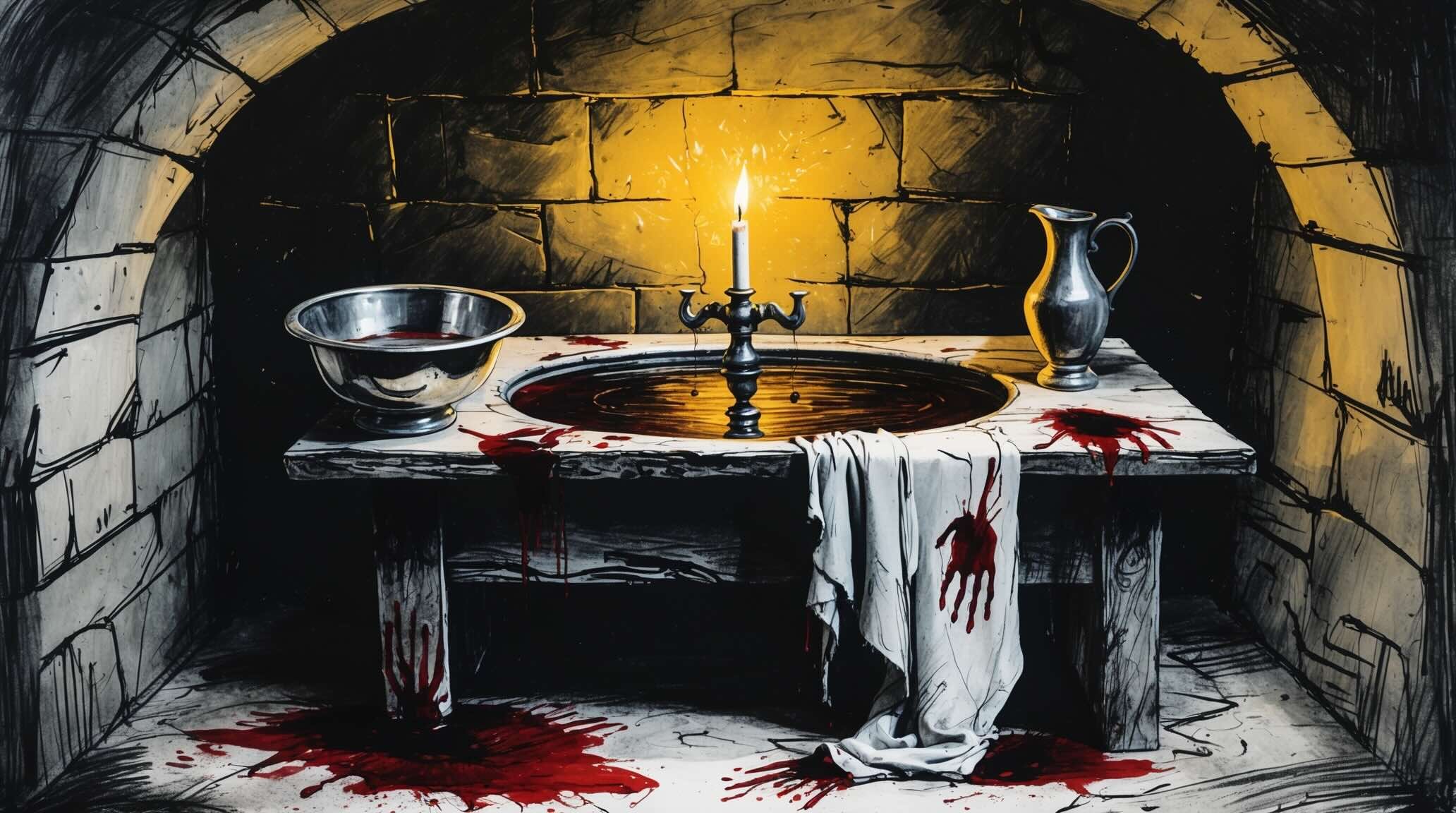
Theme Profile – At a Glance
- Focus: Guilt as the conscience the Macbeths cannot silence, and paranoia as the fear that grows once the killing has begun.
- Key Characters: Macbeth, Lady Macbeth, King Duncan, Banquo.
- The Core Tension: Macbeth and Lady Macbeth murder their way to the throne – then discover that the mind cannot be ruled the way a kingdom can.
- Key Manifestations: The voice that cries "Sleep no more" after Duncan's murder; the blood that will not wash; Banquo's ghost at the feast; Macbeth's spiralling fear; Lady Macbeth's sleepwalking collapse.
- Famous Quote:
"Will all great Neptune's ocean wash this blood..."
(Act 2, Scene 2) - The Outcome: The fearless wife breaks first and dies; the hesitant husband grows numb and fights to the end. Guilt destroys them both, but it does it differently.
The Voice That Cries Sleep No More
The murder of Duncan happens offstage. What Shakespeare puts in front of us is the aftermath – the moment Macbeth returns to his wife with the bloody daggers in his hands and his nerve already breaking. He has the crown within reach. What he cannot do is quiet his own mind. The first symptom of guilt in this play is not remorse spoken aloud. It is a hallucinated voice, and the thing it takes from him is sleep.
Original
Methought I heard a voice cry 'Sleep no more!
Macbeth does murder sleep', the innocent sleep,...
(Act 2, Scene 2)
Shakespeare Retold (Modern Verse)
I thought I heard a cry: ‘Don’t go to sleep!
Macbeth will murder sleepers!’ Innocent folk...
Sleep, in the world of the play, is what mends the day's damage – the thing that lets an untroubled mind start again each morning. By murdering Duncan in his bed, Macbeth has killed the very condition that would let him recover from the act. The guilt is not a feeling he can work through. It is a permanent injury, announced in A2S2 and never healed. From this scene onward, Macbeth is a man who cannot rest, and the play measures his decline by how little peace he is allowed.
The voice also names him directly. It does not say "a murder has been done." It says "Macbeth does murder sleep." Guilt in this play is intensely personal – it fastens onto the doer and will not let go. Lady Macbeth tries to talk him out of it, dismissing the voice as the product of a frightened mind. She is wrong, and the rest of the play proves it.
Blood That Will Not Wash
The image Shakespeare returns to, again and again, is blood that cannot be washed away. It is the play's central symbol of guilt – physical, visible, impossible to ignore. Standing over his own stained hands moments after the murder, Macbeth asks the question the whole play will answer in the negative.
Original
Will all great Neptune's ocean wash this blood
Clean from my hand? No, this my hand will rather
The multitudinous seas incarnadine,
Making the green one red.
(Act 2, Scene 2)
Shakespeare Retold (Modern Verse)
Will all the oceans' water wash this blood
Clean from my hands? No way! Instead, my hands
Will turn the seas the scarlet tint of flesh,
And make the green seas red.
The logic is reversed, and that reversal is the point. The blood does not get diluted by the ocean. The ocean gets stained by the blood. One murder is enough to discolour the whole sea. Guilt, in Macbeth's imagination, is not a stain that water can lift – it is a force that spreads outward and contaminates everything it touches. This is the same image that will return, transformed, in his wife's sleepwalking: the little hand no perfume can sweeten.
The contrast between husband and wife is set up here too. Lady Macbeth's answer to the same problem is brisk and literal – "A little water clears us of this deed." She believes the guilt can be rinsed off with the blood. The play will spend three more acts demonstrating that she is the one who has misjudged it, and that Macbeth's instinct in A2S2 – that no quantity of water is enough – is the true one.
Full of Scorpions: The Spiral into Paranoia
Once Macbeth is king, the guilt does not subside. It mutates into something else: fear. Having killed to take the throne, he now lives in terror of losing it, and that terror turns him against the one man whose presence accuses him – Banquo, who heard the witches' prophecy and whose descendants are promised the crown. Paranoia, in this play, is guilt turned outward. The man who cannot trust himself cannot trust anyone.
Original
To be thus is nothing;
But to be safely thus. – Our fears in Banquo
Stick deep; and in his royalty of nature
Reigns that which would be feared: 'tis much he dares;...
(Act 3, Scene 1)
Shakespeare Retold (Modern Verse)
There’s no point being king
Unless a safe king. All my fears of Banquo
Run deep. His natural wish to be a king
Means that he should be feared. He’s very daring,...
The crown has solved nothing. "To be thus is nothing" – simply to hold the title is worthless to a man who feels unsafe in it. The murder that was supposed to end Macbeth's striving has only begun it. Each killing demands another to protect it, and the further he wades into blood, the harder it becomes to stop. By the banquet scene, the fear he has tried to murder away returns in the most literal form possible – the dead man walks back into the room. Macbeth's guilt and his paranoia have become the same thing, and they sit down at his own table.
The Great Inversion
The most devastating structural move in the play is the swap. At the start, Lady Macbeth is the fearless one – the partner who steadies her husband's nerve, scrubs the blood from her hands without flinching, and calls his terrors childish. Macbeth is the one who shakes. By the end, the positions have reversed entirely. He has grown numb to horror; she is destroyed by it. The guilt she suppressed in Act 2 surfaces in Act 5, and it surfaces in her sleep, where the conscious will that once controlled her can no longer hold.
Original
Out, damned spot! Out, I say! – One: two: why, then, 'tis time to do't. – Hell is murky! – Fie, my lord, fie!
(Act 5, Scene 1)
Shakespeare Retold (Modern Verse)
Get off, damned spot! Get off, I say! One, two: well then It’s time to do it. Hell is a dark place! Crap, my lord, crap!
The shift into prose is the clue. Lady Macbeth, who spoke the play's most controlled and commanding verse, now speaks broken, fragmentary prose – the language of a mind that has lost its order. The imaginary spot she rubs at is the blood she once dismissed as nothing a little water could not clear. The water was never enough. The guilt she thought she had mastered has waited four acts and then taken everything – her sleep, her reason, and finally her life. The fearless one breaks; the fearful one hardens. Guilt does not spare either of them, but it ruins them in opposite directions.
"Macbeth is Shakespeare's most profound and mature vision of evil."
— G. Wilson Knight, The Wheel of Fire, 1930
Key Quotes on Guilt and Paranoia
Quote 1
O, full of scorpions is my mind, dear wife!
(Act 3, Scene 2)
Shakespeare Retold (Modern Verse)
My mind is full of scorpions, dear wife!
Quote Analysis: This is one of the play's most exact pictures of a guilty mind. The scorpions are inside Macbeth's own head – his thoughts have turned venomous, and they sting him from within. The line comes after he is king and supposedly safe, which is the point: the throne has not bought him peace, only a different kind of torment. The image also marks how far he and his wife have drifted. He confides his agony to her, but he does not tell her his plan to kill Banquo. The shared partnership of the early acts is breaking down, and each of them is now suffering alone.
Quote 2
Thou canst not say I did it: never shake
Thy gory locks at me.
(Act 3, Scene 4)
Shakespeare Retold (Modern Verse)
You cannot say I did this. Do not shake
Your bloodied head at me.
Quote Analysis: Macbeth addresses these words to a ghost no one else at the banquet can see. The guilt he carries has become a hallucination, and it appears at the worst possible moment – the public feast where he is meant to perform his authority as king. His defence is revealing. "Thou canst not say I did it" is the protest of a man who knows perfectly well that he did, and who hired others to do the actual killing so that his own hand would stay clean. The ghost is the proof that this distancing does not work. Guilt does not care who held the knife.
Quote 3
All causes shall give way: I am in blood
Stepped in so far that, should I wade no more,
Returning were as tedious as go o'er:...
(Act 3, Scene 4)
Shakespeare Retold (Modern Verse)
Nothing must stop me now. I’ve so much blood
Upon my hands that, should I choose to backtrack,
It would be like repeating all I’ve done.
Quote Analysis: This is the moment Macbeth stops fighting his guilt and decides to outrun it. He pictures himself standing mid-river in a flood of blood, so far from the bank that turning back would be as exhausting as pushing on. It is a chilling piece of logic: he will keep killing not because he wants to, but because stopping now feels harder than continuing. Guilt has not vanished – it has simply been overruled by exhaustion and dread. From here, the paranoid murders multiply, and the conscience that tormented him in Act 2 is gradually beaten into numbness.
Quote 4
Here's the smell of the blood still: all the perfumes of Arabia will not sweeten this little hand.
(Act 5, Scene 1)
Shakespeare Retold (Modern Verse)
My hands still smell of blood. All the perfumes of Arabia won’t make my hand smell sweet.
Quote Analysis: Lady Macbeth's sleepwalking gives the blood-that-will-not-wash image its final, unbearable form. Earlier she insisted that "a little water" would clear them of the deed. Now, asleep and beyond pretence, she smells the blood that water could never remove and knows that nothing will lift it. The detail of the "little hand" is devastating – the same hand that once seemed strong enough for anything is now small, helpless, and permanently marked. This is the woman who scorned her husband's guilt, undone by exactly the guilt she denied. The fearless partner has become the play's clearest casualty of conscience.
Key Takeaways
- Guilt Costs Them Sleep First: The murder of Duncan robs Macbeth of rest before it robs him of anything else. The voice crying "Sleep no more" is the play's earliest sign that the mind cannot be ruled like a kingdom.
- The Blood Will Not Wash: Blood that no ocean can clean is the play's master-image of guilt. Lady Macbeth thinks a little water will do it; the play spends three acts proving her wrong.
- Paranoia Is Guilt Turned Outward: Once Macbeth is king, his guilt becomes fear. He kills Banquo to feel safe, sees his ghost at the feast, and wades deeper into blood with every act.
- The Great Inversion: The fearless wife collapses and dies; the fearful husband grows numb and fights on. Guilt destroys them both, but in opposite directions.
Study Questions and Analysis
Why does the murder of Duncan rob Macbeth of sleep?
Sleep is one of the play's controlling symbols, and the murder of Duncan attacks it directly. Macbeth kills a sleeping, defenceless guest in his own house – the most sacred bond of hospitality in the period broken at its most vulnerable point. The crime is against rest itself, and the punishment fits: the man who murdered a sleeper will never sleep soundly again.
'Glamis hath murdered sleep, and therefore Cawdor
Shall sleep no more; Macbeth shall sleep no more.'
(Act 2, Scene 2)
Shakespeare Retold (Modern Verse)
The Thane of Glamis murders sleepers; Cawdor
Won’t sleep again; Macbeth won’t sleep again.’
The voice itemises Macbeth's titles – Glamis, Cawdor, Macbeth – as though guilt were calling the roll of everything he has been and convicting all of it. A. C. Bradley, in his 1904 Shakespearean Tragedy, located the heart of the play in Macbeth's tormented imagination: a conscience so powerful that it produces hallucinated daggers and disembodied voices before the body is even cold. On Bradley's reading, Macbeth is not a callous criminal who feels nothing. He is a man of vivid moral imagination who commits a crime his own conscience cannot bear, and the sleeplessness is the first instalment of the price.
The wider point is structural. Shakespeare establishes sleeplessness in A2S2 and then uses it to chart the whole tragedy. Macbeth's exhaustion deepens; Lady Macbeth's guilt eventually surfaces in sleepwalking, the cruellest possible inversion of restful sleep. The bed that should restore them has become the place where guilt does its work.
What does the blood imagery tell us about guilt in the play?
Blood is the play's most insistent image, and it carries the theme of guilt from beginning to end. After the murder, Macbeth stares at his stained hands and imagines that no amount of water could ever clean them.
Will all great Neptune's ocean wash this blood
Clean from my hand? No, this my hand will rather
The multitudinous seas incarnadine,
Making the green one red.
(Act 2, Scene 2)
Shakespeare Retold (Modern Verse)
Will all the oceans' water wash this blood
Clean from my hands? No way! Instead, my hands
Will turn the seas the scarlet tint of flesh,
And make the green seas red.
The image works by reversal. The ocean does not dilute the blood; the blood discolours the ocean. Guilt, for Macbeth, is not something that can be diminished by being spread thin – it is a contaminating force that grows the more it is exposed. This is the opposite of his wife's view. Lady Macbeth insists that "a little water clears us of this deed," treating guilt as surface dirt.
The play sets these two readings against each other and then delivers its verdict across the remaining acts. By A5S1, the blood Lady Macbeth dismissed has become the smell she cannot wash from her sleepwalking hand. G. Wilson Knight, in his 1930 The Wheel of Fire, read the whole tragedy as a "nightmare of fear and evil," a world in which the natural order is poisoned and the imagery of blood and darkness spreads until it colours everything. The blood that stains Neptune's ocean is that nightmare in miniature: one crime that refuses to stay contained.
Is Banquo's ghost real, or a hallucination produced by guilt?
The play stages the ghost without settling the question, and the staging is deliberate. Only Macbeth sees Banquo at the feast; the assembled lords see nothing but their king raging at an empty stool. Whether the ghost is a real visitation or a projection of Macbeth's guilt is left for the audience to decide.
Avaunt! And quit my sight! Let the earth hide thee!
Thy bones are marrowless, thy blood is cold;...
(Act 3, Scene 4)
Shakespeare Retold (Modern Verse)
Leave! Get out of my sight! Earth, bury him!
Your bone marrow has gone, your blood is cold;...
The case for hallucination is strong and is supported by the play's own pattern. Macbeth has already hallucinated the dagger that led him to Duncan's chamber, and he has already heard the voice crying "Sleep no more." His guilty imagination has a track record of producing things that are not there. On this reading, the ghost is the same faculty at work – conscience made visible, the murdered friend conjured by the murderer's own mind at the very moment he is trying to celebrate the murder's success.
The case for a real ghost rests on the play's supernatural framework. This is a world that already contains the witches, prophecies that come true, and a cosmos that registers Duncan's murder with storms and unnatural darkness. In such a world, a returning ghost is not out of place. A. C. Bradley in 1904 noted that Shakespeare leaves the matter open precisely because both readings serve the tragedy. If the ghost is real, the universe itself is hunting Macbeth; if it is a hallucination, his own mind is. Either way, the message is the same – there is no safety, and the killing of Banquo, far from securing the throne, has only multiplied Macbeth's terror. The deeper point is that for the theme of guilt it scarcely matters which it is. A conscience that produces ghosts and a universe that sends them punish the guilty man identically.
How does paranoia drive Macbeth's later murders?
Once Macbeth is king, his guilt curdles into fear, and the fear becomes a motive in its own right. The first murder was driven by ambition; everything after it is driven by the need to feel safe. He has the crown the witches promised, but he also remembers that they promised Banquo's line the throne, and that knowledge poisons every moment of his reign.
To be thus is nothing;
But to be safely thus. – Our fears in Banquo
Stick deep;...
(Act 3, Scene 1)
Shakespeare Retold (Modern Verse)
There’s no point being king
Unless a safe king. All my fears of Banquo
Run deep....
The logic is the engine of the second half of the play. To feel safe, Macbeth must remove Banquo; once Banquo is dead and his ghost has returned, Macbeth must consult the witches again; when they warn him of Macduff, he orders the slaughter of Lady Macduff and her children. Each act of violence is a response to a fear, and each generates new fears in turn. Paranoia is self-feeding.
The decisive moment comes in the banquet scene, when Macbeth resolves to wade on rather than turn back. He has reached a point where stopping feels more costly than continuing, and he says so directly: the dead, he believes, demand more blood.
It will have blood; they say, blood will have blood:...
(Act 3, Scene 4)
Shakespeare Retold (Modern Verse)
The ghost will want my blood; those killed want blood!
G. Wilson Knight in 1930 described the play's atmosphere as a pervading nightmare of fear, and Macbeth's escalating murders are that nightmare's logic made literal. The man who killed to gain peace of mind finds that murder produces only more fear, and the only response his paranoia can imagine is more murder.
Why does Lady Macbeth collapse under guilt when Macbeth seems to harden?
This reversal is the play's most psychologically acute move, and critics have spent a century explaining it. In the early acts, Lady Macbeth is the controlled one. She steels her husband's nerve, manages the bloody aftermath of the murder, and dismisses his terrors as childish. Macbeth is the one who shakes and hallucinates. By Act 5, the two have swapped places: Macbeth has grown numb to horror, while his wife is being destroyed by it in her sleep.
What, will these hands ne'er be clean? – No more o' that,
my lord, no more o' that: you mar all with
this starting.
(Act 5, Scene 1)
Shakespeare Retold (Modern Verse)
What, will I never get these hands clean? No more of that,
my lord, no more of that: you’ll spoil everything
by acting jumpy.
Sigmund Freud, in his 1916 essay "Some Character-Types Met with in Psycho-Analytic Work," took Lady Macbeth's collapse as a case study. His reading is that she is one of those "wrecked by success" – the person who can drive towards a forbidden goal with iron will, but who breaks down once the goal is achieved and there is nothing left to suppress. The very strength that made her formidable before the murder leaves her defenceless after it. The will that held the guilt down had a purpose; once Macbeth is secure on the throne, the purpose is gone, and the suppressed guilt surges up unchecked – in sleep, where the will cannot reach.
There is a competing emphasis worth holding alongside Freud's. Macbeth does not escape guilt; he survives it differently. His conscience is not cured but cauterised – beaten into the numbness he describes when he says he has "almost forgot the taste of fears." Where Lady Macbeth's guilt detonates inward, Macbeth's hardens into the brutal fatalism of the final act. A. C. Bradley in 1904 read the pairing as a study in two temperaments meeting the same horror: the imaginative husband, who suffers his guilt vividly and openly from the first, and the practical wife, who refuses to imagine the consequences until they overwhelm her all at once. The play offers no single mechanism for the inversion. What it insists on is that guilt finds them both, and that no amount of will can finally keep it out.
What is the significance of Lady Macbeth speaking in prose during the sleepwalking scene?
It is one of the most precise effects in the play, and it is easy to miss on the page. For most of the tragedy, Lady Macbeth speaks in controlled, commanding blank verse – the measured pentameter of a woman who has mastered herself and intends to master events. In the sleepwalking scene, that control is gone, and so is the verse. She speaks in broken, disordered prose.
Out, damned spot! Out, I say! – One: two: why, then, 'tis time to do't. – Hell is murky! – Fie, my lord, fie!
(Act 5, Scene 1)
Shakespeare Retold (Modern Verse)
Get off, damned spot! Get off, I say! One, two: well then It’s time to do it. Hell is a dark place! Crap, my lord, crap!
The form mirrors the mind. The fragmentary syntax – the broken half-thoughts, the sudden jumps from the imaginary spot to the night of the murder to a remembered exchange with her husband – is the sound of a personality coming apart. Shakespeare reserves verse for control and reaches for prose when control fails. The audience hears the collapse before it fully understands it.
Sigmund Freud in 1916 read the scene as the return of everything Lady Macbeth had repressed: the guilt she dismissed in waking life forces its way out in sleep, when the conscious will that policed it is switched off. The detail of the imaginary "spot" is the cruellest stroke. The woman who told her husband that "a little water clears us of this deed" now cannot wash an imaginary stain from her hand however hard she rubs. The literal-minded confidence of Act 2 has become the obsessive, hopeless scrubbing of Act 5. Critics from A. C. Bradley onward have noted that the scene wins our pity for a character who has done monstrous things – the prose, the broken rhythms, and the small helpless gestures make her suffering human and immediate in a way her earlier ruthlessness never allowed.
Does Macbeth ever truly escape his guilt, or only grow numb to it?
The play is careful to distinguish the two, and the distinction matters for how we read the ending. Macbeth does change across the five acts. The man who could not say "Amen" and who hallucinated a dagger becomes the man who orders the murder of women and children almost as routine business. But the play does not present this as freedom from guilt. It presents it as a kind of deadening – conscience worn down rather than answered.
The evidence is in Macbeth's own account of himself in the final act. He describes a man who has supped so full of horrors that they no longer move him – not a man at peace, but a man who has lost the capacity to feel. This is not the resolution of guilt; it is its terminal stage. The same conscience that tormented him so vividly in Act 2 has been beaten into silence, and the silence is presented as a loss, not a recovery.
The deeper reading turns on what guilt has cost him by the time he stops feeling it. His wife is dead, and his response – that she would have died sooner or later – is the flat voice of a man who can no longer summon grief. A. C. Bradley in 1904 argued that Macbeth's tragedy is precisely that he retains enough imagination to know what he has become, even after he has lost the feeling that might have stopped him. He is not a monster who never felt; he is a man who felt intensely, did the deed anyway, and was hollowed out by the doing.
There is a counter-emphasis in the criticism worth registering. L. C. Knights, in his 1933 essay "How Many Children Had Lady Macbeth?", urged readers to attend to the play as a dramatic poem about evil and its consequences rather than as a psychological case history of a single mind. On that reading, Macbeth's numbness is less an individual's emotional arc than the play's statement about what guilt does to the moral nature itself: it does not free the guilty, it deadens them, draining meaning out of life until, in the famous reckoning of the final act, existence itself seems to signify nothing. Whether one reads it as Bradley's intimate tragedy of conscience or Knights's broader poem of moral ruin, the verdict on guilt is the same. Macbeth does not escape it. He is destroyed by it slowly, from the inside.