Lady Macduff
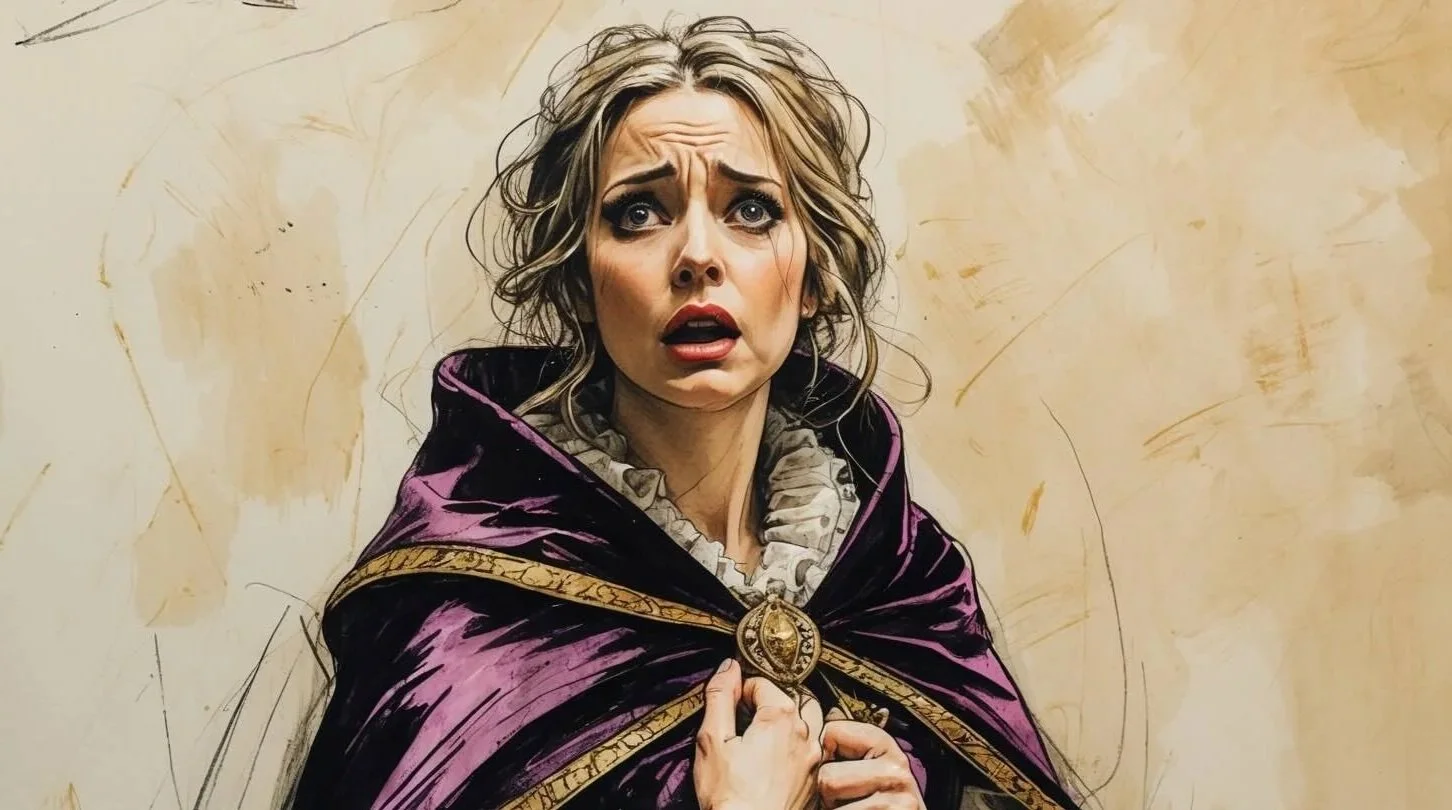
Character Profile – At a Glance
- Role: Wife to Macduff, mother, and tragic victim of Macbeth’s paranoid tyranny.
- Key Traits: Fiercely protective, outspoken, morally grounded, and deeply feeling.
- The Core Conflict: Left defenceless by her husband’s abrupt flight to England, she grapples with intense feelings of abandonment while facing the brutal reality of a kingdom descending into chaos.
- Key Actions: Condemns her husband’s flight as an act of betrayal; engages in witty, poignant banter with her young son; is brutally murdered by assassins.
- Famous Quote:
"Whither should I fly?
I have done no harm."
(Act 4, Scene 2) - The Outcome: Slaughtered along with her children by Macbeth’s hired murderers, her death marks the point of no return for the tyrant and provides the ultimate catalyst for Macduff’s bloody revenge.
The Abandoned Matriarch
Lady Macduff’s brief but devastating appearance centres entirely on her reaction to her husband’s absence. When Macduff flees to England to join Malcolm, he prioritises his duty to the state and the restoration of true kingship over the safety of his own family. Lady Macduff, left entirely in the dark, interprets this not as noble patriotism, but as cowardice and an unnatural betrayal of his familial duty.
Original
Wisdom! To leave his wife, to leave his babes,
His mansion and his titles in a place
From whence himself does fly? He loves us not;
He wants the natural touch…
(Act 4, Scene 2)
Shakespeare Retold (Modern Verse)
Wisdom! To leave his wife and leave his children,
His mansion and his titles in a place
So unsafe, he runs off? He doesn’t love us;
He’s lacking basic instinct…
Her raw, emotional response underscores the terrible human cost of political upheaval. She measures her husband’s behaviour against the laws of nature – comparing him unfavourably to the "poor wren" that will fight an owl to protect its young. By accusing him of lacking "the natural touch," she introduces a vital critique of the hyper-masculine political world where ambition and statecraft obliterate fundamental human compassion and family loyalty.
The Articulator of Moral Inversion
When the Messenger arrives to warn her of approaching danger and departs in haste, Lady Macduff is left alone with her son in the moment between warning and arrival. The speech she delivers in that interval is one of the play’s most pointed pieces of moral analysis.
Original
But I remember now
I am in this earthly world; where to do harm
Is often laudable, to do good sometime
Accounted dangerous folly…
(Act 4, Scene 2)
Shakespeare Retold (Modern Verse)
But I remember
I’m living in this world, where doing harm
Is often praised, but when someone does good
It’s deemed a dangerous, silly act.
The argument is the recognition of moral inversion. Lady Macduff has been reasoning, up to this moment, within the conventional framework – she has done no harm, therefore she should be safe. The middle clauses register the collapse of this framework. The "earthly world" she has remembered she is living in is the world Macbeth’s tyranny has produced – a world in which the conventional moral arithmetic no longer applies. The connection to the play’s broader thematic vocabulary is exact. The Witches’ A1S1 chorus – "Fair is foul, and foul is fair" – had established the play’s running theme of moral inversion at its opening. The Lady Macduff speech is the play’s clearest piece of evidence that the inversion has, by A4S2, become the actual operating logic of the kingdom. Shakespeare’s decision is to give the most clear-eyed articulation of that inversion to the figure who is its purest victim – Lady Macduff, whose innocence has been the condition of her vulnerability.
"The ideology of gender seems just as destructive from the submissive side as from the rebellious. The obedient wife dies, with her cherished son, just as the rebellious, murderous lady will die."
— Susan Snyder, Macbeth: A Modern Perspective, Folger Shakespeare Library
Innocence Slain: The Foil and the Threshold
Lady Macduff stands in stark contrast to Lady Macbeth. Where Lady Macbeth famously prays to be "unsexed" and rejects maternal instincts (boasting in A1S7 that she would dash her own baby’s brains out for power), Lady Macduff is defined by her maternal devotion. She is deeply embedded in the domestic sphere, representing the natural order, fertility, and innocence that Macbeth is systematically destroying. When the murderers finally arrive and demand her husband’s whereabouts, her response is one of unbroken defiance.
Original
I hope, in no place so unsanctified
Where such as thou mayst find him.
(Act 4, Scene 2)
Shakespeare Retold (Modern Verse)
I hope in nowhere that is so god-awful
That he may meet some people such as you.
Her slaughter that follows is completely unprovoked and serves no strategic purpose. It is an act of pure, nihilistic spite, and it confirms Macbeth’s total surrender to evil. The earlier murders – Duncan, Banquo – had operated within the register of tragic conflict between ambition and conscience; Macbeth’s dagger soliloquy, post-murder collapse, and banquet-scene breakdown were all evidence of the moral struggle the killings produced. The Lady Macduff slaughter works in a different register entirely. Macbeth orders it at the end of A4S1 ("This deed I’ll do before this purpose cool") without soliloquy and without struggle. The scene therefore functions as the play’s moral threshold: before A4S2, Macbeth is legible as a tragic figure whose moral collapse the audience reads with horrified empathy; after A4S2, the audience’s response shifts to revulsion, and the resolution of the play – Macduff’s eventual killing of Macbeth at A5S8 – becomes not merely possible but morally necessary.
Key Quotes
Quote 1Fathered he is, and yet he’s fatherless.
(Act 4, Scene 2)
Shakespeare Retold (Modern Verse)
He has a father, but his father’s left him.
Poor bird! Thou’ldst never fear the net nor lime,
The pitfall nor the gin.
(Act 4, Scene 2)
Shakespeare Retold (Modern Verse)
Poor bird! You do not fear the things that trap you,
The decoy nor the snare.
He has killed me, mother:
Run away, I pray you!
(her son, Act 4, Scene 2)
Shakespeare Retold (Modern Verse)
He has killed me, mother:
Run away, I beg you!
Key Takeaways
- Symbol of Innocence: She represents the domestic peace, maternal love, and natural order that Macbeth’s tyranny destroys.
- Thematic Foil: Her fierce dedication to her child starkly contrasts with Lady Macbeth’s rejection of motherhood, highlighting the theme of gender and unnatural behaviour.
- Critique of Masculinity: Her condemnation of Macduff forces the audience to question the ethics of prioritising political duty over family protection.
- Catalyst for the Climax: Her brutal, senseless murder is the ultimate proof of Macbeth’s depravity, providing the emotional fuel required for Macduff to exact his revenge and restore Scotland.
Study Questions and Analysis
How does Lady Macduff act as a foil to Lady Macbeth?
The pairing of the play’s two named "Lady" figures is one of Shakespeare’s most carefully constructed pieces of dramatic contrast, and the most obvious contrast is in their relationship to maternal capacity. Lady Macbeth’s A1S5 invocation is the play’s most explicit rejection of the maternal-feminine register:
Come, you spirits
That tend on mortal thoughts, unsex me here…
Come to my woman’s breasts,
And take my milk for gall…
(Lady Macbeth, Act 1, Scene 5)
Shakespeare Retold (Modern Verse)
Come, evil spirits
That make me think of death, make me more manly…
Come to my woman’s breasts
And turn my milk to bile…
The A1S7 imagery is sharper still: Lady Macbeth’s hypothetical willingness to have "plucked my nipple from his boneless gums, / And dashed the brains out" converts the maternal body into the instrument of its own infant’s destruction. Lady Macduff’s A4S2 appearance works in the opposite register. She is defined entirely through her maternal relationship, and her "natural touch" speech – the accusation that Macduff has failed to demonstrate the basic protective instinct even "the poor wren, / The most diminutive of birds" displays – articulates the maternal-natural framework against which her husband’s political abandonment is measured.
The decision Shakespeare makes is to position the two women as opposing models of female engagement with the play’s gender ideology. Lady Macbeth attempts to escape femininity entirely; Lady Macduff accepts the womanly role her culture assigns her. But the deeper critical reading complicates the simple foil structure. Susan Snyder’s Folger Modern Perspective essay, quoted on this page, observes that "the ideology of gender seems just as destructive from the submissive side as from the rebellious. The obedient wife dies, with her cherished son, just as the rebellious, murderous lady will die who consigned her own nursing baby to death." Both women die. Within the gender economy the tragedy constructs, neither submission nor rebellion guarantees survival, and the two deaths are the play’s evidence that the moral universe Macbeth has produced has no functional place for either model of womanhood.
Why is Lady Macduff so angry with her husband?
The A4S2 opening is one of the most carefully constructed pieces of domestic outrage in the play. Ross has arrived at the Macduff castle with the news that Macduff has "fled" to England, and he has, on his own evidence, no further information about why. Lady Macduff is the wife who has not been told. Her opening question – "What had he done, to make him fly the land?" – names the bewilderment that underlies the anger. Macduff’s flight, on the information available to her, has no apparent cause: he has not been accused of treason, has not been threatened, and has not committed any act that would necessitate sudden departure.
The "natural touch" speech is the centre of her response, and the wren imagery she develops is the heart of her argument:
for the poor wren,
The most diminutive of birds, will fight,
Her young ones in her nest, against the owl.
All is the fear and nothing is the love…
(Act 4, Scene 2)
Shakespeare Retold (Modern Verse)
even weak wrens,
The smallest of all birds, know they must fight
Against an owl that tries to steal her chicks.
He’s run from fear; it’s not to do with love.
The argument has three components: the contrast between Macduff’s flight and the wren’s behaviour, since even the smallest creature defends its young; the diagnosis of motive, that the flight is driven by fear rather than love; and the implicit accusation that Macduff has weighed his political safety against his family’s and chosen his own. Ross’s defence ("Things at the worst will cease, or else climb upward / To what they were before") attempts to relocate the question into the broader political context, reading the flight as strategic withdrawal rather than cowardice, but it does not persuade her. Her anger continues, the witty mother-son dialogue follows, and within fifty lines the murderers have arrived. The scene’s argument is that Lady Macduff’s anger is, on the available evidence, entirely rational: she has been given no information that would let her assess the political stakes, and she has been left in a place she correctly identifies as dangerous.
How does Lady Macduff’s murder differ from the murders of Duncan and Banquo?
The difference between Macbeth’s earlier and later murders is one of Shakespeare’s most carefully constructed pieces of moral arithmetic. The earlier murders had political-strategic rationales. Duncan’s death in A2S2 was the regicide that produced Macbeth’s accession; Banquo’s death in A3S3 was driven by the prophecy that Banquo "shall get kings" and by Macbeth’s A3S1 calculation that the dynastic threat could only be addressed by Banquo’s elimination. Both murders, however indefensible, had identifiable strategic functions. The Lady Macduff slaughter works outside this arithmetic. The A4S1 lines in which Macbeth orders the attack are exact:
The castle of Macduff I will surprise;
Seize upon Fife; give to the edge o’ the sword
His wife, his babes, and all unfortunate souls
That trace him in his line.
(Macbeth, Act 4, Scene 1)
Shakespeare Retold (Modern Verse)
I’ll go to Macduff’s castle to surprise them;
I’ll seize the town of Fife; and thrust my sword in
His wife, his children, and all those unlucky
Enough to be descendants.
The order has no strategic logic. Lady Macduff and her children are not in the line of succession and cannot become political threats; their deaths cannot prevent any prophecy or remove any rival claimant. The murder is therefore not strategic but performative – an act of state terror directed at the family of a thane who has already fled the country. Macbeth’s earlier murders had operated within the register of tragic conflict between ambition and conscience, but he orders this one at the end of A4S1 ("This deed I’ll do before this purpose cool") without soliloquy and without struggle. As A. C. Bradley’s 1904 Shakespearean Tragedy recognises, Macbeth’s late acts of cruelty do not reach the tragic register of the earlier murders because they are not motivated by struggle of conscience, and the audience’s response shifts correspondingly from horrified empathy to revulsion. The A4S2 scene is the pivot at which the play converts its protagonist from a tragic figure whose downfall we mourn into a tyrant whose elimination we anticipate.
Is Lady Macduff justified in calling her husband a traitor?
The question Lady Macduff raises in A4S2 is one of the play’s most carefully constructed pieces of moral-political ambiguity, and the answer depends on which framework of "traitor" the question is asked within. Her son asks her directly, "Was my father a traitor, mother?" She replies, "Ay, that he was," defines a traitor as "one that swears and lies," and concludes that "every one that does so is a traitor, and must be hanged." Her application of the definition to Macduff is internally consistent: he has, in her framing, sworn to protect his family and has, by his flight, failed to honour the oath.
The complicating fact is that by the play’s broader political framework, Macduff has indeed committed treason in the legal-political sense that registers in Macbeth’s intelligence network and that produces the A4S2 slaughter. By A3S6, Lennox and the Lord are discussing his flight to the English court; by A4S1, the Witches’ second apparition is warning Macbeth to "beware Macduff." Macduff has, in the register of Macbeth’s regime, joined an armed rebellion against the sitting king. The play’s dramatic irony depends on the convergence of the two frameworks: Lady Macduff calls Macduff a traitor for one reason (domestic abandonment), while the murderers who arrive within fifty lines are operating on the second (political rebellion).
The decision Shakespeare makes is to refuse to adjudicate which framework is morally correct. The A4S3 testing scene at Malcolm’s court will give Macduff’s side – the flight as the act of a patriot who has judged that the legitimate restoration can only be organised from England – while Lady Macduff’s A4S2 articulation gives the opposing register. Susan Snyder’s Folger Modern Perspective argues that Ross’s brief defence in A4S2 "strives to relocate the moral ambiguity of Macduff’s conduct in the situation created by Macbeth’s tyrannical rule." Lady Macduff’s reading of him as a traitor is therefore both right within her framework and partial, since her framework cannot accommodate the political pressures that produced his decision. The play’s quiet answer is that the question cannot be cleanly resolved.