Appearance vs Reality
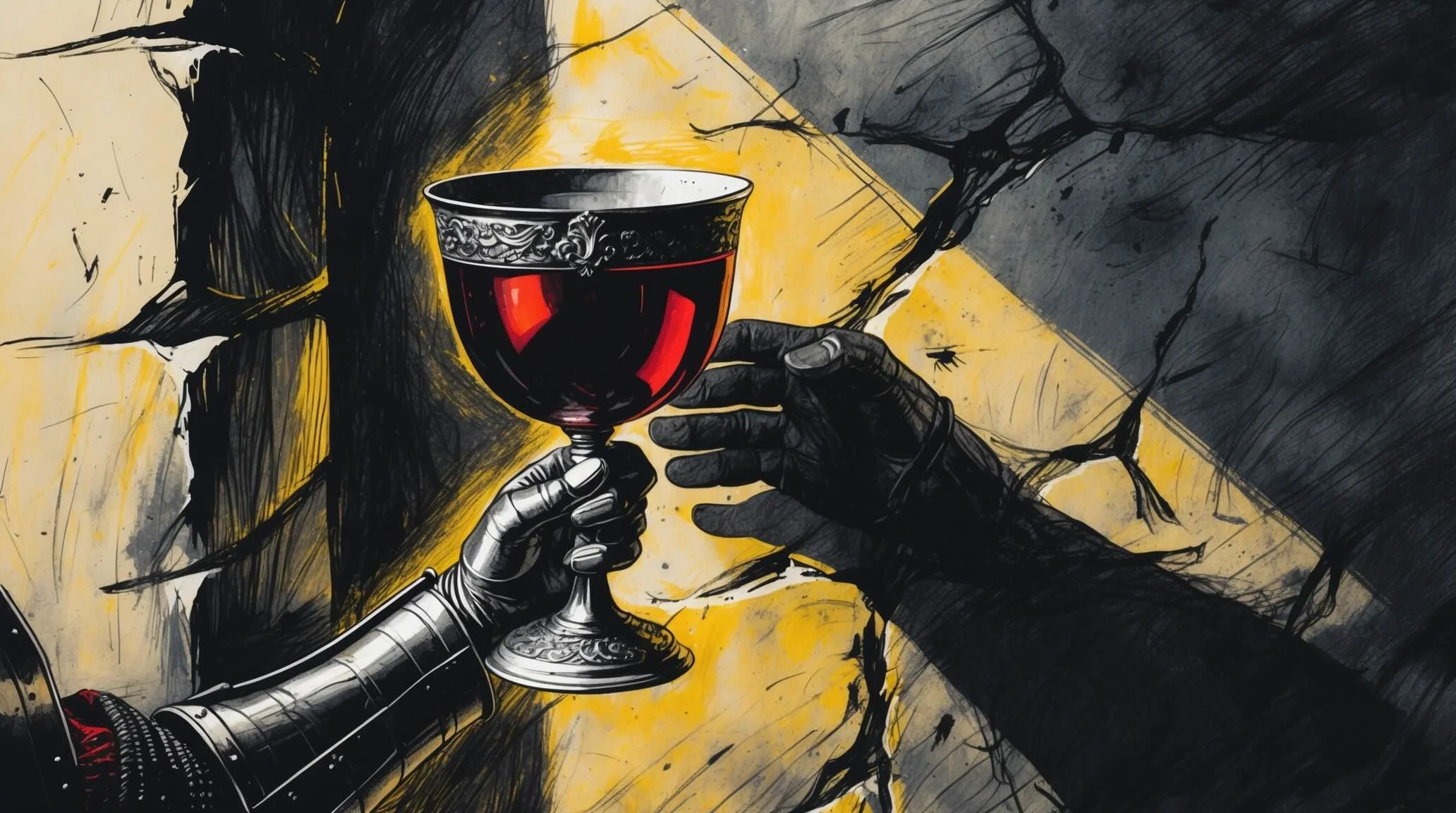
Theme Profile – At a Glance
- Focus: The gap between seeming and being – the loyal face worn over the murderous heart, and a world where what looks fair turns out to be foul.
- Key Characters: Macbeth, Lady Macbeth, King Duncan, Banquo, The Witches.
- The Core Tension: To take the crown, the Macbeths must hide what they are. Every smile in the play may be a mask, and the audience is never allowed to forget it.
- Key Manifestations: Duncan's misplaced trust in Act 1, Scene 4; the Macbeths coaching each other to deceive; the drunken Porter on equivocation in Act 2, Scene 3; the witches' double-meaning prophecies; Macbeth's final discovery that he has been tricked.
- Famous Quote:
Your hand, your tongue: look like the innocent flower,
But be the serpent under't.
(Act 1, Scene 5) - The Outcome: The deception works long enough to win the crown, but the strain of holding the mask in place destroys both Macbeths. The face that hid the heart cannot hide it forever.
The World Announced as a Lie
Before the plot has properly begun, the play tells the audience how to watch it. The witches' opening chant – "Fair is foul, and foul is fair" – sets the rule that will govern everything that follows: in this play, surfaces cannot be trusted, and the things that look most attractive are often the most dangerous. The line is a warning to the audience as much as a spell. Watch the faces, it says, and assume nothing.
That warning is dramatised almost at once. When Macbeth hears the witches' prophecy that he will be king, he is not lifted by it but unsettled, and his aside in Act 1, Scene 3 turns the whole solid world to vapour. The murder he is already imagining feels more real to him than the ground under his feet.
Original
Shakes so my single state of man that function
Is smothered in surmise, and nothing is
But what is not.
(Act 1, Scene 3)
Shakespeare Retold (Modern Verse)
Is shaking me so much, I barely function
Through overwhelming thoughts, and nothing's real
But my imagination.
"Nothing is but what is not" is the theme compressed into a single phrase. The real and the imagined have changed places in Macbeth's mind. Banquo, watching the same prophecy land, draws the soberer conclusion: that evil often tells the truth about small things in order to lie about large ones. He understands the trap before Macbeth has even seen it.
Original
The instruments of darkness tell us truths,
Win us with honest trifles, to betray's
In deepest consequence.
(Act 1, Scene 3)
Shakespeare Retold (Modern Verse)
Satanic forces feed us half the truth
To coax us with minutia, then betray us
With devastating impact.
The Face That Cannot Be Read
The play's great irony is that the man who trusts most is the man with the most to lose. King Duncan is good, generous, and fatally unable to see through a smile. His reflection in Act 1, Scene 4 comes as he laments the first Thane of Cawdor, a trusted traitor who has just been executed – and he speaks it, with terrible dramatic irony, moments before welcoming the second.
Original
There's no art
To find the mind's construction in the face:
He was a gentleman on whom I built
An absolute trust.
(Act 1, Scene 4)
Shakespeare Retold (Modern Verse)
One is unable
To know another's thoughts by how they look:
He was a gentleman in whom I'd built
An absolute trust.
There is no art, Duncan says, to read the mind in the face – and the next face he turns to is Macbeth's. The line is the theme's thesis statement delivered by its first victim. If a king cannot tell loyalty from treason by looking, then the whole social order rests on a trust that the play is about to betray. Duncan's goodness is real, and it is precisely what makes him blind.
Coaching the Mask
The most chilling thing about the Macbeths' deception is that it is taught. Murder, in this play, is a performance two people rehearse together. When Macbeth's face betrays his turmoil, Lady Macbeth reads it instantly and tells him to fix it. Her instruction in Act 1, Scene 5 is the play's clearest statement of the gap between seeming and being: be one thing, look another.
Original
Your face, my thane, is as a book where men
May read strange matters. To beguile the time,
Look like the time; bear welcome in your eye,
Your hand, your tongue: look like the innocent flower,
But be the serpent under't.
(Act 1, Scene 5)
Shakespeare Retold (Modern Verse)
My lord, your face is read just like a book
Revealing bad intentions. To deceive them,
Be like them, with a welcoming expression
In actions and in words. Look like a flower,
But be the snake below.
The image is exact. The flower is the surface that invites; the serpent is the truth that strikes. By the end of Act 1, Scene 7 Macbeth has absorbed the lesson and can say it back in his own voice, sealing his commitment to the murder with a couplet about disguise. He has learned that the false face is the price of the crown.
Original
Away, and mock the time with fairest show:
False face must hide what the false heart doth know.
(Act 1, Scene 7)
Shakespeare Retold (Modern Verse)
Go back and pass the time without a mention,
And smile to hide the source of our intention.
Equivocation and the Final Reckoning
The play gives the theme its own theory, and it gives it to a drunk. The Porter in Act 2, Scene 3, imagining himself the gatekeeper of hell, lets in an "equivocator" – a man who tells a truth designed to deceive, who swears on both sides of a question at once. The joke had a sharp contemporary edge for Shakespeare's audience, but its function in the play is structural: equivocation is exactly what the witches do to Macbeth, and what Macbeth does to everyone around him.
Original
Faith, here's an equivocator, that could swear in both the scales against either scale; who committed treason enough for God's sake, yet could not equivocate to heaven:
(Act 2, Scene 3)
Shakespeare Retold (Modern Verse)
Ah, here's a waffler, capable of waffling for both sides of a legal argument; who lied about his faith in front of God, but couldn't lie or blag his way to heaven.
The Porter's speech is prose, the loose rhythm of a comic turn, and the contrast is deliberate: the play's clearest diagnosis of equivocation is delivered in its least elevated voice. The witches have promised Macbeth things that are true to the ear and false to the hope – that no man "of woman born" can harm him, that he is safe until a forest moves. He hears these as guarantees. They are riddles. When Macduff reveals that he was "from his mother's womb / Untimely ripped," Macbeth finally understands that the surface meaning was the trap. His last great speech is the play's verdict on every double meaning that has carried him to this point.
Original
And be these juggling fiends no more believed,
That palter with us in a double sense;
That keep the word of promise to our ear,
And break it to our hope.
(Act 5, Scene 8)
Shakespeare Retold (Modern Verse)
And I do not believe those witches now
As they prevaricate with double meanings
So we believe the promises they make
Until they break our hopes.
The avenger of the theme is reality itself. Macbeth has spent the play managing appearances – his own face, the witches' words, the show he puts on for his guests – and reality has been quietly closing in the whole time. The man who learned to "look like the innocent flower" dies because he believed a surface meaning that was never the truth.
"Two main themes, which can only be separated for the purpose of analysis, are blended in the play—the themes of the reversal of values and of unnatural disorder. And closely related to each is a third theme, that of the deceitful appearance, and consequent doubt, uncertainty and confusion."
— L. C. Knights, How Many Children Had Lady Macbeth?, 1933
Key Quotes on Appearance vs Reality
Quote 1
Look like the innocent flower,
But be the serpent under't.
(Act 1, Scene 5)
Shakespeare Retold (Modern Verse)
Look like a flower,
But be the snake below.
Quote Analysis: This is the theme in two lines. Lady Macbeth hands her husband a complete philosophy of deception: the surface must be inviting, the truth beneath it must strike. The flower and the serpent are not two halves of a person but a deliberate strategy – present the one, conceal the other. The image is biblical, recalling the serpent in Eden, and it casts the murder of Duncan as a kind of fall. What makes it so unsettling is that it is offered as practical advice, calmly, the way one might coach an actor before a performance.
Quote 2
There's no art
To find the mind's construction in the face:
He was a gentleman on whom I built
An absolute trust.
(Act 1, Scene 4)
Shakespeare Retold (Modern Verse)
One is unable
To know another's thoughts by how they look:
He was a gentleman in whom I'd built
An absolute trust.
Quote Analysis: Duncan is speaking about the first Thane of Cawdor, a trusted traitor – and the dramatic irony is brutal, because he says it just before turning to greet Macbeth, the man who will become the second. The line states the theme's central problem outright: the face is not a reliable guide to the heart. Duncan's tragedy is that he is too good to suspect, and his goodness is exactly the blindness the play punishes. A king who cannot read treason in a smile is a king who will not survive a court built on smiles.
Quote 3
Away, and mock the time with fairest show:
False face must hide what the false heart doth know.
(Act 1, Scene 7)
Shakespeare Retold (Modern Verse)
Go back and pass the time without a mention,
And smile to hide the source of our intention.
Quote Analysis: By the close of Act 1, Scene 7, Macbeth has taken his wife's lesson and made it his own. The rhyming couplet seals the scene and his decision together: the neat, closed sound of "show" and "know" mirrors the tidy concealment the lines describe. "False face" and "false heart" are bound by the same word, which is the point – the deception is total, surface and depth working in concert. He has stopped resisting the mask and begun to wear it deliberately.
Quote 4
And be these juggling fiends no more believed,
That palter with us in a double sense;
That keep the word of promise to our ear,
And break it to our hope.
(Act 5, Scene 8)
Shakespeare Retold (Modern Verse)
And I do not believe those witches now
As they prevaricate with double meanings
So we believe the promises they make
Until they break our hopes.
Quote Analysis: This is the theme's final reckoning, spoken as Macbeth faces Macduff and his own death. "Palter" means to deal evasively, to use words in a "double sense" – and Macbeth now understands that the prophecies he treated as guarantees were riddles all along. They kept their promise "to our ear" while breaking it "to our hope": true in the letter, false in the meaning. The man who spent the play deceiving others ends it as the one most completely deceived. Equivocation, the play insists, is a weapon that eventually turns on the hand that uses it.
Key Takeaways
- The Play Warns You First: "Fair is foul, and foul is fair" tells the audience from the opening scene that surfaces lie. Watching Macbeth means learning to distrust every face.
- Trust Is What Gets Punished: Duncan's goodness makes him unable to read treason in a smile. The play is hard on the trusting and rewards, for a time, the deceiver.
- The Mask Is Taught: The Macbeths coach each other to "look like the innocent flower." Deception in this play is a performance two people rehearse together.
- Equivocation Turns on Its User: The witches palter with Macbeth in a double sense, just as he deceives everyone else. The man who lived by the false face dies by a meaning he failed to read.
Study Questions and Analysis
What does "fair is foul, and foul is fair" mean for the whole play?
The witches' chant in A1S1 is the play's organising principle, not just an eerie opening. It announces a world in which moral and visual categories have been inverted: what looks good is bad, what sounds reassuring is a trap, and the audience must spend the rest of the evening reading against the surface.
L. C. Knights, in his landmark 1933 essay How Many Children Had Lady Macbeth?, treated this inversion as central to the play's design. Knights argued that the play blends the theme of "the reversal of values" with that of "unnatural disorder," and that closely related to both is "the theme of the deceitful appearance, and consequent doubt, uncertainty and confusion." On his reading, appearance versus reality is not one theme among several but the connective tissue binding the play's moral and natural disorder together. A world where values are reversed is necessarily a world where faces cannot be trusted.
The principle pays off immediately in Macbeth's own response to the prophecy. The thing he most wants is also the thing that most frightens him, and his sense of what is real begins to dissolve.
Shakes so my single state of man that function
Is smothered in surmise, and nothing is
But what is not.
(Act 1, Scene 3)
Shakespeare Retold (Modern Verse)
Is shaking me so much, I barely function
Through overwhelming thoughts, and nothing's real
But my imagination.
"Nothing is but what is not" is "fair is foul" relocated inside a single mind. The reversal the witches announced for the world is now happening to Macbeth's perception. Critics from A. C. Bradley onward have noted that Macbeth's imagination is unusually vivid – it is what makes his soliloquies so powerful and his guilt so torturing – and here that imagination is already overwhelming his grip on reality before the murder has even been agreed. The play makes the case that a person who lets the unreal become more real than the real has begun the journey to the dagger he will later see in the air.
Why does Shakespeare make Duncan so trusting?
Duncan's trust is a deliberate dramatic choice, and it carries the theme. Shakespeare needed a victim whose goodness was beyond question, both so that the murder would be unambiguously evil and so that the gap between appearance and reality would have something pure to destroy. A suspicious, worldly king might have caught Macbeth; Duncan cannot, because his virtue is precisely an inability to imagine treachery.
The point is sharpened by placement. Duncan delivers his most famous reflection on the unreadability of faces while mourning the first Thane of Cawdor, who betrayed him – and he delivers it moments before greeting Macbeth, who will betray him far worse.
There's no art
To find the mind's construction in the face:
He was a gentleman on whom I built
An absolute trust.
(Act 1, Scene 4)
Shakespeare Retold (Modern Verse)
One is unable
To know another's thoughts by how they look:
He was a gentleman in whom I'd built
An absolute trust.
The dramatic irony is so heavy it almost becomes unbearable. Duncan articulates the exact lesson he is failing to learn. He has just been betrayed by one trusted man and is about to repeat the mistake with another, while telling us that such mistakes are unavoidable because faces cannot be read. L. C. Knights saw this kind of patterning – statement undercut by its own context – as part of the play's method of building "doubt, uncertainty and confusion" into its very structure. Duncan is not naive in any ordinary sense; he is good in a world that has been rigged against goodness. The play's bleakest suggestion is that in a court governed by "fair is foul," the trusting are simply the next to die.
How do the Macbeths use deception differently from each other?
Both Macbeths deceive, but the play distinguishes their relationship to the mask. Lady Macbeth is, at least at first, the natural performer. She instructs her husband in concealment as though it were a skill she has already mastered, reading his face like a book and telling him to rewrite it.
Your face, my thane, is as a book where men
May read strange matters. To beguile the time,
Look like the time; bear welcome in your eye,
Your hand, your tongue: look like the innocent flower,
But be the serpent under't.
(Act 1, Scene 5)
Shakespeare Retold (Modern Verse)
My lord, your face is read just like a book
Revealing bad intentions. To deceive them,
Be like them, with a welcoming expression
In actions and in words. Look like a flower,
But be the snake below.
Macbeth, by contrast, has to learn the mask, and he never wears it as comfortably as he wears the knife. His soliloquies betray everything his public face is meant to hide; the deception that comes naturally to his wife is, for him, a constant act of suppression. This is the irony the second half of the play exploits. The roles reverse. By the banquet scene, it is Macbeth who can murder Banquo and host a dinner over it, while Lady Macbeth's composure is the first to crack – and by the sleepwalking scene the woman who taught the false face is the one whose unconscious self confesses everything. A. C. Bradley in his 1904 Shakespearean Tragedy drew attention to this trajectory: Lady Macbeth's apparent strength is a forced suppression that exacts a terrible delayed price, while Macbeth grows colder as she breaks. The mask, the play argues, does not come free to anyone. It is paid for either in a shattered mind or in a hardened one.
What is the point of the Porter's "equivocator" speech?
The drunken Porter in A2S3 can look like comic relief dropped between the murder and its discovery, but his speech is one of the most thematically precise passages in the play. Imagining himself the porter of hell-gate, he admits an "equivocator" – someone who tells the literal truth in a way designed to mislead, who can "swear in both the scales against either scale."
Faith, here's an equivocator, that could swear in both the scales against either scale; who committed treason enough for God's sake, yet could not equivocate to heaven:
(Act 2, Scene 3)
Shakespeare Retold (Modern Verse)
Ah, here's a waffler, capable of waffling for both sides of a legal argument; who lied about his faith in front of God, but couldn't lie or blag his way to heaven.
For Shakespeare's first audiences the joke had a topical edge – equivocation was associated with the Jesuit doctrine made notorious by the Gunpowder Plot trials of 1606, in which a man could speak words that were technically true while intending to deceive. But its dramatic function outlasts the topical reference. Marjorie Garber, in her 2004 Shakespeare After All, reads equivocation as the play's master-key: the witches equivocate with their prophecies, Macbeth equivocates with his guests, and the Porter, drunk at the gate, names the whole mechanism out loud. Garber stresses that the witches' language is true in the letter and false in the meaning – the very definition of equivocation – and that Macbeth's downfall is the working-out of his failure to hear the difference. The Porter, placed precisely between Duncan's murder and its discovery, turns the audience's attention to the linguistic machinery that the rest of the play runs on. He is the play laughing, grimly, at its own deepest method.
How do the witches' prophecies fit the appearance-versus-reality theme?
The witches are the theme's purest practitioners. Every prophecy they offer is true and misleading at once, which is exactly the equivocation the Porter describes. They tell Macbeth he cannot be harmed by any man "of woman born" and that he is safe until Birnam Wood comes to Dunsinane. He hears impossibilities and so hears guarantees. The reality is that both conditions can be met – by a man delivered by caesarean section, and by an army carrying branches – and the gap between what the words seem to promise and what they actually allow is the space he falls through.
This is where the play's interest in language becomes inseparable from its plot. Marjorie Garber's 2004 Shakespeare After All argues that the witches' "double sense" is not incidental colour but the structural engine of the tragedy: Macbeth is destroyed by a failure of interpretation, by taking the comforting surface meaning when a more careful listener would have heard the trap. The prophecies "keep the word of promise to our ear" while breaking it "to our hope," and Macbeth only understands this when it is far too late.
And be these juggling fiends no more believed,
That palter with us in a double sense;
That keep the word of promise to our ear,
And break it to our hope.
(Act 5, Scene 8)
Shakespeare Retold (Modern Verse)
And I do not believe those witches now
As they prevaricate with double meanings
So we believe the promises they make
Until they break our hopes.
There is a hard question underneath this. If the witches only ever spoke true – Macbeth did become king, and was undone exactly as warned – then the deception is not in their words but in his hearing of them. A. C. Bradley in 1904 was careful to argue that the witches do not control Macbeth; they reveal him to himself, supplying the suggestion that his own ambition was already reaching for. On that reading the equivocation is collaborative. The witches palter, but Macbeth wants to be paltered with – he chooses the reading that flatters his desire over the one that would have saved him. The appearance-versus-reality theme, at its deepest, is not only about being deceived but about wanting to be.
Does Macbeth deceive himself as well as others?
Self-deception is the form the theme takes inside Macbeth's own head, and it is arguably the most important version of it. The external deceptions – the smiling welcome to Duncan, the hosting of a murdered man's seat at dinner – are deliberate performances. But Macbeth is also continually managing his own perception of what he is doing, and this internal equivocation is what allows him to keep going.
The pattern begins before the first murder, when his imagination overwhelms his sense of the real, and it deepens as he learns to act against what he knows. By A3S2 he has internalised the lesson of the false face so completely that he frames concealment as a shared necessity, instructing himself and his wife to disguise their hearts. He has stopped seeing the mask as a betrayal of who he is and started treating it as who he must be.
The play's most disturbing suggestion is that constant deception erodes the self doing the deceiving. A. C. Bradley noted Macbeth's growing numbness – the man who could barely speak after killing Duncan can, by the end, receive news of his wife's death almost without feeling. The "false face" has been worn so long that the "false heart" beneath it has hardened into something that no longer registers what it has lost. When reality finally breaks through in A5S8 and Macbeth grasps that the prophecies were riddles, the recognition is too late to be redemptive. He has equivocated with himself for so long that he meets the truth as a stranger. The theme's bleakest lesson is that a person who spends a life persuading others he is something he is not may end by no longer knowing what he is.
Is the appearance-versus-reality theme ultimately optimistic or bleak?
The play can be read both ways, and the tension between them is part of its power. On the optimistic reading, reality wins. The Macbeths' deception is brilliant and it works for a time, but it cannot last. The mask cracks: Lady Macbeth's mind betrays her in the sleepwalking scene, Macbeth's tyranny becomes visible to the whole of Scotland, and Birnam Wood does come to Dunsinane. The world the witches inverted with "fair is foul" is set right again when Malcolm is crowned, the rightful order restored, the deceivers exposed and destroyed. On this view the play is finally moral: truth is buried but not killed, and it claws its way back to the surface.
There is a bleaker reading that the play does not let us dismiss. The restoration at the end is real, but it has been bought with a stage full of bodies, and the means of Macbeth's defeat – an army hiding behind branches, a man hiding the manner of his birth – are themselves a kind of equivocation. Reality wins, but it wins by out-deceiving the deceiver. G. Wilson Knight, in his 1930 The Wheel of Fire, read the play as a drama of evil flooding a world and being, with great difficulty, expelled – but the world that survives is scarred, and the audience has been made complicit in distrusting every face it sees.
The most honest answer is that the play holds both. L. C. Knights in 1933 located its lasting unease precisely in "the deceitful appearance, and consequent doubt, uncertainty and confusion" – a confusion the ending tidies on the level of plot without entirely dispelling on the level of feeling. The crown is back on a true head. But the play has spent five acts teaching us that a true head and a false one can look exactly alike, and that lesson does not unlearn itself just because the curtain falls on a coronation. We leave the theatre having watched how easily the innocent flower hides the serpent – and a little less sure, ever after, of any face we are shown.