Power and Ambition
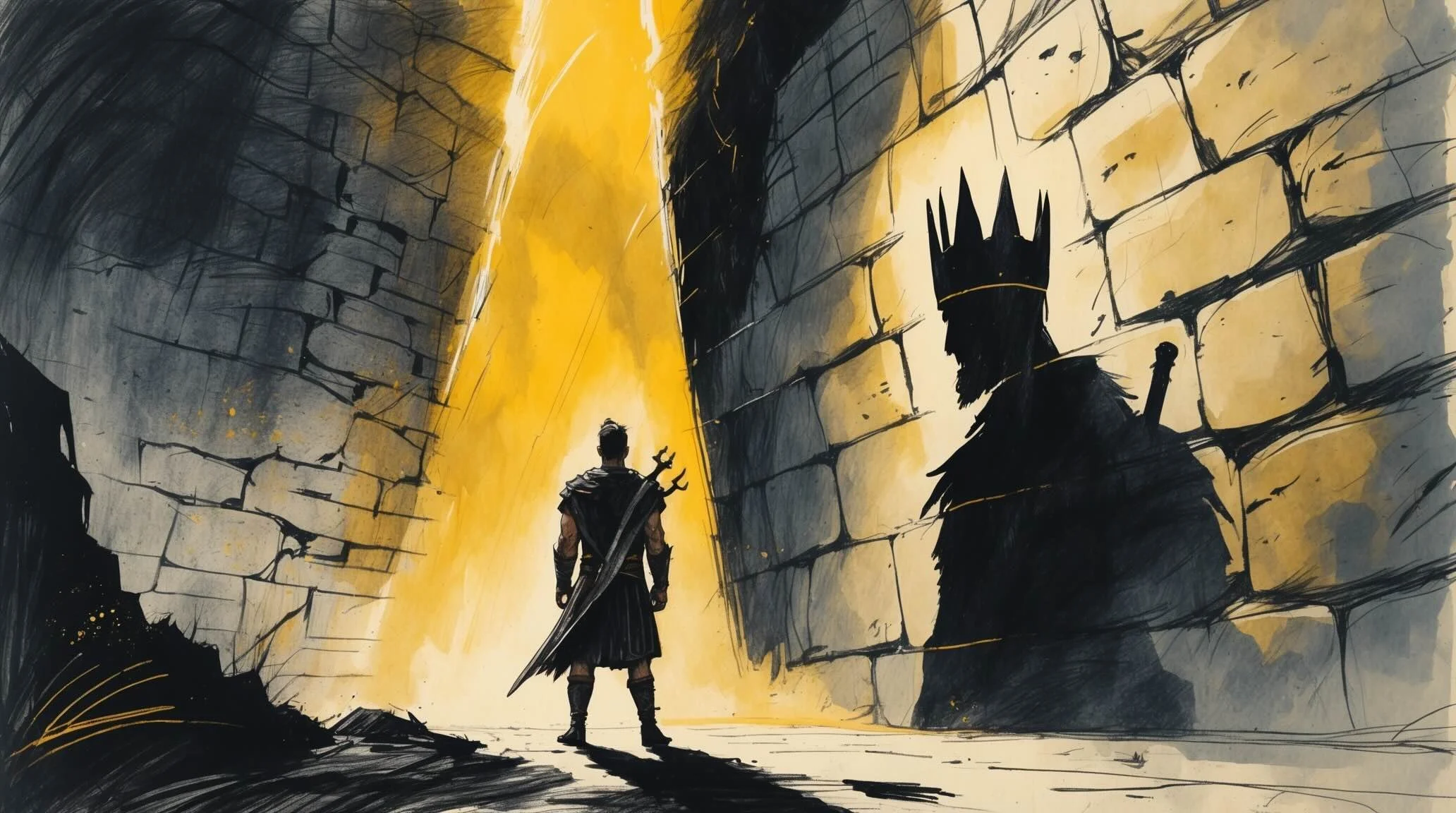
Theme Profile – At a Glance
- Focus: Ambition as the engine of the play – the desire for power, and the discovery that holding power is nothing like wanting it.
- Key Characters: Macbeth, Lady Macbeth, King Duncan, Banquo, Malcolm.
- The Core Tension: Macbeth wants the crown badly enough to kill for it, and is horrified by what killing for it makes him. Desire and conscience pull in opposite directions.
- Key Manifestations: The witches' prophecy in Act 1; Lady Macbeth's reading of her husband; the dagger soliloquy before the murder; the fear of Banquo; the slide into tyranny once the crown is won.
- Famous Quote:
"Vaulting ambition, which o'erleaps itself
And falls on the other."
(Act 1, Scene 7) - The Outcome: Macbeth gets everything ambition promised and none of what it seemed to promise. The crown brings only fear, insomnia, and a tightening circle of murder, until the thing he climbed for destroys him.
The Engine of the Play
Ambition is not a sub-theme in Macbeth – it is the motor that drives every turn of the plot. Almost everything that happens after Act 1 happens because one man wants something he is not entitled to and decides to take it. The witches supply the prophecy, but they supply nothing else: no dagger, no plan, no push. What they offer is a possibility, and Macbeth's ambition does the rest. The play is, in one sense, a sustained study of what a single desire can do to a good man once he stops resisting it.
What makes the theme so unsettling is that Macbeth is not a stupid or a wicked man at the start. He is brave, admired, and – crucially – fully aware of what his ambition is asking of him. He names it precisely.
Original
Two truths are told,
As happy prologues to the swelling act
Of the imperial theme.
(Act 1, Scene 3)
Shakespeare Retold (Modern Verse)
The witches told two truths,
But they're just warm-ups to the main event
Whereby I will be king.
The phrase "the imperial theme" is the giveaway. Within seconds of hearing that he is Thane of Cawdor, Macbeth has already leapt past the title he has just earned to the crown he has not. The prophecy has not made him ambitious; it has given his ambition a target. The "swelling act" is his own imagination, swelling toward a throne that is currently occupied by a living king he serves. The murder is, in embryo, already present in the metaphor.
Macbeth's Ambition Against Lady Macbeth's
The play sets two ambitions side by side, and the contrast is one of its sharpest pieces of characterisation. Macbeth wants the crown but recoils from the means. Lady Macbeth wants it too, and has no such recoil – or believes she has none. When she reads his letter, she diagnoses him with a precision that doubles as a confession of her own nature.
Original
To catch the nearest way: thou wouldst be great;
Art not without ambition, but without
The illness should attend it...
(Act 1, Scene 5)
Shakespeare Retold (Modern Verse)
To snatch your first chance. You do strive for greatness,
And you have high ambition, but without
The ruthlessness that's needed...
Her reading is exact. Macbeth's ambition is real but conditional; it wants the prize and balks at the price. What he lacks, in her view, is the "illness" – the ruthlessness – to close the gap. So she supplies it. She does not have more ambition than her husband; she has fewer scruples about feeding it, and she knows it. Her response is not to want the crown more, but to make herself capable of taking it, which is why she calls on the spirits to strip her of the very feelings that might stop her.
Original
That tend on mortal thoughts, unsex me here,
And fill me from the crown to the toe top-full
Of direst cruelty!
(Act 1, Scene 5)
Shakespeare Retold (Modern Verse)
That make me think of death, make me more manly,
And fill me from my head down to my toes
With awful cruelty!
The bitter irony of the play is that she is wrong about herself. The ruthlessness she summons is borrowed, not native, and it does not hold. By Act 5 she is the one undone by conscience while Macbeth has hardened into a killer who feels almost nothing. The ambition that needed her to ignite it survives her; she does not survive it.
The Soliloquy of Conscience
The single greatest piece of evidence that Macbeth understands ambition morally – rather than merely dramatising it – is the soliloquy that opens A1S7. Alone, with the murder an hour away, Macbeth thinks the whole thing through, and he cannot find a reason to do it that survives examination. Duncan is a good king, a kinsman, and a guest. Every code Macbeth lives by forbids the act. The only thing on the other side of the scale is the wanting itself.
Original
That tears shall drown the wind. I have no spur
To prick the sides of my intent, but only
Vaulting ambition, which o'erleaps itself
And falls on the other.
(Act 1, Scene 7)
Shakespeare Retold (Modern Verse)
To make them cry and drown the wind. There's no more
That's motivating me to act, except
Ambition, like a man mounting his horse
And falling off the other side.
The image is one of the most precise diagnoses of ambition in English literature. A rider so eager to mount that he vaults clean over the saddle and lands in the dirt on the far side: ambition that overreaches itself and brings about its own fall. Macbeth sees this clearly. He knows that his one motive is also the seed of his ruin – and he goes ahead anyway. This is the play's tragic centre. The flaw is not blindness but a clear-eyed surrender to the one desire he knows will destroy him.
The Insecurity of Power Achieved
The cruellest turn the theme takes is what happens after the crown is won. Ambition imagines power as an arrival, a settled state of having. The play shows it as nothing of the kind. The moment Macbeth is king, he discovers that the throne is not a possession but a position to be defended, and that everyone near it is now a threat. The wanting did not end with the getting; it simply changed its object from the crown to the security of the crown.
Original
To be thus is nothing;
But to be safely thus. – Our fears in Banquo
Stick deep...
(Act 3, Scene 1)
Shakespeare Retold (Modern Verse)
There's no point being king
Unless a safe king. All my fears of Banquo
Run deep...
"To be thus is nothing; but to be safely thus" is the epitaph for every ambition in the play. Being king is worthless unless the kingship is safe, and it can never be safe, because the same logic that made Macbeth a regicide makes everyone else a potential one. He has Banquo killed not for what Banquo has done but for what the witches promised his line. The murders multiply because the insecurity is bottomless. By the time he reflects on it, he is so deep in blood that going back looks no easier than going on.
Original
All causes shall give way: I am in blood
Stepped in so far that, should I wade no more,
Returning were as tedious as go o'er...
(Act 3, Scene 4)
Shakespeare Retold (Modern Verse)
Nothing must stop me now. I've so much blood
Upon my hands that, should I choose to backtrack,
It would be like repeating all I've done...
This is ambition's final state in the play: not satisfaction, but a man wading through a river of blood who has lost the sense that the far bank is any closer than the one behind him. Power has delivered the opposite of what it promised. The crown that was supposed to be the end of striving has become an endless, exhausting defence of a thing that brings no peace.
"His imagination is thus the best of him, something usually deeper and higher than his conscious thoughts; and if he had obeyed it he would have been safe."
— A. C. Bradley, Shakespearean Tragedy, 1904
Key Quotes on Power and Ambition
Quote 1
The Prince of Cumberland! That is a step
On which I must fall down, or else o'erleap,
For in my way it lies.
(Act 1, Scene 4)
Shakespeare Retold (Modern Verse)
The Prince of Cumberland! That is a challenge
To trip me up, unless I overcome it,
For it stands in my way.
Quote Analysis: Duncan has just named his son Malcolm as heir, and Macbeth's reaction is instant and revealing. The naming of an heir is a constitutional act, but Macbeth reads it as a personal obstacle – a "step" that must be either climbed over or fallen upon. In a single phrase, the loyal thane has recast his king's lawful succession as something blocking his own path. The ambition was always there; Duncan's announcement simply shows Macbeth exactly what stands between him and the throne, and his mind goes immediately to removing it rather than accepting it.
Quote 2
For in my way it lies. Stars, hide your fires;
Let not light see my black and deep desires...
(Act 1, Scene 4)
Shakespeare Retold (Modern Verse)
For it stands in my way. Stars, do not shine,
So folk can't see these dark desires of mine...
Quote Analysis: The moment Macbeth's ambition turns murderous, his instinct is concealment. He asks the stars to put out their light so that no one – including, perhaps, himself – can see what he now wants. The "black and deep desires" are too dark to be looked at directly. This is the first appearance of the play's great pattern: the gap between the public face and the private wish. Ambition here is not yet action, but it has already become something to be hidden, which tells us Macbeth knows exactly how monstrous it is.
Quote 3
If it were done when 'tis done, then 'twere well
It were done quickly...
(Act 1, Scene 7)
Shakespeare Retold (Modern Verse)
If there's no retribution, it's as well
To do it quickly...
Quote Analysis: The opening of the great soliloquy catches Macbeth trying to reason his ambition into something manageable. If the murder could be a single, sealed act – done and finished, with no consequences spilling out of it – he could bring himself to do it. The whole rest of the speech is the discovery that this is impossible: that the deed will not stay done, that violence breeds more violence, that "we but teach bloody instructions, which, being taught, return to plague the inventor." Ambition wants a clean transaction. The play insists there is no such thing.
Quote 4
Upon my head they placed a fruitless crown,
And put a barren sceptre in my gripe...
(Act 3, Scene 1)
Shakespeare Retold (Modern Verse)
They crowned me, but my children won't succeed me.
They handed me a useless royal sceptre...
Quote Analysis: This is the bitterest discovery in the whole theme. Macbeth has the crown – and finds it "fruitless," the sceptre "barren." The witches promised the throne to him but the line of kings to Banquo, which means Macbeth has murdered, damned himself, and seized power for the benefit of another man's descendants. The ambition that drove him has delivered a prize with no future in it. He has become king at the cost of everything, only to be a dead end. It is the precise mechanism by which the play makes power feel like loss.
Key Takeaways
- Ambition Drives the Plot: The witches only offer a prophecy. Everything that follows – the murder, the tyranny, the war – flows from Macbeth's own desire for power, not from any force outside him.
- He Knows and Acts Anyway: Macbeth's tragedy is that he sees his ambition clearly, names it as his only motive and his certain ruin, and chooses it regardless. The flaw is not ignorance but surrender.
- Two Kinds of Ambition: Macbeth wants the crown but recoils from the means; Lady Macbeth supplies the ruthlessness he lacks. Yet her hardness is borrowed, and it breaks before his does.
- Power Brings No Peace: Once won, the crown is not an arrival but a siege. "To be thus is nothing; but to be safely thus" – and safety never comes, so the killing never stops.
Study Questions and Analysis
Is ambition Macbeth's fatal flaw, or is the cause more complicated?
Ambition is the obvious answer, and it is the right one as far as it goes – but the play is more careful than the single-word version suggests.
The case for ambition as the fatal flaw is strong and Macbeth makes it himself. In the A1S7 soliloquy he surveys every possible motive for killing Duncan and finds only one that survives.
That tears shall drown the wind. I have no spur
To prick the sides of my intent, but only
Vaulting ambition, which o'erleaps itself
And falls on the other.
(Act 1, Scene 7)
Shakespeare Retold (Modern Verse)
To make them cry and drown the wind. There's no more
That's motivating me to act, except
Ambition, like a man mounting his horse
And falling off the other side.
He names ambition as his single spur and predicts, in the same breath, that it will overreach and fall. By the standards of Aristotelian tragedy, this is a textbook hamartia: a flaw in an otherwise admirable man that drives him to his destruction.
But several critics have complicated the picture. A. C. Bradley, in his 1904 Shakespearean Tragedy, argued that Macbeth's defining quality is not really ambition at all but imagination – a mind so vivid that it conjures daggers in the air and voices crying "sleep no more." On Bradley's reading, the ambition is genuine, but it is Macbeth's terror of his own imagined deed, and his inability to live with it afterward, that makes the tragedy. The flaw and the greatness are the same faculty.
Others locate the cause partly outside Macbeth. The witches plant the prophecy; Lady Macbeth supplies the will. G. Wilson Knight, in his 1930 The Wheel of Fire, read the whole play as the eruption of a force of evil and disorder into a previously ordered world, with Macbeth less its author than its conduit. On this view, ambition is the channel through which a larger darkness enters, not the root cause in itself.
The most defensible reading holds these together. Ambition is the necessary cause – without it, no prophecy and no wife could move Macbeth to murder. But it is not a sufficient one on its own. It needs the witches to give it a shape, Lady Macbeth to give it a nerve, and Macbeth's own conscience to give the tragedy its weight. A man without ambition would not have fallen; a man without conscience would not have suffered. The play needs both.
How does Lady Macbeth's ambition differ from her husband's?
The two ambitions look similar from a distance and turn out to be opposites under examination. The difference is the play's most precise study of what wanting power actually requires.
Macbeth's ambition is intense but obstructed by conscience. He wants the crown and is stopped, again and again, by the thought of what taking it would mean. Lady Macbeth's ambition appears to have no such brake. When she reads his letter, she diagnoses the exact problem.
To catch the nearest way: thou wouldst be great;
Art not without ambition, but without
The illness should attend it...
(Act 1, Scene 5)
Shakespeare Retold (Modern Verse)
To snatch your first chance. You do strive for greatness,
And you have high ambition, but without
The ruthlessness that's needed...
The key word is "illness" – the ruthlessness, the moral sickness, that ambition needs if it is going to act. She judges that her husband has the desire but lacks the willingness to do the necessary evil, and she casts herself as the supplier of that missing element. This is not more ambition; it is a different relationship to the same ambition. She is the project manager of his desire.
What makes her tragic, rather than simply monstrous, is that she is wrong about her own capacity. The cruelty she calls on the spirits to "fill" her with is not natural to her; it is summoned, performed, willed into being. Harold Bloom, in his 1998 Shakespeare: The Invention of the Human, observed that Macbeth's imagination runs ahead of his actions throughout, anticipating consequences his wife cannot yet feel – and the same imaginative depth that torments him is, finally, what she discovers she also possesses. By Act 5 she is sleepwalking, scrubbing at a spot of blood that will not wash out, undone by the very conscience she thought she had abolished. Her ambition was real; her ruthlessness was borrowed, and the loan came due.
The reversal is one of Shakespeare's cruellest structural ironies. The partner who seemed strong is destroyed by conscience; the partner who seemed weak hardens into something past feeling. Their ambitions started in the same place and ended at opposite poles.
Why does the play show power bringing no satisfaction?
This is the central insight of the theme, and the play stages it with relentless logic. Ambition imagines power as an arrival – a settled state of having. Macbeth dismantles that idea step by step.
The dismantling begins the instant the crown is won. As king, Macbeth's first sustained speech is not triumph but fear.
To be thus is nothing;
But to be safely thus. – Our fears in Banquo
Stick deep...
(Act 3, Scene 1)
Shakespeare Retold (Modern Verse)
There's no point being king
Unless a safe king. All my fears of Banquo
Run deep...
The crown turns out to be worthless without security, and security is exactly what murder cannot buy. The logic is self-defeating: the act that won the throne also taught everyone how thrones change hands, so every subject is now a potential Macbeth. The insecurity is structural, not psychological. It cannot be reassured away; it can only be answered with more killing, which produces more enemies, which demands more killing.
There is a further turn of the screw. The witches promised Macbeth the crown but Banquo's descendants the line, so even a perfectly secure reign would be hollow.
Upon my head they placed a fruitless crown,
And put a barren sceptre in my gripe...
(Act 3, Scene 1)
Shakespeare Retold (Modern Verse)
They crowned me, but my children won't succeed me.
They handed me a useless royal sceptre...
L. C. Knights, in his 1933 essay "How Many Children Had Lady Macbeth?", argued that the play should be read not as a character-study but as a dramatic statement about a particular moral condition – here, the condition of a man who has sacrificed everything that makes life worth living in exchange for a power that turns to ash in his hands. The "fruitless crown" and "barren sceptre" are the images Shakespeare gives to that ash. Macbeth has bought sterility at the price of his soul. The play's verdict on ambition is delivered not as a sermon but as this slow, airless suffocation: the man who got what he wanted, and found it was nothing.
What part do the witches play in Macbeth's ambition?
The witches are the catalyst, but the play is careful to make them less than the cause – and this distinction matters enormously for how we judge Macbeth.
What the witches actually do is small. They greet Macbeth with a title he already holds, a title he is about to receive, and a crown. They offer no instruction, no plan, no temptation beyond the bare statement of a possibility. And yet the effect on Macbeth is seismic: within seconds he has leapt to the throne.
Two truths are told,
As happy prologues to the swelling act
Of the imperial theme.
(Act 1, Scene 3)
Shakespeare Retold (Modern Verse)
The witches told two truths,
But they're just warm-ups to the main event
Whereby I will be king.
The crucial contrast is Banquo, who hears the same prophecy – indeed a greater one, that his sons will be kings – and does nothing. He is wary, he warns that "instruments of darkness" tell truths to win us to our harm, and he goes no further. The prophecy is identical; the response is not. The difference is the ambition each man brings to it.
This is why most critics resist reading the witches as the cause of the tragedy. They activate something already present. G. Wilson Knight, in his 1930 The Wheel of Fire, treated them as the visible form of a disorder that runs through the whole play – a darkness that finds in Macbeth a willing host. But a host must be willing. The witches' prophecy is true; what Macbeth does with the truth is his own.
The harder question is one the play deliberately leaves open: did the witches merely predict Macbeth's future, or did they help cause it by naming it? If Macbeth had never met them, would the ambition have stayed dormant? The play offers no clean answer. What it does insist on is that prophecy and ambition needed each other. The witches lit the fuse, but Macbeth packed the powder, and the explosion is his.
Does Macbeth understand what his ambition is doing to him?
Almost uniquely among Shakespeare's tragic figures, Macbeth understands his own destruction with terrible clarity – and this self-awareness is what makes the play so disturbing.
This is not a man deceived. From the first prophecy onward, Macbeth narrates his own moral collapse as it happens. He knows that his desire to conceal his "black and deep desires" marks them as evil. He knows, in the great soliloquy, that ambition is his only motive and that it will overreach and fall. He even knows, once he is king, that he has gained nothing.
The clearest evidence comes at the play's midpoint, when Macbeth surveys the river of blood he is standing in and recognises that he is past the point of return.
All causes shall give way: I am in blood
Stepped in so far that, should I wade no more,
Returning were as tedious as go o'er...
(Act 3, Scene 4)
Shakespeare Retold (Modern Verse)
Nothing must stop me now. I've so much blood
Upon my hands that, should I choose to backtrack,
It would be like repeating all I've done...
This is not the speech of a man who does not know what he has become. He measures the blood precisely; he weighs going on against turning back and judges them equally exhausting. The horror is that the knowledge does not stop him. He chooses forward.
A. C. Bradley, in 1904, made this self-awareness central to his reading. For Bradley, Macbeth's imagination is "the best of him" – the faculty that conjures the air-drawn dagger and hears the voice cry "sleep no more" – and it works as a kind of conscience he cannot silence. The tragedy is not that Macbeth fails to see; it is that he sees everything and proceeds anyway. Harold Bloom, in 1998, pushed this further, describing Macbeth's imagination as proleptic – it leaps ahead and experiences the consequences of his crimes before he commits them, so that he is, in a sense, already living in the ruined future while still in the present.
This is what separates Macbeth from a simple villain. A villain does not suffer; Macbeth suffers continuously, from foresight as much as from guilt. His ambition does not blind him. It does something worse: it overrides a clear sight of exactly where it leads.
How does the language of the play reinforce the theme of ambition?
Shakespeare embeds the theme in the play's imagery so thoroughly that ambition is felt in the texture of the verse before it is stated as an idea.
The dominant images are of overreaching and falling. The defining metaphor is the rider who vaults too hard and lands on the far side of the horse – "vaulting ambition, which o'erleaps itself." The same vertical logic runs through Macbeth's reaction to Malcolm's promotion: the Prince of Cumberland is a "step" to be "o'erleaped." Ambition in this play is always upward motion that risks a fall, and the verbs – leap, vault, o'erleap, fall down – carry the warning inside the desire.
A second cluster is concealment and darkness. Once ambition turns murderous, it seeks the dark.
For in my way it lies. Stars, hide your fires;
Let not light see my black and deep desires...
(Act 1, Scene 4)
Shakespeare Retold (Modern Verse)
For it stands in my way. Stars, do not shine,
So folk can't see these dark desires of mine...
The "black and deep desires" want the stars put out – and Lady Macbeth echoes the same wish moments later, calling on "thick night" to hide her knife. Light and dark become the play's moral register: ambition is what cannot stand to be seen. The recurring blood imagery – Macbeth "in blood stepped in so far," Lady Macbeth's "out, damned spot" – tracks the same theme into its consequences, the visible residue of what the darkness was hiding.
A third pattern is the imagery of clothes and ill-fitting garments – Macbeth wearing "borrowed robes," his title hanging on him "like a giant's robe upon a dwarfish thief." L. C. Knights, whose 1933 essay insisted that Macbeth be read as a dramatic poem rather than a gallery of characters, was the critic who most influentially redirected attention to exactly this: the way the play's meaning lives in its iterative imagery, the clusters of light and dark, blood and clothing, growth and barrenness. On Knights's account, you cannot separate the theme of ambition from the verbal music that carries it. The "fruitless crown" and the "barren sceptre" are not decoration; they are the argument. The imagery is how the play thinks.
Is Macbeth a play that warns against ambition, or something more ambiguous?
On the surface the play looks like a straightforward moral lesson: ambition leads to murder, murder leads to tyranny, tyranny leads to destruction. But reducing Macbeth to a cautionary tale misses most of what makes it great.
The cautionary reading has real support. The play was written under James I, a king with a personal interest in the divine right of kings and the punishment of regicides, and it dramatises with great force the cosmic disorder that follows the murder of a lawful king – the horses that eat each other, the daylight that turns to dark, the sleeplessness, the blood that will not wash off. By the end, order is restored: Malcolm is crowned, the tyrant is dead, the rightful line returns. Read this way, the play endorses a clear moral and political order, and ambition is the sin that briefly disrupts it.
But the experience of watching the play resists this tidiness, and the resistance is located in Macbeth himself. We are not invited to despise him. We are placed inside his mind, given his soliloquies, made to feel his terror and his foresight and his despair. A. C. Bradley noted that Macbeth, almost alone among Shakespeare's villains, retains our sympathy to the end – partly because of the imaginative grandeur of his suffering. A pure cautionary tale would not work this hard to keep us with its sinner.
There is also the question of what the play thinks about the order it restores. L. C. Knights and, in his own idiom, G. Wilson Knight both read the play as something larger and stranger than a political object lesson – Knights as a sustained poetic meditation on the destruction of the human and the natural, Wilson Knight as a vision of evil and "the death of the world" against which the restoration of Malcolm feels almost provisional. The disorder Macbeth unleashes is so total, so metaphysical, that the tidy ending struggles to contain it.
The richest reading holds the ambiguity open. Macbeth is, on its surface, a warning – ambition really does destroy the man who indulges it, exactly as the play's moral framework promises. But underneath, it is a study of how a good and imaginative man comes to do a terrible thing with his eyes open, and of how little satisfaction the prize delivers. The warning is real. So is the sympathy. The play asks us to condemn the deed and grieve the man at the same time, and it is the holding of both that makes it tragedy rather than sermon.