The Supernatural
Theme Profile – At a Glance
- Focus: The supernatural as the force that opens the play and shadows every act – prophecy, the dagger, the ghost, and the apparitions – and the question of whether it causes Macbeth's crimes or merely reflects them.
- Key Characters: The Witches, Macbeth, Banquo, Lady Macbeth.
- The Core Tension: Do the Witches make Macbeth's future, or only name a desire already in him? The play never lets the audience decide.
- Key Manifestations: The Witches' prophecies in Act 1, Scene 3; the floating dagger in Act 2; Banquo's ghost at the feast; the three apparitions and the show of kings in Act 4, Scene 1.
- Famous Quote:
"Fair is foul, and foul is fair..."
(Act 1, Scene 1) - The Outcome: Every prophecy comes true, but never in the way Macbeth expects. The supernatural keeps its word and destroys him with it.
The Prophecy That Starts the Play
Macbeth begins not with a man but with a storm and three figures who should not exist. Before the audience meets the hero, it meets the Witches, and the play's first proper scene with Macbeth in it hands him a future. On a blasted heath, returning from a battle he has just won for his king, he is stopped by three creatures who greet him by titles he does not yet hold.
Original
All hail, Macbeth! Hail to thee, thane of Glamis!
All hail, Macbeth, hail to thee, thane of Cawdor!
All hail, Macbeth, thou shalt be king hereafter!
(Act 1, Scene 3)
Shakespeare Retold (Modern Verse)
All hail, Macbeth! Hail to you, Thane of Glamis!
All hail, Macbeth! Hail to you, thane of Cawdor!
All hail, Macbeth! You'll be the king in future!
The structure of the greeting is a trap. The first title, Thane of Glamis, Macbeth already holds – it is true and harmless. The second, Thane of Cawdor, is delivered to him within minutes by the king's messengers, so it appears to be confirmed before his eyes. By the time the third title arrives – "king hereafter" – the Witches have established a pattern of truth-telling, and Macbeth has every reason to believe the crown is coming too. The supernatural here does not command. It suggests, and lets the suggestion do its work.
What it never does is explain. The Witches do not tell Macbeth how the crown will come, or that he must murder Duncan to take it. They name an end and leave the means to him. This is the play's central ambiguity in miniature: the prophecy is true, but the crime that fulfils it is Macbeth's own. Banquo hears the same Witches on the same heath and is not moved to kill anyone. The difference is not in the prophecy. It is in the man who receives it.
The Dagger of the Mind
Between the prophecy and the murder, the supernatural changes register. It stops speaking through external creatures and starts working inside Macbeth's own head. On the night he goes to kill Duncan, alone in the dark, he sees a weapon hanging in the air before him.
Original
Is this a dagger which I see before me,
The handle toward my hand? Come, let me clutch thee.
(Act 2, Scene 1)
Shakespeare Retold (Modern Verse)
Is this a dagger that I see before me,
The handle pointing at my hand? I'll hold it.
The dagger is the play's most deliberate piece of uncertainty. Macbeth himself cannot decide what it is. He reaches for it and his hand passes through nothing. He calls it a "dagger of the mind, a false creation," then a moment later insists he can still see it as clearly as the real one at his belt. The play offers no stage direction, no chorus, no voice from above to settle the matter. Is this a true supernatural sign, sent to lead him to the deed – or the first hallucination of a guilty conscience already rehearsing the crime?
The answer the play gives is that the question cannot be answered, and that this is the point. The dagger points "toward" Duncan's chamber, as if guiding him. But it is also the exact shape of the thing Macbeth has already decided to do. Whether the spirit world is steering him or his own mind is showing him his intention, the result is identical. He follows the dagger up the stairs. The supernatural and the psychological have become impossible to separate – and that fusion is where the horror of the play lives.
The Ghost at the Feast
The supernatural does not let Macbeth enjoy what it has given him. Having taken the crown, he secures it by having Banquo murdered – the one man who heard the prophecies and might guess the truth. At the banquet meant to celebrate his reign, the dead man returns to claim his seat.
Original
Thou canst not say I did it: never shake
Thy gory locks at me.
(Act 3, Scene 4)
Shakespeare Retold (Modern Verse)
You cannot say I did this. Do not shake
Your bloodied head at me.
Banquo's ghost repeats the riddle of the dagger, and sharpens it. No one else at the table sees anything. Macbeth's guests watch their king rage and flinch at an empty stool, and Lady Macbeth tells them it is a familiar fit, nothing more. If the ghost is real, it is invisible to everyone but the murderer. If it is not real, it is the murderer's guilt made visible to him alone. Either reading works, and the play withholds the verdict.
The detail that gives the scene its force is Macbeth's choice of words. "Thou canst not say I did it" is a denial no one has accused him of needing. The guests think the king is unwell; only Macbeth knows there is a murder to deny. The ghost, whatever it is, has dragged the hidden crime into the open by making him defend himself against a charge that has not been made. The supernatural here functions as conscience with a face – the thing the murderer cannot order, bribe, or kill a second time.
The Apparitions and the Equivocation of Hell
In the final movement of the supernatural plot, Macbeth goes back to the Witches, and this time he asks. He demands to know his future, and they show it to him – three apparitions that hand him prophecies he chooses to hear as guarantees.
Original
Macbeth! Macbeth! Macbeth! Beware Macduff;
Beware the thane of Fife. Dismiss me. Enough.
(Act 4, Scene 1)
Shakespeare Retold (Modern Verse)
Macbeth! Macbeth! Macbeth! Beware Macduff;
Beware the thane of Fife. Release me. Enough.
The apparitions are masterpieces of equivocation – truths shaped to be misheard. The second tells Macbeth that "none of woman born" shall harm him, and he takes it as immortality, never imagining a man delivered by Caesarean section. The third promises he is safe until Birnam Wood marches to Dunsinane, an impossibility he laughs at, never picturing an army cutting branches for camouflage. Each prophecy is true. Each is built to be understood wrongly by a man who wants reassurance.
This is the supernatural's cruellest move and its most honest. The Witches never lie to Macbeth. They tell him exactly what will happen and let his own confidence translate the warnings into promises. The first apparition – "beware Macduff" – is a plain instruction he half-ignores; the comfortable ones that follow are the ones he believes. By the end, every prophecy has come true to the letter, and each has helped destroy him. The instruments of darkness have told him nothing but truths, and the truths have done the work of lies.
"The witches are the heroines of the piece, however little the play itself recognises the fact."
— Terry Eagleton, William Shakespeare, 1986
Key Quotes on The Supernatural
Quote 1
When shall we three meet again
In thunder, lightning, or in rain?
(Act 1, Scene 1)
Shakespeare Retold (Modern Verse)
When will we three meet again?
In thunder, lightning, or in rain?
Quote Analysis: The play's opening lines belong not to the hero but to the Witches, and the choice tells the audience how to read everything that follows. The Witches speak in a shorter, chanting metre than the rest of the play – a different rhythm for a different order of being. They meet in storms, and they meet to find Macbeth. By giving them the first word, Shakespeare places the supernatural before the human action, so that when Macbeth finally appears he walks into a world the Witches have already claimed. The crown he will seize was named on this heath before he ever set foot on it.
The instruments of darkness tell us truths,
Win us with honest trifles, to betray's
In deepest consequence.
(Act 1, Scene 3)
Shakespeare Retold (Modern Verse)
Satanic forces feed us half the truth
To coax us with minutia, then betray us
With devastating impact.
Quote Analysis: Banquo, hearing the same prophecies as Macbeth, supplies the play's clearest warning about how the supernatural operates. The "instruments of darkness" do not deceive with lies – they deceive with truths. They win trust by being right about small things ("honest trifles") so that they can ruin you over the large ones. This is the mechanism of the whole play, named at the start by the one man clear-headed enough to see it. Banquo's insight is exactly what Macbeth refuses to hear, and the difference between the two men is the difference between recognising the trap and walking into it.
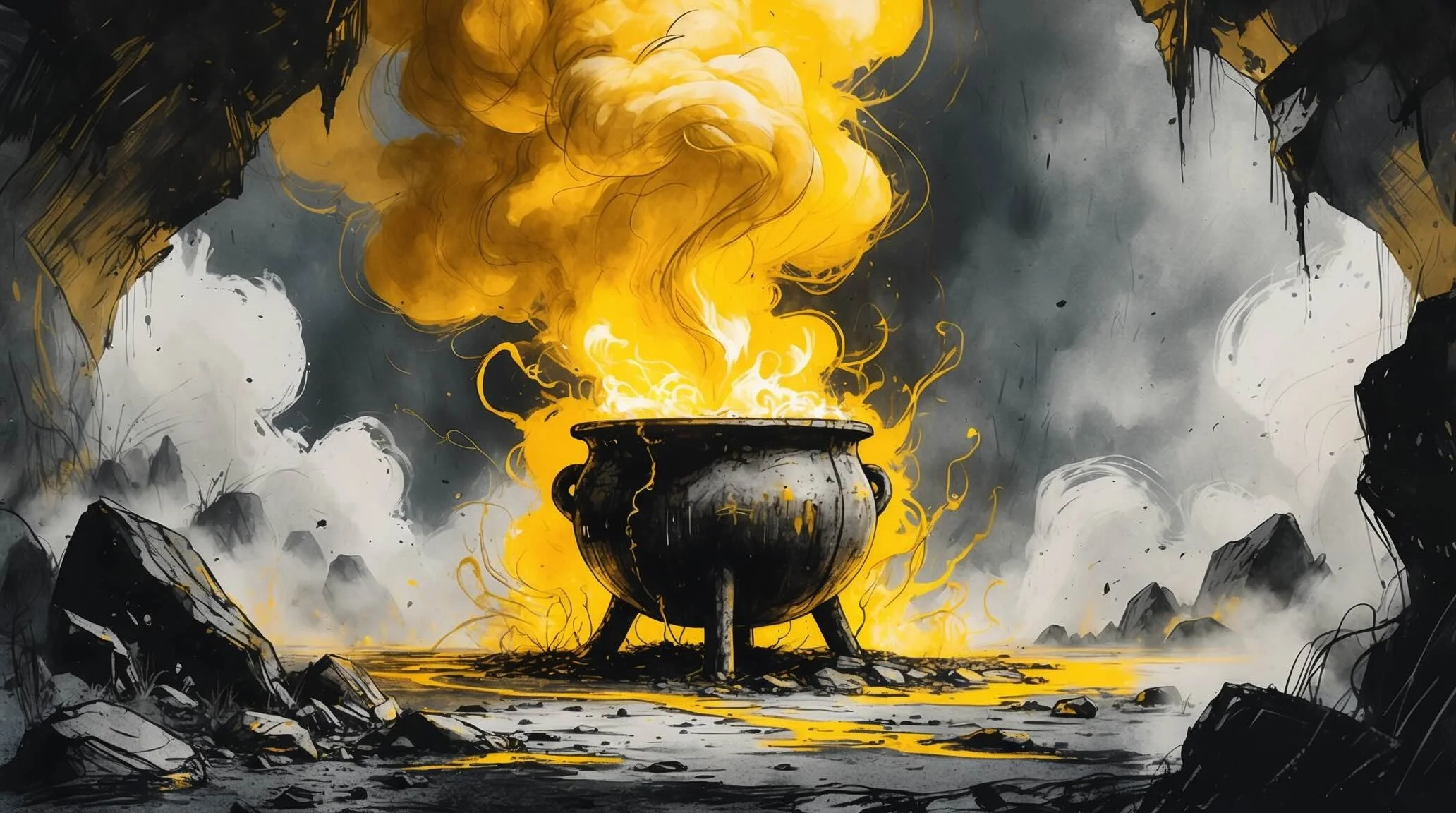
Double, double toil and trouble;
Fire burn, and cauldron bubble.
(Act 4, Scene 1)
Shakespeare Retold (Modern Verse)
Double, double toil and trouble;
Fire burn, and cauldron bubble.
Quote Analysis: The most famous incantation in English drama is built on the Witches' chanting metre and on the word "double" – a word that runs through the whole play. The Witches deal in doubles: fair and foul, the truth that is also a trap, the prophecy that means two things at once. Their spell is a piece of theatre designed to impress Macbeth before they show him the apparitions, and it works. The hypnotic rhythm and the grotesque ingredients announce a power he believes he can command. He has come to use the Witches, but the scene makes clear that they are the ones conducting it.
Thou hast it now: king, Cawdor, Glamis, all,
As the weird women promised, and, I fear,
Thou play'dst most foully for't...
(Act 3, Scene 1)
Shakespeare Retold (Modern Verse)
You've got it now: king, Cawdor, Glamis, all things
Those weird women promised, but, I fear
You cheated awfully for it...
Quote Analysis: Banquo opens Act 3 by adding up the Witches' arithmetic, and he gets the right answer. Every title they named has come to Macbeth, exactly as foretold – and Banquo suspects, correctly, that Macbeth "play'dst most foully for't." The lines do two things at once. They confirm that the prophecy was accurate, and they pin the guilt back on the man, not the magic. The Witches promised; Macbeth cheated. Banquo's quiet reckoning is also his death sentence, because he remembers the other half of the prophecy – that his own children, not Macbeth's, will be kings – and that memory is exactly what Macbeth cannot allow to survive.
Key Takeaways
- The Supernatural Opens the Play: The Witches speak first, before Macbeth appears. The supernatural is not an intrusion into the world of the play – it is the world the human action walks into.
- Cause or Mirror: The play never decides whether the Witches make Macbeth's future or only name a desire already in him. Banquo hears the same words and is not moved to murder.
- Ambiguity Is the Method: The dagger and Banquo's ghost can be read as real spirits or as guilty hallucinations. The play withholds the verdict, and the fusion of the two is the source of its terror.
- The Truth That Traps: The Witches never lie. They tell Macbeth truths shaped to be misheard, and let his own confidence turn warnings into promises that destroy him.
Study Questions and Analysis
Do the Witches cause Macbeth's actions, or only predict them?
This is the central question the supernatural plot poses, and the play is built to keep it open. The Witches greet Macbeth with three titles and a future, but they never tell him to kill anyone. They name the crown; the murder is his.
If you can look into the seeds of time,
And say which grain will grow and which will not,
Speak then to me...
(Act 1, Scene 3)
Shakespeare Retold (Modern Verse)
If you can see what happens in the future
And know which crops will grow, and which will not,
Then speak to me...
The cleanest evidence for the "mirror" reading is Banquo. He stands beside Macbeth on the heath and hears the identical prophecies – indeed it is Banquo, not Macbeth, who first dares the Witches to "look into the seeds of time." Banquo is told his descendants will be kings, a prophecy quite as tempting as Macbeth's own. Yet Banquo commits no crime. The supernatural input is the same for both men; the output is opposite. On this reading, the Witches do not implant ambition – they reveal one that is already there, and only Macbeth's pre-existing desire turns prophecy into murder.
Marjorie Garber, in her 2004 Shakespeare After All, reads the Witches as figures of equivocation whose power lies in ambiguity rather than command. They speak truths that the hearer completes. On this view, the Witches are catalysts, not causes: they supply the spark, but the combustible material is Macbeth's own.
The counter-tradition takes the supernatural more seriously as agency. G. Wilson Knight, in his 1930 The Wheel of Fire, described the play as saturated in an atmosphere of evil and darkness that seems to press in on the human characters from outside – a force in the world, not merely a projection of one man's mind. On this reading the Witches are genuine instruments of darkness, and Macbeth is partly their victim, drawn into a current of evil larger than himself.
The play refuses to choose. Macbeth is neither a free agent who happens to receive accurate information nor a puppet with no responsibility for his crimes. He is a man who hears a true prophecy and decides what to do about it – and the tragedy is that the deciding is genuinely his.
Is the floating dagger real, or a hallucination?
The dagger is the play's most carefully constructed piece of uncertainty, and it is uncertain because Macbeth himself cannot resolve it.
Is this a dagger which I see before me,
The handle toward my hand? Come, let me clutch thee.
I have thee not, and yet I see thee still.
(Act 2, Scene 1)
Shakespeare Retold (Modern Verse)
Is this a dagger that I see before me,
The handle pointing at my hand? I'll hold it.
It isn't really there, yet I can see it.
The text supports both readings deliberately. In favour of hallucination: Macbeth's hand passes through it, he calls it a "dagger of the mind, a false creation," and he traces it to a "heat-oppressed brain." This is a man diagnosing his own delusion even as he stares at it. In favour of the supernatural: the dagger points toward Duncan's chamber, as if leading him, and it appears at the precise moment the spirit world of the play has every reason to want the murder done. There is no stage direction telling an audience whether to see a prop or empty air, and productions choose differently.
The deeper point is that the play makes the distinction collapse. Whether an external spirit is steering Macbeth or his own guilty imagination is rehearsing the crime, the effect is identical – he follows the dagger to the deed. Marjorie Garber notes that Macbeth repeatedly stages this uncertainty between the seen and the imagined, the outer and the inner, until the audience can no longer tell which is which. The dagger belongs to the same family as Banquo's ghost: a vision that may be sent or may be summoned by conscience, and that the play deliberately refuses to label.
This ambiguity is not a weakness in the writing. It is the writing's purpose. A clearly real dagger would make Macbeth a victim of forces; a clearly imagined one would make the play a psychological study with no supernatural stakes. By holding both at once, Shakespeare keeps the question of agency – the play's true subject – permanently live.
What does Banquo's ghost represent?
Banquo's ghost works on the same principle as the dagger: it may be a real spirit, or it may be the visible form of Macbeth's guilt, and the play stages it so that both readings hold.
Thou canst not say I did it: never shake
Thy gory locks at me.
(Act 3, Scene 4)
Shakespeare Retold (Modern Verse)
You cannot say I did this. Do not shake
Your bloodied head at me.
The crucial stagecraft is that no one else at the banquet sees the ghost. Macbeth's guests watch their king rage at an empty stool, and Lady Macbeth covers for him by calling it a momentary fit he has suffered since childhood. If the ghost is a genuine apparition, it has chosen to appear to the murderer alone. If it is guilt, then guilt has become so powerful that it generates its own theatre, complete with a figure only the guilty man can see.
The detail that exposes Macbeth is his language. "Thou canst not say I did it" is a denial of a charge no one has made – the guests believe their king is simply unwell. Only Macbeth knows there is a murder to deny, and the ghost forces that hidden knowledge out of him in front of the whole court. Whatever the ghost is, its dramatic function is to make the concealed crime briefly visible. It is conscience with a face: the one enemy Macbeth cannot have murdered, because killing Banquo a second time is exactly what produces it.
G. Wilson Knight read the banquet scene as a moment where the play's pervasive evil breaks through the surface of the ordinary social world – the feast, the toast, the royal table – and contaminates it. The ghost is the point at which the darkness Macbeth has served comes to sit down with him in public. Whether one reads it as spirit or symptom, the scene marks the moment Macbeth's reign begins visibly to come apart, undone not by an army but by a dead man at dinner.
How do the apparitions in Act 4 use equivocation?
Equivocation – saying something true in a way designed to mislead – is the engine of the Act 4 prophecies, and arguably of the whole supernatural plot. The apparitions never lie to Macbeth. They tell him exactly what will happen, and trust his confidence to translate the truth into a falsehood.
Be bloody, bold, and resolute; laugh to scorn
The power of man, for none of woman born
Shall harm Macbeth.
(Act 4, Scene 1)
Shakespeare Retold (Modern Verse)
Be violent, bold and strong; laugh in the face
Of powerful men, for none born by a woman
Will harm Macbeth.
Macbeth hears "none of woman born" as a guarantee of immortality. The audience, and eventually Macbeth, learns that Macduff was "from his mother's womb untimely ripped" – delivered by what we would call Caesarean section – and so falls outside the phrase's literal meaning. The third apparition works the same way: Macbeth is safe until Birnam Wood comes to Dunsinane, an impossibility until Malcolm's soldiers cut branches to hide their numbers and the wood appears to move. Every word is true. Every word is built to be misheard.
Marjorie Garber, in her 2004 Shakespeare After All, places equivocation at the centre of the play, linking it to the contemporary scandal of the Gunpowder Plot trials, where the Jesuit doctrine of equivocation – telling a truth designed to deceive – was a live and frightening idea. The Witches' prophecies dramatise exactly this: a truth that damns precisely because it is true. The first apparition's plain warning, "beware Macduff," is the one Macbeth half-ignores, because it offers no comfort. The comfortable prophecies are the ones he believes, and they are the ones that kill him.
The deeper reading is that equivocation is the supernatural's whole method in Macbeth. From "Fair is foul, and foul is fair" onward, the play's spirit world speaks in truths that double back on the hearer. Macbeth is not destroyed by deception. He is destroyed by accurate information he was too eager to misread – which makes the responsibility, once again, partly his own.
Why does Shakespeare open the play with the Witches?
The decision to give the first scene to three supernatural figures, before the hero or the war or the court, is one of the most deliberate in Shakespeare. It establishes the supernatural as the frame within which the human story will happen.
Fair is foul, and foul is fair:
Hover through the fog and filthy air.
(Act 1, Scene 1)
Shakespeare Retold (Modern Verse)
What's fair is foul; what's foul is fair;
Let's fly through foggy, filthy air.
The opening does three things at once. It sets the metre – the Witches' chant runs on a shorter, hypnotic rhythm that marks them off from the human verse of the play. It sets the moral weather – "Fair is foul, and foul is fair" announces a world in which categories have collapsed and nothing can be trusted to be what it seems. And it sets the priority – by speaking first, the Witches claim the play before Macbeth enters it, so that his every choice is made inside a world they have already defined.
Stephen Greenblatt, in his 1993 essay 'Shakespeare Bewitched', situates the play's witchcraft within the acute Jacobean anxiety about the supernatural – an anxiety the new king, James I, had himself stoked with his 1597 treatise Daemonologie and his personal involvement in witch trials. For an audience in 1606, the Witches were not quaint folklore but a genuine and frightening category of being. Greenblatt's wider interest is in how the theatre handles the uncanny – how it summons forces it cannot quite control onto a public stage – and the opening scene is exactly such a summoning.
There is also a darker, more provocative reading. Terry Eagleton, in his 1986 William Shakespeare, argues that the Witches are the play's truth-tellers – marginal, anarchic figures who see through the social order that condemns them, and whose prophecies are simply accurate. On Eagleton's account the play is more frightened of the Witches than it has any right to be, because what they actually do is tell the truth. Opening with them, on this reading, is opening with the one perspective in the play that is never wrong.
How did James I's interest in witchcraft shape the play?
Macbeth was written around 1606, shortly after James VI of Scotland became James I of England, and the play is unusually attentive to the new king's known preoccupations. Two of those preoccupations were Scottish history and witchcraft, and the supernatural plot sits at the intersection of both.
James had a documented, personal obsession with witchcraft. He believed witches had raised storms to sink his ship returning from Denmark, presided over the North Berwick witch trials in the 1590s, and published Daemonologie in 1597, a treatise arguing for the reality of witches and the duty to hunt them. A play performed before this king that opened with three storm-raising witches was engaging directly with his stated beliefs and fears. The Witches are not decorative; they are topical.
Stephen Greenblatt, in his 1988 Shakespearean Negotiations, reads Jacobean drama as constantly negotiating with the anxieties and authority of the period, and witchcraft was one of the era's most charged subjects. The play takes a real and frightening contemporary category and puts it on stage, where it can be both indulged and contained. For an audience steeped in the king's Daemonologie, the Witches confirmed that the supernatural was a present danger – which made the question of Macbeth's responsibility all the sharper, since a real witch's prophecy was a real temptation, not a metaphor.
The play also flatters its patron in the supernatural scenes. In the Act 4 cauldron scene, the Witches show Macbeth a procession of kings descending from Banquo – and James I claimed descent from the historical Banquo. The "show of kings" thus runs the royal line forward to the man watching the play, with one of the apparitions carrying a "two-fold balls and treble sceptres" that gestured at James's own union of the English and Scottish crowns. The supernatural here does political work, anchoring the legitimacy of the reigning dynasty in prophecy.
A modern reader does not need to know any of this to feel the Witches' power, but the context explains why Shakespeare gave the supernatural such weight in this play specifically. He was writing for a king who took it deadly seriously.
Are the Witches evil, or do they simply tell the truth?
This is the most contested question the supernatural raises, because the Witches' actual behaviour supports two opposite readings at once. Everything they tell Macbeth turns out to be true. The damage is done by how he hears it.
How now, you secret, black, and midnight hags!
What is't you do?
(Act 4, Scene 1)
Shakespeare Retold (Modern Verse)
What's going on, you secretive old hags!
What have you done?
The conventional reading treats the Witches as straightforwardly evil – "secret, black, and midnight hags," instruments of darkness who exist to lure men to damnation. G. Wilson Knight's 1930 The Wheel of Fire supports this: the Witches belong to the play's atmosphere of pervasive evil, agents of a darkness that wants Macbeth's soul. On this view their truths are bait, "honest trifles" offered only to "betray's in deepest consequence," as Banquo warns. The accuracy of the prophecies is part of the trap, not evidence of innocence.
Terry Eagleton, in his 1986 William Shakespeare, makes the provocative counter-case. The Witches, he argues, are the only characters who tell the truth without flinching, and the play punishes them for it. They are marginal, anarchic women, exiles from the male political order of thanes and kings, and what they offer is not lies but a destabilising honesty that the social order cannot tolerate. On Eagleton's reading, the play is the establishment's nightmare about figures who stand outside it and see it clearly.
The text genuinely supports both. The Witches never tell Macbeth a falsehood – not one prophecy fails. But they also clearly delight in his destruction, gather around a cauldron of horrors, and conjure apparitions designed to mislead. They are truthful and malicious at once, and that combination is more frightening than either alone. A liar can be caught out; a malicious truth-teller cannot. The play's final position may be that the most dangerous supernatural force is not one that deceives, but one that tells you exactly what is coming and lets you destroy yourself believing you understand it.