Macbeth: Act 2, Scene 2 – Analysis
Scene Profile – At a Glance
- Location: The courtyard and inner rooms of Macbeth's castle, immediately after the murder.
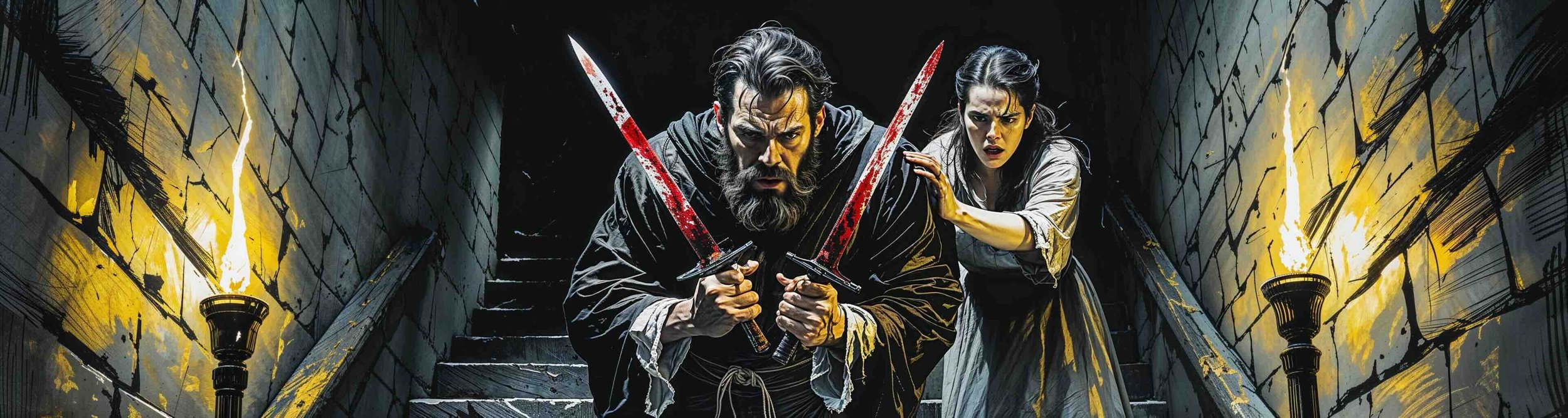
- What Happens: Lady Macbeth waits, having drugged the guards, while Macbeth kills Duncan. He returns shaken, carrying the bloody daggers and hearing voices. Lady Macbeth takes the daggers back herself, and a knocking at the gate leaves them scrambling to hide their guilt.
- Key Characters: Macbeth and Lady Macbeth.
- Dramatic Function: The murder itself, kept offstage. The scene shows the immediate psychological collapse of the murderers and the first signs of the guilt that will destroy them.
- Famous Quote:
"Methought I heard a voice cry 'Sleep no more!
Macbeth does murder sleep'..."
(Macbeth, Act 2, Scene 2) - Why It Matters: This is where the cost of ambition becomes real. The deed is done, and instantly the play turns from desire to dread, paranoia, and a guilt that no water can wash away.
Scene Summary
Lady Macbeth waits in the courtyard, made bold by the wine she has used to drug Duncan's guards. She is tense, startled by every sound, and admits she would have killed the king herself had he not looked like her own sleeping father. Macbeth enters, having done the deed, and the two speak in short, frightened half-lines.
Macbeth is in shock. He describes the guards waking, saying their prayers, and how he could not say "Amen" in reply. He says he heard a voice cry that he had murdered sleep itself. Lady Macbeth tries to calm him, telling him not to dwell on it, but he is fixed on his failure to be blessed and on the voice that condemned him.
She notices he has carried the daggers out of Duncan's room and orders him to take them back and smear the guards with blood. He refuses, too afraid to look on what he has done, so she takes the daggers herself, scorning his cowardice. While she is gone, a knocking begins at the gate. Macbeth, staring at his bloodstained hands, fears that all the oceans could not wash them clean. Lady Macbeth returns, her own hands now red, and hurries him to their chamber to wash and put on their nightgowns, so they will not be caught awake.
The Murder Offstage
Shakespeare makes the bold choice never to show the killing. Instead we watch Lady Macbeth wait, every nerve stretched, listening to the sounds of the house. Her opening words reveal both her steel and the crack beneath it: the drink that has emboldened her, and the one human flaw that stopped her doing the deed herself.
Original
Had he not resembled
My father as he slept, I had done't.
(Lady Macbeth, Act 2, Scene 2)
Shakespeare Retold (Modern Verse)
If Duncan hadn't looked
Just like my father, sleeping, I'd have killed him.
This is the first hint that Lady Macbeth is not the unfeeling figure she pretends to be. For all her earlier talk of dashing out a baby's brains, the sight of a sleeping man who looked like her father stayed her hand. By keeping the murder offstage, Shakespeare forces our attention onto the murderers' minds rather than the act, and this small confession plants the seed of the breakdown that will eventually undo her.
"Macbeth Does Murder Sleep"
When Macbeth returns, he is not triumphant but unstrung. The centre of the scene is his account of a voice he heard crying out as he left the chamber, a voice that named his crime not as the killing of a king but as the killing of sleep itself.
Original
Methought I heard a voice cry 'Sleep no more!
Macbeth does murder sleep', the innocent sleep,
Sleep that knits up the ravelled sleeve of care,
The death of each day's life, sore labour's bath,
Balm of hurt minds, great nature's second course,
Chief nourisher in life's feast, –
(Macbeth, Act 2, Scene 2)
Shakespeare Retold (Modern Verse)
I thought I heard a cry: ‘Don’t go to sleep!
Macbeth will murder sleepers!’ Innocent folk–
Who’ve let their cares of life fade as they sleep,
As day turns into night – let sleep soothe pain
And heal their troubled minds. Sleep’s like a main course
That feeds us through our life…
This is one of the play's richest speeches, a hymn to the very thing Macbeth has destroyed. Sleep is imagined as a healer, knitting up the "ravelled sleeve of care", washing away the day's labour, soothing hurt minds. By murdering Duncan in his bed, Macbeth has murdered his own peace; the voice announces that "Macbeth shall sleep no more". The prophecy is exact. From this night on, neither Macbeth nor his wife will know natural rest, and the insomnia that follows is the inner punishment for the outer crime.
Blood That Will Not Wash
The scene's final movement turns on a single image: blood on the hands. Macbeth stares at his stained hands in horror, while Lady Macbeth insists the stain is trivial and easily cleaned. The gulf between them – his metaphysical terror, her brisk practicality – is the heart of the moment.
Original
Will all great Neptune's ocean wash this blood
Clean from my hand? No, this my hand will rather
The multitudinous seas incarnadine,
Making the green one red.
(Macbeth, Act 2, Scene 2)
Shakespeare Retold (Modern Verse)
Will all the oceans' water wash this blood
Clean from my hands? No way! Instead, my hands
Will turn the seas the scarlet tint of flesh,
And make the green seas red.
Macbeth's grand, world-staining image – that his hands would turn the green seas red rather than be washed clean – measures the size of his guilt. The blood is no longer a physical mark but a moral one, and no quantity of water can reach it. Lady Macbeth answers with the chilling, dismissive line that "a little water clears us of this deed", a confidence the play will brutally overturn. Her own descent into compulsive hand-washing later makes this scene tragically ironic: she will spend her last sane hours trying to scrub away a stain she here calls nothing.
Language and Technique
- Stichomythia: The clipped, alternating half-lines ("When?" / "Now." / "As I descended?") create a breathless, panicked rhythm that mirrors the couple's fear.
- Personification of sleep: Sleep is imagined as an innocent victim and a nurturing power, so that murdering it becomes murdering peace itself.
- Blood imagery: Blood shifts from a literal stain to a symbol of inescapable guilt, a motif that runs through the rest of the play.
- Hyperbole: "Great Neptune's ocean" and the "multitudinous seas" inflate the guilt to a cosmic scale that no water can cleanse.
- Dramatic irony: Lady Macbeth's "a little water clears us of this deed" looks forward to her later sleepwalking, when she cannot wash the imagined blood away.
Key Quotes from Act 2, Scene 2
Quote 1I have done the deed. Didst thou not hear a noise?
(Macbeth, Act 2, Scene 2)
Shakespeare Retold (Modern Verse)
I've murdered Duncan. Did you hear a noise?
But wherefore could not I pronounce 'Amen'?
I had most need of blessing, and 'Amen'
Stuck in my throat.
(Macbeth, Act 2, Scene 2)
Shakespeare Retold (Modern Verse)
But how come I could not declare, 'Amen'?
I needed blessing most, but then 'Amen'
Got stuck within my throat.
Infirm of purpose!
Give me the daggers: the sleeping and the dead
Are but as pictures: 'tis the eye of childhood
That fears a painted devil.
(Lady Macbeth, Act 2, Scene 2)
Shakespeare Retold (Modern Verse)
You weakling!
Give me those daggers. People dead or sleeping
Are merely pictures; only eyes of children
Will fear a painted devil.
My hands are of your colour; but I shame
To wear a heart so white.
(Lady Macbeth, Act 2, Scene 2)
Shakespeare Retold (Modern Verse)
My hands are red like yours, but I'd be shamefaced
To have your timid heart.
Key Takeaways
- The murder is kept offstage: Shakespeare focuses on the murderers' minds rather than the act, making guilt, not violence, the subject of the scene.
- Macbeth has murdered his own peace: The voice crying "sleep no more" predicts the insomnia that will torment both of them for the rest of the play.
- Blood becomes a symbol of guilt: Macbeth's stained hands turn from a physical fact into a moral stain that "all great Neptune's ocean" cannot wash clean.
- Lady Macbeth is in control – for now: She seizes the daggers and dismisses the guilt, but small cracks (her father, the "painted devil") foreshadow her collapse.
- The knocking begins the reckoning: The sound at the gate forces the couple to hide their crime and ends the scene in fear rather than triumph.
Study Questions and Analysis
Why does Shakespeare keep the murder of Duncan offstage?
Keeping the killing offstage is one of the play's most powerful decisions. The audience never sees the blow; instead it watches Lady Macbeth wait and listen, then hears Macbeth describe the aftermath in fragments. This shifts the focus from the physical act to its psychological cost, which is where the real drama of the scene lies.
It also makes Duncan's death more terrible by leaving it to the imagination. We are spared the sight of an old, sleeping king being stabbed, but we are given Macbeth's broken account of the guards waking and praying, and his obsession with the word "Amen". The horror is internalised. Shakespeare understood that a guilty mind reporting a crime can be more harrowing than the crime shown directly, and the choice keeps our sympathy fixed, uneasily, on the murderers themselves.
What does the "Sleep no more" speech mean?
Macbeth hears, or imagines, a voice crying out that he has murdered sleep, and the speech that follows is a meditation on what sleep gives to human beings: rest, healing, and an innocent forgetting of care. By killing Duncan in his bed, Macbeth has symbolically destroyed sleep itself, and the voice tells him he "shall sleep no more".
'Glamis hath murdered sleep, and therefore Cawdor
Shall sleep no more; Macbeth shall sleep no more.'
(Macbeth, Act 2, Scene 2)
Shakespeare Retold (Modern Verse)
The Thane of Glamis murders sleepers; Cawdor
Won’t sleep again; Macbeth won’t sleep again.
The repetition of his titles – Glamis, Cawdor, Macbeth – is a kind of sentence passed on his whole identity. The prophecy proves exact: Macbeth becomes a tortured insomniac, and Lady Macbeth ends the play sleepwalking, unable to rest. Sleep in the play stands for a clear conscience, and the murderers have forfeited both at once. The speech is the first announcement of the inner punishment that will outlast any external threat.
How are Macbeth and Lady Macbeth contrasted in this scene?
The scene is built on the gap between them. Macbeth is overwhelmed by guilt, hearing voices, fixating on his failure to say "Amen", and convinced that no ocean can wash his hands clean. Lady Macbeth is brisk and practical: she takes the daggers back herself, smears the guards with blood, and insists that "a little water clears us of this deed".
For now she is the stronger of the two, mastering her nerves where he has lost his. But the contrast is not as simple as it looks. She has already admitted she could not kill Duncan because he resembled her father, and her scorn for fear sounds like a woman holding herself together by force. L. C. Knights, in How Many Children Had Lady Macbeth? (1933), urged readers to attend to the poetry and its moral movement rather than treating the couple as case studies; read that way, the scene shows two people discovering, at different speeds, that the deed has changed them for ever. Her control here makes her later collapse all the more devastating.
What is the significance of the blood imagery?
Blood is the central image of the scene and one of the great motifs of the play. When Macbeth looks at his hands, the blood on them stops being a physical stain and becomes a sign of guilt that cannot be removed. His claim that all of "great Neptune's ocean" could not wash it clean – that his hands would sooner turn the seas red – measures a guilt that has grown beyond the human scale.
Against this, Lady Macbeth's flat assurance that "a little water clears us of this deed" sets up one of the play's bitterest ironies. She believes guilt can be washed off like dirt; he knows, even now, that it cannot. By the end of the play their positions will have reversed, with Lady Macbeth scrubbing at imaginary blood that "will not out". The blood that appears in this scene therefore reaches forward across the whole tragedy, a stain that spreads rather than fades.
Why is the knocking at the gate so dramatically effective?
The knocking that begins near the end of the scene is a masterstroke of stagecraft. It arrives just as the murderers are at their most exposed, hands bloody and nerves in pieces, and it forces them into sudden, panicked action. Every knock makes Macbeth flinch, deepening the sense of a guilt that hears accusation in every sound.
It also breaks the unbearable intimacy of the murder scene with an intrusion from the outside world, reminding us that the deed cannot stay private. Someone is at the gate, and morning, discovery, and consequence are coming. The knocking pulls the couple away to wash and disguise themselves, ending the scene not on triumph but on flight. The essayist Thomas De Quincey, in a famous piece of 1823, wrote on exactly this moment, arguing that the knocking marks the return of the ordinary human world after the suspension of it during the murder, and the effect on stage is precisely that jolt back into reality.