Macbeth: Act 2, Scene 3 – Analysis
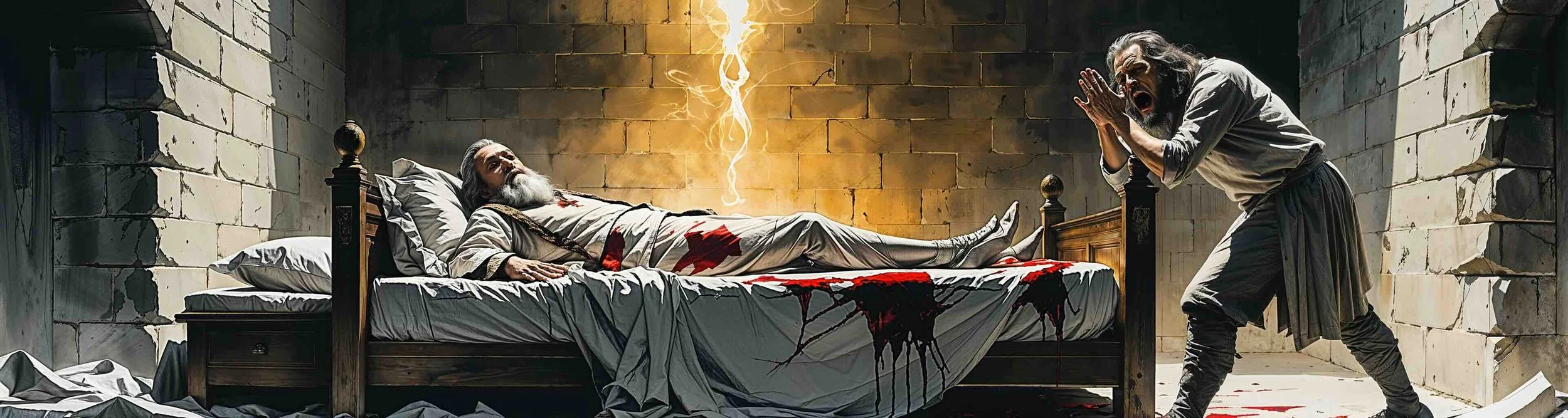
Scene Profile – At a Glance
- Location: The courtyard of Macbeth's castle, the morning after the murder.
- What Happens: A drunken Porter jokes his way to the gate to admit Macduff and Lennox. Macduff goes to wake the king and discovers Duncan murdered. Macbeth kills the guards, Lady Macbeth faints, and Duncan's sons Malcolm and Donalbain flee for their lives.
- Key Characters: The Porter, Macduff, Macbeth, Lady Macbeth, Banquo, Malcolm, Donalbain, Lennox, and Ross.
- Dramatic Function: The discovery scene. Comic relief gives way to chaos, the murder is exposed, and the kingdom begins to fracture as the heirs flee.
- Famous Quote:
"Confusion now hath made his masterpiece!"
(Macduff, Act 2, Scene 3) - Why It Matters: The crime is now public. The flight of the princes lets suspicion fall on them and clears Macbeth's path to the throne, while the scene's omens mark Scotland as a country thrown into disorder.
Scene Summary
As the knocking continues, a drunken Porter staggers to the gate, imagining himself the gatekeeper of hell admitting sinners. He lets in Macduff and Lennox, and jokes with Macduff about how drink both stirs and spoils desire. Macbeth appears, pretending to have just woken, and points Macduff towards Duncan's chamber. While they wait, Lennox describes a wild, ominous night of storms and strange screams.
Macduff returns in horror: the king has been murdered. He raises the alarm, ringing the bell and calling the household from their beds. Lady Macbeth, Banquo, and the king's sons Malcolm and Donalbain all appear. Macbeth and Lennox go to the chamber and return having seen the body and the bloodstained guards.
Macbeth announces that, in a rage of grief and love for the king, he has killed the two guards. Macduff questions why, and Macbeth defends himself with a vivid, theatrical speech. Lady Macbeth faints and is carried out. Malcolm and Donalbain, whispering aside, realise their own lives are in danger surrounded by "daggers in men's smiles". Banquo calls for the thanes to meet and investigate the murder. Alone, the two princes decide to flee – Malcolm to England, Donalbain to Ireland – trusting that separation will keep them safer.
The Porter and the Gate of Hell
After the tension of the murder, Shakespeare releases the pressure with comedy. The Porter, slow and hungover, pretends he is the keeper of hell-gate, ushering in a procession of imaginary sinners: a greedy farmer, an equivocator, a thieving tailor. His prose tumbles out in loose, lowercase wraps, marking it off from the surrounding verse.
Original
Faith, here's an equivocator, that could swear in both the scales against either scale; who committed treason enough for God's sake, yet could not equivocate to heaven: O, come in, equivocator.
(Porter, Act 2, Scene 3)
Shakespeare Retold (Modern Verse)
Ah, here’s a waffler, capable of waffling for both sides of a legal argument; who lied about his faith in front of God, but couldn’t lie or blag his way to heaven. Oh, come in, waffler!
The Porter's hell-gate fantasy is darker than it first appears. Without knowing it, he is exactly right: the castle has become a kind of hell, and a murderer does live behind the gate he is opening. The "equivocator" who could "swear in both the scales" glances at the religious controversies of Shakespeare's own day, but it also names the play's method – a world where fair is foul and nothing means what it says. The comedy gives the audience a breath, but its imagery keeps the horror in view.
The Discovery of the Body
The comic interlude collapses the instant Macduff returns from the king's chamber. His language breaks down into raw exclamation, unable at first even to name what he has seen. The shift from the Porter's loose prose to Macduff's broken cries is one of the most violent tonal turns in Shakespeare.
Original
Confusion now hath made his masterpiece!
Most sacrilegious murder hath broke ope
The Lord's anointed temple, and stole thence
The life o' the building!
(Macduff, Act 2, Scene 3)
Shakespeare Retold (Modern Verse)
This is the most confusing thing of all time!
An awful, profane murderer has broke open
The king’s own sanctuary, and taken from it
All life within the room!
Macduff frames the murder as a religious outrage. The king is "the Lord's anointed temple", his body a holy building broken open by "sacrilegious" violence. This is the Renaissance idea of the king as God's representative on earth, so that regicide is not merely a crime but a kind of blasphemy. Macduff's instinctive horror, and his honesty, mark him out from the start as the moral opposite of Macbeth, and it is fitting that the man who first names the murder as sacrilege will eventually be the one to avenge it.
Macbeth's Performance and the Princes' Flight
In the chaos, Macbeth must act the part of the loyal, grief-stricken host. He confesses he has killed the guards, and when challenged, defends himself with a speech so ornate it arouses suspicion. Meanwhile Malcolm and Donalbain quickly grasp that the safest course is to run.
Original
There's daggers in men's smiles: the near in blood,
The nearer bloody.
(Donalbain, Act 2, Scene 3)
Shakespeare Retold (Modern Verse)
The smiling men have daggers. Nearer the dead king,
The nearer we are to death.
Donalbain's image of "daggers in men's smiles" distils the play's obsession with the gap between appearance and reality. The princes understand that in a court where their father has just been murdered, friendly faces may hide killers, and that as the closest in blood to Duncan they are the most likely next targets. Their flight is sensible, but it has a fatal cost: by running, they make themselves look guilty, allowing suspicion to fall on them and clearing the way for Macbeth to be named king.
Language and Technique
- Comic relief: The Porter's drunken prose gives the audience a release of tension before plunging them back into horror, and sharpens the contrast when the body is found.
- Prose versus verse: The Porter and his banter with Macduff are in low, colloquial prose; the noble characters speak in verse, a class and tonal marker Shakespeare uses throughout.
- Equivocation: The Porter's jokes about the "equivocator" echo the play's central theme of doubleness, where words and faces deceive.
- Pathetic fallacy: Lennox's account of the storm – chimneys blown down, screams in the air, the earth shaking – makes nature itself rebel against the unnatural crime.
- Religious imagery: Duncan as "the Lord's anointed temple" presents the murder as sacrilege, framing kingship as sacred and its violation as damnation.
Key Quotes from Act 2, Scene 3
Quote 1The night has been unruly: where we lay,
Our chimneys were blown down; and, as they say,
Lamentings heard i' the air; strange screams of death,
And prophesying with accents terrible
Of dire combustion and confused events
New hatched to the woeful time...
(Lennox, Act 2, Scene 3)
Shakespeare Retold (Modern Verse)
It was a wild night: where we were sleeping
Our chimneys were blown down; and, people said
They heard sad crying in the air, like death screams,
And terrifying voices prophesying
Of deadly fires and strange occurrences
That makes our future awful...
Had I but died an hour before this chance,
I had lived a blessed time; for, from this instant,
There's nothing serious in mortality:
All is but toys: renown and grace is dead...
(Macbeth, Act 2, Scene 3)
Shakespeare Retold (Modern Verse)
If I had died an hour before this happened
I would have lived a charmed life; but from now on,
There’s nothing worthwhile living anymore.
Life is a joke; our gracious king is dead...
Here lay Duncan,
His silver skin laced with his golden blood;
And his gashed stabs looked like a breach in nature
For ruin's wasteful entrance...
(Macbeth, Act 2, Scene 3)
Shakespeare Retold (Modern Verse)
Here was Duncan,
His pallid skin daubed with his regal blood;
And stab-wound gashes seemed almost unnatural
By how they entered wastefully...
This murderous shaft that's shot
Hath not yet lighted, and our safest way
Is to avoid the aim.
(Malcolm, Act 2, Scene 3)
Shakespeare Retold (Modern Verse)
Their murderous plan
Is not yet fully formed, and we are safest
To not be here when it is.
Key Takeaways
- Comic relief sharpens the horror: The Porter's drunken hell-gate routine eases the tension and then makes the discovery of the body hit harder.
- The Porter's jokes echo the play: His talk of equivocation and hell unknowingly describes the murderous, deceitful house he is letting visitors into.
- Nature recoils from the crime: The storm, the screams, and the shaking earth present the murder as a violation of cosmic order.
- Macbeth's grief is a performance: His killing of the guards and his over-decorated description of the body begin to arouse suspicion.
- The princes' flight backfires: Malcolm and Donalbain run for safety, but it casts suspicion onto them and opens the throne to Macbeth.
Study Questions and Analysis
What is the purpose of the Porter scene?
The Porter scene is the most famous example of comic relief in Shakespeare. Coming straight after the murder, it lets the audience breathe and laugh before the discovery of the body plunges them back into horror. The drunken Porter, shuffling to the gate and grumbling about the knocking, is funny precisely because he is so ordinary in a house that has just become monstrous.
But the comedy is not merely a break; it is woven into the play's meaning. The Porter imagines himself as the keeper of hell-gate, admitting sinners one by one, and without knowing it he is right: the castle behind him really has become a hell, with a murderer inside. His jokes about the "equivocator" who could not lie his way to heaven tie directly to the play's concern with deception and damnation. Samuel Taylor Coleridge (1818), uneasy with the bawdy humour, doubted the scene was wholly Shakespeare's, but most modern readers see it as a brilliant stroke, using laughter to deepen the dread rather than relieve it.
Why does Macbeth kill the guards?
Macbeth kills the two guards almost as soon as the murder is discovered, and the move is a desperate piece of damage control. The guards are the only people who could be questioned about the night, and they might protest their innocence or reveal that they were drugged. By killing them, Macbeth silences the witnesses and removes any chance of his story unravelling.
He dresses the act up as an overflow of loyal rage, claiming his "violent love" for Duncan outran his reason. But Macduff's blunt question – "Wherefore did you so?" – shows the explanation does not entirely convince. The killing of the guards is the first crime Macbeth commits to cover the first, and it sets the pattern for the rest of the play: each murder breeds the next, and his attempts to secure himself only deepen the suspicion and bloodshed around him.
How does the scene present the murder as a crime against nature?
Shakespeare repeatedly frames Duncan's murder not just as a personal crime but as a rupture in the natural and divine order. Lennox describes a night of impossible violence – chimneys blown down, screams and prophesying voices in the air, the earth itself feverish and shaking – as though nature is convulsing in protest.
Most sacrilegious murder hath broke ope
The Lord's anointed temple, and stole thence
The life o' the building!
(Macduff, Act 2, Scene 3)
Shakespeare Retold (Modern Verse)
An awful, profane murderer has broke open
The king’s own sanctuary, and taken from it
All life within the room!
Macduff's image of the king as "the Lord's anointed temple" rests on the doctrine of the divine right of kings, the belief that a monarch is appointed by God. To kill him is therefore sacrilege, a sin against heaven as much as against the man. The omens and the religious language together build a picture of a whole created order thrown into disorder by one act of ambition, a disorder that will spread through Scotland until the rightful king is restored.
Why do Malcolm and Donalbain flee, and what are the consequences?
As the closest blood-relatives of the murdered king, Malcolm and Donalbain reason that they are the most likely next victims. In a castle where their father has just been killed, they cannot trust anyone; as Donalbain puts it, there are "daggers in men's smiles". They decide to separate – Malcolm to England, Donalbain to Ireland – calculating that being apart will make them harder to destroy.
Their instinct for survival is sound, but the consequences are grave. Their sudden flight makes them look guilty of arranging their father's death, exactly the suspicion Macbeth needs. With the heirs gone and apparently implicated, the crown passes to Macbeth almost by default. The princes' departure also fractures Scotland, sending its rightful future king into exile and leaving the country under a usurper. Their escape keeps the line of true kingship alive for the play's eventual resolution, but in the short term it hands Macbeth precisely what he wanted.
How does Lady Macbeth behave when the murder is discovered?
Lady Macbeth's conduct in this scene is ambiguous and much debated. When the alarm is raised she appears and asks, with apparent innocence, what could cause such a "hideous trumpet" to wake the house. When Macbeth describes killing the guards, she faints and has to be carried out.
The faint can be read two ways. It may be a calculated performance, a clever distraction to draw attention away from Macbeth's suspiciously elaborate speech just as it risks giving him away. Or it may be genuine, the first sign that her steel is beginning to fail her now that the deed is real and bloody rather than merely planned. The play deliberately leaves the question open. Either way, it is a turning point: the woman who scorned her husband's weakness in the previous scene either fakes a collapse to save him, or actually collapses, and both readings point towards the breakdown that will eventually destroy her.