
Macbeth Themes: Fate
Fate – At a Glance
Central Conflict: The tension between Predestination (the Witches' prophecies) and Free Will (Macbeth’s choices).
The Core Question: Does Macbeth fulfill the prophecy because it is fated, or because he acts to make it happen?
Impact on Macbeth: Reliance on fate makes Macbeth passive initially ("chance may crown me"), then arrogant ("I bear a charmed life"), and finally nihilistic.
Key Dynamic: The Witches acting as the "Weird Sisters" (from the Old English wyrd, meaning fate).
The Outcome: Macbeth challenges fate ("come fate into the list") but ironically fulfills every part of the prophecy through his own resistance.
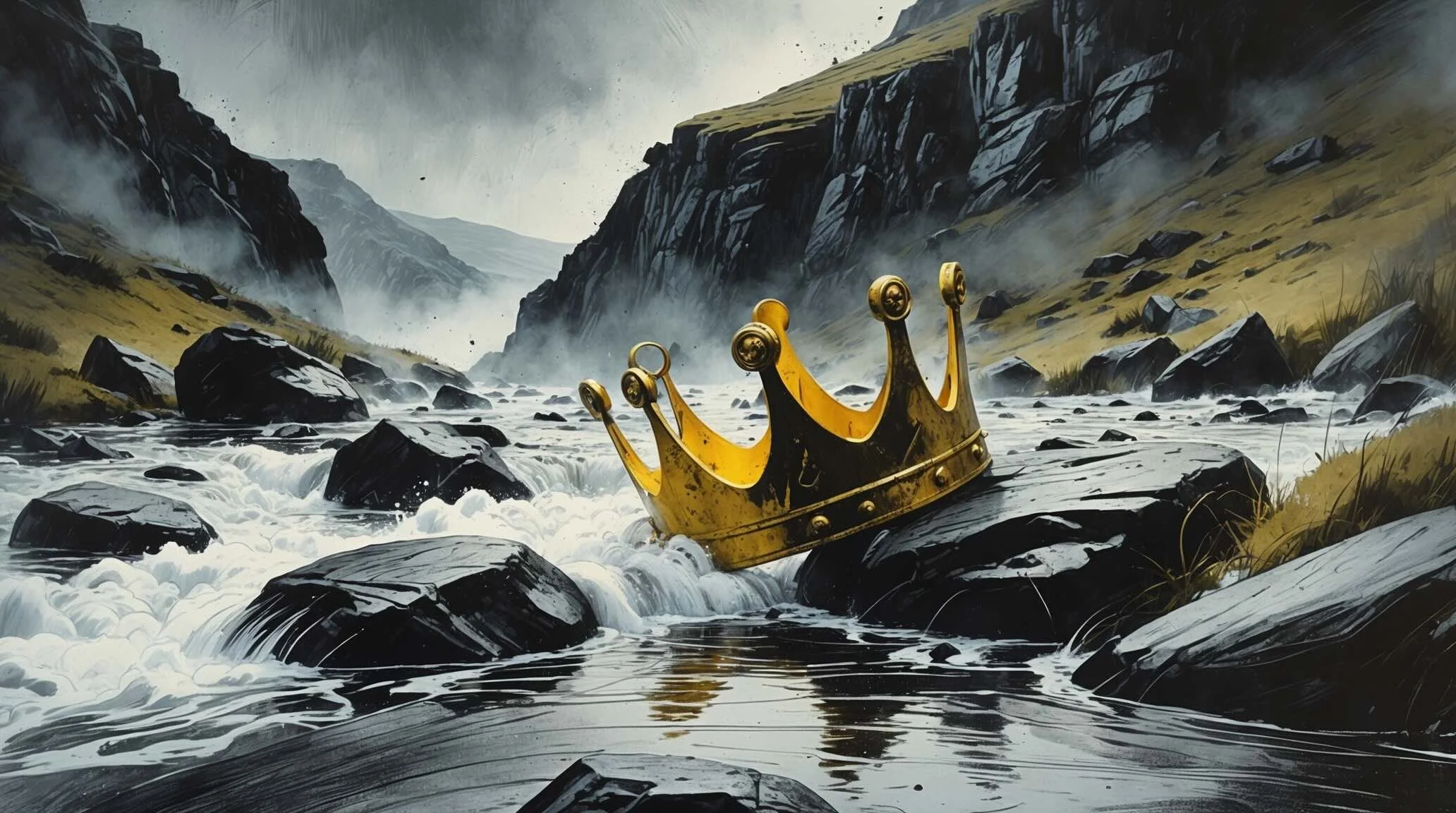
The Evolution of Fate
The tragedy of Macbeth hinges on a paradox: The Witches know the future, but Macbeth creates it.
1. The Temptation (Passive Acceptance)
When the Witches first hail Macbeth as "King hereafter," he is terrified but intrigued. Crucially, the Witches never tell him to kill Duncan. They simply state a destination, not the journey. Initially, Macbeth decides to leave it to fate:
Original:
If chance will have me king, why, chance may crown me,
Without my stir. (Macbeth – Act 1, Scene 3)
Shakespeare Retold (Modern Verse):
If fate will make me king, then fate might crown me
Without my intervention.
Here, Macbeth aligns himself with the idea of Destiny. If it is meant to be, it will happen without his intervention. However, his "vaulting ambition" (fuelled by Lady Macbeth) quickly overrides this passivity, leading him to force the hand of fate through murder.
2. The Challenge (fighting Fate)
Once King, Macbeth becomes obsessed with the parts of the prophecy that don't benefit him—specifically, that Banquo’s children will be kings. He attempts to "cancel and tear to pieces" the great bond of destiny by murdering Banquo and Fleance.
Original:
Rather than so, come fate into the list,
And champion me to the utterance! (Macbeth – Act 3, Scene 1)
Shakespeare Retold (Modern Verse):
Instead of that, come on then fate, let’s fight:
You’re champion, but I’ll fight till death!
This is the turning point. Macbeth declares war on Fate itself. He believes he can enjoy the privileges of the prophecy (Kingship) while rejecting the consequences (Banquo's line). His failure to kill Fleance suggests that while Macbeth can manipulate the present, he cannot alter the decreed future.
3. The Reliance (False Security)
In the final acts, Macbeth becomes a slave to the prophecies. He misinterprets the Apparitions (the "bloody child" and the "armed head") as guarantees of invincibility.
He believes he leads a "charmed life," unaware that the Witches are equivocating—telling half-truths to lead him to destruction. His reliance on fate makes him reckless, resulting in a tyrant who is unprepared for the "moving grove" and the man "not of woman born."
“Macbeth himself appears driven along by the violence of his fate like a vessel drifting before a storm: he reels to and fro like a drunken man.”
Key Quotes on Fate
Quote 1: The Initial Reaction
Original:
If chance will have me king, why, chance may crown me,
Without my stir. (Macbeth – Act 1, Scene 3)Shakespeare Retold (Modern Verse):
If fate will make me king, then fate might crown me
Without my intervention.Analysis: Macbeth’s only moment of true innocence regarding the prophecy. He personifies "Chance" as a force that can act independently of him. If he had stayed true to this thought, the tragedy might have been avoided.
Quote 2: The Challenge
Original:
Rather than so, come fate into the list,
And champion me to the utterance! (Macbeth – Act 3, Scene 1)Shakespeare Retold (Modern Verse):
Instead of that, come on then fate, let’s fight:
You’re champion, but I’ll fight till death!Analysis: "The list" refers to a jousting arena. Macbeth is challenging Fate to a duel to the death ("utterance"). It highlights his arrogance (hubris); he believes a mortal man can defeat the metaphysical laws of the universe.
Quote 3: The Juggling Fiends
Original:
And be these juggling fiends no more believed,
That palter with us in a double sense. (Macbeth – Act 5, Scene 8)Shakespeare Retold (Modern Verse):
And I do not believe those witches now
As they prevaricate with double meanings.Analysis: Macbeth’s final realisation. He understands too late that the Witches ("juggling fiends") have tricked him with words that have double meanings ("palter in a double sense"). Fate wasn't lying, but it was deceptive.
Key Takeaways – Fate
The Weird Sisters: The word "Weird" comes from the Anglo-Saxon Wyrd, meaning Fate. They are the architects of the prophecy, but not necessarily the architects of the actions.
Self-Fulfilling Prophecy: Macbeth brings about his own downfall by trying to fulfil (or avoid) the prophecies.
Equivocation: Fate in Macbeth speaks in riddles. It is never straightforward, warning the audience that reliance on supernatural guarantees is dangerous.
Nature vs Unnatural: Fate (in the sense of the "natural order") ultimately corrects itself. Macbeth’s "unnatural" reign is inevitably toppled by the forces of order (Malcolm/Macduff).
Study Questions and Analysis
-
No, the Witches are catalysts, not controllers. They provide the information (the prophecy), but they do not command Macbeth to kill. Macbeth possesses free will and chooses to act on their words. As Banquo notes, one can listen to the Witches without losing one's soul; Macbeth chooses not to.
-
A self-fulfilling prophecy is a prediction that causes itself to become true due to the positive feedback between belief and behaviour. If the Witches had never told Macbeth he would be King, he likely would never have murdered Duncan. His belief in the fate is what caused the fate to occur.
-
Yes, but it is eroded by his choices. In Act 1, he deliberates and makes a conscious choice to kill Duncan. By Act 3, he feels "stepped in blood so far" that returning is impossible. By Act 5, he feels trapped by the prophecy. Shakespeare suggests we have free will to start a path, but once started, the destination may be inevitable.
-
Banquo is skeptical. He asks the Witches to speak to him but remains passive ("neither beg nor fear your favours"). He warns Macbeth that "instruments of darkness" often tell truths to betray us. Banquo represents the Christian response to fate: trusting in God's providence rather than dark magic.
-
This is the classic equivocation of fate. Macbeth interprets it literally (trees cannot walk), leading to false security. However, fate operates metaphorically—Malcolm's army uses branches as camouflage. It teaches that fate is often literal in wording but metaphorical in meaning.
-
Macbeth is greedy. He wants the "honour" of being King (promised by the Witches) but rejects the "discomfort" of Banquo’s sons succeeding him (also promised). He tries to edit the prophecy to suit his ego, proving his hubris.