Othello: Act 3, Scene 2 – Analysis
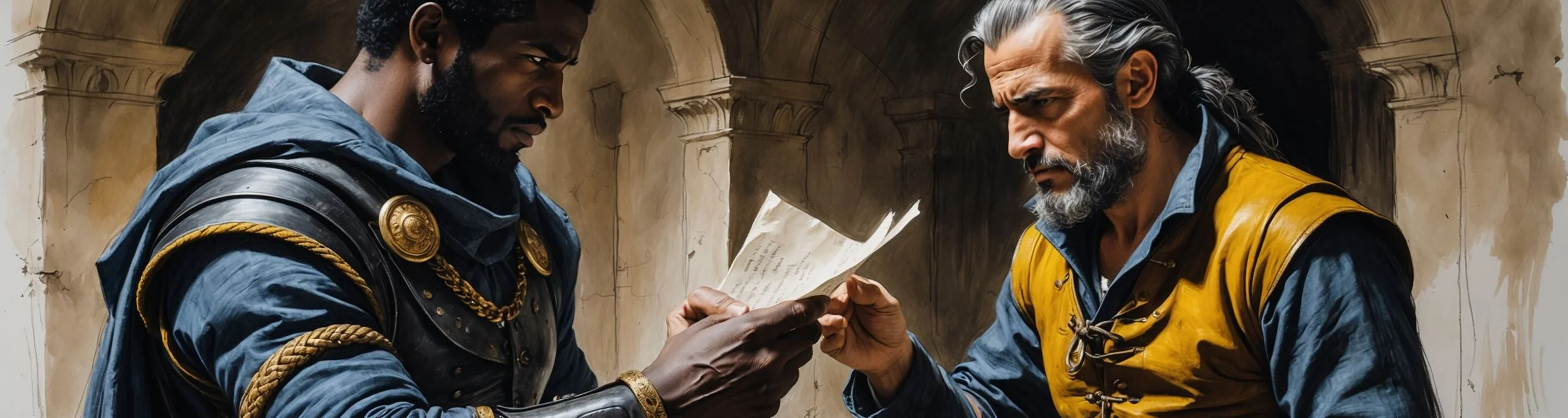
Scene Profile – At a Glance
- Location: A room in the castle on Cyprus.
- What Happens: Othello hands Iago letters to deliver to the Senate, then sets off to inspect the island's fortifications, taking Iago and some gentlemen with him.
- Key Characters: Othello and Iago.
- Dramatic Function: A brief, businesslike bridge – it shows Othello as a diligent commander and clears him off stage so the Cassio–Desdemona meeting can happen exactly as Iago intends.
- Famous Quote:
"These letters give, Iago, to the pilot..."
(Othello, Act 3, Scene 2) - Why It Matters: Othello's easy, trusting reliance on "honest Iago" is quietly ominous, because the errand he is so calmly delegating is part of the trap closing around him.
Scene Summary
In a room in the castle, Othello gives Iago a packet of letters to pass to the ship's pilot, who is to carry his greetings to the Senate in Venice. Othello says he will be walking on the fortifications and tells Iago to come and find him there. Iago promises to see it done, and Othello invites the gentlemen with him to go and inspect the castle's defences. One of them answers that they will wait on his lordship, and they all leave together.
A Trusting Commander Walks Into the Trap
This is one of the shortest scenes in the play, and almost nothing happens in it: a general gives an order and goes to do his job. Yet its placement is everything. Othello is shown here at his most admirable – conscientious, calm, attending to letters and fortifications – and at his most exposed. He delegates without a second thought to the one man he should never trust, and the plainness of his instructions makes the moment quietly chilling.
Original
These letters give, Iago, to the pilot;
And by him do my duties to the senate:
(Othello, Act 3, Scene 2)
Shakespeare Retold (Modern Verse)
Give my ship’s captain these letters, Iago;
And have him send my greetings to the senate.
There is no suspicion in Othello's voice, only the easy authority of a man handing routine business to a reliable subordinate. The dramatic irony is the whole point: the audience knows what Othello does not, that the trusted ensign is even now steering him towards ruin. By stepping away to inspect the "works", Othello also clears the stage, removing himself so that the meeting between Cassio and Desdemona in the next scene can unfold precisely as Iago has planned. The scene's stillness is deceptive; it is the quiet before the machinery of the tragedy starts to turn.
Language and Technique
- Dramatic irony: Othello calmly trusts Iago with his correspondence, while the audience knows Iago is plotting his downfall – every ordinary word carries a second, darker meaning.
- Plain, businesslike verse: The lines are flat and practical – letters, duties, the senate – making Othello sound like a competent administrator rather than a tragic hero, which is exactly why the trust beneath them is so unsettling.
- Stagecraft: The scene exists largely to move Othello off stage; his exit to the "works" is a piece of plotting machinery that frees the space for the scene to come.
Key Quotes from Act 3, Scene 2
Quote 1That done, I will be walking on the works;
Repair there to me.
(Othello, Act 3, Scene 2)
Shakespeare Retold (Modern Verse)
When done, I will be walking on the ramparts;
Come find me there.
Well, my good lord, I'll do't.
(Iago, Act 3, Scene 2)
Shakespeare Retold (Modern Verse)
I will do that, my lord.
Key Takeaways
- A bridging scene: Very little happens – Othello sends letters and goes to inspect the fortifications – but the scene clears him off stage for what follows.
- Othello the good commander: He is shown as diligent and conscientious, attending calmly to correspondence and the island's defences.
- Trust as a weakness: Othello delegates without hesitation to the one man he should never rely on, deepening the play's dramatic irony.
- Setting the trap: By stepping away, Othello makes room for the Cassio and Desdemona meeting that Iago has engineered in the next scene.
Study Questions and Analysis
What is the dramatic and structural function of Act 3, Scene 2?
The scene is a short connective passage whose main job is logistical: it moves Othello off stage. He gives Iago letters for the Senate and announces that he is going to walk on the fortifications, taking the gentlemen with him. In about a dozen lines, the scene clears the central character out of the way so that the long, devastating temptation scene that follows can take place exactly as Iago has arranged.
That done, I will be walking on the works;
Repair there to me.
(Othello, Act 3, Scene 2)
Shakespeare Retold (Modern Verse)
When done, I will be walking on the ramparts;
Come find me there.
Shakespeare often uses brief scenes like this to manage time and movement and to vary the rhythm of the action. Coming between Desdemona's promise to plead for Cassio and the scene in which Iago begins to poison Othello's mind, this quiet interlude lets the audience breathe before the tension tightens. Structurally it is a hinge: small in itself, but essential to getting the right characters in the right places for the catastrophe to begin.
What does this scene show about Othello and his trust in Iago?
It shows Othello at his most capable and his most vulnerable at once. He is a model commander here – handling official correspondence, sending his duties to the Senate, going to inspect the defences of the island he has been posted to guard. There is no anxiety in him, none of the turmoil that will consume him an act later; he is simply doing his job well.
These letters give, Iago, to the pilot;
And by him do my duties to the senate:
(Othello, Act 3, Scene 2)
Shakespeare Retold (Modern Verse)
Give my ship’s captain these letters, Iago;
And have him send my greetings to the senate.
The unsettling thing is how completely he relies on Iago. He hands over his letters and his movements without a flicker of doubt, treating his ensign as the most dependable man around him. A. C. Bradley, in Shakespearean Tragedy (1904), stressed that Othello is not naturally suspicious but a man of open, trusting nature, which is exactly why Iago can ruin him; this small scene quietly demonstrates that trust in action. The theme of appearance versus reality is at work in miniature: the "honest Iago" Othello sees and the schemer the audience knows are the same man, and the distance between them is the tragedy.
Why does Shakespeare include such a short scene at all?
Short scenes earn their place by what they make possible elsewhere. This one performs several jobs economically. It reminds the audience that Othello has real duties on Cyprus, grounding the tragedy in a world of letters, ships and fortifications. It demonstrates his trust in Iago without a word of comment. And, most practically, it removes him from the stage so that the next scene can begin.
There is also a question of pace and contrast. By placing a calm, ordinary moment of administration directly before the scene in which Iago starts to destroy Othello's peace of mind, Shakespeare sharpens the horror of what follows. Marjorie Garber, in Shakespeare After All (2004), notes how Shakespeare's dramaturgy uses such modulations of tempo to control an audience's experience, letting tension gather in the gaps. The brevity is the point: the scene is the quiet, unsuspecting normality that the rest of the act will shatter, and the manipulation and deceit already in motion needs exactly this kind of innocent stillness to work against.