Romeo and Juliet: Act 4, Scene 2 – Analysis
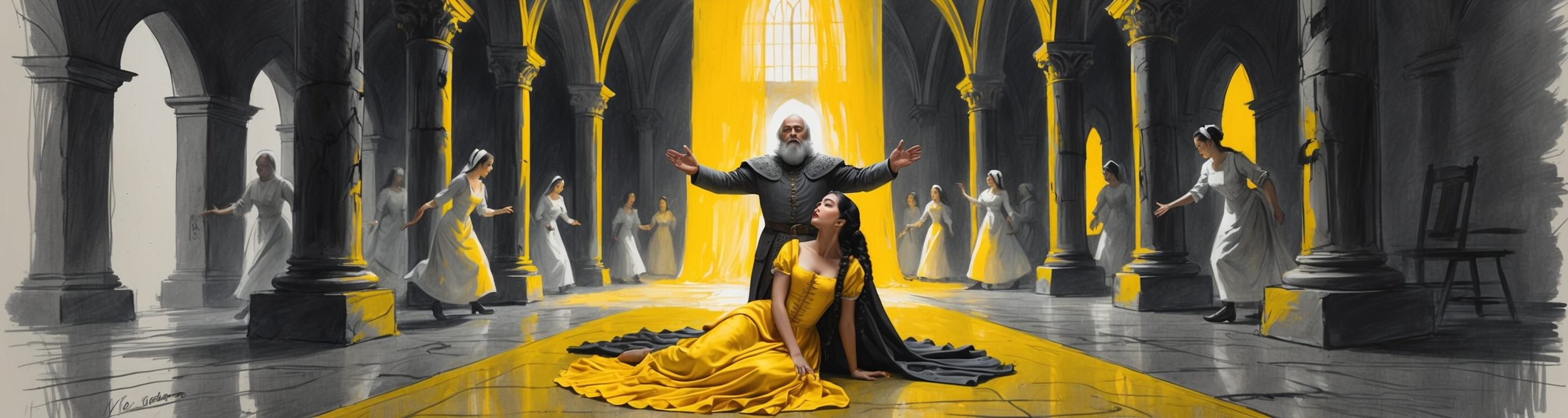
Scene Profile – At a Glance
- Location: A hall in the Capulet house, amid the wedding preparations.
- What Happens: Juliet returns from the Friar's cell, kneels to her father and apologises, pretending she now gladly agrees to marry Paris. Delighted, Capulet brings the wedding forward a day, to Wednesday.
- Key Characters: Juliet, Lord Capulet, the Nurse, Lady Capulet.
- Dramatic Function: Juliet's feigned obedience wins her father's trust and the freedom to act – but his delight backfires, moving the wedding forward and squeezing the Friar's plan.
- Famous Quote:
"Henceforward I am ever ruled by you."
(Juliet, Act 4, Scene 2) - Why It Matters: Juliet learns to lie convincingly, and her success rebounds on her: the wedding she dreads now comes a day sooner, tightening the trap around the Friar's scheme.
Scene Summary
The Capulet house is busy with preparations for the wedding. Lord Capulet sends servants out with invitations and to hire cooks, fretting that there is barely time to be ready. He asks whether Juliet has gone to Friar Laurence, and the Nurse confirms she has – then announces that she is returning, looking cheerful.
Juliet enters transformed. She kneels before her father, apologises for her earlier defiance, and declares that she now joyfully agrees to marry Paris and will obey him in everything. Overjoyed, Capulet is so pleased that he moves the wedding forward a day, from Thursday to Wednesday. Lady Capulet worries there will not be enough time, but Capulet, delighted that his "wayward girl" is "reclaimed", insists all will be well and bustles off to tell Paris himself.
Juliet's Feigned Obedience
Juliet returns from the Friar's cell wearing a mask. Only one scene earlier she stood up to her father; now she kneels, calls her resistance a sin, and surrenders herself to his will. The performance is flawless – and entirely calculated.
Original
And beg your pardon: pardon, I beseech you!
Henceforward I am ever ruled by you.
(Juliet, Act 4, Scene 2)
Shakespeare Retold (Modern Verse)
And beg for your forgiveness: please forgive me!
From now on, I will do just what you say.
This is a Juliet we have not seen before. The girl who, in A3S5, told her father plainly that she would not marry Paris has learned a darker skill: she can now say the opposite of what she means and be believed. Her words are pious and submissive – she has been to "shrift", she will "fall prostrate", she is "ever ruled" by him – and every one of them is a lie in service of the Friar's plan to take the sleeping draught and escape the match. Crucially, she has been "enjoined / By holy Laurence" to do exactly this, so the performance is part of the scheme. The dutiful daughter and the rebel have collapsed into a single, frighteningly capable young woman who will say whatever the moment requires.
Capulet's Joy and the Quickened Clock
Capulet swallows the performance whole. So delighted is he by his daughter's return to obedience that he does the worst possible thing: he brings the wedding forward by a day.
Original
Send for the county; go tell him of this:
I'll have this knot knit up to-morrow morning.
(Capulet, Act 4, Scene 2)
Shakespeare Retold (Modern Verse)
Go fetch Count Paris and tell him of this:
We’ll hold the wedding now tomorrow morning.
It is one of the cruellest ironies in the play. Juliet's lie was meant to buy her time and freedom; instead it costs her the very thing she most needs. By performing obedience so well, she makes her father so happy that he cannot wait – the wedding leaps from Thursday to Wednesday, and the careful timing of the Friar's plan, built around her taking the potion the night before the original date, is thrown out by a full day. Lady Capulet's mild protest that "there is time enough" is brushed aside. The scene ends with Capulet light-hearted and busy – "my heart is wondrous light" – while the audience watches the clock he has just sped up begin to run against the lovers.
Language and Technique
- Dramatic irony: Capulet hears obedience and rejoices; the audience knows Juliet's words are a performance and that his delight is about to wreck the Friar's plan.
- Religious language: Juliet speaks of "shrift", repentance and falling "prostrate", borrowing the vocabulary of confession to make her lie sound sincere.
- The kneeling gesture: Juliet physically lowers herself before her father, a visible act of submission that masks her real defiance.
- Light imagery: Capulet's "my heart is wondrous light" gives his joy a glow that the audience reads as the opposite – the brightness before the dark.
- Bustle and prose: The scene opens in busy, everyday prose with the servants and cooks, grounding the tragedy in ordinary domestic haste.
Key Quotes from Act 4, Scene 2
Quote 1Where I have learned me to repent the sin
Of disobedient opposition...
(Juliet, Act 4, Scene 2)
Shakespeare Retold (Modern Verse)
I’ve been where I have learned to be repentant
For all the disobedience I’ve shown...
Why, I am glad on't; this is well: stand up:
This is as't should be. Let me see the county;
(Capulet, Act 4, Scene 2)
Shakespeare Retold (Modern Verse)
Well, I am glad to hear of this; stand up:
This is as it should be. Let’s meet the Count;
Against to-morrow: my heart is wondrous light,
Since this same wayward girl is so reclaimed.
(Capulet, Act 4, Scene 2)
Shakespeare Retold (Modern Verse)
To be ready tomorrow: I’m so happy
My wayward girl is now back in the fold.
Key Takeaways
- Juliet performs obedience: She kneels and apologises to her father, pretending she now gladly agrees to marry Paris, exactly as the Friar instructed.
- A new, secretive Juliet: The girl who openly defied her father has learned to lie convincingly – a sign of how far she has grown and hardened.
- The wedding is moved forward: Capulet is so delighted that he brings the marriage forward a day, from Thursday to Wednesday.
- The trap tightens: Her successful lie backfires, squeezing the timing of the Friar's plan and increasing the pressure that will help wreck it.
Study Questions and Analysis
How has Juliet changed by the start of this scene?
The change is striking. Only one scene earlier, in A3S5, Juliet openly refused to marry Paris and was threatened with being thrown into the streets. Here she returns from the Friar's cell apparently transformed: she kneels to her father, calls her resistance a sin, and promises to obey him in everything.
And beg your pardon: pardon, I beseech you!
Henceforward I am ever ruled by you.
(Juliet, Act 4, Scene 2)
Shakespeare Retold (Modern Verse)
And beg for your forgiveness: please forgive me!
From now on, I will do just what you say.
The submission is entirely feigned. Coppélia Kahn, in Man's Estate: Masculine Identity in Shakespeare (1981), reads Juliet's development across the play as a movement towards an autonomy she can only exercise in secret, hemmed in by a patriarchal household that allows her no open choice. Seen this way, her performance here is not a retreat but a sign of growth: she has learned that the only way to act on her own will is to mask it as obedience. The earlier Juliet wore her heart on her sleeve on the balcony; this Juliet has discovered concealment, and she is alarmingly good at it.
Why does Capulet bring the wedding forward, and why does it matter?
Capulet moves the wedding forward purely out of joy. Juliet's apparent obedience delights him so much that he cannot wait, and he changes the date from Thursday to Wednesday on the spot.
Send for the county; go tell him of this:
I'll have this knot knit up to-morrow morning.
(Capulet, Act 4, Scene 2)
Shakespeare Retold (Modern Verse)
Go fetch Count Paris and tell him of this:
We’ll hold the wedding now tomorrow morning.
The consequence is disastrous. The Friar's plan depends on careful timing – Juliet is to take the sleeping potion the night before her wedding, be found "dead", and be laid in the tomb, where Romeo will meet her when she wakes. By advancing the date a full day, Capulet compresses that schedule and leaves no margin for error. This is a clear instance of the play's preoccupation with time and haste: again and again, characters act too fast, and here a father's impatience to be happy speeds the whole machine towards catastrophe. The bitter irony is that Juliet's own success in deceiving him is what triggers it.
What is the effect of the dramatic irony in this scene?
The irony is the engine of the whole scene. The audience knows that Juliet is married to Romeo, that her apology is a performance, and that she and the Friar are plotting her escape; Capulet, the Nurse and Lady Capulet know none of it. Every warm, relieved word Capulet speaks therefore lands twice – once as he means it, and once as we hear it.
Against to-morrow: my heart is wondrous light,
Since this same wayward girl is so reclaimed.
(Capulet, Act 4, Scene 2)
Shakespeare Retold (Modern Verse)
To be ready tomorrow: I’m so happy
My wayward girl is now back in the fold.
Susan Snyder, in her essay 'Romeo and Juliet: Comedy into Tragedy' (1970), describes how the second half of the play takes situations that look like comedy – here, a reconciliation between father and daughter that ought to end happily – and turns them tragic. Capulet's contentment is exactly the kind of resolution a comedy would reward; in this play it is a mistake the audience watches him make in real time. The effect is a deepening dread: the happier Capulet grows, the more clearly we see the trap closing, and the lighter his heart, the heavier ours.
What does the scene show about Juliet's growth into an independent agent?
This short scene marks a decisive step in Juliet's development. She has moved from open, doomed defiance to a controlled, secret resistance – and the new mode is far more effective. She manages the encounter with her father completely: she chooses when to kneel, what to confess, and how to phrase her surrender, and she comes away with exactly what she needs, her father's trust and the freedom to act.
It is worth remembering how young she is, and how far she has travelled in a few days. The girl who spoke her love aloud on the balcony, unable to hide anything, has become a strategist capable of a sustained, convincing lie to the man who holds power over her life. Critics have long noted that Juliet matures faster and more completely than Romeo; Marjorie Garber, in Shakespeare After All (2004), is among those who stress how the play hands its heroine a steadiness and resolve her impulsive husband never quite achieves. The danger, of course, is that her competence is bent entirely towards a plan that depends on others – the Friar, the potion, a letter to Romeo – none of which she can finally control. Her growth into a decisive, secretive agent is real, but it unfolds inside a trap that her own success has just made tighter.