Romeo and Juliet: Act 4, Scene 1 – Analysis
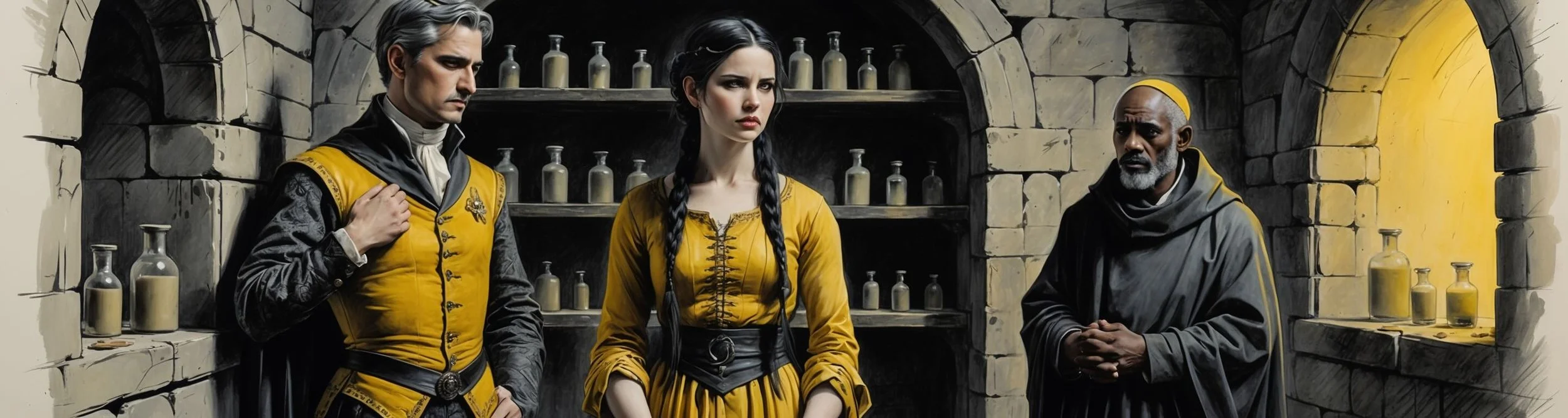
Scene Profile – At a Glance
- Location: Friar Laurence's cell.
- What Happens: Paris tells the Friar of his Thursday wedding to Juliet. Juliet arrives, fences with Paris in tense courtesies, then threatens suicide rather than marry him. The Friar offers a desperate plan: a potion to make her seem dead.
- Key Characters: Friar Laurence, Juliet, Paris.
- Dramatic Function: The scene that sets the play's machinery of disaster in motion – the sleeping-potion plan that is meant to save the lovers and instead destroys them.
- Famous Quote:
"Take thou this vial, being then in bed,
And this distilled liquor drink thou off..."
(Friar Laurence, Act 4, Scene 1) - Why It Matters: Juliet's courage and the Friar's scheme combine here into the plan whose single failure – an undelivered letter – will bring about both lovers' deaths.
Scene Summary
At his cell, Friar Laurence is talking with Paris, who has come to arrange his wedding to Juliet on Thursday. The Friar is uneasy at the haste and points out that Paris does not even know whether Juliet has agreed. Paris explains that her father has rushed the match to pull her out of her grief for Tybalt.
Juliet arrives, and Paris greets her as his wife-to-be. The two exchange a series of pointed, double-edged courtesies: Paris presses his claim on her, and Juliet parries every line with cool, evasive wit, conceding nothing. Once Paris finally leaves, the mask drops.
Alone with the Friar, Juliet collapses into despair and threatens to kill herself rather than marry Paris, drawing a knife to show she means it. The Friar, seeing how far she will go, proposes a desperate alternative.
She is to consent to the wedding, then on Wednesday night drink a potion he gives her. It will make her appear dead for forty-two hours. Her family will lay her in the Capulet tomb; meanwhile the Friar will send word to Romeo, who will come, wait for her to wake, and carry her away to Mantua. Juliet seizes the plan at once and leaves with new resolve.
The Rushed Wedding
The scene opens not with Juliet but with Paris, settling the date of a marriage the bride has never agreed to. The Friar's discomfort is immediate, and it is the discomfort of a man who already knows a secret that makes the whole arrangement impossible.
Original
You say you do not know the lady's mind:
Uneven is the course, I like it not.
(Friar Laurence, Act 4, Scene 1)
Shakespeare Retold (Modern Verse)
You say you don’t know if the girl’s consented;
This is irregular; I do not like it.
Paris is not a villain, and the scene takes care to show it. He is a courteous, conventional young man who genuinely believes he is doing right, and he reports Capulet's reasoning sympathetically: the wedding has been hurried to lift Juliet out of her mourning. But the audience hears what Paris cannot – that Juliet is already married, that her grief is not for Tybalt but for the banished Romeo, and that every date Paris sets is tightening a trap. The Friar's aside, "I would I knew not why it should be slowed," lets us feel the gap between what the scene's characters know and what we do. The machinery of haste that has driven the whole play is now closing on Juliet.
Juliet Fences with Paris
When Juliet arrives, Paris greets her warmly as his wife. What follows is one of the play's most controlled exchanges: a duel of courtesies in which Paris presses and Juliet deflects, every line carrying a meaning beneath its polite surface.
Original
That may be, sir, when I may be a wife.
(Juliet, Act 4, Scene 1)
Shakespeare Retold (Modern Verse)
That may be so, sir, when I am a wife.
Paris calls her "my wife"; Juliet answers that this may be true "when I may be a wife" – technically agreeing, secretly denying, since to her she is a wife already, and not his. The whole conversation runs on this knife-edge. When Paris asks whether she has come to confess to the Friar, she answers that to say so would be to confess to Paris himself; when he insists she does not deny loving him, she replies that she will confess she loves "him" – meaning the priest, or meaning Romeo, never Paris. It is the same quick, equal wit Juliet showed at the feast in A1S5, but turned cold and defensive. She gives Paris nothing, and the courtesy never cracks.
The Threat of Suicide
The moment Paris is gone, the performance ends. Juliet turns to the Friar in raw desperation, and when he can offer no easy answer, she produces a knife and makes clear she will use it on herself before she will become Paris's wife.
Original
Do thou but call my resolution wise,
And with this knife I'll help it presently.
(Juliet, Act 4, Scene 1)
Shakespeare Retold (Modern Verse)
Then you must say my own solution’s wise
That I’ll achieve directly with this knife.
This is a different Juliet from the girl of the early acts. Faced with an impossible bind – a husband in exile, a wedding she cannot refuse, parents she cannot defy – she reaches for the most absolute exit there is. The speech is not hysterical but argued: she reminds the Friar that God joined her to Romeo, that her hand cannot be sealed to another, and that if his wisdom and experience can find no honourable way out, the knife will be her judge. It is a threat, but also a kind of dare to the Friar – help me, or watch me do this – and it is exactly what forces him to produce his desperate plan.
The Friar's Plan
Seeing that Juliet truly means to die, the Friar offers a third way between marriage and suicide – a scheme as bold and dangerous as the death it is meant to prevent. It turns on a potion that will counterfeit death itself.
Original
Take thou this vial, being then in bed,
And this distilled liquor drink thou off...
(Friar Laurence, Act 4, Scene 1)
Shakespeare Retold (Modern Verse)
Take this small bottle, and when you’re in bed,
Drink all the potion that’s inside of it...
The plan is laid out with the Friar's usual careful detail: Juliet will consent to the wedding, sleep alone, and drink the potion on Wednesday night. It will stop her pulse and breath and leave her cold and stiff for forty-two hours, so that her family, believing her dead, will lay her in the Capulet vault. The Friar will send letters to Romeo, who will come to the tomb, wait for her to wake, and carry her to Mantua. It is an ingenious solution and a deeply risky one, depending on perfect timing and a single letter reaching Romeo in time. The audience, watching the Friar's confidence, also hears how much could go wrong – and in A5S1 and A5S2, almost all of it does. Juliet, for her part, hears only deliverance: "Give me, give me! O, tell not me of fear!"
Language and Technique
- Double meaning: Juliet's replies to Paris work on two levels at once – polite on the surface, privately denying him, since words like "wife" and "him" mean something different to her than to Paris.
- Stichomythia: The Paris exchange is built from clipped, line-for-line ripostes, a verbal fencing match that shows Juliet matching him blow for blow.
- Imagery of death: Juliet's catalogue of horrors – snakes, charnel-houses, rattling bones, yellow skulls – piles up grim physical detail to prove how far she will go.
- Dramatic irony: Paris arranges a wedding the audience knows can never happen, and the Friar's plan is described with a confidence we already sense is misplaced.
- The aside: The Friar's quiet "I would I knew not why it should be slowed" lets the audience share his secret knowledge while Paris remains in the dark.
Key Quotes from Act 4, Scene 1
Quote 1It may be so, for it is not mine own.
(Juliet, Act 4, Scene 1)
Shakespeare Retold (Modern Verse)
Perhaps my face belongs to someone else.
O, bid me leap, rather than marry Paris,
From off the battlements of yonder tower...
(Juliet, Act 4, Scene 1)
Shakespeare Retold (Modern Verse)
Tell me to jump – rather than marry Paris –
From off the battlements of that there tower...
Hold, daughter: I do spy a kind of hope,
Which craves as desperate an execution.
(Friar Laurence, Act 4, Scene 1)
Shakespeare Retold (Modern Verse)
Wait, daughter; for I see a ray of hope,
Requiring desperation to achieve it.
Give me, give me! O, tell not me of fear!
(Juliet, Act 4, Scene 1)
Shakespeare Retold (Modern Verse)
Give it to me! Don’t talk to me of fear!
Key Takeaways
- The wedding is set: Paris and the Friar fix the Thursday marriage, though the Friar knows it cannot lawfully happen.
- Juliet outwits Paris: She parries his courtesies with double-edged replies, conceding nothing while staying outwardly polite.
- Suicide threatened: Alone with the Friar, Juliet draws a knife and vows to die rather than betray Romeo.
- The potion plan: The Friar's scheme to fake Juliet's death sets up the tragedy's final, fatal chain of events.
Study Questions and Analysis
Why is Friar Laurence uneasy about the marriage between Paris and Juliet?
On the surface, the Friar objects to the haste: Paris wants to marry on Thursday, only days away, and admits he does not even know whether Juliet has consented. The Friar calls the whole course "uneven" and says plainly that he does not like it.
You say you do not know the lady's mind:
Uneven is the course, I like it not.
(Friar Laurence, Act 4, Scene 1)
Shakespeare Retold (Modern Verse)
You say you don’t know if the girl’s consented;
This is irregular; I do not like it.
But his real unease is one he cannot voice. As Harley Granville-Barker observed in his Prefaces to Shakespeare (1930), the Friar is throughout a man managing a secret that keeps outrunning him, and here the dramatic irony is acute: he alone (besides the audience) knows that Juliet is already married to Romeo, so any second wedding would be bigamous and sacrilegious. His objection to the "haste" is a screen for the deeper objection he dare not state. The scene thus turns the play's recurring theme of time and haste into something almost unbearable: the faster Capulet pushes the wedding, the closer the Friar's secret comes to catastrophe.
How does Juliet handle her conversation with Paris?
With remarkable composure. Paris greets her as his wife and presses her at every turn, and Juliet answers each advance with a courtesy that is also a refusal – agreeing in words while denying in meaning. She tells him she will be a wife "when I may be a wife", confesses she loves "him" (the Friar, or Romeo, never Paris), and turns even his compliment about her face into a quiet evasion.
It may be so, for it is not mine own.
(Juliet, Act 4, Scene 1)
Shakespeare Retold (Modern Verse)
Perhaps my face belongs to someone else.
The technique is what critics call dramatic equivocation – saying something literally true that the listener is bound to misunderstand. M. M. Mahood, whose Shakespeare's Wordplay (1957) traces how the play's puns carry its meanings, shows how steadily Juliet's language has matured: the witty double meanings she once traded in love at the feast are now weapons of self-defence. She never lies outright – that matters to her sense of fidelity – yet she yields Paris nothing. It is one of the clearest demonstrations in the play that Juliet, not Romeo, is the more resourceful and self-possessed of the two.
What does Juliet's threat of suicide reveal about her character?
It reveals how completely she has hardened into resolve. The moment Paris leaves, Juliet abandons all courtesy and tells the Friar she would rather die than marry Paris, drawing a knife to prove it. Her catalogue of horrors – leaping from a tower, lurking among serpents, being chained with bears, shut in a charnel-house – is not panic but argument: she will face any terror to stay faithful to Romeo.
Do thou but call my resolution wise,
And with this knife I'll help it presently.
(Juliet, Act 4, Scene 1)
Shakespeare Retold (Modern Verse)
Then you must say my own solution’s wise
That I’ll achieve directly with this knife.
Critics have long noted that Juliet grows faster and further than Romeo. Coppélia Kahn, in Man's Estate: Masculine Identity in Shakespeare (1981), reads Juliet's defiance here as a young woman seizing control of her own body and fate in a world that allows her almost none – her father disposes of her in marriage, so she claims the one decision left to her, the decision to die. The threat is also dramatically necessary: it is the pressure that forces the Friar to produce his plan. Juliet does not merely ask for help; she makes clear that the alternative to help is her death, and the scene's whole second half follows from that.
What is Friar Laurence's plan, and why is it so risky?
The Friar proposes that Juliet consent to the wedding, then on Wednesday night drink a potion that will make her appear dead. Her pulse and breath will stop, her body will turn cold and stiff, and she will lie like a corpse for forty-two hours before waking "as from a pleasant sleep".
Take thou this vial, being then in bed,
And this distilled liquor drink thou off...
(Friar Laurence, Act 4, Scene 1)
Shakespeare Retold (Modern Verse)
Take this small bottle, and when you’re in bed,
Drink all the potion that’s inside of it...
Believing her dead, her family will lay her in the Capulet vault; the Friar will send letters to warn Romeo, who will come to the tomb, wait for her to wake, and take her away to Mantua. The plan's danger is built into its design. It depends on faultless timing, on Juliet's nerve holding while she is buried alive, and above all on a single letter reaching Romeo. Susan Snyder, in 'Romeo and Juliet: Comedy into Tragedy' (1970), argues that the play's second half is governed by accident and mischance rather than character flaw, and the Friar's scheme is the perfect example: there is nothing wrong with it except that the world refuses to cooperate. When the letter fails to arrive in A5S2, every other part of the plan works exactly as designed – which is precisely what makes the ending so cruel.
How does this scene develop the theme of fate?
It tightens the sense, established in the Prologue, that the lovers are caught in something larger than themselves. Every choice made here is meant to save them and instead steers them towards the tomb. The wedding is hurried to comfort Juliet; the Friar's plan is devised to rescue her; Juliet embraces it as deliverance. Yet the audience, who knows the Prologue's promise of "death-marked love", watches each hopeful step lead downward.
The scene is thick with grim foreshadowing. Juliet's willingness to be "shut me nightly in a charnel-house" and hidden "with a dead man in his shroud" anticipates exactly where she will lie; the potion that mimics death prefigures the real death to come. Caroline Spurgeon, in Shakespeare's Imagery and What It Tells Us (1935), traced how images of tombs and untimely death run through the play, gathering force as it nears its end; this scene is where those images crowd in. The theme of fate and destiny works less through supernatural decree than through this remorseless logic, in which good intentions and bad luck combine to produce disaster.
Is Friar Laurence to blame for the tragedy that follows?
This is one of the play's most debated questions, and this scene is where the case against the Friar begins. His plan is ingenious, but it is also reckless: he gambles Juliet's life on a drug, a tomb, and a letter, when other courses – telling Capulet the truth, sending Juliet openly to Romeo – were at least possible. Critics divide sharply. Harley Granville-Barker, in his Prefaces to Shakespeare (1930), saw the Friar as well-meaning but fatally given to over-elaborate schemes, a man whose love of contrivance helps undo the lovers he means to help.
Others are gentler. Harold Bloom, in Shakespeare: The Invention of the Human (1998), treats the Friar as essentially benevolent, caught like everyone else in a tragedy whose true engine is the feud and sheer ill chance rather than any single person's error. The play itself seems to hold both views: the Friar's plan is genuinely the best hope available in an impossible situation, and yet its very complexity is what leaves so much room for the mischance that destroys it. The question of individual responsibility against the pressure of circumstance is left deliberately open – which is part of why the play endures.
Why does Shakespeare make Paris sympathetic rather than villainous in this scene?
Paris could easily have been written as a rival to despise, but Shakespeare draws him as decent and conventional. He is courteous to Juliet, respectful to the Friar, and sincere in his grief at her supposed mourning; he reports Capulet's reasoning with evident care for her wellbeing. Nothing he does is cruel, and his only fault is that he stands, unknowing, in the lovers' way.
This makes the scene more painful, not less. As Marjorie Garber notes in Shakespeare After All (2004), the tragedy of Romeo and Juliet is not a clash of good against evil but of love against circumstance, and a sympathetic Paris sharpens that. There is no villain to blame for Juliet's plight: a kind man wants to marry her, a loving father has arranged it, a well-meaning friar tries to save her, and the result is still catastrophe. Paris's very blamelessness deepens the dramatic irony, since the audience watches a good man build a wedding on ground that has already given way beneath him, and it prepares for the genuine pathos of his own death in the tomb in A5S3.