Romeo and Juliet: Act 3, Scene 5 – Analysis
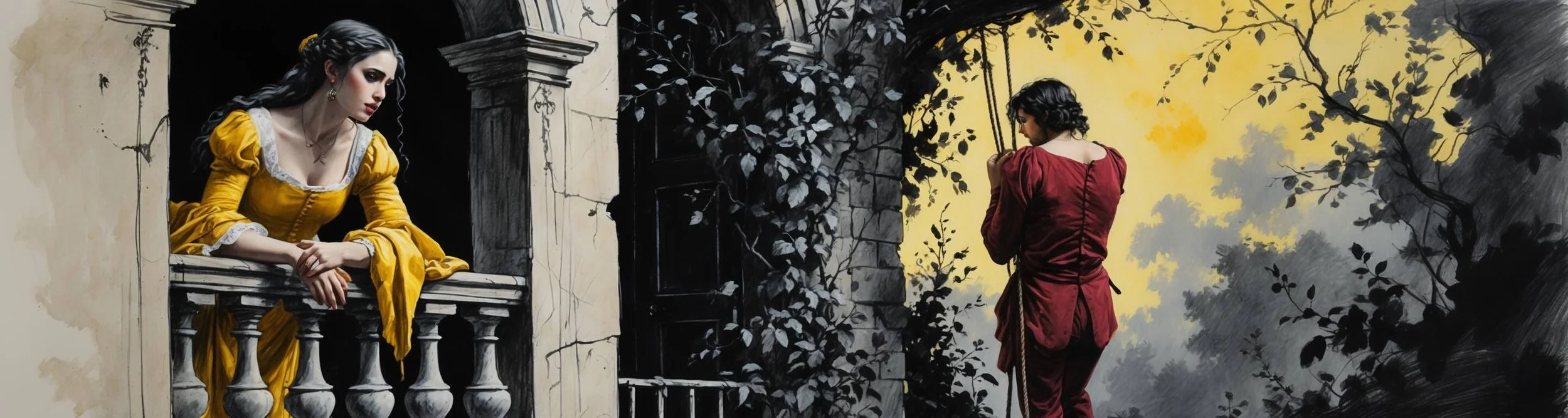
Scene Profile – At a Glance
- Location: Capulet's house in Verona – Juliet's chamber, opening at the window above.
- What Happens: Romeo and Juliet part at dawn after their wedding night. Lady Capulet brings news that Juliet must marry Paris on Thursday; Juliet refuses, and Capulet erupts in fury, threatening to disown her. The Nurse advises Juliet to forget Romeo and marry Paris, and Juliet, betrayed, resolves to seek Friar Laurence.
- Key Characters: Romeo, Juliet, Lord Capulet, Lady Capulet, the Nurse.
- Dramatic Function: The scene that closes every door on Juliet – husband gone, father raging, mother and Nurse withdrawn – leaving her utterly alone and driving her towards the Friar's desperate plan.
- Famous Quote:
"It was the nightingale, and not the lark..."
(Juliet, Act 3, Scene 5) - Why It Matters: Juliet is stripped of every ally in a single scene. Her isolation here is what makes the Friar's reckless scheme – and the tragedy that follows – feel inevitable.
Scene Summary
It is dawn, the morning after Romeo and Juliet have spent their wedding night together. At the window of Juliet's chamber, the lovers cling to one another and argue gently about the birdsong they can hear: Juliet insists it is the nightingale, the bird of night, while Romeo knows it is the lark, the herald of morning. To stay means death, since Romeo is banished on pain of execution. At last Juliet urges him to go, and Romeo climbs down to begin his exile in Mantua.
No sooner has he gone than Lady Capulet arrives. Believing Juliet's tears are for her dead cousin Tybalt, she promises that Romeo will be poisoned in Mantua, then delivers what she thinks is joyful news: Juliet is to marry Paris on Thursday at Saint Peter's Church. Juliet refuses outright, and her mother, exasperated, leaves the matter to her father.
Lord Capulet enters, and when he learns Juliet will not obey, his earlier good humour explodes into rage. He calls her names, threatens to drag her to the church, and swears that if she will not marry Paris he will throw her out to beg, starve and die in the streets. Lady Capulet refuses to intervene and walks out, washing her hands of her daughter.
Alone with the Nurse, Juliet begs for comfort. The Nurse, ever practical, advises her to forget the banished Romeo and marry Paris, who is the better man anyway. The betrayal is total: the one person who has always taken Juliet's side now counsels her to commit bigamy. Juliet hides her horror, sends the Nurse away, and resolves to go to Friar Laurence for help – and if he can offer none, to take her own life.
The Dawn Parting
The scene opens with one of the most beautiful partings in Shakespeare: an aubade, a dawn-song between lovers who must separate. Juliet, desperate to keep Romeo a little longer, pretends the birdsong is the nightingale – the bird of night – and not the lark that announces the morning he must leave by.
Original
It was the nightingale, and not the lark,
That pierced the fearful hollow of thine ear...
(Juliet, Act 3, Scene 5)
Shakespeare Retold (Modern Verse)
That was a nightingale and not a lark
That made the piercing whistle in your ear...
The whole exchange turns on a sweet pretence: Juliet knows the truth and chooses to deny it, because the lark means daybreak, and daybreak means exile and the threat of death. Romeo, more clear-eyed, names the lark and the streaks of light in the east, but then, moved by her, offers to stay and die if that is what she wants – at which point Juliet, alarmed, reverses herself and urges him to flee. The lovers' tenderness is shadowed throughout by danger; even their private dawn is haunted by the sentence hanging over Romeo. It is a scene of intimacy that the audience already knows is the last time they will see each other alive.
Foreboding and Farewell
As Romeo finally descends, the lovers exchange farewells loaded with dread. Juliet, looking down at him in the orchard below, is struck by a vision so dark it reads as prophecy.
Original
Methinks I see thee, now thou art below,
As one dead in the bottom of a tomb...
(Juliet, Act 3, Scene 5)
Shakespeare Retold (Modern Verse)
I think I see you, now that you’re below me,
As though you’re dead and lying in a tomb...
Juliet calls it an "ill-divining soul" – a spirit that senses evil coming – and the image she sees is exactly how the play will end: Romeo dead in the Capulet tomb. This is dramatic irony at its most painful, because the audience knows her foreboding is accurate. The parting itself is full of the play's restless sense of time: Juliet swears she must hear from Romeo every hour, because a single minute feels like many days. Their love is measured in moments stolen against a clock that is always running out, and this is the last moment they will share.
The Marriage Demand and Capulet's Rage
The mood breaks the instant Lady Capulet enters with what she imagines is wonderful news. Juliet refuses to marry Paris, and when Capulet arrives and hears of her defiance, the genial host of A1S5 vanishes. In his place is a tyrant, and the violence of his language is shocking.
Original
An you be mine, I'll give you to my friend;
And you be not, hang, beg, starve, die in the streets,
(Capulet, Act 3, Scene 5)
Shakespeare Retold (Modern Verse)
If you’re my daughter, you will wed my friend;
But if not, you’ll beg, starve, die in the streets,
Capulet's fury exposes the brutal reality beneath Verona's patriarchy: a daughter who disobeys her father has no rights, no home and no future. He calls her "baggage", a "green-sickness carrion", threatens to drag her to the church "on a hurdle", and finally disowns her outright – she may beg and starve in the streets for all he cares. What makes the scene so unbearable is that Juliet cannot explain herself: she is already married to Romeo, and to say so would be to confess everything. She kneels, she pleads, and she is shouted down. The same man whose good humour once shielded Romeo from Tybalt now turns the full force of his rule against his own child.
Abandoned by Mother and Nurse
With her father gone, Juliet turns first to her mother and then to the Nurse, and both fail her. Lady Capulet refuses even to speak to her. The Nurse, asked for comfort, gives advice that severs Juliet's last bond.
Original
Then, since the case so stands as now it doth,
I think it best you married with the county.
(the Nurse, Act 3, Scene 5)
Shakespeare Retold (Modern Verse)
So, in the situation you are facing,
I think it best you’re married to Count Paris.
The Nurse means well. To her practical, earthbound mind, Romeo is banished and may as well be dead, while Paris is here and is "a lovely gentleman" – so why not marry him? But to Juliet, who is already Romeo's wife, the advice is a betrayal that amounts to a counsel of bigamy and faithlessness. The woman who raised her, who carried her love-messages and helped arrange her secret wedding, now tells her to abandon her husband for convenience. Something hardens in Juliet at this moment. She thanks the Nurse with cold courtesy, then, once she is alone, turns on her: "Ancient damnation!" From here, Juliet stands entirely alone – and her decision to seek the Friar, and to die if he cannot help, is the direct result of that isolation.
Language and Technique
- The aubade: The opening is a dawn-song – a traditional lovers' lament that morning is coming – with the nightingale and lark standing for the night they want and the day they dread.
- Light and dark imagery: "More light and light; more dark and dark our woes!" ties the growing daylight directly to the lovers' growing grief, reversing the play's earlier pattern of light as joy.
- Dramatic irony: Juliet's vision of Romeo "as one dead in the bottom of a tomb" foretells the ending, and the audience knows it is true even as she does not.
- Violent diction: Capulet's torrent of insults – "baggage", "carrion", "hilding" – turns a father's speech into something closer to a beating, dramatising his power over his daughter.
- Extended metaphor: Capulet pictures the weeping Juliet as a storm at sea – her eyes the sea, her body a boat, her sighs the winds – a controlling image that treats her grief as a tempest to be mastered.
Key Quotes from Act 3, Scene 5
Quote 1More light and light; more dark and dark our woes!
(Romeo, Act 3, Scene 5)
Shakespeare Retold (Modern Verse)
Our sorrow darkens as the day draws brighter.
Yon light is not day-light, I know it, I:
It is some meteor that the sun exhales,
(Juliet, Act 3, Scene 5)
Shakespeare Retold (Modern Verse)
That light is not the daylight, I am sure:
It is a meteor the sun spat out
Hang thee, young baggage! Disobedient wretch!
I tell thee what: get thee to church o' Thursday...
(Capulet, Act 3, Scene 5)
Shakespeare Retold (Modern Verse)
Go hang yourself, you bag! Rebellious lowlife!
I’ll tell you what: be in the church on Thursday...
Is there no pity sitting in the clouds,
That sees into the bottom of my grief?
(Juliet, Act 3, Scene 5)
Shakespeare Retold (Modern Verse)
Are there no gods that look down from above
And see the depth and content of my grief?
I'll to the friar, to know his remedy:
If all else fail, myself have power to die.
(Juliet, Act 3, Scene 5)
Shakespeare Retold (Modern Verse)
I’ll go to seek the friar’s remedy;
If all else fails, I have the power to die.
Key Takeaways
- The dawn parting: Romeo and Juliet separate at daybreak in a tender aubade, debating nightingale and lark – the last time they meet alive.
- Capulet's rage: The genial host of the feast becomes a tyrant, threatening to disown Juliet and throw her out to starve if she will not marry Paris.
- Every ally lost: Husband banished, father raging, mother withdrawn, and the Nurse advising her to forget Romeo – Juliet is left completely alone.
- The turn to the Friar: Juliet resolves to seek Friar Laurence, and to die if he cannot help, setting the final tragedy in motion.
Study Questions and Analysis
What is the significance of the nightingale and the lark at the start of the scene?
The opening of the scene is an aubade – a traditional dawn-song in which lovers lament that morning has come to part them. Juliet insists the bird they hear is the nightingale, which sings at night, rather than the lark, which announces day, because day means Romeo must flee into exile or be put to death.
It was the nightingale, and not the lark,
That pierced the fearful hollow of thine ear...
(Juliet, Act 3, Scene 5)
Shakespeare Retold (Modern Verse)
That was a nightingale and not a lark
That made the piercing whistle in your ear...
The birds work as symbols of the lovers' impossible wish to hold off time. Caroline Spurgeon, in her landmark study Shakespeare's Imagery and What It Tells Us (1935), traced how the play opposes the lovers' world of night and starlight to the harsh daylight of Verona's feud and authority; here that contrast is at its most literal, with night standing for love and safety and day for separation and danger. The exchange is also a small reversal of A2S2, where night brought the lovers together at the balcony; now night is the only thing keeping them together, and dawn is the enemy. Shakespeare lets the moment hold both tenderness and dread, so that even the lovers' happiest privacy is shadowed by the death sentence hanging over Romeo.
Why does Capulet react so violently to Juliet's refusal to marry Paris?
Capulet's fury can seem to come from nowhere, given how gently he spoke of Juliet's marriage in A1S2, where he told Paris to wait two years and win her heart. But several pressures converge. He believes he has secured an excellent match; he assumes Juliet's grief is for Tybalt and that a wedding will lift her spirits; and, crucially, he reads her refusal as a direct challenge to his authority as father and head of the household.
Hang thee, young baggage! Disobedient wretch!
I tell thee what: get thee to church o' Thursday...
(Capulet, Act 3, Scene 5)
Shakespeare Retold (Modern Verse)
Go hang yourself, you bag! Rebellious lowlife!
I’ll tell you what: be in the church on Thursday...
Coppélia Kahn, in her influential study Man's Estate: Masculine Identity in Shakespeare (1981), reads the moment as a stark display of the father's power in a patriarchal household, where a daughter is property to be bestowed and disobedience threatens the whole structure of male authority the feud depends on. Capulet's language – "baggage", "carrion", his threat to drag her "on a hurdle" – reduces Juliet to an object, and his promise to throw her out to "beg, starve, die in the streets" makes brutally plain that an unmarried, disowned daughter has no place in this world. The scene's deepest irony is that Juliet's "disobedience" is in fact a marriage vow she cannot reveal: she is being punished for a faithfulness her father can never know about.
How does Juliet's foreboding vision of Romeo work as dramatic irony?
As Romeo climbs down from the window to begin his exile, Juliet looks at him and is seized by a dark premonition. The image she describes is precise and terrible.
Methinks I see thee, now thou art below,
As one dead in the bottom of a tomb...
(Juliet, Act 3, Scene 5)
Shakespeare Retold (Modern Verse)
I think I see you, now that you’re below me,
As though you’re dead and lying in a tomb...
The irony is acute because the audience, primed by the Prologue's promise of "star-crossed lovers" and "death-marked love", knows that this vision is literally what is coming: Romeo will die in the Capulet tomb. Juliet calls herself "ill-divining" – able to sense evil – and the play repeatedly gives its young lovers these flashes of accurate foresight, from Romeo's "some consequence yet hanging in the stars" in A1S4 onwards. Critics differ on what to make of this pattern. Susan Snyder, in her essay 'Romeo and Juliet: Comedy into Tragedy' (1970), argued that the play begins in the world of romantic comedy and turns tragic, with such premonitions marking the shift; once the deaths of Mercutio and Tybalt in A3S1 have tipped the play into tragedy, the lovers' world fills with omens. Whether these moments suggest genuine fate or simply the lovers' growing dread, their effect is the same: they tighten the audience's sense that the ending is already written.
Why is the Nurse's advice such a serious betrayal of Juliet?
Throughout the play the Nurse has been Juliet's closest companion – her foster-mother, her confidante, the go-between who carried her love-messages and helped arrange her secret marriage to Romeo. So when Juliet, abandoned by both parents, turns to her for comfort, the Nurse's response lands as a profound betrayal.
Then, since the case so stands as now it doth,
I think it best you married with the county.
(the Nurse, Act 3, Scene 5)
Shakespeare Retold (Modern Verse)
So, in the situation you are facing,
I think it best you’re married to Count Paris.
The Nurse's logic is entirely practical: Romeo is banished and effectively lost, Paris is present and a "lovely gentleman", so Juliet should make the best of things. But she is, in effect, advising bigamy, urging Juliet to abandon a sacred vow for convenience. Marjorie Garber, in Shakespeare After All (2004), notes how the Nurse and Friar Laurence, the two adults the lovers trust most, both ultimately fail them through a worldly wisdom that cannot match the absolute quality of the lovers' commitment. For Juliet the moment is decisive: it is the instant she grows up. She masks her revulsion, dismisses the Nurse with icy politeness, and then turns on her once alone – "Ancient damnation!" From this point she will trust no one but the Friar, and act alone. The severing of the Nurse is one of the loneliest moments in the play.
How does this scene mark a turning point in Juliet's character?
Act 3, Scene 5 is where Juliet completes her transformation from sheltered child to a young woman who must face the world entirely alone. At the start of the play she is obedient, telling her mother in A1S3 that she will "look to like" Paris no further than her parents wish. By the end of this scene she has defied her father, concealed her marriage, seen through the Nurse, and resolved to take her fate into her own hands.
I'll to the friar, to know his remedy:
If all else fail, myself have power to die.
(Juliet, Act 3, Scene 5)
Shakespeare Retold (Modern Verse)
I’ll go to seek the friar’s remedy;
If all else fails, I have the power to die.
The closing couplet shows a Juliet of extraordinary resolve. She considers suicide not in panic but as a deliberate last resort, the one choice still left to her in a world that has stripped away every other. Coppélia Kahn's reading of the play (1981) stresses how Juliet, more than Romeo, must wrestle free of family authority to claim her own identity, and this scene is the crucible of that struggle. Some critics see her growth as the play's true emotional centre: where Romeo tends to react, Juliet plans, weighs, and decides. The girl who once needed the Nurse to fetch a name now sends her away for good, and faces the Friar's desperate scheme on her own terms.
What role does Lady Capulet play in this scene?
Lady Capulet is the one who first brings the news of the Paris marriage, presenting it as "joyful tidings", and her failure to understand her daughter is one of the scene's quiet tragedies. She has so little real intimacy with Juliet that she misreads her grief entirely – assuming the tears are for Tybalt – and even offers, chillingly, to have Romeo poisoned in Mantua, not knowing she is promising to murder her daughter's husband.
When Capulet's rage reaches its height, Juliet turns to her mother for help, and Lady Capulet's response is to abandon her. She refuses to intercede with her husband and walks out with a flat dismissal: "Do as thou wilt, for I have done with thee." The line is devastating in its coldness. Coppélia Kahn (1981) reads Lady Capulet as a woman so thoroughly shaped by the patriarchal household that she cannot side with her daughter against its master, even when his cruelty is plain; her own position depends on her husband's authority. The effect is to leave Juliet doubly orphaned – not by death but by the withdrawal of the very people who should protect her. Of the three adults who fail Juliet in this scene, her mother's failure is the quietest and, in some ways, the bleakest.
How does Act 3, Scene 5 drive the plot towards the tragedy?
This scene is the great accelerator of the second half of the play. Up to this point Juliet's situation, while dangerous, still has room to manoeuvre; by the end of the scene every safe option has been closed off, and only desperate ones remain. Romeo is gone to Mantua, the Paris wedding is fixed for Thursday, her father has threatened to disown her, and her mother and Nurse have both withdrawn their support.
The result is that Juliet is forced towards Friar Laurence, and it is the Friar's reckless plan – the sleeping potion, the feigned death, the letter that never arrives – that produces the catastrophe. Susan Snyder (1970) describes how the play's tragic machinery, once set running by the deaths in A3S1, gathers an unstoppable momentum; this scene is where that momentum becomes irreversible for Juliet. It also sharpens the play's interest in haste: Capulet's decision to bring the wedding forward compresses the time the lovers have, and it is the lack of time, as much as the feud, that destroys them. By closing every door at once, Shakespeare ensures that the rest of the tragedy can only run downhill, faster and faster, to the tomb Juliet has already foreseen.