Romeo and Juliet: Act 4, Scene 3 – Analysis
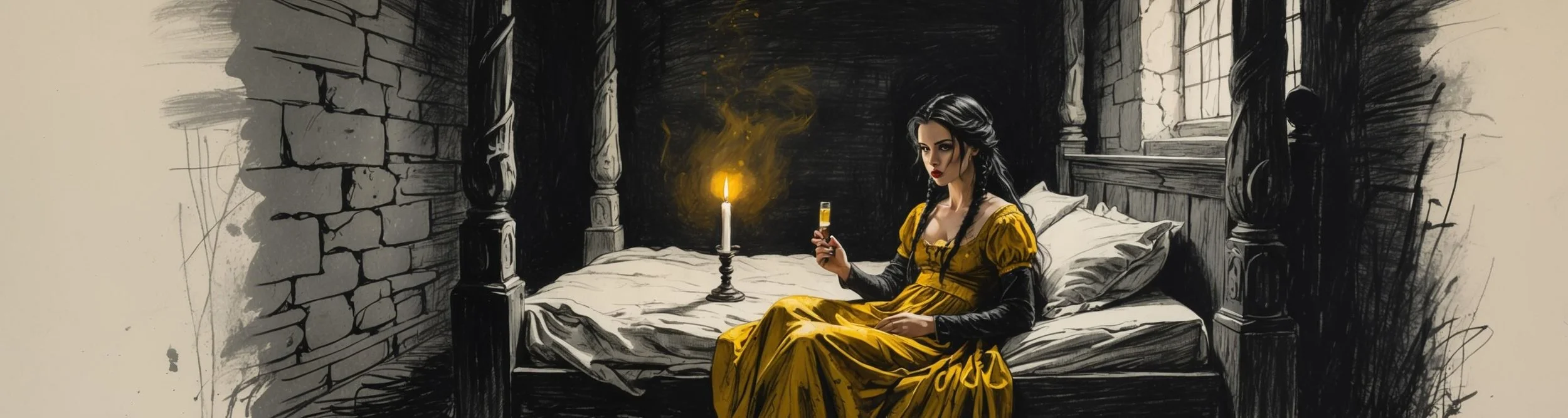
Scene Profile – At a Glance
- Location: Juliet's chamber in the Capulet house, the night before her wedding to Paris.
- What Happens: Juliet sends away the Nurse and her mother so she can be alone. Working through her terror in a long soliloquy, she imagines everything that could go wrong, then drinks the Friar's potion to Romeo and falls onto her bed.
- Key Characters: Juliet, Lady Capulet, the Nurse.
- Dramatic Function: Juliet's great solo test of nerve – she must act entirely alone, and her decision to drink commits the play to the desperate plan that will end in the tomb.
- Famous Quote:
"Romeo, I come! This do I drink to thee."
(Juliet, Act 4, Scene 3) - Why It Matters: A study of courage and isolation in a girl not yet fourteen. Alone and terrified, Juliet conquers her fear and drinks – one of the bravest acts in the play.
Scene Summary
It is the night before the wedding the Capulets have arranged with Paris. In her chamber, Juliet tells the Nurse that her clothes for the morning are chosen, but asks to be left alone tonight to say her prayers. Lady Capulet looks in to offer help; Juliet sends her away too, and mother and Nurse leave her by herself.
Alone, Juliet takes out the vial of potion the Friar has given her. Before she can drink, her fears crowd in. What if the mixture does not work, and she is forced to marry Paris after all? She lays a dagger beside her as a final escape. Then a darker fear: what if the potion is really a poison, given by the Friar to hide that he has already married her to Romeo?
Worst of all, she imagines waking too early, alone in the family vault among the bones of her ancestors and the fresh corpse of Tybalt, breathing foul air, surrounded by ghosts and horrors until she goes mad. The vision nearly overwhelms her. She seems to see Tybalt's ghost hunting for Romeo.
Conquering her terror, Juliet calls out to Romeo, drinks the potion to him, and falls onto her bed behind the curtains.
Dismissing the World
The scene opens quietly, with Juliet managing the people around her. She has just agreed to the wedding to win her family's trust, and now she must clear the room so she can do the one thing none of them must see. She sends the Nurse off and gently turns away her mother's offer of help.
Original
So please you, let me now be left alone,
And let the nurse this night sit up with you...
(Juliet, Act 4, Scene 3)
Shakespeare Retold (Modern Verse)
So, if you don’t mind, leave me on my own,
And let the nurse take care of you tonight...
There is something quietly heartbreaking in this. The two women who have shared Juliet's whole life – her mother and the Nurse who raised her – are being eased out of the room, and they have no idea why. Juliet must lie to them to be alone, and her isolation here is total: the plan can only work if no one knows she is carrying it out. As the door closes, she says goodbye with a line that lands harder than her mother can hear: "Farewell! God knows when we shall meet again." She is not sure she will survive the night.
The Terror of the Tomb
Now alone, Juliet takes out the vial. What follows is one of the great soliloquies of the play – not a speech of resolve but of mounting panic, as one terrible possibility leads to the next. First the practical fear: what if the drug simply does not work? She sets a dagger by her bed, deciding she will kill herself before she marries Paris. Then a worse thought: what if the Friar has poisoned her to hide his part in her secret marriage?
Original
What if it be a poison, which the friar
Subtly hath ministered to have me dead...
(Juliet, Act 4, Scene 3)
Shakespeare Retold (Modern Verse)
But what if it’s a poison that the friar
Has subtly given me so that I’ll die...
She talks herself out of that one – the Friar has always been a holy man – but the relief does not last, because the deepest fear is still coming. What if she wakes too early, alone, sealed in the Capulet vault? Her imagination, which has been racing, now runs wild with the horror of the place: the foul air, the packed bones of her ancestors, the fresh, festering corpse of Tybalt, the wandering spirits the living are said to hear. She pictures herself driven mad, tearing Tybalt from his shroud, dashing out her own brains with a kinsman's bone. It is the most frightening speech Shakespeare gives any of his heroines, and what makes it extraordinary is that, having imagined all of it, she still drinks.
Drinking to Romeo
At the very peak of her terror, Juliet seems to hallucinate Tybalt's ghost rising to hunt down Romeo. It is the moment her fear could tip her into collapse – and instead she breaks through it. She turns from the ghost to Romeo himself, makes the drink an act of love rather than fear, and swallows it.
Original
Romeo, I come! This do I drink to thee.
(Juliet, Act 4, Scene 3)
Shakespeare Retold (Modern Verse)
Romeo, I’m coming! I’ll drink this for you.
The single line does enormous work. After fifty lines of spiralling dread, Juliet steadies herself on the one thing that matters – Romeo – and turns the most terrifying act of her life into a toast. It is a child of not yet fourteen, with no help and no certainty, choosing to face the tomb rather than betray the man she loves. She falls onto the bed behind the curtains, and the next time the household enters this room they will believe she is dead.
Language and Technique
- Soliloquy: Alone on stage, Juliet thinks aloud, so we follow every twist of her fear in real time – the speech is the action.
- Rhetorical questions: "What if this mixture do not work at all?" Her panic builds through a chain of "what if" questions, each darker than the last.
- Gruesome imagery: Foul air, packed bones, a festering corpse and torn-out shrieking mandrakes make the vault horribly vivid and physical.
- Sensory detail: She imagines the smells, the sounds and the touch of the tomb, so the terror feels real rather than abstract.
- Dramatic irony: The audience knows the plan, so we share both her fear of the vault and our dread of what is actually about to go wrong.
Key Quotes from Act 4, Scene 3
Quote 1My dismal scene I needs must act alone.
(Juliet, Act 4, Scene 3)
Shakespeare Retold (Modern Verse)
I have to do this awful act alone.
How if, when I am laid into the tomb,
I wake before the time that Romeo
Come to redeem me? There's a fearful point!
(Juliet, Act 4, Scene 3)
Shakespeare Retold (Modern Verse)
And what if, when I’m laid into the tomb,
I wake before the time that Romeo
Has come to rescue me? That’s rather scary!
O, look! Methinks I see my cousin's ghost
Seeking out Romeo, that did spit his body
Upon a rapier's point: stay, Tybalt, stay!
(Juliet, Act 4, Scene 3)
Shakespeare Retold (Modern Verse)
Oh look! I think I see my cousin’s ghost
Searching for Romeo, who split his body
Open upon his rapier: wait there, Tybalt!
Key Takeaways
- Total isolation: Juliet clears the room and faces the night entirely alone, knowing no one can help her with what she must do.
- A spiral of fear: Her soliloquy moves from practical worry to imagined horror – the drug failing, the Friar poisoning her, waking mad in the tomb.
- The vault made vivid: Foul air, packed bones and Tybalt's festering corpse turn her fear into something the audience can almost smell and touch.
- Courage at fourteen: Having imagined the worst, Juliet steadies herself on Romeo and drinks – one of the bravest acts in the play.
Study Questions and Analysis
Why does Juliet insist on being left completely alone in this scene?
On the surface, Juliet sends the Nurse and her mother away so she can say her prayers before her wedding. The real reason is that the plan she is about to carry out can only work in secret: she must drink the Friar's potion and appear dead, and no one in the household can be allowed to see her do it. To get her privacy, she has to deceive the two women closest to her.
I'll call them back again to comfort me:
Nurse! What should she do here?
My dismal scene I needs must act alone.
(Juliet, Act 4, Scene 3)
Shakespeare Retold (Modern Verse)
I’ll call them back again to bring me comfort:
Nurse! I must stop; what can she do to help me?
I have to do this awful act alone.
The moment is poignant because Juliet very nearly does call the Nurse back, then realises there is no point: no one can share this with her. Coppélia Kahn, in Man's Estate: Masculine Identity in Shakespeare (1981), reads Juliet's progress through the play as a movement away from her family and nurse towards an independent adult selfhood, and this scene is a key step – she severs the last comforting ties and stands utterly alone. Her isolation is not just practical but symbolic: the dependent child of Act 1 has become a young woman who must make the gravest decision of her life with no help at all.
What fears does Juliet work through in her soliloquy, and in what order?
The speech is built as a rising staircase of fear, each step worse than the last. Juliet begins with a practical worry: what if the potion simply does not work, and she finds herself married to Paris after all? She answers that fear by laying a dagger beside her, resolving to die rather than betray Romeo. Next comes a darker suspicion: what if the Friar has actually given her a real poison to kill her, so that his part in her secret marriage is never discovered? She reasons herself out of this, trusting that he has always been a holy man.
Then the worst fear arrives, and her imagination takes over completely: what if she wakes too early, alone in the family vault? She pictures the foul air, the bones of her ancestors, the freshly buried Tybalt, the spirits said to wander there, until she imagines herself going mad and dashing out her own brains. The structure matters: the speech moves from things she can control (the dagger, her trust in the Friar) to a horror she cannot, and it is at the height of that horror that she must find the courage to act. Marjorie Garber, in Shakespeare After All (2004), notes how the play repeatedly places its young lovers in tombs and death-like states; here Juliet rehearses her own burial in advance, in terrifying detail, before she has even drunk.
How does Shakespeare make the vault so frightening in this scene?
The horror of the vault is built almost entirely from sensory detail, so that the audience experiences it through Juliet's imagination rather than seeing it on stage. She conjures the smells of the tomb, the sealed and airless dark, the bones of generations of Capulets packed around her, and the fresh corpse of Tybalt rotting in his shroud. She adds the sounds: the shrieks of torn mandrake roots, said to drive the living mad, and the spirits that are believed to gather there at night.
Where bloody Tybalt, yet but green in earth,
Lies festering in his shroud; where, as they say,
At some hours in the night spirits resort...
(Juliet, Act 4, Scene 3)
Shakespeare Retold (Modern Verse)
Where bloodied Tybalt, not yet green and rotten,
Lies festering in his shroud; where, as they say,
At some time in the night, the spirits wander...
Caroline Spurgeon, in Shakespeare's Imagery and What It Tells Us (1935), traced how the play's pattern of light is set against images of darkness and the tomb; here the imagery of the vault is at its most concentrated and physical. The effect is to make Juliet's courage all the greater: she does not flinch from imagining the very worst, in vivid detail, and chooses to face it anyway. The speech also works by dramatic irony, since the audience knows she really will wake in that vault – and that the rescue she is counting on will fail.
What does this scene reveal about Juliet's courage and maturity?
This soliloquy is the fullest measure of how far Juliet has grown. The obedient daughter of the early acts is gone; in her place is a young woman who weighs a terrifying decision, sees every danger in it clearly, and acts. Crucially, her courage is not the courage of someone who does not understand the risk. She imagines, in unbearable detail, waking mad and alone among the dead – and still she drinks. That is far braver than acting in ignorance.
O, if I wake, shall I not be distraught,
Environed with all these hideous fears?
(Juliet, Act 4, Scene 3)
Shakespeare Retold (Modern Verse)
Oh, if I wake up, won’t I be distraught
Surrounded by those awful things that scare me?
Harold Bloom, in Shakespeare: The Invention of the Human (1998), argued that Juliet outgrows everyone around her, including Romeo, in maturity and intelligence, and this scene is strong evidence. Coppélia Kahn (1981) similarly sees her as the play's true tragic agent, making decisions while the adults fail her. That a character "not yet fourteen" should command a speech of this psychological depth and then act on it is one of the reasons the role is so prized; the terror is real, and so is the resolve that overcomes it.
How does the soliloquy end, and why is the final line so important?
The speech climbs to its most frightening point when Juliet seems to see the ghost of Tybalt rising to take revenge on Romeo. At that moment her imagination has almost overwhelmed her – and then she breaks through. She turns from the phantom to Romeo himself, and makes the act of drinking a gesture of love rather than fear.
Romeo, I come! This do I drink to thee.
(Juliet, Act 4, Scene 3)
Shakespeare Retold (Modern Verse)
Romeo, I’m coming! I’ll drink this for you.
The line is a masterstroke of compression. After fifty lines of dread, Juliet steadies herself on the single thing that gives the risk meaning – reunion with Romeo – and turns the most terrifying act of her life into a toast. Harley Granville-Barker, in his Prefaces to Shakespeare (1930), praised the way Shakespeare lets the soliloquy run its full course of terror before the resolve arrives, so that the courage is earned rather than assumed. The line also deepens the play's sense of fate: "I come" reads, in hindsight, less as a hope of reunion than as a step towards the shared death in the tomb that the Prologue promised from the start.