Romeo and Juliet: Act 4, Scene 5 – Analysis
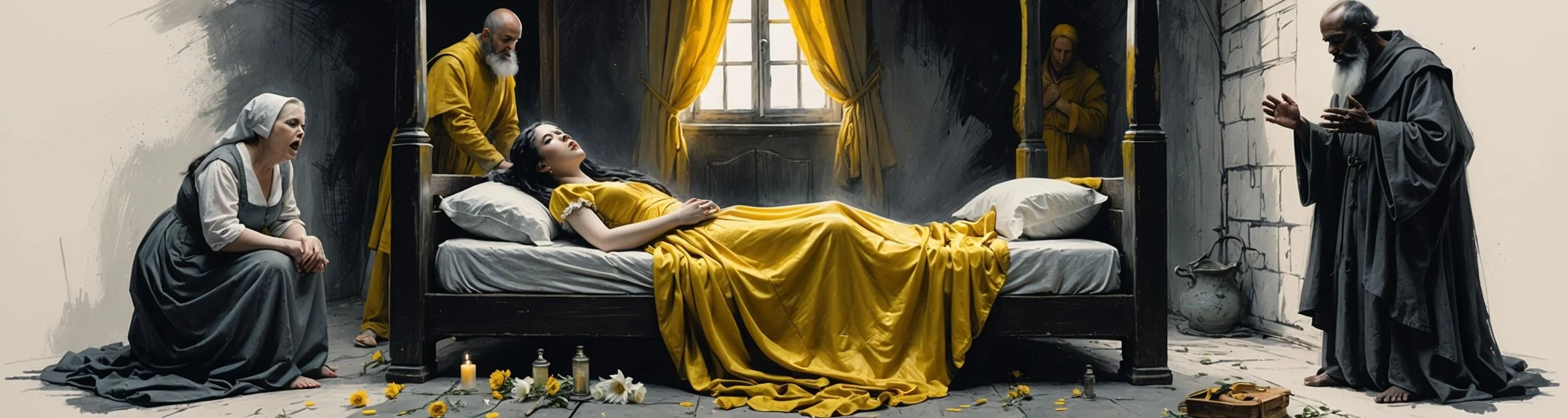
Scene Profile – At a Glance
- Location: Juliet's chamber in the Capulet house, on the morning of her wedding to Paris.
- What Happens: The Nurse goes to wake Juliet and finds her apparently dead. The household erupts in grief, but Friar Laurence, who knows the truth, urges restraint and tells them to carry her to the tomb. The scene then turns to comic banter between Peter and the hired musicians.
- Key Characters: the Nurse, Lord Capulet, Lady Capulet, Paris, Friar Laurence.
- Dramatic Function: The false climax of the tragedy – the family mourns a death the audience knows is only sleep, and the plan that should save the lovers is already going wrong.
- Famous Quote:
"Death lies on her like an untimely frost
Upon the sweetest flower of all the field."
(Capulet, Act 4, Scene 5) - Why It Matters: Dramatic irony is at its sharpest here: we watch real grief poured out over a girl who is only drugged, and the abrupt comic ending unsettles everyone in the theatre.
Scene Summary
It is the morning of Juliet's wedding to Paris. The Nurse bustles in to wake her, teasing the supposedly sleepy bride. When Juliet does not stir, the Nurse pulls back the curtains and discovers her cold and still. Believing her dead, she cries out in horror for help.
Lady Capulet arrives, then Capulet, and the household collapses into grief. Capulet touches his daughter and finds her cold; the Nurse, Lady Capulet, Capulet and Paris each lament in turn, their cries piling on top of one another.
Friar Laurence enters with Paris and the wedding musicians. Knowing the truth – that Juliet has taken his sleeping potion – he steps in to calm the family, reminding them that she is now in heaven and that grief helps no one. He instructs them to dress her in her finest clothes and carry her to the family tomb, turning the wedding preparations into a funeral.
The mourners go out. The scene then changes tone completely: the hired musicians, now with no wedding to play, banter with the Capulets' servant Peter about payment and a song, trading insults and puns before going off to wait for dinner.
The Nurse's Discovery
The scene opens lightly, almost comically. The Nurse comes to rouse the bride, scolding her for lying in and joking that she should sleep now because Paris will give her little rest tonight. The bawdy teasing makes the discovery that follows all the more shocking.
Original
Alas, alas! Help, help! My lady's dead!
O, well-a-day, that ever I was born!
(the Nurse, Act 4, Scene 5)
Shakespeare Retold (Modern Verse)
Oh no, oh no! Help, help! My lady’s dead!
I curse the day that ever I was born!
The Nurse's cry is raw and instinctive, the voice of a woman who has loved Juliet like her own child since infancy. There is no poetry in her grief, only repetition and panic – "Help, help!", "alas, alas!" – and the audience feels the full weight of it even while knowing it is misplaced. This is the engine of the whole scene: every word of mourning is real, and every word is wasted, because Juliet is only sleeping. Shakespeare lets us watch the household break apart over a tragedy that has not happened.
The Household's Grief
Lady Capulet, Capulet and Paris arrive in quick succession, and the chamber fills with lament. Capulet, who only scenes earlier was raging at his daughter, now touches her cold body and finds his anger turned to anguish.
Original
Death lies on her like an untimely frost
Upon the sweetest flower of all the field.
(Capulet, Act 4, Scene 5)
Shakespeare Retold (Modern Verse)
Death covers her like unexpected frost
That kills the sweetest flower in all the field.
The grief is formal and heightened – each mourner takes a turn, the cries stacking into a kind of shared keening. Capulet's image of Juliet as a flower killed by frost is genuinely moving, and it picks up the play's running association of the young lovers with delicate, short-lived natural beauty. Yet there is something studied in the way the family laments, a sense of ritual rather than wild feeling, and this controlled, almost competitive grieving is part of what makes the scene strange. The mourning is sincere, but it is also performed – and the audience, holding the secret, watches it with a doubled awareness.
Friar Laurence Counsels Restraint
Friar Laurence enters knowing exactly what has happened, since he supplied the potion himself. He cannot say so, and instead steps in to quiet the family with the consolations of religion, telling them that Juliet is better off in heaven and that their grief is, in a sense, selfish.
Original
She's not well married that lives married long;
But she's best married that dies married young.
(Friar Laurence, Act 4, Scene 5)
Shakespeare Retold (Modern Verse)
It’s not a happy marriage when it’s long;
It’s better, when you’re married, dying young.
There is a queasy double meaning in everything the Friar says. To the family his words are pious comfort; to the audience, who know Juliet is alive, they sound almost like a man brazening out a lie. His advice that she should be carried to the tomb is, of course, exactly what his plan requires – he needs her in the Capulet vault so that Romeo can collect her when she wakes. The Friar is managing the crisis even as he appears to soothe it, and his counsel of restraint is also damage control. It is a measure of how far his well-meant scheming has now pulled him into deception.
The Musicians' Coda
The mourners leave to prepare the funeral, and the scene takes a sharp and disconcerting turn. The hired wedding musicians, suddenly with nothing to play, fall into knockabout comedy with the servant Peter, who demands a cheerful tune and then trades insults and bad puns with them.
Original
Faith, we may put up our pipes, and be gone.
(a Musician, Act 4, Scene 5)
Shakespeare Retold (Modern Verse)
Let’s put our instruments away, and leave.
The tonal switch is jarring, and it is meant to be. Moments after a household has wept over a dead child, the stage is given over to wordplay about silver sounds and unpaid fees. Some find the coda a misjudgement or a sop to the groundlings; others read it as deliberate – a deflating reminder that life, and the trades that serve it, carry on indifferently around private catastrophe, and a way of keeping the audience off balance before the final act. Either way it sits oddly against the grief that precedes it, and the discomfort is the point. The scene refuses to let us settle into pure tragedy.
Language and Technique
- Dramatic irony: The audience knows Juliet is only drugged, so every cry of grief lands twice – as real feeling and as wasted feeling.
- Repetition: The mourners pile up echoing cries – "she's dead, she's dead, she's dead", "O day! O day! O day!" – building a stylised, ritual lament.
- Antithesis: Capulet turns every wedding word into its funeral opposite – instruments to bells, wedding cheer to burial feast, hymns to dirges.
- Nature imagery: Juliet is "the sweetest flower of all the field", killed by an "untimely frost", continuing the play's link between the young and fragile, brief beauty.
- Tonal switch: The shift from heightened grief to the musicians' low comedy is abrupt and unsettling, refusing the audience a simple tragic mood.
Key Quotes from Act 4, Scene 5
Quote 1O woe! O woful, woful, woful day!
Most lamentable day, most woful day...
(the Nurse, Act 4, Scene 5)
Shakespeare Retold (Modern Verse)
Oh woe! Oh, woeful, woeful, woeful day!
Most awful, mournful day, most woeful day...
O son! The night before thy wedding-day
Hath Death lain with thy wife. There she lies...
(Capulet, Act 4, Scene 5)
Shakespeare Retold (Modern Verse)
Oh son-in-law! The night before your wedding,
Death’s killed your wife in sleep. She’s lying there...
All things that we ordained festival,
Turn from their office to black funeral...
(Capulet, Act 4, Scene 5)
Shakespeare Retold (Modern Verse)
All of our preparations for the wedding
Must be converted for the funeral.
For though fond nature bids us an lament,
Yet nature's tears are reason's merriment.
(Friar Laurence, Act 4, Scene 5)
Shakespeare Retold (Modern Verse)
But though our human nature makes us cry,
We should be glad to know the reason why.
Key Takeaways
- The false death: The Nurse finds Juliet apparently dead, but the audience knows she has only taken the Friar's sleeping potion.
- Grief over nothing: The Nurse, Lady Capulet, Capulet and Paris all mourn in heightened, formal language for a death that has not happened.
- The Friar's double game: Friar Laurence calms the family and sends Juliet to the tomb – the very thing his secret plan requires.
- The jarring coda: The scene ends with comic banter between Peter and the musicians, an unsettling switch from grief to low comedy.
Study Questions and Analysis
Why is the discovery of Juliet's "death" so heavy with dramatic irony?
Dramatic irony is at its most intense in this scene because the audience holds a piece of knowledge that every character on stage lacks: Juliet is not dead at all, but has taken Friar Laurence's potion, which only mimics death. We have watched her drink it and heard the Friar explain the plan, so when the Nurse pulls back the curtains and cries out, we know her grief is misplaced before she does.
Alas, alas! Help, help! My lady's dead!
O, well-a-day, that ever I was born!
(the Nurse, Act 4, Scene 5)
Shakespeare Retold (Modern Verse)
Oh no, oh no! Help, help! My lady’s dead!
I curse the day that ever I was born!
The effect is complex and deliberately uncomfortable. We feel the genuine pain of a family losing a child, yet we also know it is unnecessary, which holds us at a slight distance from the mourning even as it moves us. Susan Snyder, in her essay 'Romeo and Juliet: Comedy into Tragedy' (1970), influentially argued that the play keeps shifting between comic and tragic modes; this scene is a striking instance, since the irony belongs to comedy – the gap between what characters believe and what we know – even as the surface is pure mourning. The result is a scene that the audience cannot take entirely straight, which prepares the ground for the genuinely irreversible tragedy of Act 5.
How does Shakespeare use repetition in the family's mourning?
The lament is built almost entirely out of repetition. The Nurse repeats "woful" and "O day!" over and over; Lady Capulet cries "she's dead, she's dead, she's dead"; Paris and Capulet pile up strings of single adjectives – "Beguiled, divorced, wronged, spited, slain!" and "Despised, distressed, hated, martyred, killed!" Each mourner takes a turn, and the cries stack on top of one another into a kind of antiphonal wailing.
The effect is to make the grief feel stylised and formal rather than naturalistic. This is sometimes read as a weakness – the lamentation can sound mechanical, even unintentionally comic in performance – and some scholars have wondered whether Shakespeare is partly parodying conventional stage grief here. Marjorie Garber, in Shakespeare After All (2004), notes how the play repeatedly sets formal, patterned language against raw feeling, and the heaped-up cries of this scene are a clear case: the very excess of the formula keeps us aware that we are watching a performance of grief. Because we also know the death is false, that awareness is sharpened, and the repetition hovers between the moving and the absurd in a way that suits the scene's unstable tone.
What does the scene reveal about Friar Laurence's position?
It places Friar Laurence in a deeply compromised position. He arrives knowing the truth – he gave Juliet the potion and devised the whole scheme – yet he must stand among the grieving family and pretend to share their loss while quietly steering events towards his own plan. His counsel of patience is genuine pastoral care, but it is also self-interested: he needs the family calm, and he needs Juliet placed in the tomb where Romeo can reach her.
For though fond nature bids us an lament,
Yet nature's tears are reason's merriment.
(Friar Laurence, Act 4, Scene 5)
Shakespeare Retold (Modern Verse)
But though our human nature makes us cry,
We should be glad to know the reason why.
Critics have long disagreed about how to judge the Friar. Harold Bloom, in Shakespeare: The Invention of the Human (1998), is sharply critical of his meddling, seeing his elaborate schemes as a chief mechanism of the catastrophe. Others read him more sympathetically as a well-meaning man overtaken by events. This scene gives evidence for both views: his words are kindly and his motives are partly good, but the play also shows him managing a family's grief with consolations he knows to be untrue, and lining up the very move – sending Juliet to the vault – that will, through one piece of bad luck, help destroy her. It is a small, telling glimpse of how far his benevolent scheming has carried him into deception.
Why does Capulet describe Death as Juliet's bridegroom?
Capulet reaches for one of the play's most haunting conceits: that Death itself has become Juliet's husband, claiming her on her wedding morning before Paris could. He calls Death his son-in-law and his heir, the suitor who has lain with the bride. This fuses the imagery of marriage and the grave, of sex and death, into a single disturbing figure.
O son! The night before thy wedding-day
Hath Death lain with thy wife. There she lies...
(Capulet, Act 4, Scene 5)
Shakespeare Retold (Modern Verse)
Oh son-in-law! The night before your wedding,
Death’s killed your wife in sleep. She’s lying there...
The Death-as-bridegroom image is part of a pattern that runs across the whole play, in which love and death are constantly entangled – Juliet herself earlier imagines making her grave her wedding bed, and Romeo will speak in Act 5 of Death keeping Juliet for his own. Caroline Spurgeon's study of the play's imagery, Shakespeare's Imagery and What It Tells Us (1935), traced how insistently it binds together brightness and darkness, love and the tomb; Capulet's conceit here is a grim flowering of that pattern. It is bleakly ironic too: Juliet has indeed escaped the marriage Capulet forced on her, but not as he thinks, and his words about a wedding turned to a funeral are truer than he knows.
What is the effect of the musicians' comic scene at the end?
The ending is one of the most debated moments in the play. Having watched a family break down over a dead child, the audience is suddenly given low comedy: the servant Peter trades insults and puns with the hired musicians about playing a merry tune and about who will be paid. The switch from heightened grief to knockabout banter is abrupt and, to many, jarring.
Faith, we may put up our pipes, and be gone.
(a Musician, Act 4, Scene 5)
Shakespeare Retold (Modern Verse)
Let’s put our instruments away, and leave.
Critical opinion is divided. Some have seen the passage as a weak afterthought, a scrap of clowning for the groundlings that modern productions often cut. Others defend it as purposeful. Harley Granville-Barker, in his Prefaces to Shakespeare (1930), was alert to how Shakespeare uses such comic relief to control the audience's mood and pace a tragedy, and the musicians' scene can be read as a deliberate easing of tension before the relentless final act. It also makes a quietly bleak point: the tradesmen are unmoved by the household's catastrophe, thinking only of their fee and their dinner, so that ordinary indifferent life is shown carrying on around private grief. Read that way, the discomfort the scene produces is exactly its purpose – it refuses to let the audience rest in pure pathos.
How does this scene fit into the play's pattern of haste and bad timing?
The scene is a hinge in the play's machinery of haste and mistiming. Everything here springs from the rushed wedding: Capulet brought Juliet's marriage to Paris forward by a day, which forced the Friar's desperate plan into action sooner than was safe, which is why the family comes to wake a "dead" bride on what should have been her wedding morning. The compression of events that has driven the whole tragedy reaches a kind of crisis point in this chamber.
What makes it tragic rather than merely unlucky is that the plan is sound but fragile, depending on perfect timing and clear communication – and the audience already senses how easily it could fail. A. C. Bradley's 1904 Shakespearean Tragedy located the force of Shakespearean tragedy partly in character and partly in a sense of fate closing in; here the two work together, as the Capulets' haste and the Friar's risky cleverness combine with sheer bad luck to set up the catastrophe. The grief in this scene is false, but it rehearses the real grief to come, and it reminds us that the rescue the lovers are relying on is a frighteningly delicate thing. From here, a single failed message in Act 5 is all it will take.