Romeo and Juliet: Act 5, Scene 1 – Analysis
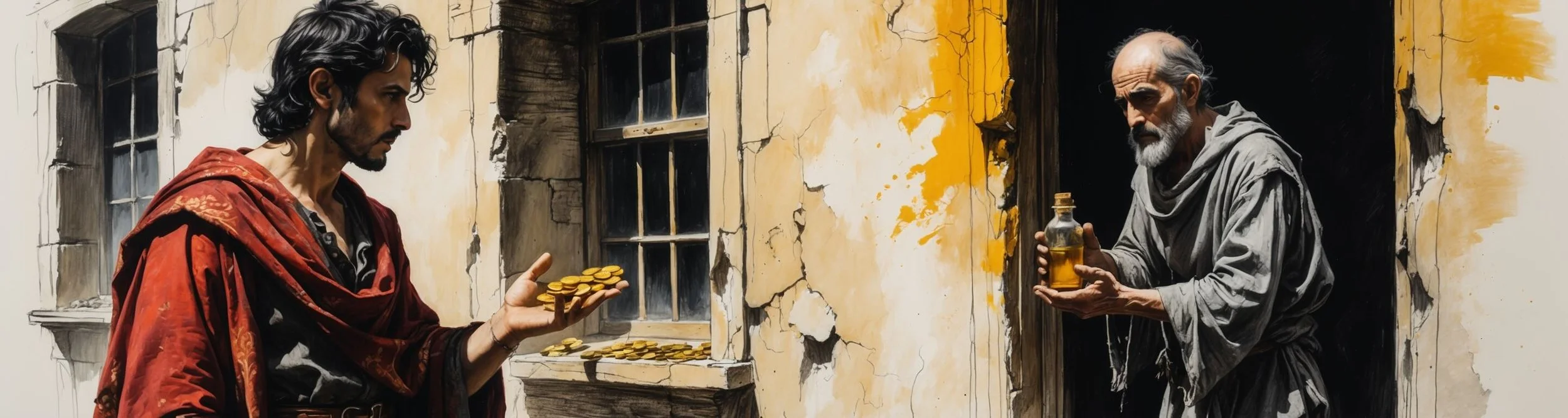
Scene Profile – At a Glance
- Location: A street in Mantua, where Romeo is in exile.
- What Happens: Romeo, cheered by a hopeful dream, is met by his servant Balthasar with the news that Juliet is dead and buried. The Friar's warning letter has not reached him. Romeo resolves to return to Verona and die beside her, and buys a deadly poison from a poor, reluctant apothecary.
- Key Characters: Romeo, with his servant Balthasar and an apothecary.
- Dramatic Function: The catastrophe begins – the false news of Juliet's death sets Romeo on the road to the tomb, and the failed letter turns the Friar's rescue plan into disaster.
- Famous Quote:
"Is it even so? Then I defy you, stars!"
(Romeo, Act 5, Scene 1) - Why It Matters: Romeo's grief hardens instantly into deadly resolve, and his haste – deciding to die before he learns the truth – drives the tragedy to its close.
Scene Summary
On a street in Mantua, where he has been living in exile, Romeo reflects on a strange but hopeful dream. He dreamt that Juliet found him dead, then revived him with a kiss, and he takes this as a sign that good news is coming.
His servant Balthasar arrives from Verona. Instead of the hoped-for news, he brings word that Juliet is dead and has been laid in the Capulet tomb. Crucially, he carries no letter from Friar Laurence – the message explaining that Juliet's death is only a sleeping-potion fake has not reached Romeo.
Romeo's reaction is immediate and absolute. He declares that he defies the stars, sends Balthasar to hire horses, and resolves to return to Verona that night to lie beside Juliet in death. He remembers a poor apothecary who lives nearby and, despite the man's fear of Mantua's death penalty for selling poison, persuades him with gold to hand over a fast and deadly drug.
Reflecting bitterly that gold does more harm in the world than any poison, Romeo takes the drug and sets off for Juliet's grave, calling it not poison but a cordial that will carry him to her.
The Hopeful Dream
The scene opens on a Romeo we have not seen before: calm, almost light-hearted, buoyed by a dream he reads as a promise of joy. After the storm of his banishment, he sounds steady, even hopeful.
Original
If I may trust the flattering truth of sleep,
My dreams presage some joyful news at hand:
(Romeo, Act 5, Scene 1)
Shakespeare Retold (Modern Verse)
If I can trust my dreams to tell the truth,
Well then, my dreams predict some happy news.
The irony is brutal. Romeo dreamt that his lady found him dead and that her kiss "breathed such life" into him that he revived "an emperor" – a dream of death overturned by love. The audience, who know what is coming, hears it the other way round: the dream is closer to a prophecy of the tomb than of rescue. He calls it "flattering" and reads only the comfort in it, his spirits high precisely at the moment his fate is about to fall. This brief calm makes the news that follows land all the harder.
The News and the Defiance of the Stars
Balthasar arrives, booted from the road, and Romeo greets him eagerly – expecting the letters that will explain the plan. What he gets instead is the worst possible report, delivered plainly.
Original
Her body sleeps in Capel's monument,
And her immortal part with angels lives.
(Balthasar, Act 5, Scene 1)
Shakespeare Retold (Modern Verse)
Her body’s in the crypt of Capulet’s
And her eternal soul is now in heaven.
The detail that drives the whole catastrophe is what Balthasar does not bring: any letter from the Friar. Friar Laurence's message, explaining that Juliet only seems dead, has failed to arrive, so Romeo believes the death is real. His response is instant and final.
Original
Is it even so? Then I defy you, stars!
(Romeo, Act 5, Scene 1)
Shakespeare Retold (Modern Verse)
Can it be true? Then I defy you, fate!
There is no hesitation, no weeping, no plan to verify the report. In a single line, grief becomes resolve: if the heavens have killed Juliet, Romeo will defy them by joining her in death. He brushes aside Balthasar's worried plea for patience – "Your looks are pale and wild" – and sends him for horses. This is the decisive, hardened Romeo of Act 5, a world away from the lovesick boy who sighed over Rosaline in Act 1. His haste, here as everywhere in the play, is fatal: had he paused even a day, the Friar's truth would have caught up with him.
The Apothecary and the Poison
Alone, Romeo turns his mind to means. He remembers a poor apothecary whose shop he had noticed nearby – a wretched, half-starved man surrounded by the props of poverty, exactly the sort of desperate figure who might break the law for money.
Original
And in his needy shop a tortoise hung,
An alligator stuffed, and other skins...
(Romeo, Act 5, Scene 1)
Shakespeare Retold (Modern Verse)
And in his meagre shop, a tortoise hung;
An alligator, stuffed; and other skins
Romeo offers forty ducats for a poison swift enough to kill instantly. The apothecary protests that Mantua's law punishes the sale with death, but Romeo answers his fear with cold logic: a man this poor and oppressed has no reason to keep faith with a world that has given him nothing. He pays not the man's will but his poverty – and the apothecary, beaten down by need, consents. Romeo's parting reflection turns the transaction inside out.
Original
There is thy gold, worse poison to men's souls,
Doing more murders in this loathsome world,
(Romeo, Act 5, Scene 1)
Shakespeare Retold (Modern Verse)
There is your gold, a worse corrupter of men
That kills more people in this wretched world
It is a startling thought from a man about to kill himself: the gold he hands over is a deadlier poison to the soul than the drug he receives. The line widens the scene into a quiet indictment of the world – a society where poverty forces a desperate man to sell death, and where money corrupts more surely than any vial. Romeo then takes the poison up tenderly, renaming it "cordial and not poison", a medicine to carry him to Juliet's grave. The drug that will end his life is, to him, the cure for his grief.
Language and Technique
- Dramatic irony: Romeo reads his dream as a promise of joy, but the audience knows it points towards the tomb, and that the news he is about to hear is false.
- The motif of the stars: "I defy you, stars!" returns to the play's image of fate written in the heavens, the lovers "star-crossed" from the Prologue onward.
- Vivid detail: The portrait of the apothecary's shop – the hanging tortoise, the stuffed alligator, the empty boxes – paints poverty in concrete, almost grotesque images.
- Paradox: Romeo calls gold a "worse poison" than the drug, and renames the poison a "cordial", turning each thing into its opposite.
- Violent simile: The poison is to work "as violently as hasty powder fired" from a cannon, linking love's despair to sudden, explosive death.
Key Quotes from Act 5, Scene 1
Quote 1Is it even so? Then I defy you, stars!
(Romeo, Act 5, Scene 1)
Shakespeare Retold (Modern Verse)
Can it be true? Then I defy you, fate!
Well, Juliet, I will lie with thee to-night.
(Romeo, Act 5, Scene 1)
Shakespeare Retold (Modern Verse)
Well, Juliet, I’ll lie with you tonight.
The world is not thy friend nor the world's law;
The world affords no law to make thee rich;
(Romeo, Act 5, Scene 1)
Shakespeare Retold (Modern Verse)
The world is not your friend, nor is the law;
The world has made no laws to make you rich;
There is thy gold, worse poison to men's souls,
Doing more murders in this loathsome world,
(Romeo, Act 5, Scene 1)
Shakespeare Retold (Modern Verse)
There is your gold, a worse corrupter of men
That kills more people in this wretched world
Key Takeaways
- False news arrives: Balthasar tells Romeo that Juliet is dead, while the Friar's letter explaining the truth never reaches him.
- Grief becomes resolve: Romeo instantly defies the stars and decides to return to Verona and die beside Juliet.
- The decisive Romeo: The hardened, fast-acting Romeo of Act 5 contrasts sharply with the lovesick boy of Act 1.
- The poison bought: A poor, frightened apothecary is persuaded with gold to break the law and sell a deadly drug.
- Haste is fatal: Acting in seconds on a false report, Romeo sets the catastrophe in motion that the Friar's plan was meant to prevent.
Study Questions and Analysis
Why does Romeo decide to kill himself the moment he hears Juliet is dead?
Romeo's decision is instant and absolute. The instant Balthasar reports that Juliet is dead and buried, Romeo neither weeps nor questions the news; he resolves at once to return to Verona and die beside her. His response is a single, decisive line of defiance.
Is it even so? Then I defy you, stars!
(Romeo, Act 5, Scene 1)
Shakespeare Retold (Modern Verse)
Can it be true? Then I defy you, fate!
Harley Granville-Barker, in his Prefaces to Shakespeare (1930), noted how decisively Romeo changes after the death of Mercutio, growing from a dreaming boy into a man who acts without hesitation; that same hardened, fast-acting figure is on show here. The decision is partly a measure of how total his love has become – a world without Juliet is, to him, no world at all. But it is also the play's deepest pattern at work: Romeo acts in haste, on incomplete information, just as he did in marrying within a day and killing Tybalt in a rage. Had he paused even briefly, the Friar's letter or a second messenger might have reached him. His strength of will, which looks heroic, is precisely what dooms him, because it leaves no room for the truth to catch up.
What is the significance of "I defy you, stars!"?
The line is the climax of the play's running image of the stars as fate. From the Prologue's "star-crossed lovers" to Romeo's fear, before the Capulet feast, of "some consequence yet hanging in the stars", the lovers have been presented as governed by forces written in the heavens. Here, told Juliet is dead, Romeo turns on those forces directly.
The defiance is ambiguous, and critics read it in opposite ways. On one reading, Romeo asserts a tragic kind of free will: if the stars have decreed Juliet's death, he will answer them with a death of his own choosing, seizing control of the one thing left to him. On another, the gesture is bitterly ironic, since in rushing to die he does exactly what fate – through the failed letter and the false report – has set up for him. He believes he is rebelling against destiny at the very moment he is fulfilling it. This tension between the lovers as free agents and as the playthings of fate runs through the whole tragedy, and the question of how much blame lies with the stars and how much with the characters' own choices is one the play deliberately leaves open. The theme of fate and destiny is nowhere more concentrated than in this one defiant line.
How does the Romeo of Act 5 differ from the Romeo of Act 1?
The change is one of the play's clearest character arcs. In Act 1, Romeo is a lovesick poseur, mooning over Rosaline in borrowed Petrarchan clichés, melancholy and passive. The Romeo of this scene is decisive, controlled and frighteningly resolute – he hears the worst, makes his choice in a single line, and carries it through without wavering.
Harley Granville-Barker, in his Prefaces to Shakespeare (1930), located the turning point at the death of Mercutio in A3S1, after which the dreaming boy is replaced by a man of swift, hard action. By Act 5 that transformation is complete. Notice how he speaks to Balthasar and the apothecary: brisk, commanding, brooking no argument. He brushes aside Balthasar's plea for patience and overrides the apothecary's fear with cold reasoning. The maturity is real – this is no longer the boy of the opening scenes – but it is a maturity entirely bent towards death. Shakespeare gives Romeo the strength to act decisively only to make that strength the instrument of his destruction, which is part of what makes the ending feel both inevitable and unbearable.
Why does Shakespeare include the long description of the apothecary and his shop?
On the surface the passage is simply Romeo remembering where to buy poison, but it does a great deal of work. The detailed portrait of the shop – the hanging tortoise, the stuffed alligator, the empty boxes and musty seeds – paints the apothecary's poverty in vivid, almost grotesque images, and that poverty is the point.
And in his needy shop a tortoise hung,
An alligator stuffed, and other skins...
(Romeo, Act 5, Scene 1)
Shakespeare Retold (Modern Verse)
And in his meagre shop, a tortoise hung;
An alligator, stuffed; and other skins
The description sets up the moral argument that follows. Romeo has marked the apothecary precisely because he is desperate enough to break the law for money, and the scene uses that desperation to widen the tragedy beyond the lovers. When Romeo declares that gold is a "worse poison" than the drug, the squalid shop is his evidence: here is a man whom poverty has driven to the edge of crime, in a world where the law protects wealth and abandons the poor. The episode also reinforces the theme of individual versus society – both Romeo and the apothecary are crushed by laws and circumstances larger than themselves, and both are forced outside the rules to get what they need. The detail that looks like decoration is really a small, bleak picture of the society in which the lovers' fate plays out.
What does the scene reveal about the theme of fate versus haste?
This scene is where fate and human haste become almost impossible to separate. On the side of fate, everything seems arranged for disaster: the Friar's letter fails to arrive, and Balthasar happens to reach Romeo with the false news first, so Romeo learns of the "death" with no means of discovering the truth. The machinery of chance and mistiming, which the play has been winding tighter since the start, springs here.
Yet the catastrophe is not fate alone. Romeo's own haste, his besetting flaw, completes it. He decides to die in a single line, hires horses the same night, and buys poison within minutes, never pausing to verify the report or send to the Friar. The play repeatedly warns against exactly this – Friar Laurence's "Wisely and slow; they stumble that run fast" – and here the warning goes catastrophically unheeded. The theme of time and haste reaches its grim climax: the few hours between Romeo's decision and the Friar's arrival at the tomb are the gap into which the whole tragedy falls. Critics have long debated where the weight of blame lies – on the indifferent stars, on a feud that poisons everything, or on the lovers' own impetuousness – and this scene is the one where all three forces visibly converge.
Why does Romeo call the poison a "cordial"?
A cordial is a medicine or restorative drink, the opposite of a poison, and Romeo's renaming of the drug is one of the play's sharpest paradoxes. Having just called gold a "worse poison" than the drug he buys, he picks the poison up tenderly and reclassifies it as a cure.
The paradox captures Romeo's whole state of mind. To a man for whom life without Juliet is unbearable, death genuinely is the remedy – the poison will "cure" his grief by ending it and carrying him to her grave. The line belongs to the play's persistent fusion of love and death: from Juliet's wish that her grave might be her wedding bed to Romeo's promise to "lie with" her this night, the lovers keep folding death into the language of love and healing. There is also a bleak irony for the audience, who know that Juliet is not dead and that the "cure" is wholly unnecessary. By renaming the poison, Romeo reveals how completely his despair has inverted the world, so that destruction looks like deliverance and the means of his death feels like comfort.