Romeo and Juliet: Act 5, Scene 2 – Analysis
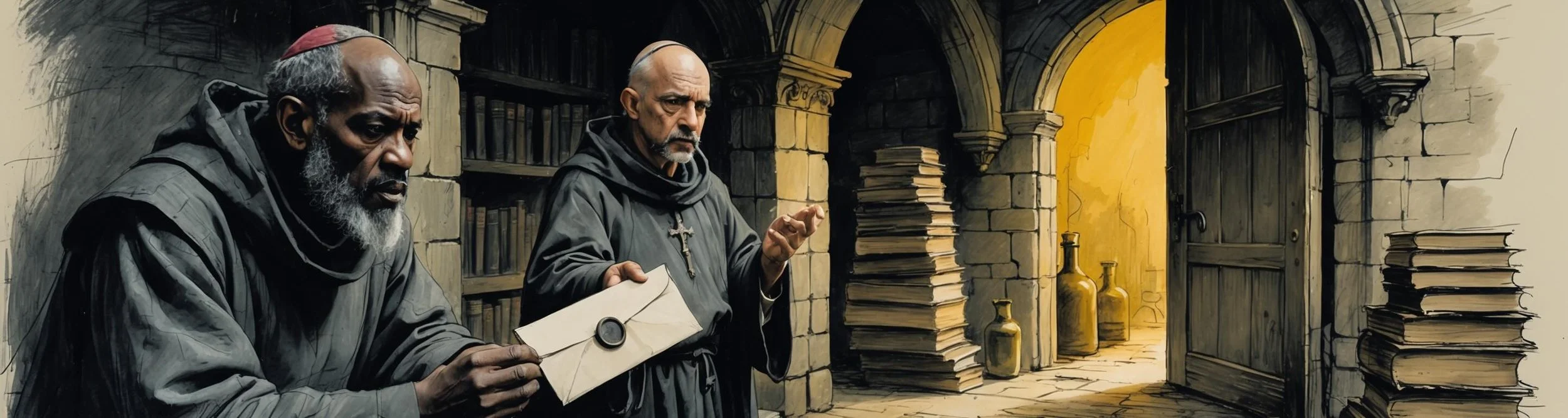
Scene Profile – At a Glance
- Location: Friar Laurence's cell in Verona.
- What Happens: Friar John returns to say he never delivered Friar Laurence's letter to Romeo: quarantined in a plague-suspected house, he could not leave Verona. Realising Romeo still believes Juliet dead, Friar Laurence rushes to fetch a crowbar and go to the tomb himself.
- Key Characters: Friar Laurence, Friar John.
- Dramatic Function: A short scene of pure plot mechanism – blind chance, in the form of a plague quarantine, breaks the rescue plan and seals the tragedy.
- Famous Quote:
"Within three hours will fair Juliet wake..."
(Friar Laurence, Act 5, Scene 2) - Why It Matters: This is the accident that kills the lovers. The plan was sound; only chance defeats it, making the catastrophe feel like fate rather than fault.
Scene Summary
At Friar Laurence's cell, Friar John arrives back from his errand. Friar Laurence asks eagerly what Romeo said, or for the letter Romeo has written in reply. Friar John has neither: he never reached Mantua. Sent to find a fellow friar to travel with him, he had called at a house where the plague was suspected, and the town's officers sealed the doors and would not let him leave. He could not even find a messenger to carry the letter on, so afraid was everyone of infection. He hands the undelivered letter back.
Friar Laurence is appalled. The letter explained everything – that Juliet is not dead but drugged, and will soon wake in the Capulet tomb. Romeo knows none of this. The Friar sends Friar John to fetch an iron crowbar and resolves to go to the vault alone. Juliet will wake within three hours; he must be there, hide her in his cell, and write to Romeo again.
The Letter That Never Arrived
The scene exists to deliver one piece of news, and it is catastrophic. Friar Laurence's whole plan depended on a single letter reaching Romeo in Mantua, telling him that Juliet's death is a fiction and when she will wake. Friar John, the messenger, never got out of Verona.
Original
Suspecting that we both were in a house
Where the infectious pestilence did reign,
Sealed up the doors, and would not let us forth;
(Friar John, Act 5, Scene 2)
Shakespeare Retold (Modern Verse)
Suspected that we’d both been in a house
In which had had an outbreak of the plague,
So they sealed up the doors and locked us in;
What stops the letter is not malice, carelessness or the feud, but an accident of public health: a quarantine. There is no villain in this scene and no mistake by anyone who matters. Friar John did his duty; he was simply shut behind a sealed door by officers doing theirs. The single thread on which the lovers' survival hangs is cut by something nobody could foresee or control – and the audience, who watched the plan laid so carefully, can only watch it fail.
Friar Laurence Races the Clock
The Friar grasps the danger at once, and the scene's second half is a man calculating against time. Juliet will wake in a tomb, alone, with no one who knows the truth coming for her. He cannot wait; he must go himself.
Original
Now must I to the monument alone;
Within three hours will fair Juliet wake:
(Friar Laurence, Act 5, Scene 2)
Shakespeare Retold (Modern Verse)
I must go to the crypt right now, alone;
Within three hours, fair Juliet will wake up:
The word "alone" carries real weight. The elaborate scheme has collapsed to one elderly friar, a crowbar, and a three-hour window. He plans to prise open the vault, hide the waking Juliet in his cell, and write to Mantua a second time. It is still, on paper, a workable rescue. But the audience has just seen time run faster than the Friar knows: Romeo has already heard a false report of Juliet's death and is, even now, riding to Verona to die beside her. The Friar is racing a clock that has already beaten him.
Language and Technique
- Dramatic irony: We already know Romeo believes Juliet dead and is hurrying to the tomb, so the Friar's confident "within three hours" rings hollow – we see the trap he cannot.
- Plain, functional verse: Unlike the soaring lines elsewhere, this scene speaks in brisk, practical sentences – news, questions, instructions – matching its job as pure plot mechanism.
- The plague as chance: The quarantine is real-world accident, not poetry; Shakespeare lets blind luck, not character, deliver the fatal blow.
- Foreboding image: The Friar's closing line, "Poor living corse, closed in a dead man's tomb", fixes the picture of a living girl trapped among the dead just before the disaster lands.
Key Quotes from Act 5, Scene 2
Quote 1I could not send it, – here it is again, –
Nor get a messenger to bring it thee,
So fearful were they of infection.
(Friar John, Act 5, Scene 2)
Shakespeare Retold (Modern Verse)
I could not send it – here, you have it back –
Nor get a messenger to bring it here,
So scared they were that I might spread infection.
Unhappy fortune! By my brotherhood,
The letter was not nice but full of charge
Of dear import, and the neglecting it
May do much danger.
(Friar Laurence, Act 5, Scene 2)
Shakespeare Retold (Modern Verse)
That’s so unfortunate! I swear by brotherhood,
The letter wasn’t nice but full of content
Of great importance, and neglecting it
Might cause much danger.
Key Takeaways
- The plan fails by accident: Friar John is quarantined in a plague-suspected house and never delivers the letter explaining Juliet's faked death.
- Romeo is left in the dark: Because the letter never arrives, Romeo still believes Juliet truly dead – the misunderstanding that kills them both.
- Chance, not character, seals the doom: No one does anything wrong; blind luck, in the form of plague, breaks the rescue.
- A race against time begins: Friar Laurence rushes to the tomb alone, but the audience knows Romeo is already on his way to die.
Study Questions and Analysis
Why does Friar John fail to deliver the letter to Romeo?
Friar John never reaches Mantua at all. Sent by Friar Laurence to carry the crucial letter to Romeo, he first looks for a fellow friar to travel with him, as was the custom. He calls at a house where the town suspects an outbreak of plague, and the health officers seal the doors and refuse to let either friar leave. He cannot get out, and cannot even find a messenger willing to carry the letter onward, because everyone is terrified of infection.
Suspecting that we both were in a house
Where the infectious pestilence did reign,
Sealed up the doors, and would not let us forth;
(Friar John, Act 5, Scene 2)
Shakespeare Retold (Modern Verse)
Suspected that we’d both been in a house
In which had had an outbreak of the plague,
So they sealed up the doors and locked us in;
The detail would have struck Shakespeare's audience as grimly familiar: plague closures repeatedly shut London's theatres in the 1590s and 1600s. What matters dramatically is that the failure is nobody's fault. Friar John is neither careless nor cowardly; he is simply caught behind a quarantine door. The whole rescue collapses on an accident of public health, which is exactly why the catastrophe that follows feels less like punishment than like terrible luck.
How does this scene present the theme of fate and chance?
This is the scene where the play's idea of fate stops being a figure of speech and becomes a plain accident. The Prologue called Romeo and Juliet "star-crossed", and across the play characters blame the stars, fortune and the heavens for what befalls them. Here the abstraction takes a concrete, almost mundane shape: a plague quarantine. Friar Laurence's own response names it directly.
Unhappy fortune! By my brotherhood,
The letter was not nice but full of charge
Of dear import, and the neglecting it
May do much danger.
(Friar Laurence, Act 5, Scene 2)
Shakespeare Retold (Modern Verse)
That’s so unfortunate! I swear by brotherhood,
The letter wasn’t nice but full of content
Of great importance, and neglecting it
Might cause much danger.
Susan Snyder, in her essay 'Romeo and Juliet: Comedy into Tragedy' (1970), argued that the play turns on the kind of accident and mistiming that, in a comedy, would be cleared up in time for a happy ending; here the timing fails fatally instead. What is striking is how small the cause is: not a great flaw or a great crime, but an undelivered note. That smallness is the play's particular vision of fate – doom arriving not through a hero's grand error but through a chain of ordinary misfortunes, each plausible, that no one could have prevented. The scene is the clearest single instance of that machinery at work.
What does Friar Laurence decide to do, and why does it matter?
Once he understands the letter never arrived, Friar Laurence acts fast. He sends Friar John for an iron crowbar and resolves to go to the Capulet tomb alone, prise it open, and be there when Juliet wakes – within three hours. He will hide her in his cell and write to Romeo a second time.
Now must I to the monument alone;
Within three hours will fair Juliet wake:
(Friar Laurence, Act 5, Scene 2)
Shakespeare Retold (Modern Verse)
I must go to the crypt right now, alone;
Within three hours, fair Juliet will wake up:
It matters because the plan is still, in itself, sound – and that is what makes the ending so painful. The Friar is not negligent here; he reacts with speed and good sense. But the audience holds knowledge he does not: Romeo has already heard the false news of Juliet's death and is hurrying towards the very tomb the Friar means to reach. The scene therefore turns on dramatic irony and on time and haste: we watch a man race a clock that has already run out. His confident "within three hours" is, to us, unbearable, because we can see how few minutes truly remain.