Romeo and Juliet: Act 5, Scene 3 – Analysis
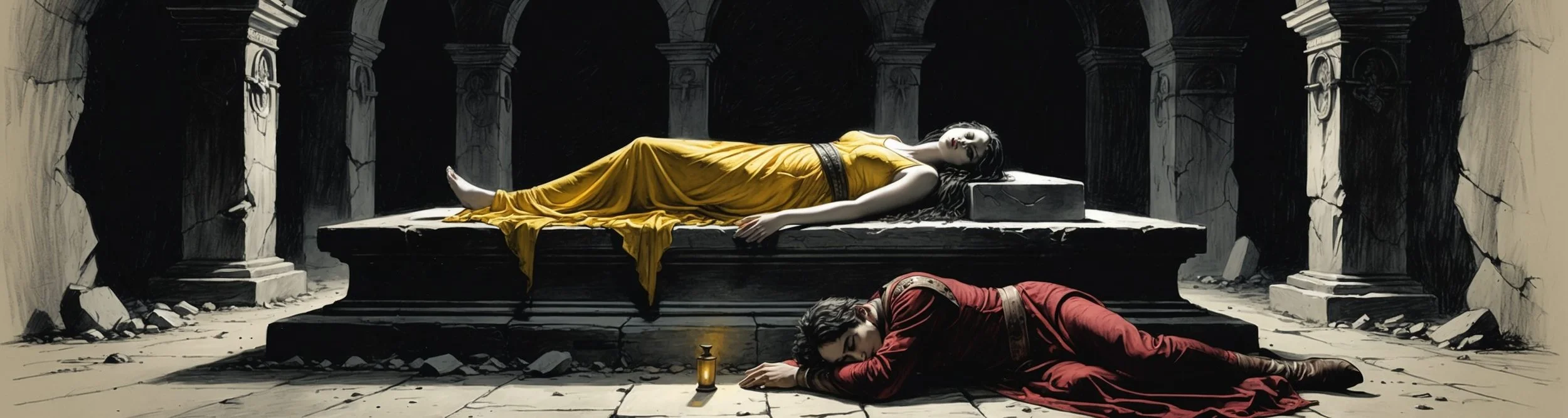
Scene Profile – At a Glance
- Location: A churchyard at night, at the Capulet tomb in Verona.
- What Happens: Paris comes to mourn Juliet and is killed by Romeo. Believing Juliet dead, Romeo drinks poison and dies beside her. Juliet wakes, finds him dead, and stabs herself. The Friar explains everything, and the grieving families finally make peace.
- Key Characters: Romeo, Juliet, Paris, Friar Laurence (with the Prince and the heads of both houses).
- Dramatic Function: The climax and resolution – the lovers die, the truth comes out, and the feud is ended at last by the deaths it caused.
- Famous Quote:
"Thus with a kiss I die."
(Romeo, Act 5, Scene 3) - Why It Matters: This is the play's tragic climax. Both lovers die within minutes of each other, missing rescue by moments, and their deaths shame the families into the peace that living could not buy.
Scene Summary
It is night in the churchyard. Paris arrives to scatter flowers on Juliet's tomb, sending his page to keep watch. When the page whistles a warning, Paris hides and watches a torch approach.
It is Romeo, with his servant Balthasar and tools to break open the tomb. Romeo sends Balthasar away with a letter for his father and a fierce warning not to interfere. Paris steps out and tries to arrest Romeo as the banished murderer of Tybalt. They fight, and Romeo kills Paris, who begs with his dying breath to be laid in the tomb beside Juliet.
Romeo carries Paris into the vault and gazes on Juliet, still so lifelike and beautiful that he cannot believe death has touched her. He says his farewells, drinks the poison he bought in Mantua, kisses her, and dies. Moments later Friar Laurence arrives, too late, and finds both young men dead just as Juliet wakes.
The Friar tries to lead Juliet away as the watch approaches, but she refuses to leave. Alone with Romeo, she finds the empty poison cup, kisses his lips for any poison left on them, then takes his dagger and stabs herself.
The watch raises the alarm. The Prince, the Capulets and the Montagues all gather at the tomb. Friar Laurence tells the whole story – the secret marriage, the sleeping potion, the letter that never arrived. The letter Romeo left confirms it. Faced with their dead children, Capulet and Montague at last take each other's hands and vow to raise golden statues of the lovers. The Prince closes the play, declaring a grief-struck peace and naming this the saddest story ever told.
Paris at the Tomb
The scene opens not with Romeo but with Paris, come quietly by night to mourn the woman he was to marry. It is an unexpectedly tender beginning, and it does Paris a kindness the rest of the play rarely affords him: here he is simply a young man grieving, scattering flowers and promising to keep nightly watch over her grave.
Original
Sweet flower, with flowers thy bridal bed I strew, –
O woe! Thy canopy is dust and stones; –
(Paris, Act 5, Scene 3)
Shakespeare Retold (Modern Verse)
My flower, I’m covering you with bridal flowers –
Oh no! You’re covered up with dust and stones; –
The grief is real, and giving it to us first matters. Paris has been the play's awkward third party – the suitable match, the man Juliet was being forced towards – and it would have been easy to let him die as a mere obstacle. Instead Shakespeare lets us see that he loved her too, in his more conventional way. It deepens the tragedy: another good young man is about to be destroyed by a death that was never real. When his page whistles and a torch appears, Paris hides, certain the intruder has come to defile the Capulet dead – and the stage is set for two men who both love Juliet to meet over her tomb.
Romeo Kills Paris
Romeo arrives armed with a crowbar and a settled purpose: to break into the tomb, look on Juliet a last time, and die beside her. He has dismissed Balthasar with a warning of terrifying ferocity. When Paris steps out to arrest him, Romeo does not want to fight – he pleads with the younger man to leave.
Original
Good gentle youth, tempt not a desperate man;
Fly hence, and leave me: think upon these gone;
(Romeo, Act 5, Scene 3)
Shakespeare Retold (Modern Verse)
Good gentle boy, don’t tempt a desperate man.
Clear off and leave me; think about these dead folk,
The plea is genuine, and it shows how far Romeo has travelled. He calls Paris "good gentle youth", says he loves him better than himself, warns him that he has come "armed against myself". But Paris will not stand aside, and Romeo, pushed past the edge, kills him. Only afterwards, looking at the dead face, does he recognise the man as Mercutio's kinsman and Juliet's intended husband – and, with a strange courtesy, he honours the dying request and lays Paris in the tomb. Even in his desperation, Romeo cannot quite stop being gentle. The killing is one more death the feud did not need, piled onto the heap before the final ruin.
Romeo's Death
Inside the vault, Romeo finds Juliet, and the cruellest irony of the play unfolds before our eyes. She is so warm and rosy that her beauty seems untouched by death – because she is not dead at all, only sleeping out the last minutes of the Friar's potion. Romeo reads the truth and misses it completely.
Original
Call this a lightning? O my love! My wife!
Death, that hath sucked the honey of thy breath,
(Romeo, Act 5, Scene 3)
Shakespeare Retold (Modern Verse)
Call this enlightenment? My love! My wife!
Death, that has stopped your lungs from sweetly breathing,
He even notices that "beauty's ensign yet / Is crimson in thy lips and in thy cheeks" – the very colour that should tell him she lives – and explains it away as death keeping her for a lover. The audience, who know she will wake in moments, can only watch. Romeo says his farewells to eyes, arms and lips, drinks the apothecary's poison, and dies with a kiss. The speed is part of the horror: he has come all the way from Mantua, fought and killed, and still arrives only a breath too early to be saved.
Juliet Wakes
Friar Laurence reaches the tomb seconds too late, finds Paris and Romeo dead, and turns to see Juliet stirring. He begs her to come away to a convent before the watch arrives, but a noise frightens him off, and Juliet, refusing to leave, is left alone with her dead husband.
Original
What's here? A cup, closed in my true love's hand?
Poison, I see, hath been his timeless end:
(Juliet, Act 5, Scene 3)
Shakespeare Retold (Modern Verse)
What’s this? A cup held in my lover’s hand?
I see it’s poison that’s untimely killed him.
Juliet takes in the scene with terrible clarity. She sees the cup, understands at once what Romeo has done, and scolds him gently – "O churl! Drunk all" – for leaving her no poison to follow him. She kisses his lips hoping some poison clings to them, finds them still warm, and as the watch approaches, acts without hesitation. There is no long lament: like Romeo, she chooses death in seconds, and her decisiveness here is the same steel she has shown since their first night.
"O happy dagger"
Hearing the watch, Juliet knows she has no time. She seizes Romeo's dagger and turns his weapon on herself, joining him in death with a few swift, almost glad words.
Original
Yea, noise? Then I'll be brief. O happy dagger!
This is thy sheath; there rust, and let me die.
(Juliet, Act 5, Scene 3)
Shakespeare Retold (Modern Verse)
What, noise? I must be quick. What luck! A dagger!
My breast will be your sheath; rust, as I die.
The dagger is "happy" because it is her way out, her means of staying with Romeo rather than living without him. Where Romeo's death is drawn-out and lyrical, Juliet's is fast and physical – a blade, a single image of the sheath, and silence. The contrast is deliberate: she has always been the more practical of the two, and she dies as she has lived, deciding for herself. Her body falls across his, and the lovers are united in death exactly as the feud kept them apart in life.
The Reconciliation
The deaths are not the end. The watch raises the alarm, and the Prince, the Capulets and the Montagues converge on the tomb. Friar Laurence tells the whole story, the letter confirms it, and the two old enemies are left standing over their dead children. Capulet reaches out first.
Original
O brother Montague, give me thy hand:
This is my daughter's jointure, for no more...
(Capulet, Act 5, Scene 3)
Shakespeare Retold (Modern Verse)
Oh brother Montague, give me your hand:
My handshake is my daughter’s dowry; I can’t
The handshake is the peace the Prince demanded in the very first scene, and it costs two children to buy it. The fathers vow to raise statues of the lovers in pure gold – a gesture both moving and bitter, since gold is what their houses had in abundance while their children had only each other. The Prince has the last word, declaring "a glooming peace" and naming the lovers "poor sacrifices of our enmity". The feud is over, but only because there is almost nothing left to fight for.
Language and Technique
- Dramatic irony: The audience knows Juliet is only sleeping, so Romeo's reading of her living colour as death's trick is unbearable to watch.
- Light and dark imagery: Romeo calls the dark tomb "a feasting presence full of light" because Juliet is in it – the play's light-against-dark pattern blazing one last time.
- Personification of death: Romeo imagines Death as a jealous lover who keeps Juliet in the dark "to be his paramour", turning the grave into a rival's bed.
- Contrast of the two deaths: Romeo's suicide is slow, spoken and poetic; Juliet's is fast and physical – matching the difference in how the two have always acted.
- The closing couplet: The play ends on a rhymed couplet – "more woe" / "her Romeo" – sealing the tragedy with the same neat finality as the opening sonnet.
Key Quotes from Act 5, Scene 3
Quote 1Here's to my love! O true apothecary!
Thy drugs are quick. Thus with a kiss I die.
(Romeo, Act 5, Scene 3)
Shakespeare Retold (Modern Verse)
This is for you, my love! Oh, herbal drugs!
You work so fast. Thus, with a kiss I die.
For here lies Juliet, and her beauty makes
This vault a feasting presence full of light.
(Romeo, Act 5, Scene 3)
Shakespeare Retold (Modern Verse)
For here lies Juliet, and her beauty makes
This vault seem full of radiating light.
To help me after? I will kiss thy lips;
Haply some poison yet doth hang on them,
(Juliet, Act 5, Scene 3)
Shakespeare Retold (Modern Verse)
To help me die with you? I’ll kiss your lips;
And hopefully some poison is still on them
See, what a scourge is laid upon your hate,
That heaven finds means to kill your joys with love.
(Prince Escalus, Act 5, Scene 3)
Shakespeare Retold (Modern Verse)
See, what a curse your hatred has created,
That heaven finds a way to kill your children.
For never was a story of more woe
Than this of Juliet and her Romeo.
(Prince Escalus, Act 5, Scene 3)
Shakespeare Retold (Modern Verse)
For never was a story of more woe
Than this of Juliet and Romeo.
Key Takeaways
- Two more deaths first: Paris is killed mourning Juliet, and Romeo lays his rival in the tomb – the feud claims even those on its edges.
- Missed by moments: Romeo drinks poison just before Juliet wakes; the Friar arrives just too late. Timing, not malice, completes the tragedy.
- Two deaths, two characters: Romeo dies slowly and poetically; Juliet dies fast and decisively – each true to how they have always acted.
- The price of peace: Only the deaths of their children move Capulet and Montague to shake hands and end the feud.
- The closing couplet: The Prince's "never was a story of more woe" seals the play with the saddest and most famous ending in Shakespeare.
Study Questions and Analysis
Why does Shakespeare have Romeo kill Paris at the start of the scene?
Paris's death is easy to forget, but it does important work. By bringing Paris to the tomb to mourn, Shakespeare gives him a final dignity the play has otherwise denied him: he is no longer just the suitable match Juliet was forced towards, but a young man who genuinely grieves her. His killing then becomes one more needless death, piled onto Mercutio and Tybalt, before the lovers even die – the feud's reach widening to the very end.
It also tests Romeo. He does not want to fight; he pleads with Paris to leave.
Good gentle youth, tempt not a desperate man;
Fly hence, and leave me: think upon these gone;
(Romeo, Act 5, Scene 3)
Shakespeare Retold (Modern Verse)
Good gentle boy, don’t tempt a desperate man.
Clear off and leave me; think about these dead folk,
Susan Snyder, in her essay 'Romeo and Juliet: Comedy into Tragedy' (1970), described how the play's second half is governed by a tragic momentum that sweeps even good intentions into disaster, and Paris's death is a clear instance: two men who both loved Juliet meet over her tomb, and one must die. That Romeo afterwards honours the dying man's wish and lays him beside Juliet shows that his gentleness survives even here. The killing is not cruelty but the machinery of the tragedy grinding on, claiming a man whose only fault was to love the same woman.
What is the central irony of Romeo's death scene?
The irony is almost unbearable, and Shakespeare makes the audience feel every second of it. We know that Juliet is not dead but drugged, and that the potion is about to wear off. Romeo, gazing on her, sees the evidence of life with his own eyes and reads it as a trick of death.
For here lies Juliet, and her beauty makes
This vault a feasting presence full of light.
(Romeo, Act 5, Scene 3)
Shakespeare Retold (Modern Verse)
For here lies Juliet, and her beauty makes
This vault seem full of radiating light.
He notices that her lips and cheeks are still crimson and that "death's pale flag is not advanced" – the exact signs that she lives – and explains them away as death keeping her beautiful for itself. Susan Snyder (1970) saw this as the point where the comic machinery of mistimed messages and sleeping potions, devices that in a comedy would resolve happily, tips fatally into tragedy. The deeper cruelty is that the catastrophe turns on minutes, not on any villain: had Romeo paused, or the Friar run faster, both would live. The scene dramatises a world where fate and accident, not wickedness, do the killing – which for many readers is more frightening than any villain could be.
How do Romeo's and Juliet's deaths differ, and what does the contrast show?
The two suicides are staged as deliberate opposites. Romeo's death is long, lyrical and meditative: he speaks a great farewell to Juliet's beauty, personifies death as a jealous lover, bids goodbye to his eyes, arms and lips, and toasts her before drinking. It is the death of a young man in love with the idea of dying for love. Juliet's is the reverse – swift, practical, almost wordless.
Yea, noise? Then I'll be brief. O happy dagger!
This is thy sheath; there rust, and let me die.
(Juliet, Act 5, Scene 3)
Shakespeare Retold (Modern Verse)
What, noise? I must be quick. What luck! A dagger!
My breast will be your sheath; rust, as I die.
Coppélia Kahn, in Man's Estate: Masculine Identity in Shakespeare (1981), reads the lovers against the violent, masculine world of the feud, and the contrast in their deaths fits that frame: Romeo dies by poison, a passive and "feminine" means, while Juliet seizes a dagger, the instrument of the male duellists who have driven the plot. The reversal is pointed. Throughout the play Juliet has been the more decisive partner – quicker to commit, clearer about the stakes – and she dies as she has lived, acting where Romeo agonises. The brevity of "I'll be brief" is the whole of her character: no rhetoric, no delay, just the deed. Together the two deaths complete the portrait of a couple whose differences were always part of their unity.
What is the role of Friar Laurence in this scene, and how much is he to blame?
The Friar is the play's great might-have-been. He arrives at the tomb only seconds too late – Romeo is already dead, and Juliet is just waking. He tries to save her, urging her to a convent, but a noise frightens him, and he flees, leaving her alone to die. He then gives the long confession that explains the whole plot to the assembled families, offering his own life to "the rigour of severest law" if any of it was his fault.
How much blame he deserves is one of the play's open questions. He acted from good motives – to end the feud by marrying the lovers, to save Juliet from bigamy with the sleeping potion – yet every plan he made depended on perfect timing and went wrong. Harley Granville-Barker, in his Prefaces to Shakespeare (1930), treated him sympathetically as a well-meaning schemer undone by haste and ill luck rather than malice. Others are harder on him: his secret marriage, his risky drug, and above all his panicked flight from the tomb leave Juliet to her death. The text holds both readings open – the Prince still calls him "a holy man" – and the question of whether the catastrophe is the Friar's bungling, the families' hatred, or sheer fate is one the play deliberately refuses to settle.
Why do the families finally reconcile, and is the ending hopeful or bleak?
The reconciliation comes only when there is nothing left to fight over. Standing before their dead children, Capulet offers Montague his hand, and the two vow to raise golden statues of the lovers. The peace the Prince ordered in the play's first scene is finally achieved – but the price is the very children who might have inherited it.
O brother Montague, give me thy hand:
This is my daughter's jointure, for no more...
(Capulet, Act 5, Scene 3)
Shakespeare Retold (Modern Verse)
Oh brother Montague, give me your hand:
My handshake is my daughter’s dowry; I can’t
Whether this is hopeful depends on how the gold is read. Marjorie Garber, in Shakespeare After All (2004), notes the bitter irony that the families memorialise in gold the children they could not value in life – the statues are a tribute and a reproach at once. The Prince's closing "glooming peace" refuses any easy comfort: the feud is over, but Verona is poorer, and the love the houses crushed has become a public monument to their failure. Many critics read the ending as redemptive – the deaths are not wholly wasted, since they end the killing – while others find it unrelievedly bleak, a peace bought too dearly to celebrate. The play, characteristically, lets both feelings stand.
How does the theme of fate reach its climax in this scene?
From the Prologue's "star-crossed lovers" onward, the play has insisted that Romeo and Juliet are doomed, and this scene delivers the doom. What is striking is how little villainy is involved. There is no Iago engineering the deaths; the catastrophe turns on a letter delayed by quarantine, a few minutes' difference, a misread sign of life. Romeo even names the force he feels above him as he resolves to die, vowing to "shake the yoke of inauspicious stars".
A. C. Bradley left Romeo and Juliet out of the four great tragedies of Shakespearean Tragedy (1904) as an early and in some respects immature work – yet its accidents were exactly what he reached for when he insisted that Shakespeare uses chance sparingly: the message that never arrived, the awakening a minute too late. For Bradley the deeper destructive force is not mischance at all but the "senseless hatred" of the two houses. Modern critics tend to split the difference, noting that the lovers' own haste – the rushed marriage, Romeo's instant resolve to die – cooperates with the bad luck. Susan Snyder (1970) framed this as comic devices turning lethal: the sleeping potion and the undelivered letter belong to comedy, where such tricks resolve happily, and the tragedy lies in their failing by inches. The scene is the meeting point of character and chance, where fate is less a god's decree than the sum of small things going wrong at the worst moment.
Why does the play end with a rhymed couplet, and what does it achieve?
After three hundred lines of death and disorder, the play comes to rest on two perfectly balanced rhymed lines spoken by the Prince.
For never was a story of more woe
Than this of Juliet and her Romeo.
(Prince Escalus, Act 5, Scene 3)
Shakespeare Retold (Modern Verse)
For never was a story of more woe
Than this of Juliet and Romeo.
Harry Levin, in his classic essay 'Form and Formality in Romeo and Juliet' (1960), showed that the play is framed by formal verse – it opens with a sonnet and closes with this couplet – so that the chaos of the action is held inside a strict poetic shape. The effect of ending on a couplet is one of finality and control: the rhyme clicks shut like a lid. There is also a quiet tenderness in the wording. Juliet is named first, "Juliet and her Romeo", and the possessive "her" keeps the lovers bound together past death. After a play obsessed with haste and broken order, the calm completeness of the closing couplet is the nearest thing to consolation it offers – the suggestion that, in art at least, the story can be made whole. Marjorie Garber (2004) notes how often Shakespeare lets a play's surviving authority figure pronounce its meaning in such a closing couplet; here the Prince's two lines turn private grief into a public story that outlives the lovers.
How does Act 5, Scene 3 resolve the play's central themes?
The final scene gathers every thread the play has spun. The theme of love and violence reaches its end in the tomb, where love literally takes the form of death: Romeo and Juliet kill themselves to be together, and the kiss that began their story becomes the act that ends it. The theme of family and honour is resolved when the feud finally collapses – but only over the bodies of the children whose love the families would not honour.
The scene also closes the play's preoccupation with time and haste. Everything has run too fast – the courtship, the marriage, the deaths – and here the speed is fatal: Romeo dies minutes before Juliet wakes, the Friar arrives minutes too late. Caroline Spurgeon, in Shakespeare's Imagery and What It Tells Us (1935), traced the play's pattern of light flashing against dark, and the pattern peaks here, in the dark vault Romeo says Juliet's beauty fills with light, and in his image of love as "a lightning before death". The Prince's final verdict ties the themes together: the lovers are "poor sacrifices of our enmity", love destroyed by hate, youth by age, light swallowed by dark. The tragedy ends not by solving its contradictions but by paying for them in full.