The Merchant of Venice: Act 4, Scene 2 – Analysis
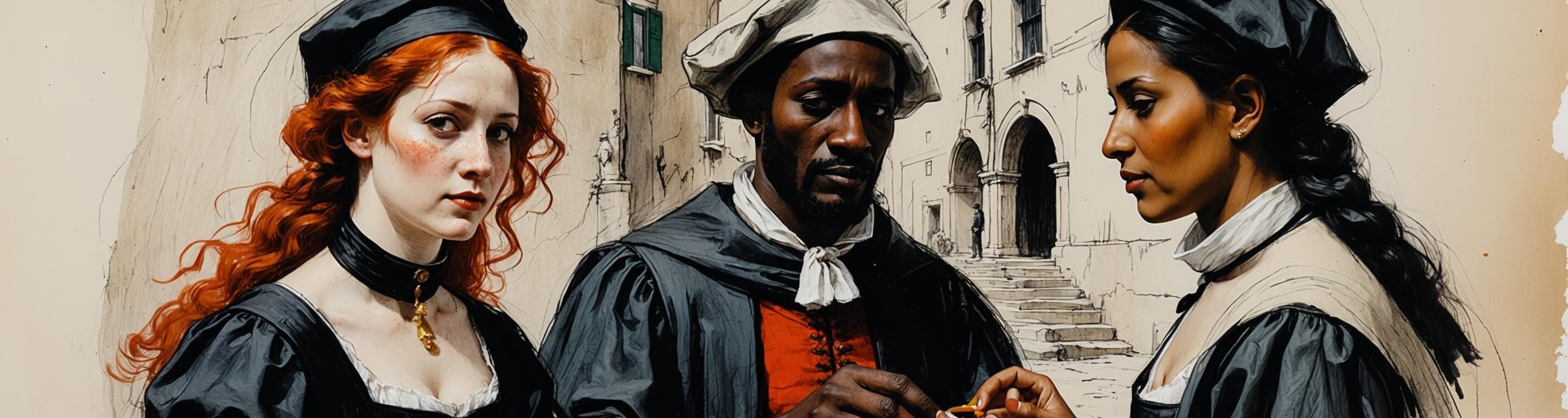
Scene Profile – At a Glance
- Location: A street in Venice, just after the trial, as Portia and Nerissa prepare to leave the city.
- What Happens: Still disguised, Portia sends Nerissa to deliver Shylock's deed of gift to his house. Gratiano catches them up to give Portia the ring Bassanio has surrendered. Nerissa privately resolves to win her own ring from Gratiano, and the two women look forward to the trick they will spring on their husbands.
- Key Characters: Portia and Nerissa (in their lawyer and clerk disguises), and Gratiano.
- Dramatic Function: A brief, busy bridging scene that sets the ring trick fully in motion and points the action away from Venice and towards the comic reckoning at Belmont.
- Famous Quote:
"Thou mayst, I warrant. We shall have old swearing
That they did give the rings away to men;"
(Portia, Act 4, Scene 2) - Why It Matters: It closes the courtroom plot and opens the play's final movement, turning the relief of the trial into the playful marital test that will dominate Act 5.
Scene Summary
On a street in Venice, Portia, still dressed as the young lawyer Balthazar, gives Nerissa the deed they forced Shylock to sign and tells her to find his house and have him sign it. The two women plan to leave that night and reach Belmont a day ahead of their husbands; the deed, which secures Shylock's wealth for Jessica and Lorenzo after his death, will be welcome news for Lorenzo.
As they are about to part, Gratiano hurries up with the ring Bassanio has just given away, sent with an invitation to dinner. Portia accepts the ring but declines the meal, and asks Gratiano to show her clerk the way to Shylock's house. Quietly, Nerissa tells Portia she will try to coax her own ring from Gratiano – the ring she made him swear to keep forever. The two women share a knowing aside about the "old swearing" to come, when their husbands must explain how they parted with their rings, before Nerissa leads Gratiano off.
The Rings Set in Motion
This short scene exists to launch the ring trick, the comic device that will carry the play to its close. Bassanio has already surrendered the ring his wife made him swear never to part with, persuaded that the clever lawyer who saved Antonio deserved it. Now Nerissa decides to set the same trap for Gratiano, turning the men's gratitude into a test of their marital faith. The women hold all the power here: they know the truth, wear the disguises, and can already picture the scene of denial and defence that awaits at Belmont.
Original
I'll see if I can get my husband's ring,
Which I did make him swear to keep for ever.
(Nerissa, Act 4, Scene 2)
Shakespeare Retold (Modern Verse)
I’ll see if I can get my husband’s ring
Which I have made him swear he’ll keep forever.
Nerissa's plan mirrors what Portia has already done with Bassanio, doubling the joke and making it a shared scheme between the two wives. The oath she mentions – that Gratiano swore to keep the ring "for ever" – is exactly what makes the trick bite: the ring is a token of fidelity, and parting with it, however innocently, looks like a small betrayal. The women are not truly angry; they are arranging a lesson, and the playful precision of "for ever" tells us the test is loving rather than cruel.
"We Shall Have Old Swearing"
Portia's reply turns the private scheme into a confident prophecy. She knows the men will protest, deny, and swear blind that they were right to give the rings away – and she relishes the prospect. The phrase "old swearing" means a great deal of vehement oath-taking, and the women already intend to "outface" and "outswear" their husbands, beating them at their own game of protestation.
Original
Thou mayst, I warrant. We shall have old swearing
That they did give the rings away to men;
But we'll outface them, and outswear them too.
(Portia, Act 4, Scene 2)
Shakespeare Retold (Modern Verse)
I bet you can. I’m sure we’ll have them swearing
That they both gave their rings away to men;
But we’ll outsmart them and we’ll talk them down.
There is a delicious dramatic irony buried in the line. The men will swear they gave the rings "away to men" – and they did, but those "men" were the women themselves in disguise. Portia and Nerissa control a secret that makes every future protest both true and absurd. The confident promise to "outface" and "outswear" their husbands also reverses the usual comic balance of power: the wives, not the men, will run the final scenes, and they will do so armed with knowledge the men cannot guess. The scene sends the action speeding towards Belmont with the trap already baited.
Language and Technique
- Bridging scene: Short and brisk, it carries the action from the Venetian courtroom to Belmont, tying off the trial plot and opening the ring plot in a few lines.
- Dramatic irony: The audience knows that the disguised women are the very "men" who received the rings, so every promise of "old swearing" is loaded with a comedy the husbands cannot see.
- Asides: Nerissa and Portia speak privately to one another, letting the audience share their plan while keeping Gratiano in the dark – a neat staging of who holds the power.
- Repetition and patterning: Nerissa's scheme deliberately echoes Portia's, doubling the trick into a shared game and giving the wives a united front.
Key Quotes from Act 4, Scene 2
Quote 1His ring I do accept most thankfully:
And so, I pray you, tell him: furthermore,
I pray you, show my youth old Shylock's house.
(Portia, Act 4, Scene 2)
Shakespeare Retold (Modern Verse)
Most gratefully I do accept this ring,
And so, please let him know. And furthermore,
Please show me where the old man Shylock lives.
Inquire the Jew's house out, give him this deed
And let him sign it: we'll away to-night
And be a day before our husbands home:
(Portia, Act 4, Scene 2)
Shakespeare Retold (Modern Verse)
Find where the Jew lives, then give him this deed
And have him sign it. We will leave tonight
Arriving home a day before our husbands.
Key Takeaways
- The ring trick begins: Nerissa resolves to win Gratiano's ring just as Portia has won Bassanio's, turning the men's gratitude into a test of faith.
- The women hold the power: Still in disguise and in command, Portia and Nerissa know a secret their husbands cannot guess, and plan to "outface" and "outswear" them.
- A bridge to Belmont: The scene ties off the trial, despatches Shylock's deed, and sends the action towards the comic reckoning of the final act.
- Dramatic irony is the engine: The husbands gave their rings "away to men" who were really their own wives, loading the coming quarrel with comedy.
Study Questions and Analysis
What is the dramatic purpose of this very short scene?
The scene is a bridge. It comes immediately after the high tension of the trial, where Portia, disguised as a lawyer, has defeated Shylock and saved Antonio's life. Shakespeare uses these few lines to release that tension and steer the play towards its comic conclusion at Belmont. The courtroom business is tidied away – the deed forcing Shylock to leave his wealth to Jessica and Lorenzo is sent off to be signed – and a lighter plot is set running in its place.
That lighter plot is the ring trick. Having secured Bassanio's ring, Portia watches Nerissa decide to win Gratiano's too, and the two women look ahead with relish to the marital comedy this will produce. The scene's brevity is deliberate: it is a hinge between the play's near-tragedy and its festive ending, quick enough to keep the momentum but pointed enough to plant everything Act 5 will need.
What is the ring trick and why does it matter?
During the trial, Portia and Nerissa appear in disguise as a young lawyer and his clerk. When Bassanio and Gratiano try to thank the lawyer for saving Antonio, the disguised wives ask for the very rings their husbands swore never to remove. Bassanio gives up his ring during the trial; this scene shows Nerissa setting out to win Gratiano's by the same means. The men hand over their tokens of fidelity, never realising they are giving them straight back to their own wives.
The trick matters because it carries the play's final movement and quietly tests the marriages. A ring sworn to be kept "for ever" stands for the promise of faithfulness, so parting with it – even out of generosity to a friend – raises a real question about where a husband's deepest loyalty lies. Coppélia Kahn, in The Cuckoo's Note (1985), reads the ring plot as a contest between the bonds men form with one another and the bond of marriage: by surrendering the ring to the lawyer, Bassanio places his debt to Antonio and his gratitude to a male friend above his vow to his wife, and the trick forces that priority into the open, even stirring the old male anxiety about cuckoldry. The comedy of Act 5 grows directly out of this small scene: the wives will confront the men with their broken oaths, enjoy their floundering excuses, and finally reveal the disguise, turning a potential crisis into a celebration of marriage. It is a playful way of asking whether the bonds of friendship and the bonds of marriage can sit comfortably together.
How does the scene present Portia and Nerissa's power?
Throughout the scene the two women are completely in command. They are still wearing the disguises that fooled the Venetian court, and they alone understand the full situation: they know they are the "men" to whom the rings were given, they control the deed that settles Shylock's estate, and they are arranging the test their husbands will have to face. Gratiano, by contrast, is simply running errands, unaware of the trap being set around him.
Portia's tone captures this authority. Her instructions are crisp and organising, and her aside to Nerissa – that they will "outface" and "outswear" their husbands – promises that the wives will dominate the coming confrontation. Karen Newman, in Portia's Ring (1987), argues that the ring works as a structure of exchange which Portia turns to her own advantage: rather than circulating as a mere token passed between men, it becomes the instrument through which she asserts control, transcending the role of an object given and received to direct the bargaining herself. In a play where women are expected to be obedient and largely silent, this brief scene quietly reverses the usual order: the wives hold the knowledge and the initiative, and the men will spend the final act on the back foot. It prepares the audience to see Portia in particular as the controlling intelligence who steers the whole resolution.