The Merchant of Venice: Act 4, Scene 1 – Analysis
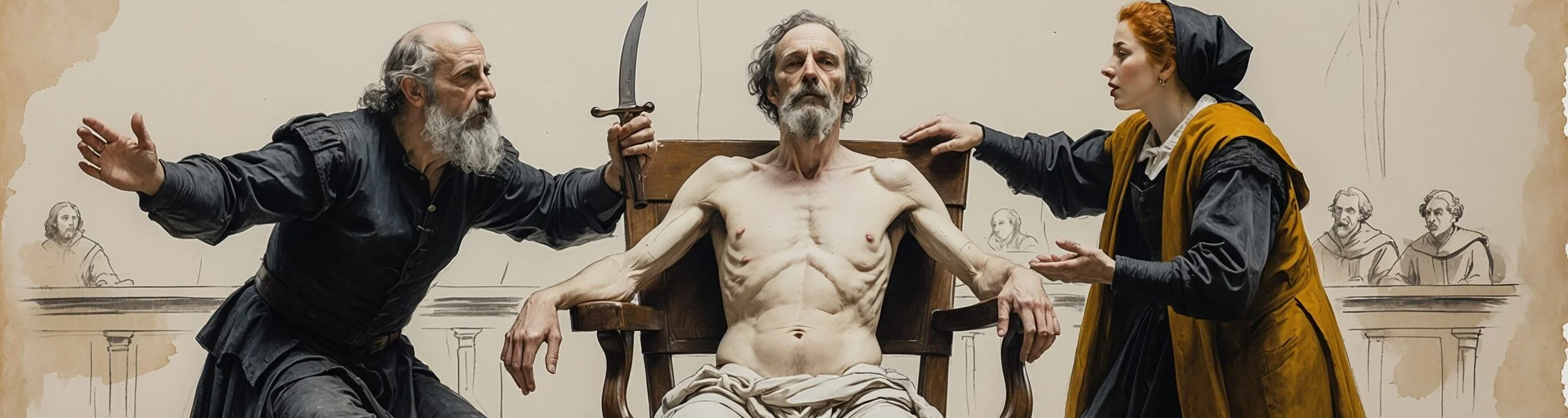
Scene Profile – At a Glance
- Location: A court of justice in Venice, where the Duke presides over the case between Shylock and Antonio.
- What Happens: Shylock demands the pound of flesh promised in his bond. The Duke and Bassanio plead in vain, until Portia arrives disguised as a young lawyer, urges mercy, and then turns the bond against Shylock by ruling that he may take flesh but not a drop of blood. Shylock is ruined, stripped of his wealth, and forced to convert to Christianity.
- Key Characters: Shylock, Portia (disguised as the lawyer Balthazar), Antonio, Bassanio, Gratiano, Nerissa (disguised as a clerk), and the Duke.
- Dramatic Function: This is the climax of the play – the trial that brings every plot strand into one room and decides the fate of both Antonio and Shylock. The bond is enforced, then turned, and the play's central conflict is resolved in a single courtroom.
- Famous Quote:
"The quality of mercy is not strained,
It droppeth as the gentle rain from heaven
Upon the place beneath:..."
(Portia, Act 4, Scene 1) - Why It Matters: The trial scene poses the play's hardest questions – what mercy is worth, whether the law can be just, and how a society treats the outsider it has shut out. The verdict saves Antonio but breaks Shylock, and audiences have argued ever since about whether justice is really served.
Scene Summary
The Duke opens his court in Venice and warns Antonio that he faces a merciless adversary. Shylock is called in, and the Duke appeals to him directly, expecting him to show mercy at the last moment and forgive the debt. Shylock refuses. He has sworn by his Sabbath to claim the forfeit named in his bond – a pound of Antonio's flesh – and will not say why, beyond his settled hatred of the merchant.
Bassanio argues with him and offers twice the original sum, then six times over, but Shylock will not be moved: he wants the bond, not the money. When the Duke asks how he can hope for mercy while showing none, Shylock points to the Venetians' own slaves and insists the flesh is his by right, bought and paid for. The Duke threatens to dismiss the court unless a learned doctor he has sent for arrives to settle the case.
A messenger brings a letter from Bellario, and then the young lawyer himself enters – in fact Portia disguised as Balthazar, with Nerissa as her clerk. Portia confirms the bond is valid under Venetian law and delivers her great plea that Shylock be merciful, since mercy is a divine quality that blesses giver and receiver alike. Shylock will not yield, and praises her as a wise judge when she rules that the law is on his side.
Portia tells Antonio to bare his chest for the knife. Then, at the last possible moment, she springs the trap. The bond grants a pound of flesh but "no jot of blood": if Shylock sheds one drop of Christian blood, his lands and goods are forfeit to the state. He may not cut more or less than an exact pound on pain of death. Shylock, undone, tries to take the money instead, but Portia refuses – he has already rejected it in open court.
Worse follows. Under an old Venetian statute against any alien who plots against a citizen's life, half Shylock's wealth goes to Antonio and half to the state, and his life lies at the Duke's mercy. The Duke spares his life; Antonio asks only that Shylock convert to Christianity and leave his estate to Lorenzo and his daughter Jessica. A broken Shylock agrees and leaves the court. Out of gratitude, Portia asks Bassanio for the ring his wife gave him – setting up the comic confusion of the final act.
The Duke Appeals to Shylock
The scene begins not with argument but with appeal. The Duke assumes, as everyone does, that Shylock is only playing out his cruelty to the last hour before relenting, and he speaks as if a moment of mercy is bound to come. He expects Shylock not merely to drop the forfeit but to forgive part of the loan as well, moved by pity for Antonio's run of misfortune.
Original
Thou'lt show thy mercy and remorse more strange
Than is thy strange apparent cruelty;
And where thou now exact'st the penalty,
Which is a pound of this poor merchant's flesh,
(Duke, Act 4, Scene 1)
Shakespeare Retold (Modern Verse)
That you will then show mercy more unusual
Than your unusual cruelty appears;
And whilst you now demand the bond is paid,
Which is a pound of this poor merchant’s flesh,
The Duke's confidence is part of the scene's cruelty. He treats mercy as the natural, expected ending – "we all expect a gentle answer, Jew" – and his certainty makes Shylock's refusal land all the harder. There is also a sting in the address: even as he begs for human feeling, the Duke calls Shylock "Jew" rather than by his name, the same casual contempt that has shaped Shylock's whole experience of Venice. The appeal to mercy is genuine, but it comes from men who have shown Shylock little of it, and the scene quietly registers that gap.
Shylock's Refusal and the Whetted Knife
Shylock answers the appeal with a flat, frightening refusal. He will give no reason for wanting the flesh beyond his "humour" – his pleasure, his will – comparing his hatred of Antonio to the inexplicable revulsions other men feel at a pig, a cat, or the drone of a bagpipe. The argument is deliberately unanswerable: he claims a right to hate without reason, just as the law grants him a right he need not justify.
Original
So can I give no reason, nor I will not,
More than a lodged hate and a certain loathing
I bear Antonio, that I follow thus
A losing suit against him. Are you answered?
(Shylock, Act 4, Scene 1)
Shakespeare Retold (Modern Verse)
So I cannot explain, nor will I try,
Except for all the hate and utter loathing
I bear Antonio, why I’ve decided
To lose my gold for him. Now, are you answered?
As the case stalls, the stage business turns chilling: Shylock kneels and sharpens his knife on his shoe sole, ready for the cutting. Gratiano rounds on him as an "inexecrable dog" with a wolf's soul, and the courtroom fills with abuse. Shylock stands unmoved, repeating that he stands "here for law". The horror of the moment is real – a man literally whetting a blade to carve into another's chest – yet Shylock's case rests entirely on the Venetians' own legal logic: he has bought his right, and they who keep slaves on the same principle are in no position to lecture him.
"The Quality of Mercy"
Into this deadlock comes Portia, disguised as the young lawyer Balthazar. She does not begin by challenging the bond; she concedes that the law is on Shylock's side, and instead makes a direct appeal to mercy. Her speech is the most famous in the play, and it argues that mercy cannot be forced or demanded – it falls freely, like rain, and blesses both the one who gives it and the one who receives it.
Original
The quality of mercy is not strained,
It droppeth as the gentle rain from heaven
Upon the place beneath: it is twice blest;
It blesseth him that gives and him that takes:
(Portia, Act 4, Scene 1)
Shakespeare Retold (Modern Verse)
It’s effortless performing acts of mercy,
And being merciful is like the rain
That falls upon the ground: it has two merits;
It benefits the giver and receiver.
The speech builds to a religious argument: mercy is "an attribute to God himself", and earthly power is never more godlike than when it tempers justice with mercy. Portia warns that none of us would be saved if we received only strict justice, since we all pray to be forgiven. It is a beautiful and genuinely moving plea – but it is aimed at a man whom Venice has consistently refused to treat with mercy, and there is an uncomfortable irony in Christians lecturing on forgiveness the outsider they have spat upon. Shylock, unmoved, simply demands the law, and the speech that should melt him glances off.
The Bond Turned: "No Jot of Blood"
Having failed to move Shylock, Portia appears to give him everything. She confirms the bond, tells Antonio to prepare his chest for the knife, and lets Shylock savour his triumph – he hails her as a second Daniel come to judgment. Then, at the very edge of the cutting, she stops him with a single legal hair-splitting that destroys his case.
Original
This bond doth give thee here no jot of blood;
The words expressly are 'a pound of flesh:'
Take then thy bond, take thou thy pound of flesh;
But, in the cutting it, if thou dost shed...
(Portia, Act 4, Scene 1)
Shakespeare Retold (Modern Verse)
This bond does not award a drop of blood.
The words expressly state, ‘a pound of flesh.’
Then take your bond and take your pound of flesh.
But if, when cutting it, you cause to shed...
The trap is the bond read with absolute literalness, the very weapon Shylock relied on. He may have his pound of flesh, but the contract says nothing of blood; if he sheds a single drop, or cuts a fraction more or less than an exact pound, he forfeits his lands and his life. Shylock instantly tries to retreat to the money, but Portia holds him to the letter of the law he insisted on – he has refused the cash in open court and may now have "merely justice and his bond". The same legalism Shylock weaponised against Antonio is turned back on him, and Gratiano gleefully throws his "Daniel" praise back in his face.
The Alien Statute and Shylock's Ruin
The reversal does not stop at saving Antonio. Portia invokes a further law: any "alien" who plots, directly or indirectly, against the life of a Venetian citizen forfeits half his goods to his intended victim and half to the state, and his life lies at the Duke's mercy. Shylock, by demanding Antonio's flesh, has placed himself squarely in this predicament.
Original
It is enacted in the laws of Venice,
If it be proved against an alien
That by direct or indirect attempts
He seek the life of any citizen,
(Portia, Act 4, Scene 1)
Shakespeare Retold (Modern Verse)
It is defined within the laws of Venice,
If it is proved against a foreigner
That by direct or indirect attempts
He tries to kill a citizen of ours,
The single word "alien" exposes the truth of Shylock's position: for all his years in Venice, the law classes him as a foreigner who can be stripped and ruined on his enemies' word. The Duke spares his life before he can beg, and Antonio waives his half of the goods – but on two conditions that many find as cruel as anything Shylock intended: that he convert to Christianity and leave his estate to the daughter who robbed and abandoned him. Shylock's flat "I am content" and his plea to be let go because he is "not well" are among the most disputed lines in Shakespeare. Whether the verdict is mercy or a second, deeper cruelty is the question the scene leaves deliberately open.
Language and Technique
- Legalism: The whole scene turns on the exact wording of a contract – "a pound of flesh", "no jot of blood" – so that the climax is won not by force or feeling but by reading the bond more literally than its author did.
- Mercy imagery: Portia's great speech draws on rain from heaven, crowns and sceptres, and the throne of God to argue that mercy is divine, setting tender natural images against the hard machinery of the law.
- Repetition: Shylock's insistent "I stand here for law" and "I will have my bond", and the chorus of "a Daniel" thrown first by Shylock and then mockingly back at him, drive the scene's rhythm and mark the moment the tide turns.
- Dramatic irony: The court takes Balthazar for a learned male doctor, while the audience knows the lawyer is Portia in disguise – an irony that makes her command of the room, and Bassanio's failure to recognise his own wife, quietly thrilling.
- Animal imagery: Shylock is abused as a dog and a wolf with a "currish spirit", language that dehumanises him even as he insists on his legal humanity, sharpening the scene's debate about who the real monster is.
Key Quotes from Act 4, Scene 1
Quote 1And earthly power doth then show likest God's
When mercy seasons justice. Therefore, Jew,
Though justice be thy plea, consider this,
That, in the course of justice, none of us
Should see salvation:...
(Portia, Act 4, Scene 1)
Shakespeare Retold (Modern Verse)
And earthly power then seems to come from God
When justice features mercy. Therefore, Jew,
Although you’re seeking justice, think of this,
That, in the course of justice, none of us
Would get to heaven lest we prayed for mercy;
The pound of flesh, which I demand of him,
Is dearly bought; 'tis mine and I will have it.
If you deny me, fie upon your law!
There is no force in the decrees of Venice.
(Shylock, Act 4, Scene 1)
Shakespeare Retold (Modern Verse)
The pound of flesh, which I insist I have,
Is fairly bought; it’s mine and I will have it.
If you refuse me, then your law be damned!
The laws of Venice lack integrity.
For, as thou urgest justice, be assured
Thou shalt have justice, more than thou desirest.
(Portia, Act 4, Scene 1)
Shakespeare Retold (Modern Verse)
Because you wanted justice, be assured
You will have justice, more than you desire.
Nay, take my life and all; pardon not that:
You take my house when you do take the prop
That doth sustain my house; you take my life
When you do take the means whereby I live.
(Shylock, Act 4, Scene 1)
Shakespeare Retold (Modern Verse)
No, take my life and all; I don’t want pity.
You take my house removing what I use
To pay the upkeep of my house; you kill me
When you remove my means to make a living.
Two things provided more, that, for this favour,
He presently become a Christian;
The other, that he do record a gift,
Here in the court, of all he dies possessed,
Unto his son Lorenzo and his daughter.
(Antonio, Act 4, Scene 1)
Shakespeare Retold (Modern Verse)
Two more provisos: in return for this,
Immediately he must become a Christian;
And also, he decries within his will
Within this court, all his possessions pass to
His son-in-law Lorenzo and his daughter.
Key Takeaways
- The climax of the play: The trial brings every plot strand into one courtroom and decides the fate of both Antonio and Shylock in a single scene.
- Mercy against justice: Portia's "quality of mercy" speech sets free, divine forgiveness against the cold letter of the law – the central tension the whole scene dramatises.
- The bond is turned: Shylock may take a pound of flesh but not a drop of blood, so the legalism he relied on is used to defeat him.
- Shylock is ruined: An old law against aliens strips him of his wealth and forces him to convert, leaving him broken rather than triumphant.
- The verdict is left open: The scene refuses to tell us whether justice is truly served, and audiences still argue over whether Shylock is a villain punished or a victim crushed.
- The rings are planted: Portia's request for Bassanio's ring sets up the comic confusion that closes the play in Act 5.
Study Questions and Analysis
How does the scene explore the conflict between mercy and justice?
The whole trial is built on the collision between mercy and justice, and the theme of mercy vs justice is dramatised more directly here than anywhere else in Shakespeare. Shylock stands for strict justice: he has a valid contract, he has been wronged, and he demands the law be applied to the letter. Portia stands, at first, for mercy: she argues that mercy is freely given, divine in origin, and blesses both giver and receiver.
But mercy is above this sceptred sway;
It is enthroned in the hearts of kings,
It is an attribute to God himself;
(Portia, Act 4, Scene 1)
Shakespeare Retold (Modern Verse)
But mercy is more regal than a sceptre;
It lives within the heart and soul of kings,
An attribute endowed by God himself;
The scene's irony is that mercy loses and justice wins – but a justice so strict it ruins the man who demanded it. For Barbara Lewalski, in her 1962 essay Biblical Allusion and Allegory in The Merchant of Venice, the clash is best read as an allegory of the Old Law against the New: Shylock embodies the letter of justice, while Portia's plea voices the Christian doctrine of mercy and grace that he refuses. Against that reading, A. D. Moody, in his 1964 study Shakespeare: The Merchant of Venice, presses the ironic counter – the Christians who preach mercy show very little of it once they have the upper hand, so their victory exposes them rather than vindicating their creed. Portia cannot persuade Shylock to be merciful, so she defeats him with the very literalism he insisted on; Shylock is then stripped, mocked, and forced to convert. The play sets up mercy as the higher value, then, as Moody insists, shows a society that praises it far more readily than it practises it.
Is the verdict against Shylock just?
This is the question the scene most wants us to argue about, and it has no settled answer. On one reading, the verdict is plainly just: Shylock intended to kill an innocent man under cover of law, and the court stops him using the same law he tried to exploit. He is given his life and even, in the end, allowed to keep half his goods. On this view the trial is a triumph of cleverness over cruelty.
On another reading, the verdict is a stitch-up. Portia wins not on principle but on a technicality – the absurd idea that one can grant a pound of flesh while forbidding the blood that must come with it – and the "alien" statute she then invokes is openly discriminatory, applying only to foreigners. Shylock is punished far beyond stopping the murder: he loses his wealth, his religion, and his daughter's inheritance. Moody's ironic reading bites hardest here: the court does not so much deliver justice as protect its own and crush an outsider it always despised. Walter Cohen, in his 1982 essay The Merchant of Venice and the Possibilities of Historical Criticism, sharpens the point from another angle – the trial is Venice defending the contracts on which its whole economy depends, and the verdict serves the commercial order as much as it serves any abstract justice. Shakespeare leaves the discomfort deliberately unresolved, which is part of why the scene still provokes such strong disagreement.
Why is Shylock forced to convert to Christianity, and how should we read it?
After Shylock's wealth is forfeit, Antonio offers to waive his own share on two conditions: that Shylock become a Christian and leave his estate to Lorenzo and Jessica. The forced conversion is the scene's most disturbing detail, and how to read it divides audiences sharply.
To many in Shakespeare's original audience, conversion might have seemed a genuine mercy – a chance to save Shylock's soul, more valuable than his money. John Gross, in his 1992 study Shylock: A Legend and Its Legacy, traces how differently the punishment has read across four centuries of staging, from a soul saved to an unbearable cruelty inflicted. To most modern readers the demand looks like the cruellest blow of all: the law has already taken Shylock's wealth, and now the court strips him of the faith and identity that made him who he is. Janet Adelman, in her 2008 study Blood Relations: Christian and Jew in The Merchant of Venice, finds in the forced conversion the play's deepest anxiety – the fear that conversion cannot in fact erase Jewishness, that Christian and Jew remain uncomfortably bound to one another. The link to the theme of prejudice and intolerance is hard to miss – the "mercy" Venice offers its outsider is to erase his difference entirely. Shylock's bare "I am content" and his request to leave because he is "not well" give almost nothing away, and the silence is part of the point: the play lets us feel the violence of the demand without telling us what Shylock feels.
What is the significance of Portia's disguise as a male lawyer?
Portia's disguise is central to both the plot and the play's interest in gender and disguise. Disguised as the young doctor Balthazar, she does what no woman in her society could do openly: she enters a courtroom, out-argues every man present, and single-handedly settles the most serious case in Venice. The men defer to "his" wisdom without ever suspecting that the brilliant lawyer is a woman – or that Bassanio's own wife is standing before him.
The disguise lets Shakespeare make a quiet point about ability and gender. Karen Newman, in her 1987 essay Portia's Ring, reads this as the spectacle of an unruly woman in disguise mastering the male court, only to turn at the trial's close to the ring – the device through which she will keep her hold on Bassanio. Portia is plainly the cleverest person in the room, yet she can only exercise that intelligence by hiding the fact that she is a woman. Her command of the law and her control of the scene's timing – letting Shylock think he has won before she springs the trap – show a mind far sharper than the men who patronised her in the casket plot. The disguise also drives the ending: it is as Balthazar that she asks Bassanio for the ring he swore never to part with, setting a private test that will play out as comedy in Act 5. Coppélia Kahn, in her 1985 essay The Cuckoo's Note, reads that ring as the move in a contest between Antonio and Portia for Bassanio – the wife reclaiming her husband from the friend who would die for him. Power, intelligence, and a little mischief all reach her through the freedom the disguise allows.
Is The Merchant of Venice an antisemitic play, or a play about antisemitism?
This is one of the most debated questions in all of Shakespeare, and the trial scene sits at its centre. The case that the play is antisemitic is straightforward: Shylock is the villain, he is abused as a "dog" and a "wolf", he is humiliated and forced to convert, and a largely Christian audience is invited to cheer his defeat. The structure of a comedy rewards the Christians and punishes the Jew.
Harold Bloom, in his 1998 study Shakespeare: The Invention of the Human, refuses to soften this: as a comedy, he argues, the play is profoundly antisemitic, and the trial's humiliation of Shylock resists any redemptive reading – and yet, Bloom concedes, Shylock so dominates the scene that he overpowers the comic frame meant to contain him. The counterweight is the long stage tradition Gross documents, in which Shylock has so often been played as a figure of dignity and pathos that audiences leave moved by him rather than against him. The case that the play is about antisemitism rests on how much sympathy Shakespeare gives Shylock even here. Shylock exposes the Venetians' hypocrisy – they own slaves but call him cruel – and his anguish at losing the "means whereby I live" is real and human. The Christians who preach mercy show him almost none. Many productions and readers now stage the scene as an indictment of the society that crushes Shylock rather than a celebration of it. The honest answer is that the play contains both: it uses antisemitic stereotypes and it also lets Shylock speak with a force that troubles those very stereotypes. The trial scene refuses to resolve the tension, which is exactly why it remains so uncomfortable and so endlessly discussed.
How does Portia win the case on a legal technicality?
Portia wins not by overturning the bond but by reading it more strictly than Shylock himself. She concedes that the contract is valid and that Shylock is entitled to his pound of flesh. Then she points out that the bond grants flesh and flesh alone – it says nothing about blood.
Shed thou no blood, nor cut thou less nor more
But just a pound of flesh: if thou cut'st more
Or less than a just pound, be it but so much
As makes it light or heavy in the substance,
(Portia, Act 4, Scene 1)
Shakespeare Retold (Modern Verse)
Don’t shed his blood, and don’t cut more or less than
A pound of flesh exactly. If you cut more
Or less than just a pound, enough that it
Is lighter or it’s heavier than stated,
The trick is a perfect piece of poetic justice. Shylock has insisted throughout on the absolute letter of the law; Portia simply applies that same literalism back. He may cut flesh, but if he spills one drop of blood or misjudges the weight by a hair, he forfeits his lands and his life. It is, strictly speaking, an impossible condition – no one can cut flesh without blood – and some readers find it a cheat rather than real law. But dramatically it is devastating: the weapon Shylock sharpened against Antonio is turned, word for word, against himself.
What is Antonio's role in the trial scene?
Antonio spends much of the scene as the near-silent figure at its centre – the body on which the whole case turns. Where Bassanio rages and bargains, Antonio is calm, resigned, almost eager to die. He calls himself "a tainted wether of the flock", the weakest sheep, fittest for slaughter, and asks only that Bassanio live on to write his epitaph.
His passivity is striking and has been read in several ways. It deepens the theme of love and friendship: Antonio's willingness to die for Bassanio is the play's grandest gesture of devotion, and his farewell – asking Bassanio's wife to judge "whether Bassanio had not once a love" – carries an intensity many find more than merely friendly. At the same time his earlier cruelty to Shylock is never forgotten, and when he sets the terms of Shylock's punishment, including the forced conversion, the merciful merchant shows a harder edge. Antonio is both the scene's sacrificial victim and one of the architects of Shylock's ruin, and the play lets those two roles sit uneasily together without smoothing them out.
Why does Portia ask Bassanio for his ring at the end of the scene?
Once the case is won, Bassanio presses the young lawyer to accept a reward. Portia, still disguised, refuses payment but asks instead for the one thing she knows Bassanio swore never to give up: the ring his wife placed on his finger, making him vow never to sell, give, or lose it.
The request is a deliberate test. Portia gave Bassanio that ring as a token of their marriage, and now, in disguise, she manoeuvres him into handing it over – first he refuses, then, urged on by Antonio, he sends Gratiano running after the lawyer with it. The moment turns the high seriousness of the trial towards the comedy of the final act, where Portia will confront Bassanio with the missing ring and watch him squirm. It is also a quiet assertion of power: having saved Antonio's life, Portia uses her disguise to gather a small, private hold over her new husband. The ring plot reminds us that beneath the courtroom drama this is still a comedy, and that Portia, not the men, is quietly in control of where it goes next.