The Tempest: Act 1, Scene 1 – Analysis
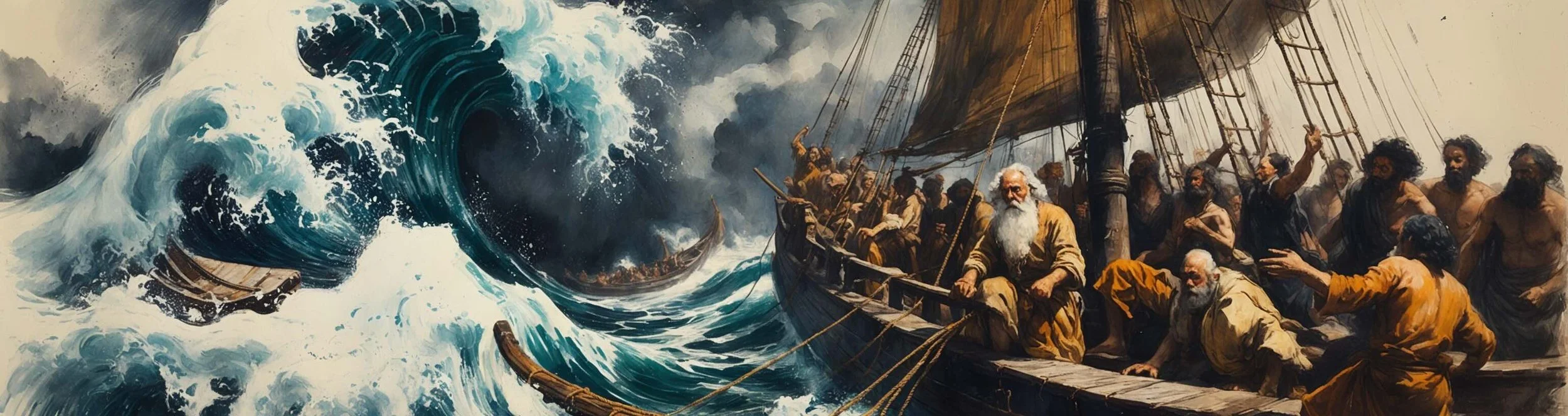
Scene Profile – At a Glance
- Location: On board a ship at sea, in a storm, somewhere between Tunis and Naples.
- What Happens: The crew fight to save the ship while the King of Naples and his courtiers get in the way. The Boatswain orders them below, the mariners give up, and the ship seems to split.
- Key Characters: The Master, the Boatswain and the Mariners; Alonso, King of Naples, with his brother Sebastian, his son Ferdinand, Antonio and old Gonzalo.
- Dramatic Function: The title’s tempest, shown before it is explained: a shipwreck that introduces the court party under pressure and turns rank upside down for one scene.
- Famous Quote:
"What cares these roarers for the name of king?"
(Boatswain, Act 1, Scene 1) - Why It Matters: The play’s first argument is about power, and the sea wins it. Everything the audience later learns about the storm – that it was staged, that nobody drowned – rewrites this scene in memory.
Scene Summary
The play opens in the middle of a storm at sea. The ship’s Master calls the Boatswain, tells him to get the sailors working before the ship runs aground, and goes off; the Boatswain shouts the crew to their tasks and takes in the topsail. Then the passengers come up on deck: Alonso, the King of Naples, his brother Sebastian, his son Ferdinand, Antonio, the Duke of Milan, and the old counsellor Gonzalo. The king asks the Boatswain to take care and wants to know where the Master is. The Boatswain tells them all to get below, because they are in the way and helping the storm.
Gonzalo asks him to be patient and to remember who is aboard. The Boatswain answers that the waves do not care about the name of king, that if the counsellor can command the elements to silence the crew will stop pulling ropes, and that if he cannot he should go to his cabin and prepare for the worst. Gonzalo takes comfort from the man’s face: he looks born to be hanged, not drowned, so the ship should be safe. The courtiers go below and come up again; Sebastian and Antonio curse the Boatswain, who tells them to work if they are so keen. Then wet mariners run in crying that all is lost. Antonio blames the drunken crew, the ship is heard splitting, Antonio and Sebastian go to sink with the king, and Gonzalo, alone, says he would give a thousand furlongs of sea for one acre of barren ground.
Rank Overboard
The scene is a shouting match between two kinds of authority, and the play makes sure the wrong one wins. The Master and Boatswain command by competence; the king and his lords command by title; and on a sinking ship only one of these counts.
Original
None that I more love than myself. You are a counsellor; if you can command these elements to silence, and work the peace of the present, we will not hand a rope more; use your authority: if you cannot, give thanks you have lived so long, and make yourself ready in your cabin for the mischance of the hour, if it so hap.
(Boatswain, Act 1, Scene 1)
Shakespeare Retold (Modern Verse)
There’s no one on board I love more than myself. You are a person of authority; if you can order the wind to die down and reach agreement with the current storm, we will no longer pull the ropes. Use your authority: if you cannot, give thanks that you’ve lived this long, and prepare yourself in your cabin for a potential disaster that might occur.
The Boatswain’s speech is the play’s opening statement on power and control. Asked to remember whom he has aboard, he answers that he loves nobody more than himself, which is not insolence but arithmetic: a drowned king is worth nothing to anyone. His challenge to Gonzalo – use your authority, silence the elements, and we will stop working – is unanswerable, and Gonzalo does not try to answer it. The scene never lets the king speak more than two lines, and the man who does the ordering is a nameless sailor. When the audience later learns that the storm was Prospero’s and the ship was never in danger, this inversion gains a second layer: even the Boatswain’s authority was borrowed from a magician on the shore.
Gallows Humour and the Splitting Ship
Between the Boatswain’s exits, Gonzalo does what he will do for the rest of the play: he finds a reason to hope. His comfort here is a proverb turned into a prophecy.
Original
I have great comfort from this fellow: methinks he hath no drowning mark upon him; his complexion is perfect gallows. Stand fast, good Fate, to his hanging: make the rope of his destiny our cable, for our own doth little advantage. If he be not born to be hanged, our case is miserable.
(Gonzalo, Act 1, Scene 1)
Shakespeare Retold (Modern Verse)
I have great confidence in this chap: I think he doesn’t look like a man who might drown; he looks more like someone who’d be hanged. May fate hold on until his hanging: make his hanging rope the rope we are using, for it’s not helping us right now. If he is not destined to be hanged, our situation is precarious.
The joke is that a man born to be hanged cannot drown, so the Boatswain’s gallows face is the ship’s insurance. It is Gonzalo’s character in miniature – cheerful, garrulous, and right for the wrong reasons, since the crew will indeed survive – and it also plants the play’s habit of treating illusion and reality as a matter of what a face seems to promise. The scene then collapses into noise: the mariners’ cry of all lost, Antonio’s curse on the wide-chapped rascal, the offstage voices calling farewell to wives and children, and the sound of the ship splitting. Gonzalo’s last speech, wishing for an acre of barren ground, is the first of the play’s many prayers for dry land, and the audience has no reason yet to doubt that everyone on board is about to die.
Language and Technique
- Prose under pressure: The whole scene is in prose, the only complete scene of the play that is: nobody has time for verse, and the language is orders, oaths and cries.
- Sailing vocabulary: “Yare”, “topsail”, “main-course”, “lay her a-hold”: real seamen’s commands, which make the storm feel technical and immediate rather than magical.
- Interrupted structure: The Boatswain exits and re-enters three times, and each return finds the courtiers back in the way – the scene is built on repetition to show that rank cannot learn.
- The unanswered challenge: “If you can command these elements to silence” – a demand the counsellor cannot meet, which settles the argument about authority in one sentence.
- Offstage voices: The farewells and the cry of “We split” are reported from within the ship, so the wreck is heard rather than seen – the play’s first piece of staged illusion.
Key Quotes from Act 1, Scene 1
Quote 1
Do you not hear him? You mar our labour: keep your cabins: you do assist the storm.
(Boatswain, Act 1, Scene 1)
Shakespeare Retold (Modern Verse)
Didn’t you hear him? You’re making our job harder: stay in your cabins, else you’ll be helping the storm.
Quote Analysis: The Boatswain’s first rebuke to the court. “You do assist the storm” makes the passengers part of the weather, and the modern prose keeps the accusation: standing about in a crisis is a way of helping it. Antonio, who asked the question, is the man who will spend the play helping storms of his own.
We are merely cheated of our lives by drunkards:
This wide-chapped rascal – would thou mightst lie drowning
The washing of ten tides!
(Antonio, Act 1, Scene 1)
Shakespeare Retold (Modern Verse)
We’ve been cheated to death by drunken sailors:
This big-mouthed rascal – you should drown ten times
From rising water of ten tides!
Quote Analysis: Antonio’s reaction to the news that all is lost is to blame the sailors and curse the Boatswain with a pirate’s death, drowned at the tide-mark. It is the first thing he does in the play and it is characteristic: no fear, no prayer, only contempt for the men doing the work. The modern verse keeps the ten tides.
Now would I give a thousand furlongs of sea for an acre of barren ground, long heath, brown furze, any thing. The wills above be done! But I would fain die a dry death.
(Gonzalo, Act 1, Scene 1)
Shakespeare Retold (Modern Verse)
I’d give fifteen thousand square miles of sea for an acre of barren ground, long heathered moor, brown shrubbery, anything but this. The will of God must be done! But I would rather die a dry death.
Quote Analysis: Gonzalo closes the scene, and the play’s first act of longing is for land – any land, barren heath and furze included. The wish is granted more literally than he could know, on an island whose barrenness or fertility the courtiers will argue about in Act 2. “I would fain die a dry death” is a joke against himself, and the modern prose keeps the rueful tone.
Key Takeaways
- The sea outranks the king: The Boatswain’s question – what do the waves care for the name of king? – is the play’s first statement on power, and nobody on deck can answer it.
- A scene of prose and noise: Orders, oaths and offstage cries replace verse: the storm is staged as chaos before Prospero reveals it as design.
- Characters shown under pressure: Antonio curses, Sebastian swears, Gonzalo jokes and hopes, Alonso prays with his son – each man’s response to the wreck is his character in brief.
- The illusion is planted: Everything here will be re-read in the next scene, when Prospero tells Miranda that not a hair has perished; the audience’s fear was the first trick of the play.
Study Questions and Analysis
Why does The Tempest open with a storm scene?
Because the storm is the play’s engine, and Shakespeare wanted the audience to feel it before understanding it. The scene gives the wreck its full terror – the crew’s frantic commands, the courtiers’ panic, the cry of all lost, the ship splitting – and then the second scene takes it all back, when Prospero tells Miranda that the storm was his work and that nobody has been harmed. The audience is put through exactly what the passengers go through, and then let in on the secret.
The scene also does the practical work of a first scene: it introduces the court party, sorts them by temperament, and establishes that the play’s world is one in which rank can be suspended. Frank Kermode’s Arden edition (1954) noted that the storm draws on the Bermuda pamphlets of 1610, which described a real hurricane, a real wreck and a miraculous survival; the scene’s sailing commands are accurate enough that they can be followed on a chart. That realism is the point. The more the storm looks like weather, the greater the shock when it turns out to be magic and art.
What does the Boatswain mean by “What cares these roarers for the name of king?”
The roarers are the waves, and the Boatswain is telling Gonzalo that the sea does not recognise titles. Gonzalo has asked him to be patient; the Boatswain replies that he will be patient when the sea is, and asks what the roaring waters care that there is a king on board. The line is a plain statement of fact with a large idea behind it: authority is a human arrangement, and in a storm it is worthless.
What cares these roarers for the name of king?
(Boatswain, Act 1, Scene 1)
Shakespeare Retold (Modern Verse)
Do these waves care you are a king?
The play returns to the idea constantly. Prospero lost Milan because he neglected the practical business of ruling; Gonzalo’s commonwealth speech in Act 2 imagines a place with no sovereignty at all; Stephano and Caliban set up a kingdom with a bottle for a sceptre. The Boatswain’s question is the first and bluntest version of the play’s argument about power and control: it belongs to whoever can actually do something. The modern prose keeps it as a question, so that the challenge to Gonzalo stays open.
Is the storm in Act 1, Scene 1 real?
Within the fiction, yes and no. The ship is really at sea and the storm is really raging, but it has been raised by Prospero’s magic through Ariel, and in Act 1, Scene 2 Ariel reports that it performed the tempest to every article, boarded the ship as St Elmo’s fire, and brought everyone safe to shore with not a hair perished. The mariners are asleep under hatches, the ship is hidden in a cove, and the courtiers have been scattered around the island in the groups Prospero wants.
So the first scene is the play’s first piece of theatre-within-theatre, and the audience is its first victim. Some critics have made this the key to the whole play: G. Wilson Knight, in The Crown of Life (1947), read Prospero as a figure of the dramatist himself, and on that reading the storm is a play staged by a playwright for an audience who do not yet know they are watching one. The scene is written to look like chaos, and the rest of the play reveals the design.
What do we learn about the characters in the storm scene?
More than they would like. Alonso’s two lines are a plea for care and an order to the crew; then he goes below to pray with his son. Antonio and Sebastian curse the Boatswain as a dog and a whoreson and blame the crew for their deaths, which is the first sight of the contempt they will show for everyone throughout the play. Gonzalo jokes about the Boatswain’s gallows face, keeps his head, and ends the scene longing for dry land; his cheerfulness under pressure is the quality that made him save Prospero’s books twelve years before.
The sailors, meanwhile, are the only competent people on stage. The Boatswain’s speeches are the play’s first expression of a recurring idea about masters and servants: that the people who do the work understand the world better than the people who own it. He returns in Act 5, reporting that the ship is whole, and the king who was told to get to his cabin has nothing to say to him but wonder.