Hamlet: Act 5, Scene 1 – Analysis
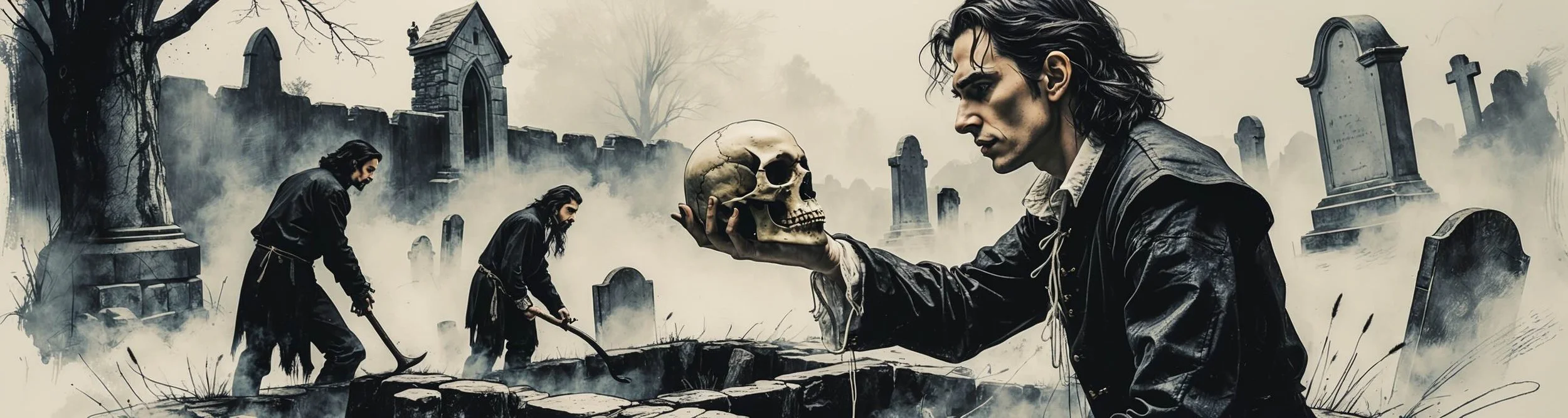
Scene Profile – At a Glance
- Location: A churchyard in Elsinore.
- What Happens: Two gravediggers joke about death while digging Ophelia's grave and debating whether she should have a Christian burial. Hamlet and Horatio arrive; Hamlet contemplates a skull, that of the old jester Yorick, and the levelling power of death. Ophelia's funeral procession enters, and a grief-stricken Hamlet leaps into her grave and grapples with Laertes.
- Key Characters: Hamlet, Horatio, Laertes, the two gravediggers.
- Dramatic Function: The graveyard scene meditates on death and mortality, shows a changed, calmer Hamlet, and brings him face to face with Laertes over Ophelia's grave.
- Famous Quote:
"Alas, poor Yorick! I knew him, Horatio..."
(Hamlet, Act 5, Scene 1) - Why It Matters: "Alas, poor Yorick" is the play's, and perhaps literature's, most famous image of mortality, and the grave fight sets up the deadly duel to come.
Scene Summary
Two gravediggers (called "clowns" for their comic role) dig a grave and argue about whether Ophelia deserves a Christian burial, since her death may have been suicide. Their banter is full of grim jokes about death, the law, and the trade of grave-digging, providing dark comic relief before the tragedy's climax.
Hamlet and Horatio arrive and watch the gravedigger toss up skulls as he works. Hamlet muses on how every kind of person ends as anonymous bones. When the gravedigger reveals that one skull belonged to Yorick, the old court jester Hamlet loved as a child, Hamlet takes it up and reflects with sorrow and disgust on what death makes of us, and how even great rulers like Alexander and Caesar end as dust.
A funeral procession approaches, and Hamlet realises with shock that it is Ophelia's. He hides and watches as a priest grudgingly performs limited rites, hinting at suicide, and as Laertes rages at the meagre ceremony and leaps into his sister's grave.
Overcome, Hamlet reveals himself and leaps into the grave too, declaring his own love for Ophelia. He and Laertes grapple furiously until they are pulled apart. Claudius calms the situation, reminding Laertes of their plan, and the scene ends with the deadly duel now imminent.
Is She to Be Buried in Christian Burial?
The act's climax begins, strangely, in comedy. The gravediggers debate Ophelia's burial in blunt, clownish terms, raising the serious question of suicide through joking and word-twisting.
Original
Is she to be buried in Christian burial that wilfully seeks her own salvation?
(the Gravedigger, Act 5, Scene 1)
Shakespeare Retold (Modern Verse)
Is she to have a Christian burial despite her suicide in search of heaven?
The gravedigger muddles his words – he means "seeks her own damnation" – but the slip is pointed: it questions whether a suicide can be saved at all. Because Ophelia may have drowned herself, she is, by the rules of the time, denied full Christian rites, and the gravediggers grimly note that her rank is the only reason she gets even this much. The comedy is bitter. It exposes how the powerful are treated gently even in death, and it makes us feel the injustice of Ophelia's end, mocked over by labourers who never knew her.
Alas, Poor Yorick
The most famous moment of the scene comes when the gravedigger hands Hamlet a particular skull. It belonged to Yorick, the king's jester, who carried the boy Hamlet on his back. Holding the skull, Hamlet confronts death made personal.
Original
Alas, poor Yorick! I knew him, Horatio: a fellow of infinite jest, of most excellent fancy...
(Hamlet, Act 5, Scene 1)
Shakespeare Retold (Modern Verse)
Oh no, poor Yorick! I knew him, Horatio. He was so funny, always making jokes...
Yorick was "a fellow of infinite jest" – endlessly funny – and now he is a stinking skull. The contrast between the living, laughing man Hamlet remembers and the grinning bone in his hand is the heart of the speech. It is the classic image of "memento mori" – a reminder that we must die – and it shows how completely death erases everything, even joy and love. The scene is less about fear than about a kind of clear, sad acceptance: this is what we all come to, and Hamlet, who has thought about death all play, finally holds it in his hands.
To What Base Uses
From Yorick, Hamlet's thought widens to all of humanity, even its greatest figures. If a jester becomes a skull, so does an emperor; death respects no rank at all.
Original
To what base uses we may return, Horatio!
(Hamlet, Act 5, Scene 1)
Shakespeare Retold (Modern Verse)
What basic use will we become, Horatio?
Hamlet imagines tracing the noble dust of Alexander the Great until it ends up plugging a beer-barrel, and Caesar's clay stopping a hole in a wall to keep out the wind. The greatest conquerors who ever lived become, in the end, building material and bung-holes. This is the same idea as the worm speech in Act 4 – that death levels everyone – but here it is calmer and more philosophical. Hamlet is no longer raging; he is contemplating, with grim humour and a strange peace, the simple, universal truth of mortality.
I Loved Ophelia
The meditation is shattered when Ophelia's funeral arrives. Watching Laertes leap into the grave in grief, Hamlet can hold back no longer; he reveals himself and jumps in after, claiming a love greater than any brother's.
Original
I loved Ophelia: forty thousand brothers
Could not, with all their quantity of love...
(Hamlet, Act 5, Scene 1)
Shakespeare Retold (Modern Verse)
I loved Ophelia. Forty thousand brothers
Could not, if all their love was added up...
This is the first time Hamlet plainly declares his love for Ophelia, and it comes too late – over her grave. After his cruelty in the nunnery scene, the sincerity of his grief is striking, though it is also wild and competitive, as he tries to outdo Laertes's mourning. Whether his love was always real or is exaggerated by guilt and rivalry is left open. The grapple with Laertes in the grave is a terrible image: the two avenging sons fighting over the body of the girl they both loved and both helped to destroy, with the deadly duel only hours away.
Language and Technique
- Comic relief: The gravediggers' jokes lighten the mood before the climax and make death ordinary, even funny, sharpening the tragedy by contrast.
- Memento mori: Yorick's skull is the classic emblem reminding us that all must die, however full of life they once were.
- Levelling imagery: Alexander and Caesar reduced to clay and bung-holes show death erasing all rank and glory.
- Prose and verse: The clowns and Hamlet's musings are in prose; the funeral and the grave fight rise into charged verse.
- Dramatic irony: Hamlet contemplates death over a grave he does not yet know is Ophelia's, deepening the shock when he realises.
Key Quotes from Act 5, Scene 1
Quote 1The gallows-maker; for that frame outlives a thousand tenants.
(the Gravedigger, Act 5, Scene 1)
Shakespeare Retold (Modern Verse)
A gallows-maker, for the frame outlives a thousand people hanged.
Imperious Caesar, dead and turned to clay,
Might stop a hole to keep the wind away...
(Hamlet, Act 5, Scene 1)
Shakespeare Retold (Modern Verse)
Imperious Caesar, dead and turned to clay,
Might plug a hole to keep the wind away...
Woo't weep? Woo't fight? Woo't fast? Woo't tear thyself?
(Hamlet, Act 5, Scene 1)
Shakespeare Retold (Modern Verse)
Would you cry? Or fight? Or starve? Or cut yourself?
The cat will mew and dog will have his day.
(Hamlet, Act 5, Scene 1)
Shakespeare Retold (Modern Verse)
Let cats be cats; this dog will have its day.
Key Takeaways
- Comedy before catastrophe: The gravediggers' jokes make death ordinary and human just before the tragic climax.
- "Alas, poor Yorick": Holding the jester's skull, Hamlet faces death made personal and final.
- Death levels all: Even Alexander and Caesar end as dust and clay – no rank survives the grave.
- Ophelia's doubtful burial: The hints of suicide deny her full rites and expose the unfairness of the powerful.
- Hamlet and Laertes clash: Hamlet declares his love and grapples with Laertes in Ophelia's grave, setting up the duel.
Study Questions and Analysis
Why does Shakespeare open the final act with comic gravediggers?
Placing two joking gravediggers at the start of the tragedy's last act is a bold piece of stagecraft. The comedy provides relief after the relentless grief and plotting of Act 4, and before the bloodbath to come, giving the audience a breath and a laugh. But it does far more than lighten the mood. By making death the subject of jokes – whose grave lasts longest, whether a suicide can be saved – the scene treats mortality as something ordinary and everyday, the common business of labourers.
This ordinariness deepens the tragedy rather than softening it. The clowns toss up skulls as casually as stones, reminding us that every great passion in the play ends in anonymous bones. Their banter about Ophelia's burial also exposes real injustice: she gets even a partial Christian funeral only because of her rank. By framing the climax with humour and hard truth, Shakespeare makes the coming deaths feel both grander and more pitiful – grand in their passion, pitiful because, to the gravediggers, they are just more work.
What is the significance of the "Alas, poor Yorick" speech?
The Yorick speech is the play's central image of mortality. The gravedigger hands Hamlet the skull of the king's old jester, a man who once carried the boy Hamlet on his back and kissed him, "a fellow of infinite jest". Now that warm, funny man is a bare, foul-smelling skull. Holding it, Hamlet confronts the simple, devastating fact that all life ends in this.
The speech belongs to a long tradition of "memento mori" – reminders that we must die – and the skull has become the most famous symbol of that idea in all of literature. What makes Hamlet's version so powerful is its tenderness. He is not staring at an abstract skull but at someone he loved, which makes death personal and immediate. The scene also marks a change in Hamlet. Where earlier he raged against death and his own mortality, here he faces it with a sad, clear-eyed calm. Yorick's skull is where Hamlet finally accepts what he has circled around the whole play: that death comes for everyone, and that no greatness or laughter can escape it.
What does the graveyard scene say about death as the great leveller?
The scene insists, again and again, that death erases every difference between people. The gravedigger jokes that Adam was the first "gentleman" because he dug; Hamlet imagines a politician's, a courtier's and a lawyer's skulls all reduced to the same silent bone. Above all, he traces the dust of Alexander the Great and Caesar – the mightiest men who ever lived – until it ends up stopping a beer-barrel or plugging a hole in a wall.
This levelling is one of the play's deepest preoccupations, picking up the worm speech of Act 4 and the contrast of king and beggar. In life, Elsinore is obsessed with rank, power and ceremony; in the graveyard, all of it is meaningless. The thought is grimly democratic and oddly comforting: the same fate that humbles the emperor also dignifies the jester and the drowned girl. For Hamlet, who has been tormented by the corruption of the powerful, there is a bleak justice in knowing that Claudius's crown, like everyone's, will end as dust. Death is the one thing in the play that cannot be cheated, bought or schemed against.
Why is there doubt about Ophelia's burial?
The doubt arises because Ophelia may have killed herself. The gravediggers argue about whether someone who "wilfully" drowned can have a Christian burial, and the priest who conducts her funeral makes plain that her rites are being cut short because her death is "doubtful". In Shakespeare's strongly Christian society, suicide was a mortal sin, and those who took their own lives were denied full burial in consecrated ground.
The episode exposes a harsh injustice and a class double standard. The gravediggers note that Ophelia is being given Christian burial at all only because she is a gentlewoman; a poorer person would be refused. So even in death, the rules bend for the highborn. The scene also keeps alive the unresolved question of whether Ophelia's drowning was suicide or accident, first raised by Gertrude's ambiguous account. By staging this debate over her open grave, Shakespeare forces us to feel the cruelty of a world that hounded Ophelia in life and now grudges her even a proper funeral. It is the final indignity heaped on the play's most powerless figure.
Why does Hamlet leap into Ophelia's grave and fight Laertes?
Hamlet has been hiding and watching the funeral, not knowing at first whose it is. When he realises it is Ophelia's, and sees Laertes leap into the grave in a storm of grief, something breaks in him. He reveals himself, declares "I loved Ophelia", and jumps in after, claiming his love outweighs "forty thousand brothers". The two men grapple until they are pulled apart.
The outburst is complex. It is partly genuine grief and guilt – Hamlet did love Ophelia, and his cruelty helped destroy her – finally breaking through. But it is also a furious rivalry with Laertes, as if mourning were a contest, which sits oddly with real sorrow. Some readers find Hamlet's grief sincere but undisciplined; others suspect it is inflamed by competition and guilt as much as love. Either way, the scene brings the two avenging sons into direct, physical conflict over Ophelia's body, turning private grudges into open enmity. It gives Laertes fresh reason to want Hamlet dead and provides the perfect cover for Claudius to push ahead with the poisoned duel.
How has Hamlet changed by this scene?
The Hamlet of the graveyard is noticeably different from the tormented prince of the earlier acts. He is calmer, more reflective, and seemingly at peace with death. Where he once raged at mortality and contemplated suicide in anguish, here he handles skulls and jokes with the gravedigger, contemplating death with a sad, philosophical steadiness. Even his violent grief over Ophelia gives way, by the scene's end, to a quiet, fatalistic acceptance.
This change has often been linked to his sea voyage and brush with death, after which he begins to speak of a "divinity that shapes our ends". Critics such as A. C. Bradley, in his 1904 Shakespearean Tragedy, noted a new calm and resignation in the final Hamlet, as though, having stopped struggling to control events, he is now ready to let them come. The graveyard scene is the clearest sign of this new mood. The man who could not act because he thought too much now thinks his way to acceptance instead, facing the prospect of his own death with a composure he never had before. It prepares us for the strange serenity with which he meets his end in the next scene.
What does the scene reveal about the theme of death and mortality?
The graveyard scene is the play's fullest meditation on death, gathering every strand of the theme into one place. It shows death as universal and levelling, reducing jesters and emperors alike to dust. It shows death as physical and undignified – skulls tossed about, bones smelling foul, bodies rotting in the earth. And it shows death as something the living must somehow live with, whether through the gravediggers' jokes, the priest's cold rules, or Hamlet's philosophy.
Crucially, the scene strips away the grandeur and ceremony that usually surround death in tragedy. There are no noble last words here, only bones and earth and squabbling. This bleak honesty is part of the play's greatness: it refuses easy comfort about the afterlife and forces both Hamlet and the audience to look at what death actually is. Yet out of that honesty comes a kind of peace. By accepting that everyone – Yorick, Alexander, Ophelia, himself – comes to the same end, Hamlet finds the calm that has eluded him all play. The scene suggests that wisdom lies not in escaping death but in facing it clearly, which is exactly what Hamlet finally learns to do.
How does this scene prepare for the final duel?
The scene drives the plot straight towards its conclusion. By bringing Hamlet and Laertes into open, physical conflict over Ophelia's grave, it converts their private grievances into public hatred and gives Laertes a fresh, raw motive to kill Hamlet. The grapple in the grave is, in effect, a rehearsal for the duel that will kill them both.
It also lets Claudius act. Watching the fight, the king soothes Laertes and quietly reminds him of "our last night's speech" – the poisoned-duel plot – urging patience until the trap is sprung. So the scene both inflames Laertes's revenge and steers it back into Claudius's controlled, deadly scheme. By its end, the duel is set, the motives are at fever pitch, and Hamlet has slipped into the calm, fatalistic acceptance with which he will walk into it. Everything is in place for the catastrophe, and the play moves without pause from the graveyard to the fencing match that ends it.