Hamlet: Act 5, Scene 2 – Analysis
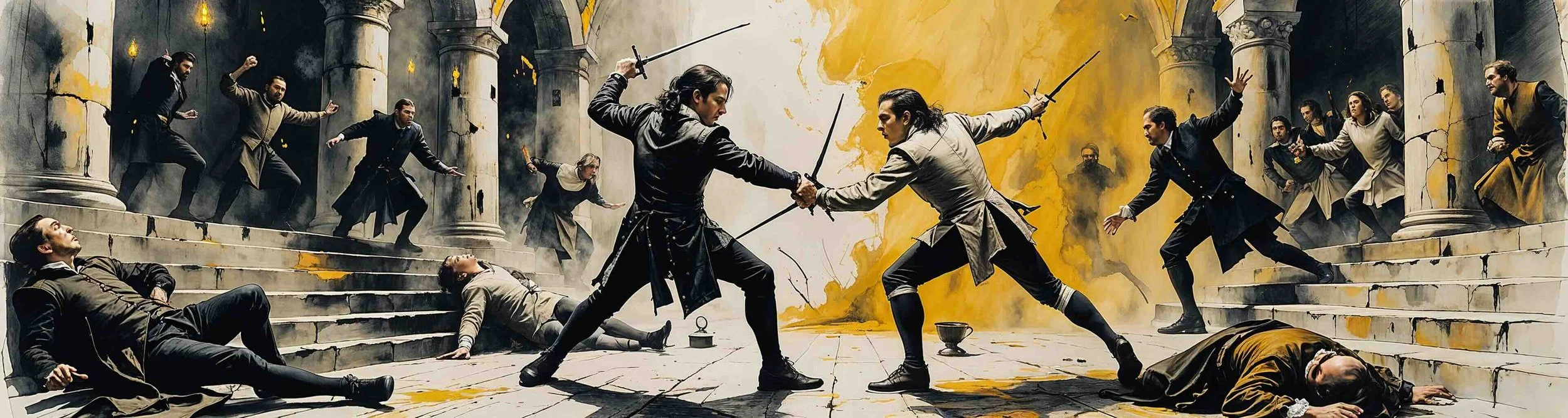
Scene Profile – At a Glance
- Location: A hall in Elsinore Castle.
- What Happens: Hamlet tells Horatio how he escaped death by rewriting Claudius's letters. He accepts a fencing match with Laertes. During the duel, Gertrude drinks the poisoned wine, both Hamlet and Laertes are wounded by the poisoned blade, and Laertes confesses the plot. Hamlet kills Claudius, then dies, asking Horatio to tell his story. Fortinbras arrives to take the throne.
- Key Characters: Hamlet, Horatio, Claudius, Laertes, Gertrude, Fortinbras.
- Dramatic Function: The final scene resolves the revenge plot in a storm of death, completing Hamlet's arc and handing Denmark to Fortinbras.
- Famous Quote:
"The rest is silence."
(Hamlet, Act 5, Scene 2) - Why It Matters: This is the tragedy's climax: Hamlet finally takes his revenge, but only as he and almost everyone else dies.
Scene Summary
Hamlet tells Horatio how, on the ship to England, he found Claudius's letters ordering his execution, secretly replaced them with forged ones condemning Rosencrantz and Guildenstern instead, and so escaped. He feels little guilt about their deaths and speaks with a new calm about fate and providence.
The foppish courtier Osric brings a challenge: Laertes wishes to fence with Hamlet in a friendly match, with the king having wagered on the outcome. Horatio urges caution, but Hamlet, strangely at peace, accepts, saying that "the readiness is all". He does not know the match is a trap, with a poisoned sword and a poisoned cup prepared by Claudius and Laertes.
The duel begins. Hamlet scores the first hits. Gertrude, celebrating her son, drinks from the poisoned cup meant for him. In the fighting, Laertes wounds Hamlet with the poisoned blade; the swords are switched in a scuffle, and Hamlet wounds Laertes with the same sword. Gertrude collapses, crying that she has been poisoned, and the dying Laertes confesses the whole plot and names the king as the cause.
In a fury, Hamlet stabs Claudius with the poisoned sword and forces him to drink the poisoned wine, finally taking his revenge. Laertes and Hamlet forgive each other before they die. With his last breath, Hamlet gives his "dying voice" to Fortinbras as the next king and begs Horatio to live and tell his story. Fortinbras arrives, surveys the carnage, and orders Hamlet honoured as a soldier.
A Divinity That Shapes Our Ends
The Hamlet of the final scene is transformed. Telling Horatio how he escaped death at sea, he describes a new faith that some higher power is guiding events, shaping outcomes beyond human planning.
Original
There's a divinity that shapes our ends,
Rough-hew them how we will...
(Hamlet, Act 5, Scene 2)
Shakespeare Retold (Modern Verse)
There is pre-determined end to things,
Despite our messing with them...
"Rough-hew" means to shape roughly; we cut and carve at our lives, but a "divinity" gives them their final form. This belief marks the great change in Hamlet. The man who once tried to control everything through thought and plotting now trusts that events will work out as they should. Many critics see this as the resolution of his long struggle to act: having stopped forcing things, he can finally move when the moment comes. It also frames his coming revenge as something closer to providence than personal vengeance – an act that happens through him rather than one he must engineer.
The Readiness Is All
When Horatio warns him that the duel may be dangerous and offers to make excuses, Hamlet refuses. He has reached a calm acceptance of whatever is to come, including death.
Original
if it be not now, yet it will come: the readiness is all...
(Hamlet, Act 5, Scene 2)
Shakespeare Retold (Modern Verse)
if not now, it will happen later on. The preparation's key...
Death will come whenever it comes; what matters is to be ready for it. Hamlet links this to the Bible's image of God's care even in "the fall of a sparrow", suggesting that if providence governs the smallest things, he can stop fearing and resisting. This serene readiness is a world away from the suicidal despair of "to be, or not to be". Hamlet has thought his way through death to a kind of peace. It is one of the play's most moving moments: the great hesitator finally stops hesitating, not by forcing himself to act, but by accepting whatever fate brings.
The Drink, the Drink!
The duel becomes a slaughter. The carefully laid plot unravels, and the first to fall is the one person it was never meant to harm. Gertrude raises the poisoned cup to toast her son.
Original
The drink, the drink! I am poisoned.
(Gertrude, Act 5, Scene 2)
Shakespeare Retold (Modern Verse)
The drink. The drink! I have been poisoned.
Gertrude's death is one of the great ironies of the play. Claudius prepared the cup to kill Hamlet, and it kills the wife he committed murder to win. As she dies, she warns Hamlet about the drink, an act of protective love that suggests she has finally chosen her son over her husband. Her cry begins the chain reaction that destroys everyone: from this moment the poison spreads outward, and the trap Claudius built closes on its own maker. The "battalions" of sorrows the king feared in Act 4 have arrived all at once.
Thou Incestuous, Murderous, Damned Dane
With his mother dead, Laertes dying, and his own death minutes away, Hamlet at last has both proof and freedom to act. Knowing he is poisoned and has nothing left to lose, he turns on Claudius.
Original
Here, thou incestuous, murderous, damned Dane,
Drink off this potion.
(Hamlet, Act 5, Scene 2)
Shakespeare Retold (Modern Verse)
Here, you incestuous, murderous, God-damned Dane:
Drink from this poison!
Hamlet stabs Claudius with the poisoned sword and then forces the poisoned wine down his throat, killing him twice over with his own weapons. The long-delayed revenge finally happens – but notice what it takes. Hamlet acts only after Claudius's plot has already killed Gertrude and doomed Hamlet himself, and only when he is dying and his crime is exposed before the whole court. He does not coldly carry out the Ghost's command; he strikes in a burst of fury at the moment of catastrophe. The revenge is achieved, but it is tangled up in his own death and is closer to a final, desperate reaction than a calculated act of justice.
The Rest Is Silence
His revenge complete and the poison taking hold, Hamlet turns to his last concerns: the succession, his reputation, and his friend. He dies in Horatio's arms, and Horatio gives him one of the most beautiful farewells in literature.
Original
Now cracks a noble heart. Good night sweet prince:
And flights of angels sing thee to thy rest!
(Horatio, Act 5, Scene 2)
Shakespeare Retold (Modern Verse)
My noble heart has cracked. Goodnight, sweet prince,
May choirs of angels sing you off to sleep.
Horatio's grief is the play's final tribute to Hamlet: a "noble heart", deserving of angels. Hamlet's own last words, "the rest is silence", are quiet and ambiguous – perhaps meaning death is silence, an end to the noise of thought and pain, or that the truth must now be told by others. After a play obsessed with words, soliloquies and questions, Hamlet ends in silence. Fortinbras arrives to find the royal family dead, claims the throne with Hamlet's blessing, and orders the prince carried off "like a soldier", restoring order to a kingdom finally purged of its corruption.
Language and Technique
- Religious imagery: "Divinity", "providence", "the fall of a sparrow" and "flights of angels" give the bloody ending a sense of fate and grace beyond human control.
- Dramatic irony: The audience knows the cup and blade are poisoned; we watch the trap close on its makers, including the king and queen.
- Stichomythia and chaos: The duel's quick exchanges and overlapping deaths create a breathless rush of catastrophe.
- The poison motif: Poison, the play's central image of hidden corruption, finally spills into the open and kills everyone it touches.
- The elegy: Horatio's "flights of angels" closes the violence with sudden, tender lyricism.
Key Quotes from Act 5, Scene 2
Quote 1The rest is silence.
(Hamlet, Act 5, Scene 2)
Shakespeare Retold (Modern Verse)
The rest is silence.
Absent thee from felicity awhile,
And in this harsh world draw thy breath in pain,
To tell my story.
(Hamlet, Act 5, Scene 2)
Shakespeare Retold (Modern Verse)
You'll put your death on hold a little while,
And in this evil world you'll take a breath
And tell my story.
Exchange forgiveness with me, noble Hamlet...
(Laertes, Act 5, Scene 2)
Shakespeare Retold (Modern Verse)
Please, let's forgive each other, noble Hamlet...
O, I die, Horatio;
The potent poison quite o'er-crows my spirit...
(Hamlet, Act 5, Scene 2)
Shakespeare Retold (Modern Verse)
I'll die, Horatio;
This potent poison's triumphed over me...
But I do prophesy the election lights
On Fortinbras: he has my dying voice...
(Hamlet, Act 5, Scene 2)
Shakespeare Retold (Modern Verse)
But I predict the crown from this election
For Fortinbras: he has my dying vote...
Key Takeaways
- Hamlet's new calm: He trusts "a divinity that shapes our ends" and accepts death – "the readiness is all".
- The trap backfires: Gertrude drinks the poisoned cup, and the poisoned sword wounds both Hamlet and Laertes.
- Revenge at last: Hamlet kills Claudius with the poisoned sword and wine, but only as he himself is dying.
- Forgiveness and story: Laertes and Hamlet forgive each other, and Hamlet begs Horatio to "tell my story".
- Order restored: Hamlet names Fortinbras heir; "the rest is silence", and Denmark passes to a new king.
Study Questions and Analysis
What does Hamlet tell Horatio about his escape and Rosencrantz and Guildenstern?
Hamlet explains that, on the ship to England, a restless instinct led him to find and open the sealed letters Claudius had sent with him. They ordered the King of England to behead Hamlet on arrival. Acting boldly and quickly, Hamlet forged a replacement letter ordering the deaths of the two messengers instead – Rosencrantz and Guildenstern – sealed it with his father's ring, and slipped it back. When the pirates attacked, he escaped, leaving the pair to carry the forged order to their own execution.
Strikingly, Hamlet feels almost no guilt. He says they "did make love to this employment" – they eagerly served the king against their friend – and so brought their fate on themselves. This coldness troubles some readers, who see Hamlet sending two former friends to death without a qualm. Others argue they were willing tools of a murderer and got what they chose. The episode shows the changed Hamlet of Act 5: decisive, ruthless when he must be, and increasingly inclined to read events as fate working through him rather than crimes he must answer for.
What does "There's a divinity that shapes our ends" reveal about Hamlet?
The line reveals a profound shift in Hamlet's outlook. For most of the play he has tried to master events through thought, planning and testing – and has been paralysed by it. Now he expresses a new belief that a higher power gives final shape to our lives, however roughly we carve at them ourselves. He has, in effect, let go of the need to control everything.
This change is often seen as the key to the play's ending. A. C. Bradley, in his 1904 Shakespearean Tragedy, noted the calm and fatalism of the final Hamlet, a man no longer at war with himself. By trusting providence, Hamlet frees himself from the endless deliberation that crippled him; he can now act when the moment arrives, because he is no longer trying to engineer the perfect revenge. The belief also recasts the bloody finale: if a "divinity" is shaping events, then Hamlet's revenge becomes less a private murder and more a part of a larger justice working itself out. Whether we find this comforting or troubling, it is the philosophical resolution of Hamlet's long struggle to act.
What does "the readiness is all" mean?
The phrase means that since we cannot know when death will come, the only thing that matters is to be prepared for it whenever it does. Hamlet says it after refusing Horatio's offer to call off the duel: death will come "now" or later, but it will come, so there is no point in fearing or dodging it. What counts is readiness of spirit.
The idea completes Hamlet's journey through the play's obsession with death. In "to be, or not to be" he was tormented by the fear of what lies beyond; here he has made his peace with it, helped by his sense that providence governs even "the fall of a sparrow". This acceptance is not despair but a kind of hard-won serenity. It also explains his behaviour for the rest of the scene: he walks calmly into a duel he half-suspects is dangerous, no longer trying to outwit fate. "The readiness is all" is, in a sense, the answer Hamlet finally finds to the questions that have haunted him – not to solve death by thinking, but to meet it without fear.
How does the final duel unfold, and who dies?
The duel is a trap that destroys nearly everyone. Hamlet and Laertes fence; Hamlet lands the first hits and Gertrude, proud of her son, drinks from the cup of poisoned wine Claudius had prepared for Hamlet. Laertes then wounds Hamlet with the unbated, poisoned sword. In a scuffle the two exchange weapons, and Hamlet wounds Laertes with the same poisoned blade. Now both men are doomed.
Gertrude collapses, crying that the drink has poisoned her. The dying Laertes, struck by remorse, confesses the whole plot and names Claudius as its author. Enraged, Hamlet stabs the king with the poisoned sword and forces him to drink the poisoned wine, killing him. Laertes and Hamlet forgive each other, and both die, along with Gertrude and Claudius. Of the main characters, only Horatio and the newly arrived Fortinbras are left alive. Four bodies lie on the stage – the entire royal family – making the ending one of the bloodiest in Shakespeare, the poison Claudius set loose having spread to kill them all.
Why does Gertrude drink the poison?
Gertrude drinks the wine to toast Hamlet's success in the duel, lifting the cup in a moment of maternal pride. On the surface it is an accident: she does not know the cup is poisoned, and Claudius's feeble warning – "Gertrude, do not drink" – comes too late and too quietly to stop her. The poison was meant for Hamlet, and it claims his mother instead.
Whether the act is purely accidental is debated. Some productions play it as Gertrude beginning to suspect the truth, drinking knowingly to protect or warn her son, especially as she ignores Claudius's warning. Her dying cry – "the drink, the drink! I am poisoned" – is a clear, deliberate warning to Hamlet about the cup, which suggests her loyalty has shifted decisively from her husband to her son. Either way, her death is bitterly ironic: Claudius murdered his brother to win Gertrude and the crown, and his own poison now kills her. It is the first stroke in the collapse of everything he built, and it confirms that the queen, whatever her earlier weakness, dies on Hamlet's side.
How does Hamlet finally kill Claudius, and is it satisfying revenge?
Hamlet kills Claudius only at the very end, after the king's own plot has already poisoned Gertrude and fatally wounded Hamlet. Learning the truth from the dying Laertes, Hamlet stabs Claudius with the poisoned sword and then forces him to drink the poisoned wine, destroying him with both of his own murderous weapons.
Whether this counts as satisfying revenge is one of the play's lasting questions. On one hand, it is fitting: Claudius dies by his own treachery, exposed before the court, and Hamlet at last does the deed the Ghost demanded. On the other hand, it is far from the clean justice the Ghost asked for. Hamlet does not hunt Claudius down in cold blood; he strikes in a frenzy only when he is dying and has nothing left to lose, and his revenge costs the lives of his mother, Ophelia, Polonius, Laertes and himself. The killing is more a final eruption of catastrophe than a triumphant act of justice. The play seems to suggest that revenge, however just its cause, cannot be achieved cleanly – it spreads like poison and consumes the avenger along with his target.
Why does Hamlet ask Horatio to "tell my story"?
As he dies, Hamlet is anguished by the thought of a "wounded name" – that he will be remembered, with the facts unknown, as nothing but a murderer who killed Polonius and the king. He stops Horatio from drinking the last of the poison and begs him to live on, in pain if necessary, to tell the true story of what happened and why.
The request matters for several reasons. It gives the loyal Horatio his final role and explains why, of all the major characters, he survives: someone must bear witness. It shows how much reputation and truth matter to Hamlet, a man who has always hated falseness and "seeming". And it has a clever theatrical effect, because the "story" Horatio promises to tell is essentially the play we have just watched, making the audience the final hearers of Hamlet's truth. In a tragedy obsessed with uncertainty and lies, Hamlet's dying wish is that, at least, the truth be told.
What is the significance of Fortinbras arriving at the end?
Fortinbras arrives just as the Danish royal family lies dead, and Hamlet, with his "dying voice", names him the next king. His appearance gives the play a sense of order restored after catastrophe: the throne does not stay empty, and Denmark passes to a strong, decisive ruler who can hold it together.
The choice is deeply meaningful. Fortinbras has been Hamlet's foil throughout – the man of action who fought for trifles while Hamlet brooded over a true cause. That this man inherits the crown, rather than the thoughtful prince, makes a pointed comment: in the harsh world of the play, decisive action wins out over reflection, for good or ill. Some critics see the ending as a hopeful cleansing, the rotten state purged and renewed under a healthy ruler; others find it bleak, the sensitive, intelligent Hamlet replaced by a blunt soldier who values glory over thought. G. Wilson Knight, in The Wheel of Fire (1930), read the play's vision as profoundly dark, with Hamlet a spreader of death; the arrival of the brisk, uncomplicated Fortinbras can feel like the world simply moving on. Either way, Fortinbras's entrance closes the tragedy with the machinery of state grinding back into motion over a stage full of corpses.
Is the ending of Hamlet tragic, just, or both?
The ending is both, and the tension between the two is part of its greatness. There is justice in it: the murderer Claudius is dead, the truth is exposed, and the corruption that poisoned Denmark is finally purged. Hamlet completes his revenge, dies with honour, and is mourned as a "noble heart". Order is restored under Fortinbras, and Laertes and Hamlet die reconciled. By the rules of tragedy, the moral balance is set right.
Yet the cost is appalling, and that is the tragedy. To kill one guilty man, the play sacrifices the innocent – Ophelia, Gertrude, Polonius – alongside the guilty, and the thoughtful, gifted Hamlet himself. Revenge, even when justified, has spread like the poison that is its central image, destroying almost everyone it touches. The play refuses to let us simply cheer Claudius's death; it makes us grieve the wreckage around it. This is what makes Hamlet so enduring: it delivers the satisfaction of justice and, at the same time, the deep sorrow of all that justice costs. The "rest is silence" is both a release and an immense loss, and the play leaves us holding both at once.