Corruption
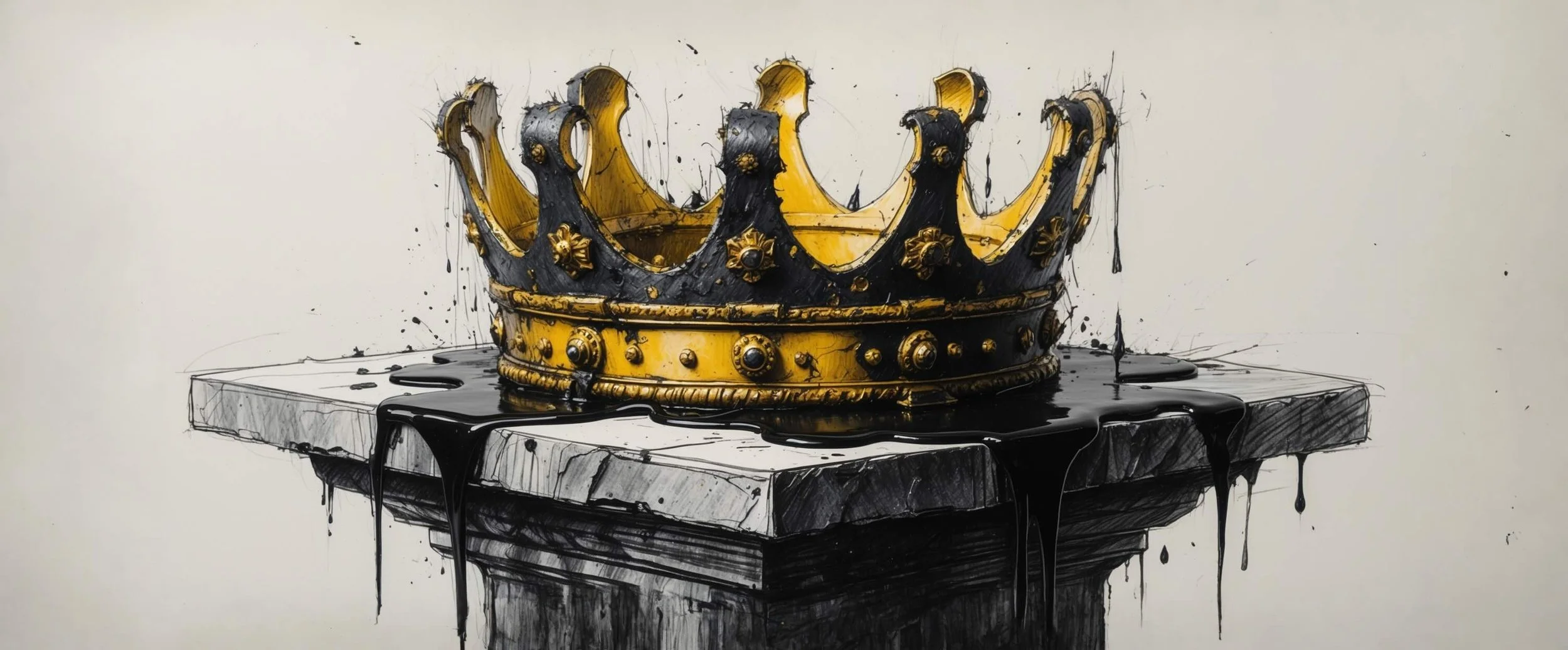
Theme Profile – At a Glance
- Focus: The moral, physical, and political decay that infects the state of Denmark, spreading outward from an initial, hidden crime.
- Key Characters: King Claudius, Prince Hamlet, Polonius, and Rosencrantz & Guildenstern.
- The Core Conflict: The tension between the outward appearance of a healthy, functioning royal court and the hidden, diseased reality of murder, incest, and espionage operating beneath the surface.
- Key Manifestations: The physical poison poured into King Hamlet's ear; the pervasive imagery of disease, ulcers, and weeds; the surveillance state created by Polonius; the literal decay of the graveyard.
- Famous Quote: "Fie on't! ah fie! 'tis an unweeded garden,
That grows to seed; things rank and gross in nature
Possess it merely."
(Act 1, Scene 2) - The Outcome: The corruption is ultimately purged from Denmark, but it requires the total destruction of the ruling family to cleanse the state, leaving the throne to a foreign power.
The Source of the Sickness
In Elizabethan political theory, the health of a nation was inextricably linked to the moral and physical health of its monarch (the "body politic"). Because King Claudius acquires the throne through fratricide and incest, his reign is fundamentally diseased. The poison he poured into his brother's ear serves as the literal and metaphorical source of Elsinore's corruption.
Original
Something is rotten in the state of Denmark.
(Act 1, Scene 4)
Marcellus’s famous observation early in the play confirms that the sickness is palpable even to the guards. The presence of The Ghost is a supernatural symptom of this earthly rot. The state cannot rest because an unnatural crime sits at its centre, and the resulting miasma infects everything it touches.
Imagery of Disease and Decay
Prince Hamlet is acutely aware of the moral decay surrounding him, and his language is saturated with images of physical sickness, tumours, and rot. He views the court not as a place of majesty, but as a hospital or a graveyard.
Original
Mother, for love of grace,
Lay not that flattering unction to your soul,
That not your trespass, but my madness speaks:
It will but skin and film the ulcerous place,
Whiles rank corruption, mining all within,
Infects unseen.
(Act 3, Scene 4)
Shakespeare Retold (Modern Verse)
Mother, for love of God,
Don’t flatter your own soul with soothing balm,
Denying your own faults, chiding my madness:
For that will only hide the real infection,
Which, left unchecked, will spread throughout your soul,
Corrupting from within.
When confronting Queen Gertrude, Hamlet uses the metaphor of a hidden, festering ulcer. He warns her that ignoring her sins will only cover the wound with a thin skin, while the infection continues to eat away at her soul from the inside. This perfectly describes the dynamic of the entire play: a polished, diplomatic exterior covering a terminal, unseen infection.
The Contagion of Court Politics
The corruption in Elsinore is highly contagious. It forces traditionally noble characters to compromise their morals in order to survive or succeed. Polonius operates a network of spies, relying entirely on deception; Rosencrantz & Guildenstern trade their childhood loyalty for royal favour; and even Laertes, a man obsessed with traditional honour, is easily manipulated by Claudius into using a poisoned, unbated sword.
Original
O heavens! is't possible, a young maid's wits
Should be as mortal as an old man's life?
Nature is fine in love, and where 'tis fine,
It sends some precious instance of itself
After the thing it loves.
(Act 4, Scene 5)
Shakespeare Retold (Modern Verse)
Oh, lord! How can it be a young girl’s mind
Is just as mortal as an old man’s life?
Our nature is so loving that this love
Will send some of its precious self to follow
The thing it loved and lost.
The collateral damage of this political contagion is the destruction of the innocent. Ophelia is driven to madness by the toxic machinations of the men around her. She is a pure flower planted in an "unweeded garden," and she is inevitably choked to death by the rank weeds of the court.
"In Hamlet, the number of images of sickness, disease, or blemish of the body... is descriptive of the unwholesome condition of Denmark morally. The idea of an ulcer or tumour, as descriptive of the unwholesome state of Denmark morally, is, on the whole, the dominating one."
— Caroline Spurgeon, Shakespeare's Imagery and What it Tells Us, 1935
Key Quotes on Corruption
Quote 1
Fie on't! ah fie! 'tis an unweeded garden,That grows to seed; things rank and gross in nature
Possess it merely.
(Act 1, Scene 2)
Shakespeare Retold (Modern Verse)
Damn it! Oh, damn! It’s a neglected garden,
Once planted, but now overrun with weeds,
Destroying what it was.
Quote Analysis: Before the Ghost's revelation, Hamlet already senses the spiritual decay of his home. By comparing Denmark to an "unweeded garden," he suggests that the natural order has been neglected. Without a true, moral King to tend the state, grotesque and parasitic elements have been allowed to thrive and choke out the good.
Something is rotten in the state of Denmark.
(Act 1, Scene 4)
Shakespeare Retold (Modern Verse)
Something is rotten in the state of Denmark.
Quote Analysis: Spoken by a lowly guard, this line establishes that the corruption of the King has trickled down to affect the very atmosphere of the country. The "rottenness" is not just a metaphor for Hamlet’s depression; it is a physical, objective reality felt by the common people.
Your worm is your only emperor for diet: we fat all
creatures else to fat us, and we fat ourselves for
maggots: your fat king and your lean beggar is but
variable service, two dishes, but to one table:
that's the end.
(Act 4, Scene 3)
Shakespeare Retold (Modern Verse)
For worms possess a mastery of eating:
we make all creatures fat to feed ourselves,
then worms eat us. Fat kings or skinny beggars
are equal food to worms, served up together.
Ain’t that the truth!
Quote Analysis: Hamlet uses the gruesome imagery of maggots consuming a corpse to taunt King Claudius. It is a profound meditation on mortality that levels all social hierarchies. Regardless of Claudius’s political power or ill-gotten wealth, he is ultimately nothing more than meat for the worms—the final, inescapable physical corruption of the body.
Let the door be shut upon him, that he may play the
fool no where but in's own house.
(Act 3, Scene 1)
Shakespeare Retold (Modern Verse)
Let’s lock him up in there so he can play
the fool in his own house, alone.
Quote Analysis: Knowing he is being spied upon, Hamlet directs this insult at Polonius. It highlights the insidious nature of the court's corruption: trust has been completely eradicated. The state operates via surveillance and deceit, turning fathers into pimps and friends into spies.
Key Takeaways
- The Body Politic: The health of Denmark is tied to the health of the King. Claudius’s hidden sins manifest as a national sickness.
- Pervasive Disease Imagery: Shakespeare extensively uses language related to ulcers, tumours, and rot to continually remind the audience of the unseen moral decay beneath the court's finery.
- The Death of Trust: The ultimate symptom of Elsinore's corruption is the total eradication of trust; every relationship in the play is tainted by espionage, manipulation, or betrayal.
- The Final Purge: The tragedy concludes with a literal bloodletting. The only way to cure the diseased state is the complete eradication of the infected royal bloodline.
Study Questions and Analysis
How does the theme of corruption relate to the Ghost? +
The Ghost is the supernatural manifestation of the hidden corruption. In Elizabethan theology, ghosts only walked the earth if the natural order had been violently disrupted. The spirit’s very existence is proof that a terrible, "foul," and unnatural crime is festering within the state, demanding a purge.
Why does Hamlet frequently use the imagery of disease and ulcers? +
Hamlet uses medical imagery to articulate the difference between appearance and reality. An ulcer can fester under the skin while the surface appears healthy. Similarly, Claudius maintains the appearance of a diplomatic, smiling King, while his soul—and by extension, his kingdom—is secretly rotting from the inside out.
How is Laertes corrupted by the court? +
Laertes begins as an honourable young man seeking open justice for his father's death. However, his passionate grief makes him vulnerable to Claudius's manipulation. The King easily infects Laertes with his own deceitful methods, convincing the noble youth to abandon his chivalric code and agree to a dishonourable, poisoned fencing match.
What role does poison play as a symbol in Hamlet? +
Poison is both the literal weapon of the play and its central metaphor. Claudius poisons King Hamlet's ear, but he also poisons the court's mind with lies. He poisons Laertes with a desire for treacherous revenge, and ultimately, the literal poison in the cup and on the sword destroys the entire royal family, representing the inescapable spread of corruption.
Is Hamlet himself corrupted by his quest for revenge? +
Yes, to an extent. In order to fight the corruption of Elsinore, Hamlet must adopt its methods. He feigns madness (deceit), verbally abuses Ophelia, murders Polonius, and coldly sends Rosencrantz and Guildenstern to their executions. His hands become stained with innocent blood, proving that one cannot fight in the mud without getting dirty.
How does the Graveyard scene (Act 5, Scene 1) highlight this theme? +
The Graveyard scene strips away all the political and royal illusions of the court to reveal the ultimate, unavoidable corruption: physical decomposition. Holding Yorick's skull, Hamlet realises that the great and the terrible all end up as the same dust. It is the great leveller that makes the political scheming of Elsinore seem utterly pointless.
How is the corruption of Denmark finally resolved? +
The sickness is cured, but the patient dies. The corrupted royal bloodline is entirely wiped out by the poisoned duel. The arrival of Fortinbras—an outsider untainted by the domestic sins of Claudius's court—represents a clean slate and the restoration of martial order, acting as the antidote to Denmark's fatal disease.