Henry V: Act 3, Scene 5 – Analysis
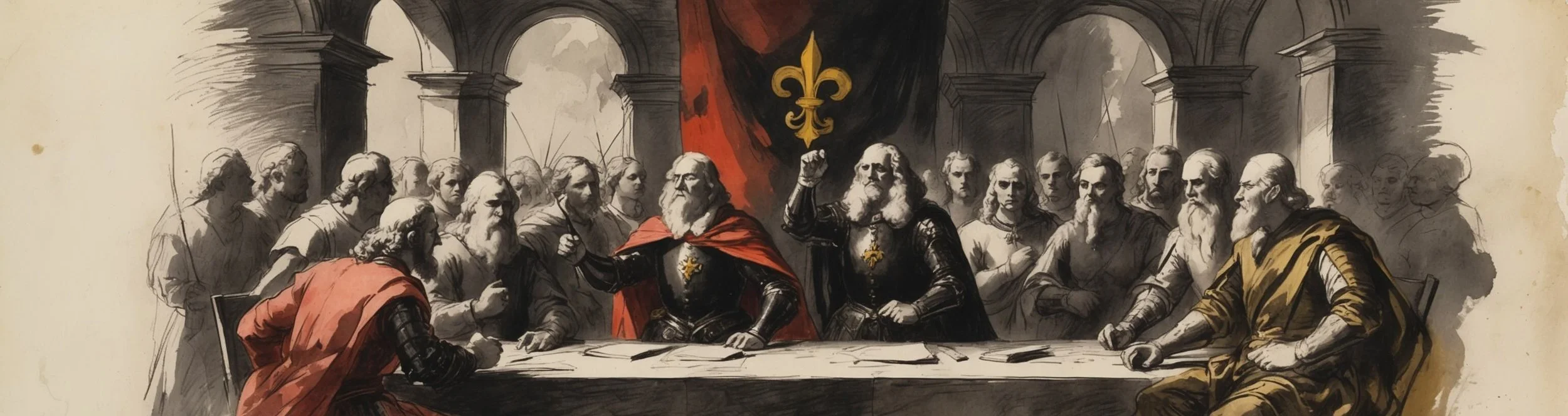
Scene Profile – At a Glance
- Location: The French King’s palace at Rouen.
- What Happens: Henry has crossed the Somme, and the French court erupts – shame, fury and bewilderment that a “barbarous” island people should outfight them. The King musters the whole nobility of France by name and sends Montjoy to demand Henry’s ransom.
- Key Characters: The King of France, the Dauphin, the Constable and Bourbon.
- Dramatic Function: French pride stung into action – and a roll-call of great names the audience will next hear read from the casualty lists of Agincourt.
- Famous Quote:
"Now forth, lord constable and princes all,
And quickly bring us word of England's fall."
(the King of France, Act 3, Scene 5) - Why It Matters: The scene shows what the English advance looks like from the other throne: an insult to nature itself. Its questions – where do the English get this mettle? – are the ones Agincourt will answer.
Scene Summary
The news is confirmed: Henry has passed the river Somme. The Constable declares that if the English are not fought, France should be abandoned outright – the vineyards given “to a barbarous people”. The Dauphin reaches for genealogy: shall a few “sprays” of France – Norman offshoots grafted onto “wild and savage stock” – shoot into the clouds and overlook the very tree that grew them? Bourbon compresses the outrage into the scene’s most quoted splutter: “Normans, but bastard Normans, Norman bastards!”
The Constable’s great speech asks the question the whole play turns on: “Where have they this mettle?” The English climate is foggy, raw and dull; their sun is pale; they drink “barley-broth” – boiled water fit for worn-out horses. How can such “sodden water” heat their blood to valour, while French blood, “spirited with wine”, seems frosty? Let the French not hang like icicles on their own thatch while a frostier people sweats gallant youth in France’s rich fields. The Dauphin adds the deepest sting: French ladies mock their men’s bred-out mettle, and talk of giving their bodies to English youth “to new-store France with bastard warriors”.
The King answers with action: Montjoy is sent with “sharp defiance”, and the nobility of France is summoned in a magnificent roll of names – Delabreth, Orleans, Bourbon, Berri, Alençon, Brabant, Bar, Burgundy, Chatillon, Rambures, Vaudemont, Beaumont, Grandpré, Roussi, Fauconberg, Foix, Lestrale, Bouciqualt, Charolois – commanded to fall on Henry’s host like an avalanche and bring him prisoner to Rouen. The Constable notes drily that Henry’s sick, famished army will surrender at the mere sight of them. The Dauphin begs to go; the King keeps him back – and closes on a confident couplet: bring us word of England’s fall.
Where Have They This Mettle?
The Constable’s bafflement is the play’s central question, asked by the enemy in the language of climate.
Original
Dieu de batailles! Where have they this mettle?
Is not their climate foggy, raw and dull,
On whom, as in despite, the sun looks pale,
Killing their fruit with frowns?
(the Constable, Act 3, Scene 5)
Shakespeare Retold (Modern Verse)
Oh, battle-god! Where did they get their strength?
Don’t they have awful, dull and foggy weather,
Whereby the sun, to spite them all, looks pale,
And kills their fruit by frowning?
The speech is Renaissance climate-theory turned against its makers: national character was supposed to follow weather and diet, so a foggy island of pale sun and boiled barley should breed cold, dull men – and yet these men are burning through France while the wine-blooded French “seem frosty”. The icicle image completes the inversion: French valour hanging decorative and frozen from its own roofs, English “cold blood” sweating in the fields. The Constable cannot answer his own question because his categories – blood, climate, breeding – are the wrong ones; the play’s answer, being built scene by scene, is leadership, necessity and words. It is the same failure of imagination that will preen through the eve of Agincourt and die on its morning.
The Avalanche Commanded
The French King’s response is the scene’s pivot from wounded pride to war – and its imagery promises an annihilation the play will invert.
Original
Bar Harry England, that sweeps through our land
With pennons painted in the blood of Harfleur:
Rush on his host, as doth the melted snow
Upon the valleys...
(the King of France, Act 3, Scene 5)
Shakespeare Retold (Modern Verse)
Rid Harry, King of England, from our land
Who sweeps through hoisting flags drenched in our blood.
Come down on them, like melted snow descends
Into the valleys where low-lying places...
Henry sweeps through France with “pennons painted in the blood of Harfleur”; the French must rush on him as melted snow rushes on the low valleys – the Alps spitting their rheum downhill on a “low vassal seat”. The image is all altitude and contempt: France the mountain, England the ditch beneath it. And around the command stands the great muster – nineteen names of dukes, princes, barons and knights, the flower of France summoned in a single sentence. The audience should hold that roll in mind: it will be read again, almost name for name, in Act 4, Scene 8 – as the list of the dead. Shakespeare builds the scene’s grandeur precisely so the casualty list can dismantle it.
Language and Technique
- Climate theory: The Constable’s argument runs on the period’s science – blood heated by wine, dulled by fog – making England’s valour a violation of natural law.
- Botanical imagery: The Dauphin’s “sprays”, “scions” and grafting make the English a gardening accident – Norman cuttings on savage stock, now overgrowing the parent tree.
- The epic muster: The roll of nineteen names imitates the epic catalogue of heroes – grandeur by enumeration – and plants the list Act 4 will read back as corpses.
- Sexual insult as panic: The madams’ mockery and the threat of “bastard warriors” put the war’s anxiety where this aristocracy feels it most: in lineage.
Key Quotes from Act 3, Scene 5
Quote 1
Original
By faith and honour,
Our madams mock at us, and plainly say
Our mettle is bred out and they will give
Their bodies to the lust of English youth
To new-store France with bastard warriors.
(the Dauphin, Act 3, Scene 5)
Shakespeare Retold (Modern Verse)
On my honour,
Our ladies make fun of us, stating plainly
Our bravery’s been bred out of us, and they’ll give
Their bodies to the lustful English youth,
Repopulating France with fighting bastards.
Quote Analysis: The Dauphin’s report of what the French ladies are saying is the scene’s rawest nerve: their men’s “mettle is bred out”, and they will give their bodies to the “lust of English youth” to restock France with bastard warriors. Coming from the play’s vainest prince, the admission is extraordinary – the war reframed as a crisis of virility, defeat imagined as cuckoldry at national scale. It also seeds the play’s ending: a French princess given, by treaty, to an English king, to breed – the ladies’ mockery made policy.
Original
Sorry am I his numbers are so few,
His soldiers sick and famished in their march,
For I am sure, when he shall see our army,
He'll drop his heart into the sink of fear
And for achievement offer us his ransom.
(the Constable, Act 3, Scene 5)
Shakespeare Retold (Modern Verse)
I’m only sorry that his army’s small,
His soldiers sick and starving as they march,
For I am sure, when he first sees our army,
His heart will sink and he’ll be terrified,
And thus, because of this, he will surrender.
Quote Analysis: The Constable’s pity for Henry’s tiny, sick, famished army – he is only sorry the victory will be so easy, since one sight of the French host will make England’s heart “drop… into the sink of fear” and buy its ransom. Every clause will be reversed: the numbers, the sickness and the fear are real, and they are exactly the conditions the Crispin’s Day speech will convert into legend. The play’s method with French confidence is always the same – record it precisely, then let the battle audit it.
Original
Now forth, lord constable and princes all,
And quickly bring us word of England's fall.
(the King of France, Act 3, Scene 5)
Shakespeare Retold (Modern Verse)
Leave, constable and princes, one and all,
Returning soon, with news of England’s fall.
Quote Analysis: The scene’s exit couplet: forth, constable and princes all – and quickly bring us word of England’s fall. The rhyme “all”/“fall” snaps shut with total assurance, and the word the King chooses – England’s fall – is the one the messengers will eventually bring, reversed. Set it beside the Act 4 French couplets (“a hundred Englishmen”) as the play’s running exhibit: French certainty always scans beautifully, and is always wrong.
Key Takeaways
- The enemy asks the play’s question: “Where have they this mettle?” – the French cannot explain English valour because their categories are blood and climate, not leadership and need.
- Pride wounded in the lineage: Bastard Normans, mocking madams, bastard warriors – the French experience the invasion as a genealogical insult before a military one.
- The muster is a casualty list in waiting: The King’s magnificent roll of names returns in Act 4, Scene 8 as the roll of the dead – grandeur built for demolition.
- Confidence on the record: The Constable’s pity for the starving English and the King’s couplet of “England’s fall” are stored by the play for precise reversal.
Study Questions and Analysis
Why are the French suddenly so furious – and so baffled?
Because the impossible is happening: a small, sick army from a despised island has taken Harfleur and crossed the Somme into the heart of France, and nothing in the French world-picture can account for it. The Constable’s bewilderment runs on the period’s actual science – climate and diet were believed to build national character – which makes English valour a breach of natural law:
Original
And shall our quick blood, spirited with wine,
Seem frosty? O, for honour of our land,
Let us not hang like roping icicles
Upon our houses' thatch...
(the Constable, Act 3, Scene 5)
Shakespeare Retold (Modern Verse)
And shall our blood, emboldened by our wine,
Seem cold and weak? In honour of our land,
Let us not hang around like icicles
From thatched roofs, while these cold and frosty people...
Wine-heated French blood hanging “like roping icicles” while barley-drinking islanders sweat in France’s rich fields – the imagery does the scene’s work: this is not fear, which the French cannot yet feel, but affronted cosmology. The fury – Bourbon’s “Norman bastards!”, the Dauphin’s grafting metaphors – is what a caste feels when its inferiors stop behaving inferiorly. For essays on the play’s design, the scene matters because Shakespeare lets the enemy ask his central question – where does English mettle come from? – three scenes after Harfleur showed the answer: not blood or climate, but a king who can talk an exhausted army through a breach.
What does the "madams mock at us" passage reveal?
That the war, for this aristocracy, is ultimately about lineage – and that its women have noticed the men failing. The Dauphin reports that the ladies of France say their men’s “mettle is bred out”, and threaten to give their bodies to English youth “to new-store France with bastard warriors”; Bourbon adds that they are sent mockingly to English dancing-schools, their grace “only in our heels” – the heels of “most lofty runaways”.
Jean E. Howard and Phyllis Rackin, in Engendering a Nation (1997), read the play’s French scenes through exactly this lens: the nation imagined as a bloodline transmitted through women’s bodies, so that military defeat is instantly translated into sexual humiliation – cuckoldry at the scale of the state. The passage also loads the play’s ending with meaning: what the madams threaten in jest – French women bearing warriors for England – is precisely what the Treaty of Troyes will enact in earnest, when Katharine is given to Henry to breed a “boy, half French, half English”. The scene’s panic is the wooing scene’s politics, two acts early.
Why does the French King list so many names?
It is an epic muster – the catalogue of heroes, the oldest device in war poetry – and Shakespeare deploys it at full length:
Original
Charles Delabreth, high constable of France;
You Dukes of Orleans, Bourbon, and of Berri,
Alencon, Brabant, Bar, and Burgundy;
Jaques Chatillon, Rambures, Vaudemont...
(the King of France, Act 3, Scene 5)
Shakespeare Retold (Modern Verse)
Charles Delabreth, high constable of France;
You Dukes of Orleans, Bourbon, and of Berri,
Alencon, Brabant, Bar, and Burgundy;
Jaques Chatillon, Rambures, Vaudemont...
Nineteen names, “high dukes, great princes, barons, lords and knights”, the entire chivalry of France mobilised in one breath: as sound, the roll is genuinely magnificent, and it is meant to be – the audience must feel the scale of what is descending on Henry’s famished column. But the list is also a trap laid two acts long. In Act 4, Scene 8, Henry will read the French dead: Charles Delabreth, high constable of France; Jaques of Chatillon; Rambures; Alençon, Brabant, Bar; Grandpré and Roussi, Fauconberg and Foix, Beaumont and Marle, Vaudemont and Lestrale – the muster of this scene, returned as a mortuary roll. Very nearly every name summoned here dies at Agincourt, and Shakespeare wrote both lists to be heard against each other. Quoting the two rolls together is one of the most striking structural points available to any essay on the play’s treatment of war.
Why is the Dauphin ordered to stay behind – and does the play keep to it?
The King’s command is flat – “Prince Dauphin, you shall stay with us in Rouen” – and the Dauphin’s protest is overruled: the heir cannot be risked in the field. Dramatically the moment completes the scene’s portrait of a divided court: the prince who sent the tennis balls, loudest in outrage, is publicly benched by his own father – a humiliation that lands harder because the audience has heard the Constable’s private opinion of his “hooded valour”.
Notoriously, the play does not quite keep to it: the Dauphin is present, boasting about his horse, in the French camp on the eve of Agincourt in Act 3, Scene 7 and Act 4, Scene 2. Editors have long noted the inconsistency – some early texts assign those camp speeches to Bourbon instead, and productions choose one arrangement or the other. For exam purposes the safe formulation is simply that the received text sends the Dauphin to the sidelines here and shows him at the front two scenes later, and that the historical Dauphin was indeed absent from Agincourt (he died, undefeated by anything but illness, weeks after the battle). What matters interpretively is the gesture: France’s heir withheld from France’s catastrophe, so that the defeat belongs to the nobility as a class rather than to one prince.