Macbeth: Act 1, Scene 5 – Analysis
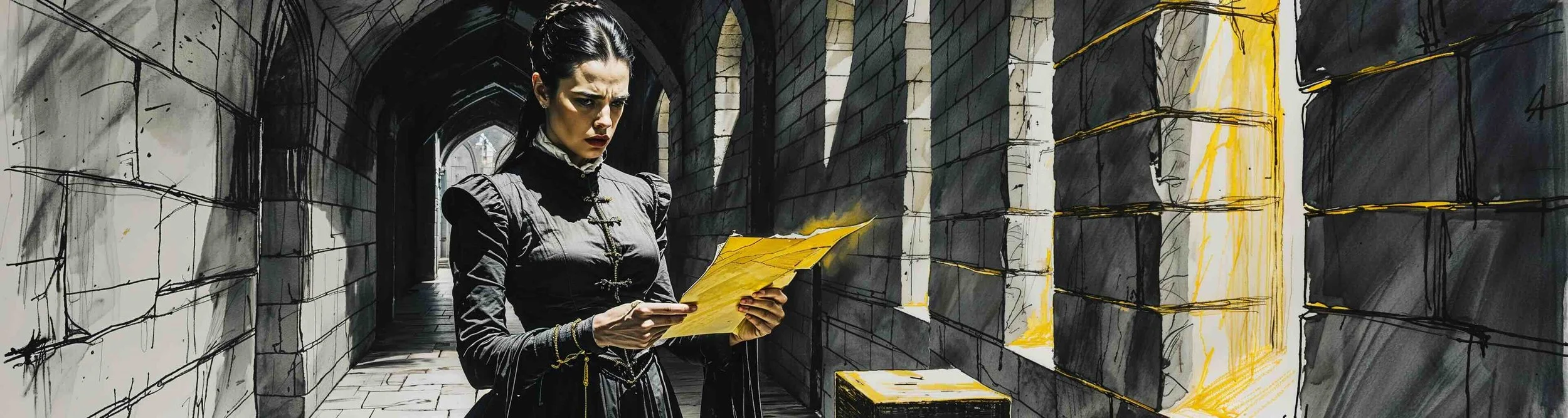
Scene Profile – At a Glance
- Location: Macbeth's castle at Inverness.
- What Happens: Lady Macbeth reads Macbeth's letter about the prophecies, fears he is too kind to seize the crown, and calls on dark spirits to "unsex" her. Learning Duncan will arrive that night, she resolves to murder him and coaches Macbeth to hide his intentions.
- Key Characters: Lady Macbeth, Macbeth, a Messenger.
- Dramatic Function: Introduces Lady Macbeth as the engine of the murder and shifts the play's driving force from prophecy to human will.
- Famous Quote:
Come, you spirits
That tend on mortal thoughts, unsex me here...
(Lady Macbeth, Act 1, Scene 5) - Why It Matters: Lady Macbeth's ferocity supplies the resolve Macbeth lacks. Without her, the murder might never happen; with her, it becomes certain.
Scene Summary
Alone in the castle, Lady Macbeth reads a letter from her husband describing his encounter with the Witches and their prophecy that he "shalt be king". The news thrills her, but it also worries her. She knows Macbeth wants the crown, yet judges him "too full o' the milk of human kindness" to take the "nearest way" – murder – to get it. He has ambition, she decides, but not the ruthlessness to match it.
A messenger brings startling news: Duncan is coming to the castle that very night. Lady Macbeth seizes the opportunity at once. In a chilling invocation, she calls on the spirits that serve "mortal thoughts" to strip away her femininity, fill her with cruelty, thicken her blood against remorse, and turn her mother's milk to "gall". She summons "thick night" to hide the murder even from heaven.
When Macbeth arrives, she greets him with the Witches' own titles and tells him plainly that Duncan must never leave the castle alive: "O, never shall sun that morrow see!" She warns him that his face betrays his thoughts and instructs him to "look like the innocent flower, but be the serpent under't". Macbeth is hesitant – "We will speak further" – but she takes command, telling him to leave the night's "great business" to her.
Reading the Letter
Lady Macbeth's first speech is a remarkably swift and clear-eyed assessment of her husband. Where Macbeth agonised over the prophecy, she reads it as an instruction and a problem to be solved. The "problem" is Macbeth himself: she diagnoses, almost clinically, the softness in his nature that might stop him doing what she believes the crown requires.
Original
yet do I fear thy nature;
It is too full o' the milk of human kindness
To catch the nearest way: thou wouldst be great;
Art not without ambition, but without
The illness should attend it...
(Lady Macbeth, Act 1, Scene 5)
Shakespeare Retold (Modern Verse)
although I fear it's not your nature;
You are too full of kindness in your heart
To snatch your first chance. You do strive for greatness,
And you have high ambition, but without
The ruthlessness that's needed...
The phrase "milk of human kindness" is double-edged. It sounds like praise – Macbeth is decent and humane – but in Lady Macbeth's mouth it is a flaw, a weakness standing between her husband and the throne. The milk imagery is crucial: it is nurturing, maternal, life-giving, and she sees it as exactly what must be purged. Within a few lines she will ask the spirits to take her own milk "for gall", turning the same image of nourishment into poison.
"Unsex Me Here"
The scene's central speech is one of the most famous in Shakespeare. Believing Macbeth too gentle, Lady Macbeth resolves to supply the cruelty herself, and she does so by calling on supernatural forces to remake her body and mind. She wants to be emptied of everything she associates with womanhood – tenderness, remorse, the capacity to nurture – and filled instead with "direst cruelty".
Original
Come, you spirits
That tend on mortal thoughts, unsex me here,
And fill me from the crown to the toe top-full
Of direst cruelty! Make thick my blood;
Stop up the access and passage to remorse...
(Lady Macbeth, Act 1, Scene 5)
Shakespeare Retold (Modern Verse)
Come, evil spirits
That make me think of death, make me more manly,
And fill me from my head down to my toes
With awful cruelty! Thicken my blood,
And stop remorseful pangs before they've started
The speech reveals a chilling self-knowledge. Lady Macbeth understands that murder requires the suppression of conscience and natural feeling, and she deliberately asks to have them removed. She links cruelty with masculinity – to "unsex" herself is to become, in her mind, more able to kill – which sets up the play's persistent association of violence with manhood. It is an act of will so extreme that it courts the supernatural, placing her, for this moment, alongside the Witches.
The Serpent and the Flower
When Macbeth arrives, the balance of the marriage is immediately clear. He is tentative; she is decisive. She has already settled the plan in her own mind and now sets about steadying his. Her advice to him is the practical application of "fair is foul": to succeed, they must master the gap between how they appear and what they intend.
Original
look like the innocent flower,
But be the serpent under't. He that's coming
Must be provided for...
(Lady Macbeth, Act 1, Scene 5)
Shakespeare Retold (Modern Verse)
Look like a flower,
But be the snake below. The king who's coming
Now must be taken care of...
The image of the innocent flower hiding the serpent beneath is the scene's emblem of deceit, and it points straight back to the Witches' "fair is foul". Lady Macbeth turns appearance into a weapon: the welcome they will give Duncan must be flawless precisely so that the murder can be perfect. Her chilling euphemism that Duncan "must be provided for" – meaning he must be killed – shows how completely she has mastered the double language the deed demands.
Language and Technique
- Soliloquy: Lady Macbeth's two great speeches give the audience direct access to her thoughts, revealing a will fiercer than her husband's.
- Imagery of milk: The "milk of human kindness" and the milk turned "for gall" make nourishment itself a measure of the kindness she wants to destroy.
- The supernatural: By summoning spirits to "unsex" her, Lady Macbeth aligns herself with the Witches and the dark forces of the play.
- Light and dark: Her call to "thick night" and the "blanket of the dark" echoes Macbeth's plea to the stars, binding the couple as enemies of the light.
- Appearance versus reality: The "innocent flower" hiding a "serpent" turns deceit into strategy and recalls the Witches' inverted morality.
Key Quotes from Act 1, Scene 5
Quote 1The raven himself is hoarse
That croaks the fatal entrance of Duncan
Under my battlements.
(Lady Macbeth, Act 1, Scene 5)
Shakespeare Retold (Modern Verse)
This messenger is an omen
That tells me Duncan's coming here to die
Within my castle walls.
Come to my woman's breasts,
And take my milk for gall, you murdering ministers...
(Lady Macbeth, Act 1, Scene 5)
Shakespeare Retold (Modern Verse)
Come to my woman's breasts
And turn my milk to bile, murderous forces
O, never
Shall sun that morrow see!
(Lady Macbeth, Act 1, Scene 5)
Shakespeare Retold (Modern Verse)
Oh, but he'll never
See the sun tomorrow!
To beguile the time,
Look like the time; bear welcome in your eye,
Your hand, your tongue...
(Lady Macbeth, Act 1, Scene 5)
Shakespeare Retold (Modern Verse)
To deceive them,
Be like them, with a welcoming expression
In actions and in words.
Key Takeaways
- Lady Macbeth drives the murder: She supplies the ruthlessness Macbeth lacks and turns the prophecy into a plan within minutes.
- She fears Macbeth's kindness: She judges him "too full o' the milk of human kindness" to seize the crown by murder.
- "Unsex me here": She calls on dark spirits to strip away her femininity and fill her with cruelty, linking violence to masculinity.
- The false face: She instructs Macbeth to "look like the innocent flower, but be the serpent under't", weaponising appearances.
- She takes command: When Macbeth hesitates, she takes charge of the night's "great business" herself.
Study Questions and Analysis
How is Lady Macbeth presented in this scene?
Lady Macbeth enters the play as a figure of formidable will. In her opening soliloquy she reads her husband with cool accuracy, identifies his hesitation as the obstacle to the throne, and resolves to overcome it. Where Macbeth agonised, she calculates; where he recoiled, she presses forward. She is, in this scene, the more decisive and more frightening of the two.
Her power is also psychological. She does not merely want the crown; she understands exactly what murder will cost in conscience and feeling, and she deliberately sets out to numb herself against it. L. C. Knights, in How Many Children Had Lady Macbeth? (1933), warned against treating Shakespeare's characters as real people with biographies, urging readers to attend instead to the poetry and its themes. Read that way, this scene is less a portrait of a wicked individual than a dramatisation of ambition deliberately silencing conscience – the play's central action, concentrated in one voice.
What does the "unsex me" speech mean?
In her great invocation, Lady Macbeth calls on supernatural spirits to "unsex" her – to remove the qualities she associates with being a woman, especially tenderness, compassion and the capacity to nurture – and to fill her instead with cruelty. She wants her blood thickened so that remorse cannot reach her, and her very milk turned to "gall".
The speech is built on the assumption, which the whole play interrogates, that ruthlessness and violence are "masculine" while pity is "feminine". To steel herself for murder, Lady Macbeth feels she must stop being a woman. The disturbing implication is that the crime is unnatural, requiring her to mutilate her own nature to commit it. The same logic returns when she goads Macbeth by questioning his manhood, making the link between cruelty and masculinity one of the scene's lasting concerns.
How does the relationship between Macbeth and Lady Macbeth appear here?
The scene establishes the early dynamic of the marriage, and it inverts the expected roles. Lady Macbeth is the dominant partner: she has decided on the murder before her husband even reaches home, she greets him as the future king, and she tells him bluntly that Duncan will not survive the night. Macbeth, by contrast, is cautious and evasive, deferring with "We will speak further."
Your face, my thane, is as a book where men
May read strange matters.
(Lady Macbeth, Act 1, Scene 5)
Shakespeare Retold (Modern Verse)
My lord, your face is read just like a book
Revealing bad intentions.
Her observation that Macbeth's face is "as a book where men may read strange matters" shows how well she knows him – and how she has already taken charge of managing him. She must teach her husband to hide what she can see plainly written on him. At this stage of the play, Lady Macbeth supplies the nerve and the strategy, and Macbeth follows; the balance of power between them will shift dramatically once the murder is done.
Why does Lady Macbeth call on darkness and the supernatural?
Lady Macbeth's appeal to "thick night" and the "murdering ministers" does two things. Practically, she wants darkness to conceal the crime – so that her knife cannot see the wound it makes and heaven cannot look through "the blanket of the dark" to cry "Hold, hold!" The murder must be hidden from God as well as from men.
More deeply, the invocation aligns her with the dark forces that opened the play. By summoning spirits to transform her, she places herself in the same supernatural register as the Witches, blurring the line between human ambition and demonic temptation. It also echoes Macbeth's own earlier plea for the stars to hide their fires, so that husband and wife are shown reaching for the same darkness independently. The scene suggests that to do this deed they must both, in a sense, invite evil in.
How does this scene shift the play from fate to human choice?
The first four scenes hand the initiative largely to the supernatural: the Witches prophesy, and events seem to confirm their words. This scene changes the emphasis. The prophecy reaches Lady Macbeth only as words on a page, and it is she – a human being, by an act of will – who turns prediction into plan. The murder is now something to be organised, not awaited.
This matters for the play's central question of fate versus free will. Lady Macbeth does not wait for destiny; she seizes it, even summoning spirits to help her do so. The decisive force in the scene is human ambition, not prophecy. By making Lady Macbeth the architect of the murder, Shakespeare keeps responsibility firmly on human shoulders: the Witches may have lit the spark, but it is the Macbeths who choose to act, and this scene is where that choice is made.