Macbeth: Act 1, Scene 4 – Analysis
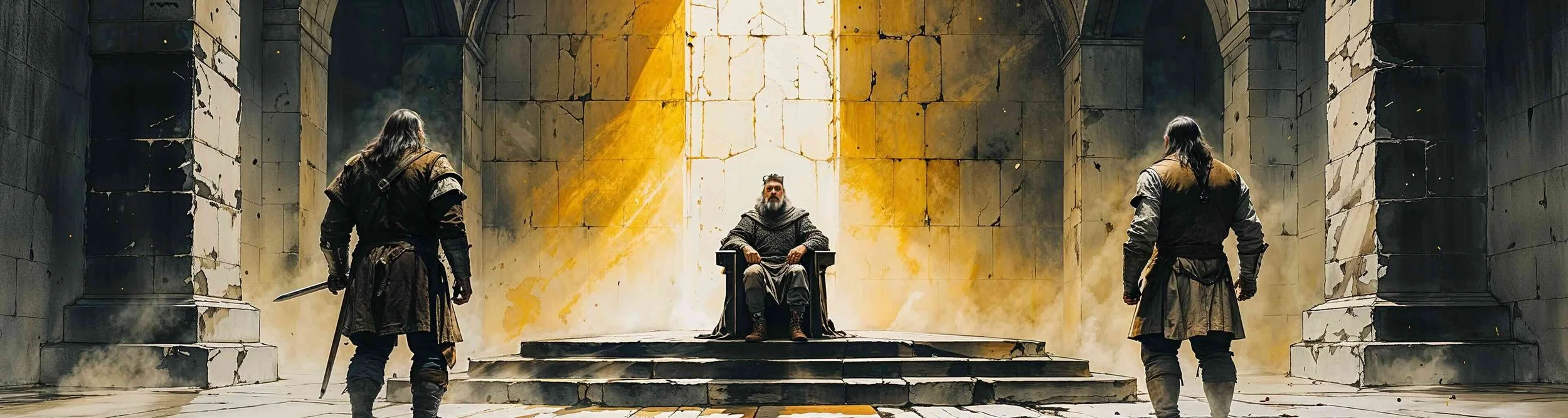
Scene Profile – At a Glance
- Location: The palace at Forres.
- What Happens: Duncan hears how the old Thane of Cawdor died nobly, then warmly thanks Macbeth and Banquo. He names his son Malcolm heir to the throne, and in an aside Macbeth recognises Malcolm as an obstacle he must "o'erleap".
- Key Characters: King Duncan, Macbeth, Banquo, Malcolm.
- Dramatic Function: Duncan's naming of an heir blocks Macbeth's path to the throne and pushes him from passive hope towards active intent.
- Famous Quote:
Stars, hide your fires;
Let not light see my black and deep desires...
(Macbeth, Act 1, Scene 4) - Why It Matters: Duncan unknowingly removes Macbeth's hope that "chance" alone might crown him. Now the throne can only be reached by action – and Macbeth begins to choose it.
Scene Summary
At the palace, Duncan asks whether the old Thane of Cawdor has been executed. Malcolm reports that Cawdor confessed his treasons, repented deeply, and died with great dignity – "nothing in his life became him like the leaving it". Duncan reflects ruefully that there is no way to read a man's true mind from his face, recalling that he had placed absolute trust in the very traitor now dead.
Macbeth, Banquo, Ross and Angus enter, and Duncan greets them with overflowing gratitude, telling Macbeth he has earned more thanks than can ever be repaid. Macbeth answers with the correct language of duty and loyalty. Duncan, moved to tears of joy, then makes a momentous announcement: he names his eldest son, Malcolm, Prince of Cumberland – the official heir to the Scottish throne.
The announcement lands on Macbeth like a blow. In an aside, he recognises Malcolm as a "step" lying directly in his path, which he must either fall down before or leap over. He calls on the stars to hide their light so that no one – including himself – will see his "black and deep desires". Duncan, oblivious, praises Macbeth once more as a "peerless kinsman" and the court sets off for Macbeth's castle at Inverness.
The Face and the Mind
The scene opens on a quietly devastating irony. Reflecting on the executed Cawdor, who betrayed him despite his complete trust, Duncan draws a lesson he is about to ignore. He admits there is no skill that lets you read a man's thoughts in his expression – and then, in the very next moment, embraces the new Cawdor with total faith.
Original
There's no art
To find the mind's construction in the face:
He was a gentleman on whom I built
An absolute trust.
(Duncan, Act 1, Scene 4)
Shakespeare Retold (Modern Verse)
One is unable
To know another's thoughts by how they look:
He was a gentleman in whom I'd built
An absolute trust.
The dramatic irony is exact. Duncan states the very truth that will kill him – that loyal faces can hide treacherous minds – and immediately demonstrates that he has not learned it. The man who enters seconds later, whom he calls "worthiest cousin", is plotting his death. Shakespeare uses Duncan's wisdom against him: he understands the danger in principle but cannot apply it, because his trusting nature will not let him suspect the people he loves.
The Prince of Cumberland
The turning point of the scene is Duncan's naming of an heir. By declaring Malcolm Prince of Cumberland, Duncan makes the succession official and, without knowing it, blocks Macbeth's path. Until now Macbeth has hoped that "chance" might crown him without any effort of his own; that hope dies here. The crown can no longer simply fall to him – it must be seized.
Original
The Prince of Cumberland! That is a step
On which I must fall down, or else o'erleap,
For in my way it lies.
(Macbeth, Act 1, Scene 4)
Shakespeare Retold (Modern Verse)
The Prince of Cumberland! That is a challenge
To trip me up, unless I overcome it,
For it stands in my way.
The metaphor of a "step" is precise. Malcolm is now a stair Macbeth must climb over to reach the throne, and the choice Macbeth frames – "fall down, or else o'erleap" – is the choice between giving up his ambition and committing himself to crime. He chooses the leap. This is the moment passive hope hardens into active intent: Macbeth knows there is now an obstacle, and he resolves to get past it rather than accept it.
Language and Technique
- Dramatic irony: Duncan laments that faces hide minds, then instantly trusts the man plotting his murder – the audience hears the warning he cannot.
- Imagery of light and dark: Macbeth begs the stars to hide their fires so light cannot see his "black and deep desires", aligning his ambition with darkness.
- Imagery of growth: Duncan speaks of "planting" Macbeth and helping him "grow", an image of nurture that the ungrateful Macbeth will betray.
- Aside: Macbeth's private speech lets the audience watch his intent harden while the trusting Duncan praises him aloud.
- Metaphor of obstruction: Malcolm becomes a "step" in Macbeth's path – the language of climbing that runs through the play's treatment of ambition.
Key Quotes from Act 1, Scene 4
Quote 1nothing in his life
Became him like the leaving it; he died
As one that had been studied in his death...
(Malcolm, Act 1, Scene 4)
Shakespeare Retold (Modern Verse)
Nothing in his life
He did with decency he showed in death.
He acted like he'd pondered his own death...
I have begun to plant thee, and will labour
To make thee full of growing.
(Duncan, Act 1, Scene 4)
Shakespeare Retold (Modern Verse)
I gave you chance to grow, and now I'll work hard
To see your full potential bloom.
Stars, hide your fires;
Let not light see my black and deep desires:
The eye wink at the hand; yet let that be,
Which the eye fears, when it is done, to see.
(Macbeth, Act 1, Scene 4)
Shakespeare Retold (Modern Verse)
Stars, do not shine,
So folk can't see these dark desires of mine;
Eyes, do not watch the actions of my hand
Till done, then my scared eyes will understand.
Key Takeaways
- Duncan cannot read faces: He admits no one can see a mind in a face, then trusts Macbeth absolutely – sealing his own fate.
- The old Cawdor dies well: His noble, repentant death sets a standard the guilt-ridden Macbeth will never reach.
- Malcolm is named heir: Duncan makes his son Prince of Cumberland, blocking Macbeth's path to the throne.
- Macbeth's intent hardens: No longer trusting to "chance", Macbeth resolves to "o'erleap" the obstacle in his way.
- Darkness and ambition align: Macbeth calls on the stars to hide his "black and deep desires", linking his goal to evil and concealment.
Study Questions and Analysis
Why is Duncan's comment about the face and the mind so important?
Duncan's reflection – that there is "no art to find the mind's construction in the face" – is one of the play's sharpest pieces of dramatic irony. He has just been betrayed by the old Thane of Cawdor, in whom he placed "absolute trust", and he draws exactly the right lesson: appearances cannot be relied on. Yet at the very moment he says it, the new Cawdor, who is plotting his murder, walks into the room to be embraced.
The line matters because it crystallises Duncan's tragic flaw. He is not foolish – he understands the danger of trusting faces – but he is constitutionally unable to act on that understanding. His goodness makes him assume goodness in others. The audience, who know Macbeth's mind, hears a warning Duncan cannot heed, and the irony deepens the sense that his murder is both terrible and, given his nature, almost unavoidable.
How does naming Malcolm as heir change Macbeth's situation?
Until this scene, Macbeth has been able to hope that the crown might come to him without his lifting a finger – that, as he put it, "chance may crown me, without my stir". Duncan's announcement destroys that hope. By naming Malcolm Prince of Cumberland, he creates a formal heir who stands between Macbeth and the throne.
which honour must
Not unaccompanied invest him only,
But signs of nobleness, like stars, shall shine
On all deservers.
(Duncan, Act 1, Scene 4)
Shakespeare Retold (Modern Verse)
But honours aren't
Exclusively for him and him alone,
But noble honours go, like stars that shine,
To those deserving.
The cruelty for Macbeth is that Duncan frames the honours generously, promising that nobleness will "shine on all deservers" – but the one honour that matters has just gone to someone else. From this point the throne cannot reach Macbeth by chance; it can only be taken. The scene therefore marks the moment his ambition is forced into a decision: accept Malcolm's elevation, or remove him.
What does the light and dark imagery reveal about Macbeth?
Macbeth's plea for the stars to hide their fires shows a man at war with his own conscience. He wants darkness not just to conceal his plans from others but to blind himself, so that his "eye" need not witness what his "hand" will do. The imagery aligns his ambition explicitly with night and concealment, and against light, which throughout the play stands for truth, order and goodness.
The speech is revealing because Macbeth already knows his desires are "black and deep" – he does not deceive himself about their nature, only wishes to hide them. This self-awareness is what makes him a tragic rather than a merely wicked figure: he sees the evil clearly and chooses it anyway. The same imagery returns in Lady Macbeth's invocation of "thick night", binding husband and wife together as conspirators who must extinguish the light to act.
How does this scene develop the theme of appearance versus reality?
The whole scene is built on the gap between how things look and how they are. Duncan opens it by lamenting that faces hide minds, and then proves his own point by trusting a murderer. Macbeth, meanwhile, performs perfect loyalty – speaking the polished language of duty and service – while his asides reveal a mind turning to murder.
This doubling makes the audience watch two performances at once: the public scene of gratitude and the private scene of intent. Macbeth's smooth speech of service to Duncan is a mask, exactly the kind of false face Lady Macbeth will later urge him to wear. The scene shows that in this court, the most dangerous threats wear the most loyal expressions, and that Duncan's downfall is sealed by his inability to see past the surface he himself has warned against.
Is Macbeth fully committed to murder by the end of this scene?
Not quite, but he has crossed an important line. In the previous scene he toyed with the idea that fate might crown him without action; here, faced with Malcolm's promotion, he recognises that the throne now requires him to act, and he steels himself to confront that "step" rather than accept it. His call to hide his "black and deep desires" shows intent forming, not merely a passing thought.
Yet he does not commit to the deed outright. He speaks of desires and obstacles, not of a definite plan, and the resolve to actually kill Duncan will not be settled until Lady Macbeth presses him in later scenes. What this scene establishes is the direction of travel: Macbeth has moved from hoping the crown might fall to him, to accepting that he must reach for it. The horror he felt at the thought of murder has not vanished, but ambition is steadily winning the argument.