Macbeth: Act 1, Scene 3 – Analysis
Scene Profile – At a Glance
- Location: A heath near Forres, where the Witches have gathered to meet Macbeth.
- What Happens: The Witches hail Macbeth as Thane of Glamis, Thane of Cawdor and future king, and tell Banquo his descendants will be kings. When Ross confirms the Cawdor title, Macbeth begins to imagine murdering Duncan.
- Key Characters: Macbeth, Banquo, the Witches, with Ross and Angus.
- Dramatic Function: The pivot of the play. The prophecies set Macbeth's ambition in motion and the murder of Duncan first enters his mind.
- Famous Quote:
All hail, Macbeth, thou shalt be king hereafter!
(The Witches, Act 1, Scene 3) - Why It Matters: The prophecy of kingship lights the fuse. From this moment Macbeth's mind turns to murder, and the tragedy becomes inevitable.
Scene Summary
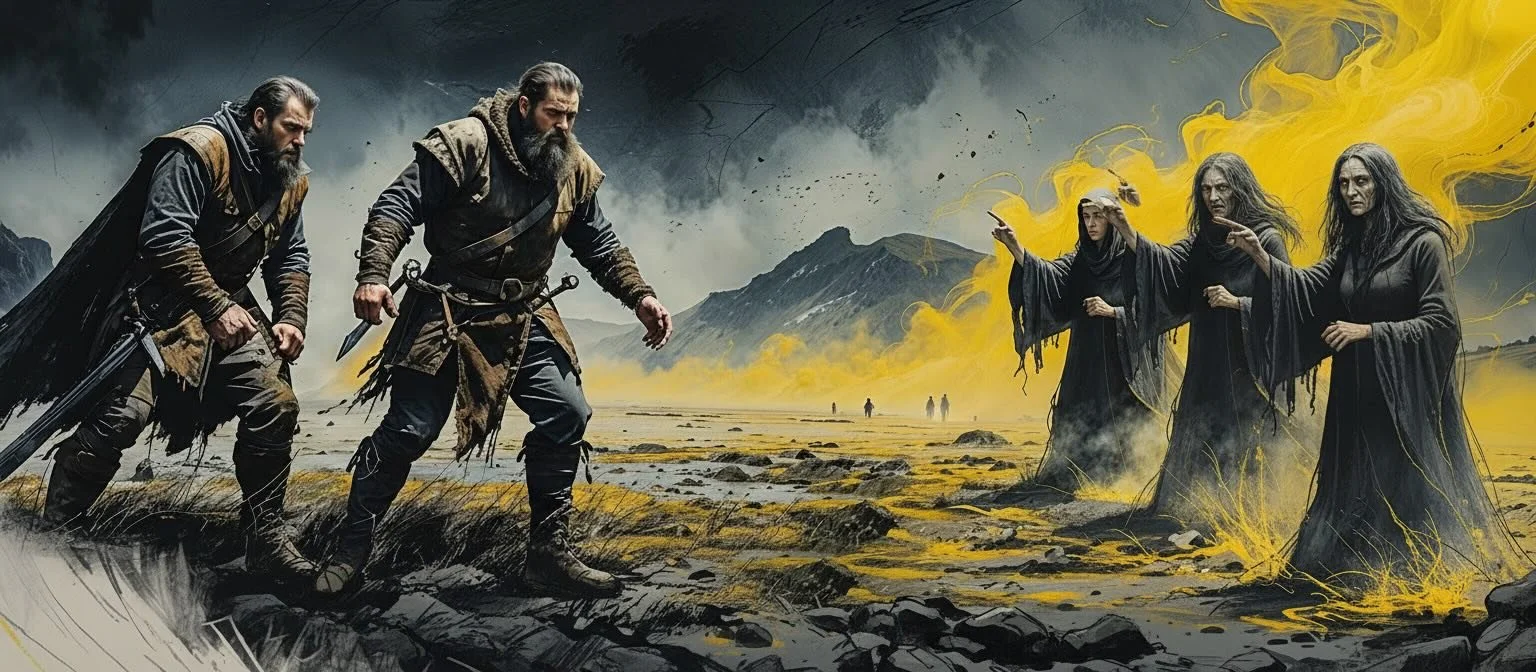
The Witches reassemble on the heath. They trade stories of the petty cruelties they have been working – killing pigs, tormenting a sailor whose wife refused them chestnuts – before a drum announces Macbeth's approach. As Macbeth and Banquo arrive, fresh from the battle, Macbeth's first words eerily echo the Witches' own paradox: "So foul and fair a day I have not seen."
Banquo notices the strange figures first and questions them. The Witches greet Macbeth with three titles: Thane of Glamis, Thane of Cawdor, and king "hereafter". Banquo, unsettled by Macbeth's reaction, asks for his own future, and they tell him riddlingly that he will be "lesser than Macbeth, and greater" and will father a line of kings, though he will never be king himself. Then they vanish into the air.
The two men are still puzzling over what they have seen when Ross and Angus arrive with news from Duncan: Macbeth has been made Thane of Cawdor. The first prophecy has come true within minutes. Macbeth is stunned, and the murder of Duncan rises unbidden in his imagination – a thought so "horrid" it makes his hair stand on end. Banquo warns that "instruments of darkness" often tell small truths to lead men into ruin. Macbeth, struggling to compose himself, resolves to leave matters to chance for now and the men set off to join the king.
The Prophecies
The heart of the scene is the triple greeting that names Macbeth's past, present and future in a single breath. The Witches do not command or threaten; they simply state, and the power of the moment lies in how quickly part of it comes true. By the time Ross confirms the Cawdor title, the audience watches prophecy harden into fact, and Macbeth's mind leaps ahead to the one prediction still outstanding.
Original
All hail, Macbeth! Hail to thee, thane of Glamis!
All hail, Macbeth, hail to thee, thane of Cawdor!
All hail, Macbeth, thou shalt be king hereafter!
(The Witches, Act 1, Scene 3)
Shakespeare Retold (Modern Verse)
All hail, Macbeth! Hail to you, Thane of Glamis!
All hail, Macbeth! Hail to you, thane of Cawdor!
All hail, Macbeth! You’ll be the king in future!
The triple "all hail" is liturgical, almost a parody of the homage owed to a king, and that is the point: the Witches crown Macbeth in words before any deed is done. The crucial difference between the three greetings is grammatical. Glamis he already is; Cawdor, unknown to him, he has just become; but king he only "shalt be". The prophecy supplies a destination without a route, and the gap between the two is exactly where Macbeth's ambition – and the murder – will rush in.
Banquo's Caution
Shakespeare immediately sets up a contrast. Banquo hears prophecies just as remarkable as Macbeth's – his children will be kings – yet his response is wary rather than hungry. Where Macbeth is "rapt", lost in thought, Banquo keeps his footing and names the danger directly: the supernatural often baits its trap with small truths.
Original
And oftentimes, to win us to our harm,
The instruments of darkness tell us truths,
Win us with honest trifles, to betray's
In deepest consequence.
(Banquo, Act 1, Scene 3)
Shakespeare Retold (Modern Verse)
And oftentimes, to get us into trouble,
Satanic forces feed us half the truth
To coax us with minutia, then betray us
With devastating impact.
This is the moral compass of the scene. Banquo sees exactly what Macbeth refuses to see: that a true prophecy can still be a trap, and that the small fulfilled promise (Cawdor) may be bait for a far costlier one. The two men hear the same words, but their characters shape what they do with them. Banquo's caution measures Macbeth's recklessness, and the play will reward and punish them accordingly.
The First Thought of Murder
Once the Cawdor title is confirmed, Macbeth's mind runs ahead in a series of asides – the play's first window into his private self. The thought of becoming king instantly attaches itself to an image of killing, and Macbeth is horrified by his own imagination. The violence is still only a "thought", but it already shakes him to the core.
Original
why do I yield to that suggestion
Whose horrid image doth unfix my hair
And make my seated heart knock at my ribs,
Against the use of nature?
(Macbeth, Act 1, Scene 3)
Shakespeare Retold (Modern Verse)
why am I dwelling on a thought
That is so awful, all my hair stands upright
And makes my heart thump, walloping my ribs,
At thoughts of killing him?
This is the true beginning of the tragedy. The Witches have planted nothing that was not already in Macbeth; they merely name his ambition, and his own mind supplies the murder. That he is appalled by the thought matters – it shows he is not a natural villain – but the thought has arrived, and it will not leave. The struggle of the rest of Act 1 is the struggle between this horror and the ambition that feeds it.
Language and Technique
- Echoing: Macbeth's first line, "So foul and fair a day I have not seen", unknowingly repeats the Witches' "fair is foul" – linking him to them before they speak.
- Triple structure: The three "all hail" greetings build incantatory power and map Macbeth's past, present and future onto a single moment.
- Paradox: Banquo's future is framed in riddles – "lesser than Macbeth, and greater", "not so happy, yet much happier" – that resist easy reading.
- Aside: Macbeth's private speeches let the audience hear the murder enter his mind while Banquo and the others remain unaware.
- Imagery of clothing: Banquo describes Macbeth's "borrowed robes" and new honours that "cleave not to their mould" – titles worn like ill-fitting clothes, a motif that runs through the play.
Key Quotes from Act 1, Scene 3
Quote 1So foul and fair a day I have not seen.
(Macbeth, Act 1, Scene 3)
Shakespeare Retold (Modern Verse)
Such dismal weather on this fateful day.
Thou shalt get kings, though thou be none:
So all hail, Macbeth and Banquo!
(The Witches, Act 1, Scene 3)
Shakespeare Retold (Modern Verse)
Your children will be kings, but you will not.
So, all hail, Macbeth and Banquo!
The thane of Cawdor lives: why do you dress me
In borrowed robes?
(Macbeth, Act 1, Scene 3)
Shakespeare Retold (Modern Verse)
The thane of Cawdor is alive! Why do you
Lend me his name?
If chance will have me king, why, chance may crown me,
Without my stir.
(Macbeth, Act 1, Scene 3)
Shakespeare Retold (Modern Verse)
If fate will make me king, then fate might crown me
Without my intervention.
Key Takeaways
- The prophecies drive the plot: The Witches name Macbeth Glamis, Cawdor and future king, setting the whole tragedy in motion.
- One prophecy comes true at once: Ross confirms the Cawdor title within minutes, making the promise of kingship feel real.
- Macbeth thinks of murder immediately: The crown instantly summons an image of killing Duncan – a thought that horrifies even him.
- Banquo is the cautious foil: He warns that "instruments of darkness" tell truths to lead men to ruin, and refuses to be carried away.
- Banquo's line will rule: The prophecy that his descendants will be kings plants the seed of his later murder.
Study Questions and Analysis
Why is the meeting with the Witches the turning point of the play?
Everything that follows flows from this scene. Before it, Macbeth is simply a loyal, victorious soldier; after it, he is a man with a crown in view and a murder in mind. The Witches give his ambition a shape and a target, and the swift confirmation of the Cawdor title convinces him that the rest of the prophecy is equally certain. From here the tragedy becomes a question not of whether Macbeth will be tempted but of how far he will go.
The scene also frames the play's central debate. The Witches predict; they do not compel. Macbeth's horrified reaction shows that the murderous thought is his own, summoned by the prophecy rather than implanted by it. Shakespeare therefore makes the supernatural a catalyst rather than a cause, and leaves us to judge how much of Macbeth's fall is fate and how much is choice.
How do Macbeth and Banquo react differently to the prophecies?
The contrast between the two men is the moral spine of the scene. Macbeth is immediately "rapt", absorbed and disturbed, and his mind races to the throne and the murder it might require. Banquo, given a prophecy just as dazzling, stays clear-eyed and suspicious. He treats the Witches as a possible trap rather than a promise.
Good sir, why do you start; and seem to fear
Things that do sound so fair?
(Banquo, Act 1, Scene 3)
Shakespeare Retold (Modern Verse)
What is alarming you? And why look scared
At news that sounds so great?
Banquo's puzzled question – why does good news frighten Macbeth? – quietly exposes the difference between them. Macbeth fears the prophecy because some part of him already intends to act on it; Banquo can hear his own without dread because he has no plan to force it. The same supernatural words meet two different consciences, and the play's outcome is shaped by that difference.
What does Macbeth's reaction reveal about his character?
Macbeth's asides give us our first sight of his inner life, and they are surprisingly conflicted. He is not a cold schemer leaping at his chance; he is a man appalled to discover the violence in his own imagination. The thought of murder makes his hair stand on end and his heart pound, and he recoils from it even as he dwells on it.
This complexity is what makes Macbeth a tragic figure rather than a simple villain. A. C. Bradley, in Shakespearean Tragedy (1904), stressed that Macbeth has a vivid moral imagination – he sees clearly the horror of what he contemplates – and that his tragedy lies in acting against his own conscience. The seeds of both the crime and the guilt that will destroy him are visible here, in the very moment the idea is born.
What is the importance of Banquo's prophecy?
The Witches' words to Banquo set up a second strand of the plot. Banquo will never be king, but his descendants will rule – which means that if Macbeth seizes the crown, he secures it not for his own line but for Banquo's. This realisation will gnaw at Macbeth and drive him to have Banquo murdered in Act 3.
The prophecy also had a topical force. Macbeth was written during the reign of King James I, who claimed descent from Banquo, so the promise that Banquo's heirs would be kings flatters the monarch in the audience and frames his dynasty as the rightful, divinely favoured one. Within the play, it ensures that Macbeth's crime can never bring him lasting security: the future, by prophecy, belongs to the man he leaves alive.
Are the Witches responsible for what Macbeth does?
This is one of the great open questions of the play, and the scene is carefully balanced to keep it open. On one side, the Witches clearly start the chain of events: without their prophecy, Macbeth would have no reason to think of the crown, let alone murder. On the other, they never tell him to kill anyone. They state a future; the means is entirely his invention.
Critics have read this either way. Some see the Witches as genuine agents of fate who doom Macbeth from the start; others, including those who emphasise his free will, argue that they merely externalise desires he already harbours, and that the murder springs from his own ambition. Shakespeare gives both readings room. The horror Macbeth feels at his own thought suggests a man making a choice, not a man controlled – but the uncanny accuracy of the prophecy keeps the question of destiny alive.
Why do the Witches open the scene talking about a sailor and his wife?
The opening exchange, in which the Witches boast of killing pigs and plotting revenge on a sailor whose wife denied them chestnuts, looks like a strange digression, but it does important work. It establishes the scale and nature of their malice before Macbeth arrives: petty, spiteful, but also limited.
Crucially, the Witch cannot sink the sailor's ship outright – "his bark cannot be lost" – only torment him with storms and sleeplessness. This quietly sets the rules for the whole play. The Witches can harass, tempt and unsettle, but they cannot simply destroy a man directly; they need human weakness to do their work. The same will be true of Macbeth: they can promise him a crown, but only he can choose to murder for it.