
Macbeth: Act 1, Scene 2 – Analysis
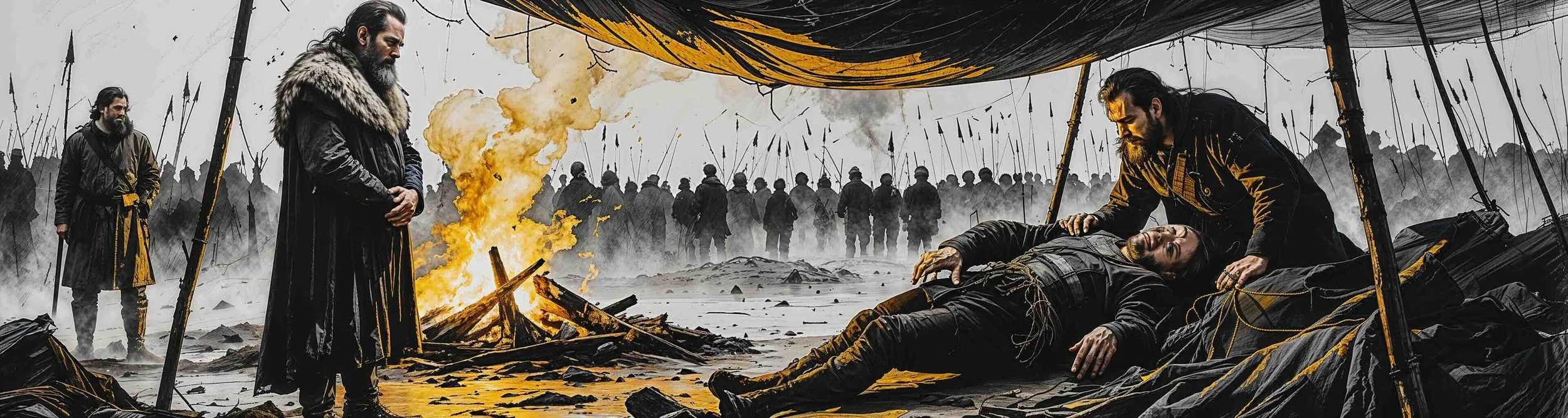
Scene Profile – At a Glance
- Location: A camp near Forres, just after a battle against rebels and a Norwegian invasion.
- What Happens: A wounded sergeant and then Ross report Macbeth's heroism in crushing the rebel Macdonwald and the Norwegians. Duncan, hearing of the Thane of Cawdor's treachery, condemns him to death and gives his title to Macbeth.
- Key Characters: King Duncan, Malcolm, the wounded Sergeant, and Ross (with Macbeth and Banquo reported but not present).
- Dramatic Function: Establishes Macbeth's reputation as a fearless warrior and loyal subject, and sets up the prophecy of Cawdor that the Witches will deliver in the next scene.
- Famous Quote:
For brave Macbeth – well he deserves that name –
Disdaining fortune, with his brandished steel,
Which smoked with bloody execution...
(Sergeant, Act 1, Scene 2) - Why It Matters: We hear Macbeth praised as the saviour of Scotland before we see him – making his later treachery all the more shocking – and Duncan unknowingly hands him a title the Witches have already promised.
Scene Summary
King Duncan and his sons arrive at a military camp to learn how the battle has gone. They meet a sergeant, fresh from the fighting and bleeding heavily, who has just saved Malcolm from capture. Duncan asks for news of the revolt, and the sergeant describes a struggle that hung in the balance like two exhausted swimmers clinging together.
The sergeant praises Macbeth above all. Against the rebel Macdonwald, supplied with troops from the western isles, Macbeth carved his way through the enemy with his sword and killed the traitor, splitting him open and setting his head on the battlements. No sooner was that victory won, though, than the King of Norway launched a fresh assault. The sergeant, fainting from his wounds, is sent off to find surgeons.
Ross then enters with the latest news from Fife. The Norwegian king, helped by the treacherous Thane of Cawdor, had begun a "dismal conflict", but Macbeth confronted him point for point and won the day. Norway now begs for a truce and has paid Scotland ten thousand dollars. Duncan, disgusted by Cawdor's betrayal, orders his immediate execution and grants his title to Macbeth, declaring: "What he hath lost noble Macbeth hath won."
Macbeth the Warrior, Reported
Shakespeare makes a striking choice here: before we ever meet Macbeth, we hear him described at length as a hero. The sergeant's blood-soaked report turns Macbeth into a force of nature on the battlefield, a man who "disdains fortune" and cuts his way to the enemy with a smoking sword. This is the public Macbeth – loyal, fearless, the saviour of his king – and the play wants us to hold this image firmly.
Original
For brave Macbeth – well he deserves that name –
Disdaining fortune, with his brandished steel,
Which smoked with bloody execution,
Like valour's minion carved out his passage...
(Sergeant, Act 1, Scene 2)
Shakespeare Retold (Modern Verse)
For brave Macbeth – he well deserves that title –
Despite the odds against him, raised his sword,
Dripping with blood from those he’d killed before,
And like a gallant son, carved out a path...
The praise is genuine, but the violence is unsettling. Macbeth "unseams" Macdonwald from the navel to the jaw and fixes his head on the battlements – brutal even by the standards of war. The same capacity for bloodshed that makes him a hero here will, only a few scenes later, be turned on his own king. Shakespeare is showing us that the qualities Scotland celebrates in Macbeth are exactly the ones that will destroy it.
Treachery and Reward
The scene's second half is built around a grim irony. Duncan learns that the Thane of Cawdor – a man he trusted – has betrayed him by helping the Norwegians, and he responds at once: Cawdor will die, and his title will pass to the loyal Macbeth. Duncan means it as a reward for faithful service, with no idea that he is fulfilling a prophecy and naming his own future murderer.
Original
No more that thane of Cawdor shall deceive
Our bosom interest: go pronounce his present death,
And with his former title greet Macbeth.
(Duncan, Act 1, Scene 2)
Shakespeare Retold (Modern Verse)
The thane of Cawdor will not cheat and harm
What we hold dear again; put him to death,
And grant his former title to Macbeth.
There is a pattern here the audience will remember. One Thane of Cawdor has just betrayed Duncan and paid with his life; the next Thane of Cawdor will betray him too. Duncan's confident judgement – punishing the traitor, rewarding the hero – looks sound, but it rests on his fatal inability to read what lies behind a loyal face. The seeds of his murder are planted in the very act of generosity that honours Macbeth.
Language and Technique
- Reported action: The battle happens offstage and reaches us through the sergeant and Ross, so our first picture of Macbeth is built entirely from others' praise.
- Violent imagery: Phrases like "unseamed him from the nave to the chaps" make Macbeth's heroism graphically bloody, hinting at the violence to come.
- Simile: The battle is "as two spent swimmers, that do cling together" – an image of exhaustion and uncertainty that captures how close-run the fight was.
- Dramatic irony: Duncan rewards Macbeth with Cawdor's title, unaware that he is fulfilling the Witches' prophecy and elevating his future killer.
- Pattern of betrayal: The old Cawdor's treachery quietly prefigures the new one's, a structural echo the audience will later recall.
Key Quotes from Act 1, Scene 2
Quote 1Till he unseamed him from the nave to the chaps,
And fixed his head upon our battlements.
(Sergeant, Act 1, Scene 2)
Shakespeare Retold (Modern Verse)
Until he’d gutted him from neck to belly
And stuck his chopped-off head upon our fort.
O valiant cousin! Worthy gentleman!
(Duncan, Act 1, Scene 2)
Shakespeare Retold (Modern Verse)
A fearless son, a gentleman indeed!
What he hath lost noble Macbeth hath won.
(Duncan, Act 1, Scene 2)
Shakespeare Retold (Modern Verse)
What he has lost, noble Macbeth has won.
Key Takeaways
- Macbeth is introduced as a hero: Before we see him, he is praised as the fearless saviour of Scotland, loyal to his king.
- His violence is striking: The graphic account of how he kills Macdonwald hints at the brutality that will later destroy him.
- The old Cawdor betrays Duncan: A trusted thane turns traitor – a pattern Macbeth will repeat.
- Duncan rewards Macbeth with Cawdor's title: Without knowing it, the king fulfils the Witches' prophecy and honours his future murderer.
- Duncan cannot read faces: His trust in the old Cawdor, and now in Macbeth, shows the blindness that makes him vulnerable.
Study Questions and Analysis
Why does Shakespeare describe Macbeth's heroism before we meet him?
By having the sergeant and Ross praise Macbeth before he appears, Shakespeare builds him up as a national hero in the audience's mind. We hear that he "disdained fortune", carved through the enemy, and saved his king and country. This reputation matters because it sets the height from which Macbeth will fall: the further the play raises him as a loyal saviour, the more shocking his murder of Duncan becomes.
It is also a clever piece of misdirection. The first scene gave us the Witches and an atmosphere of evil; this scene gives us a Macbeth who seems entirely admirable. The audience is left to wonder how this brave, loyal man could possibly be the figure the Witches have marked out, which sharpens the tension when the two worlds finally meet.
How does the violence of the battle prepare us for the rest of the play?
The sergeant's description is unusually graphic. Macbeth does not simply defeat Macdonwald; he "unseams" him from navel to jaw and mounts his head on the battlements. The bloodshed is celebrated here as heroism, but it establishes early that Macbeth is a man entirely at ease with killing.
Which ne'er shook hands, nor bade farewell to him,
Till he unseamed him from the nave to the chaps...
(Sergeant, Act 1, Scene 2)
Shakespeare Retold (Modern Verse)
He didn’t shake his hand nor say goodbye
Until he’d gutted him from neck to belly
This matters because the play will soon ask us to watch Macbeth kill again – but in cold blood, against an innocent king. The battlefield violence is sanctioned and praised; the murder of Duncan is not. Shakespeare establishes Macbeth's capacity for slaughter in a context where it is honoured, so that the horror of the later killings lies not in any new ability but in the loss of any just cause.
What is the significance of the Thane of Cawdor's betrayal?
The old Thane of Cawdor's treachery does two jobs at once. First, it sets up the dramatic irony of the next scene: Duncan transfers Cawdor's title to Macbeth, exactly as the Witches will prophesy, so the prophecy starts coming true almost before it is spoken. Second, it establishes a pattern of trusted men betraying the king.
Duncan's own words point up his fatal flaw when he reflects, in the following scene, that there is no way to read a traitor's mind from his face. The first Cawdor deceived him completely; now he places "absolute trust" in a new one. The betrayal quietly warns the audience that loyalty in this play is never safe to assume, and that Duncan's generous, trusting nature is precisely what leaves him exposed.
How is King Duncan presented in this scene?
Duncan comes across as a warm, grateful and just king. He honours the wounded sergeant, praises Macbeth and Banquo lavishly, punishes the traitor and rewards the loyal. There is nothing tyrannical about him; he is the model of legitimate, gracious kingship that Macbeth will later destroy.
Yet the scene also hints at his weakness. Duncan governs through trust and gratitude, relying on others to report the truth and on appearances to guide his judgement. That openness makes him a good man but a vulnerable king, and the play will turn it against him. The very generosity that makes him beloved – rewarding Macbeth so readily – is what places the means of his own destruction into his murderer's hands.
What does the language of swimming and storms add to the scene?
The sergeant reaches for natural imagery to convey how uncertain the battle was. He compares the armies to "two spent swimmers" who cling together until neither can swim, capturing a struggle so even that exhaustion, not strength, might decide it. He then likens the Norwegian attack to a sudden storm breaking out of a clear sky.
These images do more than decorate the report. The swimmers suggest how finely balanced Scotland's fate is, dependent on one man's effort tipping the scales. The storm imagery, arriving so soon after the thunder and "fog and filthy air" of the opening scene, keeps the natural world disordered and turbulent – a fitting backdrop for a kingdom whose order is about to be overturned from within.
Why is the battle reported rather than shown?
Staging a full battle was impractical in Shakespeare's theatre, but the choice to report it is also artistic. By filtering Macbeth's heroism through the sergeant's and Ross's words, Shakespeare keeps Macbeth offstage and mysterious for one more scene, building anticipation for his entrance among the Witches.
Reporting the action also lets Shakespeare colour it. A staged fight would simply be a fight; a described one can be shaped into heroic, even mythic, language, with smoking swords and split bodies. The praise is mediated through admiring witnesses, so we receive Macbeth as Scotland sees him – a legend – before we ever encounter the private, hesitant man who will weigh murder in his own mind.
