Macbeth: Act 3, Scene 4 – Analysis
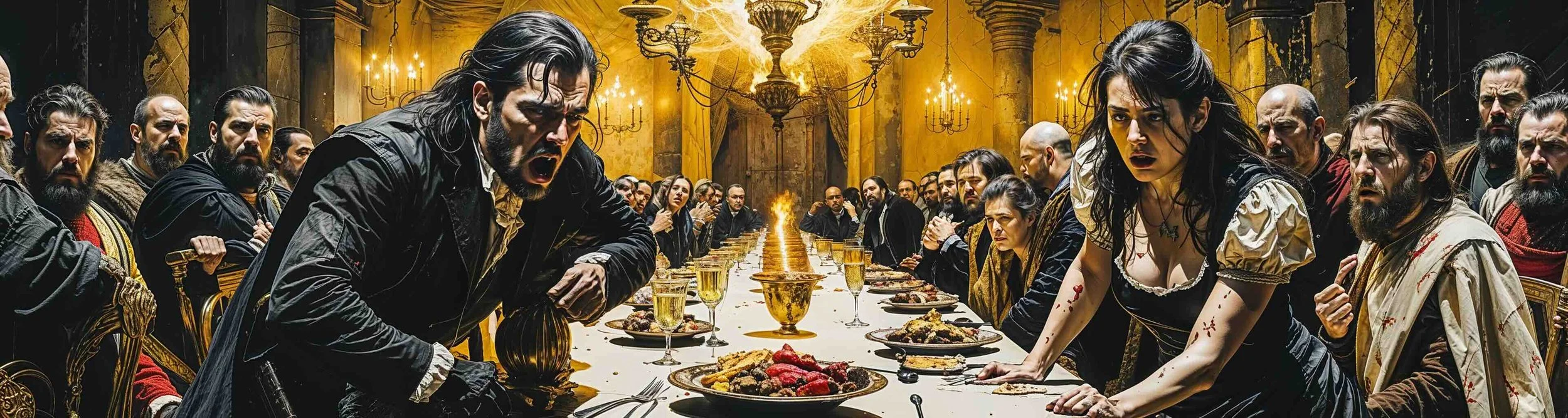
Scene Profile – At a Glance
- Location: The hall in the palace at Forres, during a state banquet.
- What Happens: At his coronation feast, Macbeth learns Banquo is dead but Fleance escaped. The ghost of Banquo then appears, visible only to Macbeth, who breaks down in front of his guests. Lady Macbeth sends the lords away.
- Key Characters: Macbeth, Lady Macbeth, the Ghost of Banquo, Ross, and Lennox.
- Dramatic Function: The public unravelling of Macbeth. His guilt becomes visible, his reign begins to crack, and he resolves to visit the witches again.
- Famous Quote:
Never shake
Thy gory locks at me.
(Macbeth, Act 3, Scene 4) - Why It Matters: The banquet is the turning point of the play. Macbeth's guilt erupts in public, the court sees their king is unwell, and from here his grip on Scotland steadily loosens.
Scene Summary
Macbeth welcomes his nobles to a grand banquet, playing the gracious host. The First Murderer appears at the door, and Macbeth slips aside to hear his report: Banquo's throat is cut, but Fleance has escaped. Macbeth is shaken by the news of the boy's survival but returns to his guests, masking his fear.
As Macbeth laments Banquo's absence and proposes a toast to him, the murdered man's ghost enters and sits in Macbeth's own seat. Only Macbeth can see it. He recoils in horror, addressing the empty chair and crying out that he did not commit the murder. The lords are bewildered, and Lady Macbeth hurries to explain that her husband suffers from a passing fit he has had since youth.
The ghost vanishes, and Macbeth recovers, but when he toasts Banquo again the ghost returns. This time Macbeth challenges it furiously, daring it to take any shape but that of the dead Banquo. Lady Macbeth, unable to control the situation, abruptly dismisses the guests before Macbeth can say more.
Alone with his wife, Macbeth broods on blood, prophecy, and the absence of Macduff, who has refused to attend. He resolves to seek out the witches again to learn the worst, and admits he is so deep in blood that there is no turning back. The couple go to bed, Macbeth confessing he is still only a beginner in murder.
The Murderer's Report
The banquet opens with Macbeth at his most kingly, but the illusion is broken almost at once. The First Murderer appears at the door with blood on his face, and Macbeth must conduct a whispered conversation about assassination while a hall full of nobles waits. The news is half good, half catastrophic.
Original
Then comes my fit again: I had else been perfect,
Whole as the marble, founded as the rock,
As broad and general as the casing air:
But now I am cabined, cribbed, confined, bound in
To saucy doubts and fears.
(Macbeth, Act 3, Scene 4)
Shakespeare Retold (Modern Verse)
I'm scared again, then. It would have been perfect.
Complete, like solid marble stood on bedrock,
All free and unconfined, like air around us.
But now I am confined within a cabin
Made up of doubts and fears.
The contrast in the imagery is everything. Had both deaths been achieved, Macbeth would have been "whole as the marble" and "broad and general as the casing air" – solid, free, complete. Instead Fleance's escape leaves him "cabined, cribbed, confined", the clustering hard consonants enacting the claustrophobia of his fear. One survivor is enough to undo all his security. The prophecy he tried to kill is still alive, and so is his terror.
The Ghost at the Feast
The dramatic heart of the play arrives when Banquo's ghost takes Macbeth's seat. The staging is brilliant: the ghost is visible only to Macbeth (and the audience), so the court sees their king ranting at an empty stool. Macbeth's public composure shatters, and his first instinct is to deny his guilt to a corpse that cannot accuse him aloud.
Original
Thou canst not say I did it: never shake
Thy gory locks at me.
(Macbeth, Act 3, Scene 4)
Shakespeare Retold (Modern Verse)
You cannot say I did this. Do not shake
Your bloodied head at me.
The line is a confession dressed as a denial. "Thou canst not say I did it" protests innocence, but only a guilty man would say it to a ghost. The "gory locks" make the murder horribly physical, the bloodied hair a reminder of the "twenty trenched gashes" the murderer described. Macbeth's mind, the same imagination that conjured the floating dagger, now produces a vision so vivid that he cannot tell it from reality, and his terror is laid bare before the whole court.
Lady Macbeth's Damage Control
While Macbeth disintegrates, Lady Macbeth fights to hold the evening together. She covers for him, dismissing his outburst as a familiar illness, and then rounds on him privately with the old weapon of his manhood. It is a last display of the steel that defined her early in the play, but it no longer works as it once did.
Original
This is the very painting of your fear:
This is the air-drawn dagger which, you said,
Led you to Duncan.
(Lady Macbeth, Act 3, Scene 4)
Shakespeare Retold (Modern Verse)
It's just a sight created out of fear,
Like the imaginary dagger you said
Led you to Duncan.
Lady Macbeth's diagnosis is clever and cutting: she insists the ghost is only "the very painting of your fear", a hallucination like the dagger before Duncan's murder. By recalling that earlier vision she tries to shame him back to composure. But the comparison rebounds, because it reminds the audience that Macbeth's hallucinations have always been bound up with real guilt. Her control is slipping; she can manage the guests, but she can no longer manage her husband's mind.
"In Blood Stepped In So Far"
With the guests gone, the scene closes on a quieter, darker note. Macbeth, drained, reflects on what he has become. He notes that Macduff has refused his summons, resolves to consult the witches again, and delivers the chilling image that defines the rest of his reign: he is so deep in blood that going back would be as hard as going on.
Original
I am in blood
Stepped in so far that, should I wade no more,
Returning were as tedious as go o'er...
(Macbeth, Act 3, Scene 4)
Shakespeare Retold (Modern Verse)
I've so much blood
Upon my hands that, should I choose to backtrack,
It would be like repeating all I've done.
The image of wading through a river of blood is one of the most famous in the play. Macbeth has reached a point of no return: he is so far across that retreat is as exhausting and as bloody as continuing. It is the logic of the tyrant, who must keep killing to protect what killing has won. The line also signals a change in his temperament – from this point he will act first and reflect later, "Strange things I have in head" that "must be acted ere they may be scanned".
Language and Technique
- The supernatural made visible: Banquo's ghost, seen only by Macbeth, externalises his guilt and turns a private conscience into a public spectacle.
- Plosive consonants: "Cabined, cribbed, confined, bound in" clusters hard sounds to enact the suffocating fear that grips Macbeth.
- Imagery of blood: From the murderer's "twenty trenched gashes" to Macbeth wading "in blood", the scene is saturated with the colour and weight of slaughter.
- Dramatic irony: Macbeth toasts "our dear friend Banquo, whom we miss" moments before the murdered Banquo appears at the table.
- Questioning manhood: Lady Macbeth's "Are you a man?" repeats the tactic she used over Duncan, but its power over Macbeth is fading.
Key Quotes from Act 3, Scene 4
Quote 1There the grown serpent lies; the worm that's fled
Hath nature that in time will venom breed,
No teeth for the present.
(Macbeth, Act 3, Scene 4)
Shakespeare Retold (Modern Verse)
The grown snake's dead; the younger one that's run
Will, over time, grow up riddled with hatred;
Now he's too young to hurt.
Which of you have done this?
(Macbeth, Act 3, Scene 4)
Shakespeare Retold (Modern Verse)
Which one of you has done this?
What man dare, I dare:
Approach thou like the rugged Russian bear,
The armed rhinoceros, or the Hyrcan tiger;
Take any shape but that, and my firm nerves
Shall never tremble...
(Macbeth, Act 3, Scene 4)
Shakespeare Retold (Modern Verse)
I dare do anything another man does:
If you came at me like a Russian bear,
A horned rhinoceros or Caspian tiger,
In any form than you are now, my nerves
Will never tremble...
It will have blood; they say, blood will have blood:
Stones have been known to move and trees to speak...
(Macbeth, Act 3, Scene 4)
Shakespeare Retold (Modern Verse)
The ghost will want my blood; those killed want blood!
I've heard of gravestones opening, trees speaking...
Key Takeaways
- The ghost makes guilt public: Banquo's apparition, seen only by Macbeth, exposes his guilt before the entire court.
- Macbeth loses control: His composure shatters at the banquet, and the lords see that their king is deeply disturbed.
- Lady Macbeth's power fades: She covers for him and shames him as before, but can no longer steady his mind or save the evening.
- Macduff's absence is ominous: Macduff's refusal to attend marks him as Macbeth's next suspect and a focus of resistance.
- No turning back: Macbeth declares he is so far "in blood" that retreat is as hard as going on, and vows to seek the witches again.
Study Questions and Analysis
Is Banquo's ghost real, or a hallucination?
The play leaves this deliberately open, and the staging makes the ambiguity central. The ghost is visible to Macbeth and to the audience, but not to any other character on stage, which strongly suggests it is a projection of Macbeth's guilty mind, like the dagger he saw before murdering Duncan. Lady Macbeth certainly treats it as a hallucination, "the very painting of your fear".
Yet the play also takes the supernatural seriously elsewhere – the witches' prophecies come true, and the world of Macbeth is one where the dead may walk. A. C. Bradley, in Shakespearean Tragedy (1904), read the ghost as the work of Macbeth's tormented imagination, while other critics have argued the play wants us to feel a genuine intrusion of the supernatural. The richness of the moment lies in the uncertainty: whether the ghost rises from Macbeth's conscience or from beyond the grave, it makes his guilt unbearably visible.
Why is the banquet scene a turning point in the play?
The banquet is the high point of Macbeth's reign and the moment it begins to fall apart. It should be a display of royal power and unity, with the new king surrounded by his nobles. Instead it collapses into chaos as Macbeth raves at an empty chair, and the lords leave having seen their king lose his grip on reality.
From this point Macbeth's authority steadily declines. The court now knows something is gravely wrong with him, Macduff's open defiance signals organised resistance, and Macbeth himself admits he must wade further into blood to survive. The scene also marks the last time we see the Macbeths together in public; afterwards their partnership disintegrates and they move towards their separate ruin. The feast that was meant to crown his success instead exposes the rot at the centre of his rule.
How does Lady Macbeth try to control the situation?
Lady Macbeth responds with the same combination of public poise and private pressure that served her over Duncan's murder. To the guests she offers a calm explanation, insisting the king has suffered such fits "from his youth" and urging them to ignore him and keep eating. To Macbeth she applies the lash of his manhood, demanding "Are you a man?" and dismissing his terror as "proper stuff" fit only for an old wives' tale.
Sit, worthy friends: my lord is often thus,
And hath been from his youth...
(Lady Macbeth, Act 3, Scene 4)
Shakespeare Retold (Modern Verse)
Sit down, good friends: my lord is often like this,
And has been since his youth...
Her quick thinking buys time, but the strain is showing. Eventually she cannot sustain the performance and has to dismiss the guests outright, abandoning the careful order of a royal feast. The scene marks the beginning of her decline: the woman who once seemed in total command can no longer control her husband, and the guilt she has suppressed will soon overwhelm her in sleep.
What does Macduff's absence signify?
Macduff's refusal to attend the banquet is mentioned almost in passing, but it carries great weight. In a culture where loyalty to the king was demonstrated by attendance at his feast, staying away is a pointed act of defiance. Macbeth notes it at once and reveals that he keeps a paid informer in every noble's house, a detail that exposes the paranoid surveillance underpinning his rule.
The moment marks Macduff as Macbeth's chief rival and the focus of resistance to come. It also drives Macbeth's next decision: unsettled by the absence and by the ghost, he resolves to seek out the witches and learn the worst. Macduff's empty place at the table thus sets two plots in motion – Macbeth's return to the witches and the gathering opposition that will eventually destroy him.
What does the scene reveal about the theme of guilt?
The banquet is the play's fullest dramatisation of guilt. Macbeth's conscience, which he has tried to suppress, takes physical form as the ghost of the man he murdered and forces its way into the most public moment of his reign. Guilt here is not a quiet feeling but an active power, one that exposes the killer in front of his whole court.
Macbeth's later reflection that "blood will have blood" extends the idea into a moral law: murder cannot stay hidden, and the dead demand reckoning. L. C. Knights, in How Many Children Had Lady Macbeth? (1933), directed attention to the play's poetry as a study of evil and its consequences, and this scene shows those consequences erupting from within. Macbeth's guilt is destroying him from the inside even as no human accuser has yet raised a hand against him.