Macbeth: Act 3, Scene 3 – Analysis
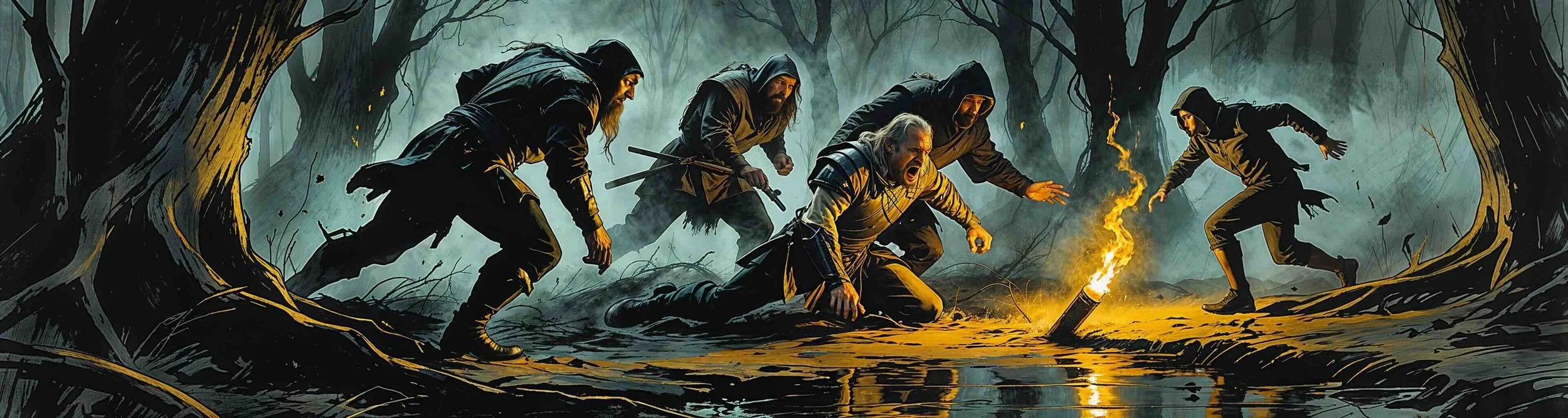
Scene Profile – At a Glance
- Location: A park near the palace at Forres, at dusk.
- What Happens: A third murderer joins the two hired by Macbeth. They ambush Banquo and his son Fleance as they approach on foot. Banquo is killed, but Fleance escapes into the dark.
- Key Characters: Banquo, Fleance, and the three Murderers.
- Dramatic Function: Macbeth's first ordered killing is carried out, yet it half fails. Fleance's escape keeps the prophecy alive and dooms Macbeth's plan from the start.
- Famous Quote:
O, treachery! Fly, good Fleance, fly, fly, fly!
(Banquo, Act 3, Scene 3) - Why It Matters: Banquo dies, but his son lives to father the line of kings the witches foresaw. Macbeth's attempt to outwit fate fails at the moment of its execution.
Scene Summary
Three murderers wait in a park near the palace as night falls. The first two, hired by Macbeth in the earlier scene, are puzzled to find a third man among them, but he assures them he was sent by Macbeth himself and knows their orders exactly. They settle in to wait for their victim, watching the last light fade in the west.
Hearing horses, they realise Banquo is approaching. As is the custom, he and his son Fleance have dismounted and are walking the last stretch to the palace gate by torchlight. The murderers strike. Banquo, mortally wounded, cries out for his son to flee and avenge him, and dies as Fleance escapes into the darkness.
The light is knocked out in the struggle, and in the confusion the killers lose Fleance. They have completed only half their task: Banquo is dead, but his son, the future the prophecy promised, has slipped away. They leave to report to Macbeth.
The Ambush and the Botched Job
The murder is swift and brutal, but Shakespeare makes sure it goes wrong. Banquo's dying breath is not for himself but for his son, and that single command – "fly" – defeats Macbeth's whole purpose. Killing Banquo was never enough; the prophecy lives through Fleance, and Fleance is gone.
Original
O, treachery! Fly, good Fleance, fly, fly, fly!
Thou mayst revenge. O slave!
(Banquo, Act 3, Scene 3)
Shakespeare Retold (Modern Verse)
I've been betrayed! Run, Fleance, son! Run, run!
You might get our revenge! You slave!
Banquo dies as he lived – loyal and clear-sighted – recognising the "treachery" instantly and thinking of the future rather than himself. His call for Fleance to "revenge" plants the seed of Macbeth's eventual ruin: the son who escapes is the dynasty the witches foretold. The murder that was meant to make Macbeth "safe" instead leaves the one threat he most feared alive and at large.
Language and Technique
- Light and dark imagery: The fading light in the west and the snuffed-out torch make darkness itself the cover for murder, echoing Macbeth's earlier plea to "seeling night".
- Dramatic irony: Banquo's casual "It will be rain to-night" is answered by the murderer's grim "Let it come down", turning small talk into a death sentence.
- The mysterious third murderer: The unexplained extra man deepens the atmosphere of paranoia and secrecy surrounding Macbeth's rule.
- Repetition: Banquo's frantic "fly, fly, fly" drives the urgency of Fleance's escape and the desperation of the moment.
Key Quotes from Act 3, Scene 3
Quote 1The west yet glimmers with some streaks of day:
Now spurs the lated traveller apace
To gain the timely inn; and near approaches
The subject of our watch.
(First Murderer, Act 3, Scene 3)
Shakespeare Retold (Modern Verse)
The remnants of the sunlight fade out west;
Spurring the tardy travellers on apace
To seek refuge in time; and soon, approaching
Will be the one we're here for.
There's but one down; the son is fled.
(Third Murderer, Act 3, Scene 3)
Shakespeare Retold (Modern Verse)
We killed just one; the son is fled.
Key Takeaways
- Banquo is murdered: Macbeth's first ordered killing is carried out, removing the friend whose nobility he feared.
- Fleance escapes: The boy's flight keeps the prophecy of Banquo's royal line alive and dooms Macbeth's plan.
- The job half fails: The murderers complete only "the best half" of the task, leaving the real threat at large.
- Darkness aids murder: The fading light and the snuffed torch make night itself the accomplice of the crime.
- Banquo dies thinking of revenge: His final cry sends Fleance to safety and points towards Macbeth's eventual downfall.
Study Questions and Analysis
Why is Fleance's escape so important?
Fleance's escape is the most significant event in the scene, far more important than Banquo's death. Macbeth had Banquo killed chiefly because of the witches' prophecy that Banquo would father a line of kings. By ordering Fleance's death too, Macbeth was trying to cut off that future. The boy's survival means the prophecy remains in force.
We have lost
Best half of our affair.
(Second Murderer, Act 3, Scene 3)
Shakespeare Retold (Modern Verse)
We've lost
The best half of our task.
The murderers themselves recognise the failure. Macbeth wanted certainty and security; instead he is left with a half-finished crime that has made his position worse, not better. Banquo is dead, but the threat Banquo represented – the future kings of his bloodline – rides off into the night in the person of his son.
Who is the mysterious third murderer?
The arrival of a third murderer, unmentioned when Macbeth hired the first two, is one of the play's small mysteries. The first murderer is suspicious until the newcomer proves he knows Macbeth's instructions exactly. Shakespeare never explains who he is, and the question has intrigued readers and directors for centuries.
Some have wondered whether the third man is Macbeth himself, in disguise, so distrustful that he must watch the murder done; others see him simply as a sign of how Macbeth's network of spies and hired men now extends everywhere. Whatever the answer, the unexplained figure deepens the scene's atmosphere of secrecy and surveillance. It suits a kingdom in which, as Macbeth later admits, there is not a noble house without a paid informer.
How does Shakespeare use light and dark in the scene?
Darkness is central to the murder. The murderers note that "the west yet glimmers with some streaks of day", so the killing happens at the very edge of night, in the failing light. Banquo and Fleance arrive carrying a torch, the one point of brightness, and in the struggle the light is struck out, plunging the scene into the confusion that lets Fleance escape.
The pattern fits the whole play. Macbeth has repeatedly called on night and darkness to hide his crimes, asking "seeling night" to blind the day. Here that darkness becomes literal: murder is done under cover of night, and it is the loss of light that both completes the ambush and spoils it. The dark serves Macbeth's evil and then, in letting Fleance slip away, turns against him.