
Macbeth: Act 3, Scene 6 – Analysis
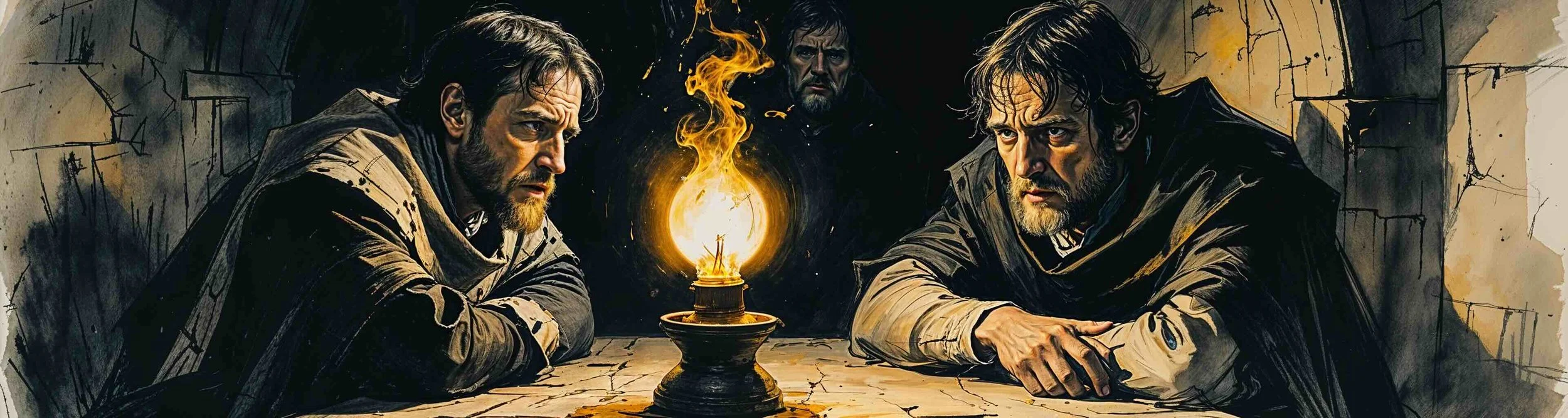
Scene Profile – At a Glance
- Location: The palace at Forres.
- What Happens: Lennox and an unnamed Lord discuss recent events in heavily ironic terms. They reveal that suspicion has turned against Macbeth, that Macduff has fled to England, and that an army is gathering to challenge the tyrant.
- Key Characters: Lennox and a Lord.
- Dramatic Function: The scene shifts the audience's viewpoint from Macbeth to the resistance. It confirms that Scotland now sees him as a tyrant and sets the opposition in motion.
- Famous Quote:
May soon return to this our suffering country
Under a hand accursed!
(Lord, Act 3, Scene 6) - Why It Matters: The scene marks the turning of the tide. The court no longer believes Macbeth's lies, and the machinery of his overthrow – Macduff, Malcolm, and an English army – is now in motion.
Scene Summary
Lennox speaks with another lord, and his words are thick with irony. He recounts the official version of recent events – that Malcolm and Donalbain murdered their father Duncan, that Banquo was killed by his fleeing son Fleance – but his sarcastic tone makes clear he believes none of it. Beneath the careful praise of Macbeth's "wise" and "noble" conduct runs a current of open suspicion.
The Lord then supplies the news that matters. Macduff, who refused to attend Macbeth's feast and now "lives in disgrace", has fled to the English court. There he seeks help from the holy King Edward and the warlike Siward to raise an army against Macbeth, hoping to restore peace, safety, and honest rule to Scotland.
Lennox welcomes the news and prays for the success of the mission. The scene ends with both men hoping that a "swift blessing" will return to their suffering country, now groaning under a tyrant's "hand accursed".
Lennox's Irony
The brilliance of the scene lies in its double-speak. Lennox appears to defend Macbeth, praising his grief and his decisive action against Duncan's grooms, but every compliment is so overstated that it becomes an accusation. The audience, and the lord he is speaking to, hear the true meaning under the loyal words.
Original
How it did grieve Macbeth! Did he not straight
In pious rage the two delinquents tear,
That were the slaves of drink and thralls of sleep?
(Lennox, Act 3, Scene 6)
Shakespeare Retold (Modern Verse)
Oh, how Macbeth did grieve! Did he not go
In loyal rage to slaughter the two servants
Who both were drunk and still were fast asleep?
The irony is razor-sharp. Lennox calls Macbeth's killing of the grooms "pious rage", but the detail that they were "slaves of drink and thralls of sleep" exposes the convenient truth: the only witnesses were murdered before they could speak. By praising the deed so warmly, Lennox invites his listener to see how suspicious it really was. This is how people speak under tyranny – saying the safe thing while making the dangerous meaning unmistakable.
The Resistance Gathers
Behind the irony, the scene delivers crucial plot information: the opposition to Macbeth is organising. Macduff has gone to England, Malcolm is sheltered at the pious King Edward's court, and an army under Siward is being raised. For the first time, the audience sees a concrete force forming against the tyrant.
Original
That, by the help of these – with Him above
To ratify the work – we may again
Give to our tables meat, sleep to our nights,
Free from our feasts and banquets bloody knives...
(Lord, Act 3, Scene 6)
Shakespeare Retold (Modern Verse)
For, with his help—and God on high
To sanction all proceedings—we again may
Put food upon our tables, sleep at night,
Host feasts and banquets safe from threats of murder...
The Lord's wish list is a quiet indictment of Macbeth's reign. The things he longs for – food on the table, sleep at night, feasts without bloodshed – are the most basic comforts of ordinary life, and the fact that they must be prayed for shows how far Scotland has fallen. The reference to "sleep to our nights" recalls Macbeth's own murdered sleep, suggesting the whole country now shares the insomnia of its guilty king. Restoration is framed as a return to normality under "Him above".
Language and Technique
- Verbal irony: Lennox praises Macbeth so excessively that the praise becomes accusation, the safe way to speak treason under a tyrant.
- Religious imagery: The "most pious Edward", the "holy king", and the appeal to "Him above" set sacred English order against Macbeth's "hand accursed".
- Imagery of nourishment and sleep: The longing for "meat" on tables and "sleep to our nights" measures the damage of tyranny in the loss of life's basic comforts.
- Choric function: Two minor characters act as a chorus, summarising events and voicing the nation's verdict on its king.
Key Quotes from Act 3, Scene 6
Quote 1Was not that nobly done? Ay, and wisely too;
For 'twould have angered any heart alive
To hear the men deny't.
(Lennox, Act 3, Scene 6)
Shakespeare Retold (Modern Verse)
How dignified, right? Yes, and very wise:
For anyone alive would have been angered
To hear the men deny it.
But, peace! For from broad words and 'cause he failed
His presence at the tyrant's feast, I hear
Macduff lives in disgrace.
(Lennox, Act 3, Scene 6)
Shakespeare Retold (Modern Verse)
Enough! By what he said and as he failed
To join the tyrant's feast, I've heard it said
Macduff lives in disgrace.
Some holy angel
Fly to the court of England and unfold
His message ere he come, that a swift blessing
May soon return to this our suffering country
Under a hand accursed!
(Lennox, Act 3, Scene 6)
Shakespeare Retold (Modern Verse)
Perhaps some guardian angel
Will fly to England's courts and give the message
Before he leaves, and thereby blessing us
With his return to this, our suffering country,
That's now led by a tyrant!
Key Takeaways
- Suspicion has turned against Macbeth: Lennox's ironic praise shows the court no longer believes the official story.
- Macbeth is now called a tyrant: The scene names him openly, marking the collapse of his legitimacy.
- Macduff has fled to England: He seeks help from King Edward and Siward to raise an army against Macbeth.
- The resistance is organising: For the first time a concrete force is forming to overthrow the tyrant.
- Scotland is suffering: The longing for food, sleep, and safe feasts measures the damage of Macbeth's reign.
Study Questions and Analysis
How does Shakespeare use irony in this scene?
The scene is built almost entirely on verbal irony. Lennox recites the official account of events – that Malcolm and Donalbain killed Duncan, that Fleance killed Banquo, that Macbeth acted nobly throughout – but his exaggerated praise makes the opposite meaning clear. When he says it was "nobly done" of Macbeth to kill the grooms, he is really pointing out that the only witnesses were conveniently silenced.
This indirect way of speaking is itself a comment on tyranny. Under a ruler who keeps a spy in every house, people cannot criticise the king openly, so they speak in code, praising him in tones that reveal the truth. The irony lets Lennox and the audience share an understanding that the official version is a lie, while keeping the words technically loyal. It is a brilliant dramatisation of how truth survives under oppression.
What is the dramatic purpose of the scene?
After the intense, personal drama of the banquet, this scene pulls back to give a wider, political view. Two relatively minor characters act as a chorus, summarising what has happened and revealing how the wider world now sees Macbeth. Their conversation confirms that the tide of opinion has turned decisively against him.
The scene also performs essential plot work. It tells us that Macduff has fled, that Malcolm is safe in England, and that an army is being raised under Siward – setting up the whole final movement of the play. By ending Act 3 with the resistance gathering, Shakespeare shifts the momentum away from Macbeth's crimes and towards his coming downfall. We leave the act knowing that the forces of order are now in motion.
How is Macbeth's tyranny presented?
For the first time in the play, Macbeth is openly called a "tyrant", and the word is used twice in the scene. The label marks a decisive change: he is no longer spoken of as a legitimate, if troubled, king but as an illegitimate oppressor whose rule is a curse on the country. The official story he has spread is treated by these speakers as a transparent lie.
The son of Duncan,
From whom this tyrant holds the due of birth...
(Lord, Act 3, Scene 6)
Shakespeare Retold (Modern Verse)
The son of Duncan,
From whom Macbeth-the-tyrant stole the crown...
The phrase "holds the due of birth" makes the charge precise: Macbeth has stolen what rightfully belongs to Duncan's son, Malcolm, the true heir. Tyranny here is defined as usurpation, the seizing of a throne that is not his by birth. The scene thus draws the play's sharp distinction between Macbeth's stolen, bloody rule and the rightful, sacred kingship that Malcolm and the pious King Edward represent.
Why is King Edward of England significant?
The English King Edward, though never seen, is an important contrast to Macbeth. He is described as "most pious" and "holy", a ruler whose court offers shelter to Malcolm and whose blessing is sought for the campaign to free Scotland. He represents legitimate, godly kingship – everything Macbeth is not.
The contrast is partly political flattery. Shakespeare wrote under King James, who valued the idea of sacred, divinely sanctioned monarchy, and the saintly Edward embodies that ideal. But the figure also serves the play's moral architecture. By setting Macbeth's "hand accursed" against England's holy king, Shakespeare frames the coming war not as mere rebellion but as a righteous restoration, with heaven itself on the side of those who would overthrow the tyrant.
