Macbeth: Act 4, Scene 1 – Analysis
Scene Profile – At a Glance
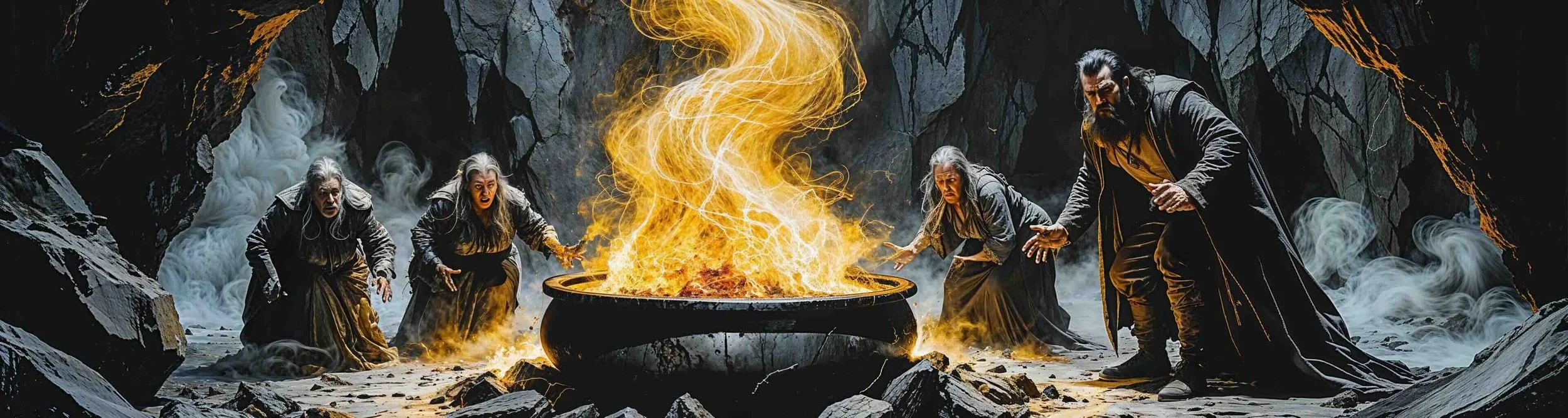
- Location: A dark cavern, where the Witches gather round a boiling cauldron.
- What Happens: The Witches brew a charm and conjure three apparitions for Macbeth: he is told to beware Macduff, that "none of woman born" can harm him, and that he is safe until Birnam Wood moves. A show of eight kings reveals that Banquo's line will reign. Macbeth resolves to slaughter Macduff's family.
- Key Characters: Macbeth, the Witches, the three apparitions, and Lennox.
- Dramatic Function: The second prophecy scene. It gives Macbeth a false sense of safety, seals Macduff's family's fate, and confirms that the crown will pass to Banquo's heirs, not his own.
- Famous Quote:
Double, double toil and trouble;
Fire burn, and cauldron bubble.
(The Witches, Act 4, Scene 1) - Why It Matters: The apparitions hand Macbeth the dangerous half-truths that make him reckless. Every promise here is literally true and fatally misleading – the engine of his final downfall.
Scene Summary
In a cavern around a boiling cauldron, the three Witches chant and throw grotesque ingredients into the pot – toad, snake fillet, eye of newt, dragon scale and worse – building a charm. Hecate arrives briefly to praise their work, and the Witches sense that "something wicked" is coming. Macbeth bursts in and demands answers, insisting they reply even if it means unleashing storms and toppling kingdoms.
The Witches summon three apparitions. The first, an armed head, warns him to beware Macduff. The second, a bloody child, tells him that "none of woman born" can harm him, which makes Macbeth feel invincible. The third, a crowned child holding a tree, promises he will never be defeated until Birnam Wood comes to Dunsinane Hill – an impossibility, he thinks.
Still hungry for certainty, Macbeth demands to know whether Banquo's descendants will ever rule. The Witches conjure a procession of eight kings, the last carrying a mirror, with Banquo's ghost following and pointing at them as his own. Macbeth is horrified: the crown he murdered for will pass to Banquo's line, not his.
The Witches vanish. Lennox enters and reports that Macduff has fled to England. Enraged, Macbeth resolves to act on impulse from now on and orders the immediate slaughter of Macduff's wife, children and household at his castle in Fife.
The Cauldron and the Chant
The scene opens with one of the most famous passages in all of Shakespeare. The Witches' chant is written in a hypnotic trochaic rhythm – a falling, drum-like beat quite unlike the play's usual iambic pentameter – that sets them apart from the human world. The ingredients they name are deliberately repellent, mixing animal parts with body parts of the marginalised and the damned, conjuring a world of total moral inversion where the unnatural is ordinary.
Original
Double, double toil and trouble;
Fire burn, and cauldron bubble.
(The Witches, Act 4, Scene 1)
Shakespeare Retold (Modern Verse)
Double, double toil and trouble;
Fire burn, and cauldron bubble.
The refrain's chiming, sing-song quality is part of its menace: evil here is communal and almost playful, a ritual performed for pleasure as much as purpose. The doubling of "double" mirrors the doubleness the whole scene is built on – prophecies that are true and false at once, and a charm that delights even as it damns. Shakespeare makes the supernatural seductive precisely so that we understand how Macbeth is drawn in.
Macbeth Demands the Truth
When Macbeth arrives, he is no longer the man who once recoiled from the Witches in fear. He confronts them as a commander, conjuring them to answer "by that which you profess" and accepting any cosmic chaos as the price of knowledge. The speech is enormous and reckless, a list of catastrophes he is willing to release just to be told his future.
Original
I conjure you, by that which you profess,
Howe'er you come to know it, answer me...
(Macbeth, Act 4, Scene 1)
Shakespeare Retold (Modern Verse)
I solemnly command, of what you claim,
However you have come to know it, tell me.
The willingness to see "castles topple on their warders' heads" reveals how far Macbeth has travelled. Knowledge has become an addiction, and he will pay any price to feel safe. The irony is that the certainty he craves is exactly what destroys him: the apparitions tell him the truth, but in a form designed to be misread, and his hunger to believe the comforting half does the rest.
The Three Apparitions
The heart of the scene is the trio of apparitions, each a riddle in human shape. The armed head warns him of Macduff; the bloody child promises that no one "of woman born" can harm him; the crowned child says he is safe until Birnam Wood marches. Macbeth seizes on the second and third as guarantees of invincibility, missing that each carries its own hidden trapdoor.
Original
Be bloody, bold, and resolute; laugh to scorn
The power of man, for none of woman born
Shall harm Macbeth.
(Second Apparition, Act 4, Scene 1)
Shakespeare Retold (Modern Verse)
Be violent, bold and strong; laugh in the face
Of powerful men, for none born by a woman
Will harm Macbeth.
Each prophecy is a piece of dramatic equivocation: literally true, deliberately deceptive. "None of woman born" sounds absolute but excludes Macduff, born by caesarean section; the moving forest sounds impossible but describes an army carrying branches as camouflage. Macbeth hears promises of safety; the audience, primed to distrust the Witches, hears the terms of his doom. His tragedy is that he stops listening at the comforting word and never weighs the catch.
The Show of Kings
Not content with safety, Macbeth pushes for the one answer he most dreads: whether Banquo's children will reign. The Witches warn him to seek no more, but he insists, and they conjure a line of eight kings stretching towards the "crack of doom", with Banquo's blood-smeared ghost following and claiming them. It is the cruellest moment of the scene: confirmation that he murdered his friend, and damned his own soul, to win a crown for another man's heirs.
Original
What, will the line stretch out to the crack of doom?
Another yet! A seventh! I'll see no more...
(Macbeth, Act 4, Scene 1)
Shakespeare Retold (Modern Verse)
What, will this line of kings stretch out forever?
Another one! A seventh! I can't look now;
The procession would have flattered Shakespeare's patron, King James, who claimed descent from Banquo – the eighth king's mirror gestures forward to James himself in the audience. For Macbeth, though, it is pure torment. He has gained nothing his own blood can keep. The vision turns his triumph hollow and pushes him from calculated villainy into the indiscriminate, purposeless cruelty that closes the scene.
Language and Technique
- Trochaic tetrameter: The Witches chant in a falling four-beat rhythm with insistent rhyme ("trouble" / "bubble"), marking them as outside the human, iambic world of the play.
- Equivocation: Every prophecy is true in a sense Macbeth does not expect – "none of woman born", the moving wood – so that truth itself becomes a trap.
- Disgust imagery: The cauldron's ingredients pile up grotesque body parts to build a world of total unnaturalness, where the foul is celebrated.
- Dumb show: The procession of eight kings is staged silently, a visual prophecy that says more to the audience (and to King James) than any words could.
- Dramatic irony: Macbeth hears reassurance where the audience hears doom, because we already distrust the "instruments of darkness".
Key Quotes from Act 4, Scene 1
Quote 1By the pricking of my thumbs,
Something wicked this way comes.
(The Witches, Act 4, Scene 1)
Shakespeare Retold (Modern Verse)
By the pain within my thumbs
I sense that something wicked comes.
How now, you secret, black, and midnight hags!
What is't you do?
(Macbeth, Act 4, Scene 1)
Shakespeare Retold (Modern Verse)
What's going on, you secretive old hags!
What have you done?
Then live, Macduff: what need I fear of thee?
But yet I'll make assurance double sure,
And take a bond of fate: thou shalt not live...
(Macbeth, Act 4, Scene 1)
Shakespeare Retold (Modern Verse)
Then you can live, Macduff: why should I fear you?
But still I will take action to be certain
And guarantee my fate: Macduff must die;
The very firstlings of my heart shall be
The firstlings of my hand. And even now,
To crown my thoughts with acts, be it thought and done...
(Macbeth, Act 4, Scene 1)
Shakespeare Retold (Modern Verse)
The first things that I think will become
The first things that I do. And right away,
To turn my thoughts to action – think it! do it! –
Key Takeaways
- Equivocation drives the plot: Every apparition tells the literal truth in a form designed to mislead, and Macbeth hears only the reassurance.
- False security is fatal: "None of woman born" and the moving wood make Macbeth reckless, which is exactly what undoes him.
- The crown is barren: The show of eight kings confirms that Banquo's heirs, not Macbeth's, will reign – he murdered for nothing he can keep.
- Macbeth is now the wicked thing: Even the Witches sense him as a disturbance; he has become what once frightened him.
- Thought collapses into action: Macbeth vows to act on impulse, and orders the pointless slaughter of Macduff's family at Fife.
Study Questions and Analysis
What is equivocation, and how does it work in this scene?
Equivocation is the use of language that is technically true but deliberately misleading – saying something in a way designed to be misunderstood. It was a live and dangerous idea for Shakespeare's first audiences, who associated it with the Gunpowder Plot trials, and the whole of Act 4, Scene 1 is built on it.
Each apparition gives Macbeth a prophecy that is perfectly accurate yet engineered to be misread. "None of woman born" excludes Macduff, who was delivered by caesarean section; Birnam Wood "moving" describes soldiers cutting branches as camouflage. Macbeth treats both as guarantees of safety because he wants them to be, and his desire to believe blinds him to the catch. The scene shows that the Witches never lie – they simply tell the truth in a shape that a frightened, greedy mind will get wrong.
How has Macbeth changed by the time he visits the Witches?
The contrast with the play's opening is stark. In Act 1 the Witches sought Macbeth out and their words left him "rapt" and afraid; here he seeks them out and bullies them for answers, conjuring them "by that which you profess" and accepting any catastrophe as the price of knowledge. He has moved from awe to entitlement.
I will be satisfied: deny me this,
And an eternal curse fall on you! Let me know.
(Macbeth, Act 4, Scene 1)
Shakespeare Retold (Modern Verse)
I won't mind what you tell me: but deny me,
Then you'll be cursed eternally! Let me know.
The threat of an "eternal curse" is almost comic in its arrogance – a mortal damning the agents of damnation. It marks how completely Macbeth has surrendered to the supernatural while imagining he commands it. A. C. Bradley, in Shakespearean Tragedy (1904), traced how Macbeth's imagination, once a source of terror and conscience, hardens into something that drives him deeper into crime rather than restraining him; this scene catches that hardening in motion.
Why does the show of eight kings horrify Macbeth so much?
The procession answers the question Macbeth most fears: it confirms that Banquo's descendants, not his own, will hold the throne. He had Banquo murdered precisely to break this prophecy, so the vision tells him the killing was both a damnable sin and a complete failure. He has bought nothing his own blood can inherit.
The detail of the eighth king holding a mirror "which shows me many more" extends the line beyond the stage and, for Shakespeare's first audience, towards King James I, who claimed descent from Banquo. What flatters the king in the audience tortures the king on stage. The vision strips away any sense that Macbeth's crimes have achieved a lasting purpose, and it is immediately after this that he abandons strategy altogether and turns to the senseless murder of Macduff's family.
What is the dramatic effect of the Witches' chant?
The chant works first as pure atmosphere. Its falling trochaic rhythm and tight rhymes set the Witches' speech apart from the iambic verse the human characters use, making them sound like a different order of being. The repeated refrain – "Double, double toil and trouble; / Fire burn, and cauldron bubble" – is hypnotic and ritualistic, drawing the audience into the spell as much as the ingredients do.
It also does thematic work. The catalogue of grotesque ingredients builds a picture of total unnaturalness, an inverted world where the foul is gathered with care and even relish. And the doubling at the heart of the refrain quietly previews the scene's method: everything here comes double, true and false at once. The chant is not just decoration – it is the play's vision of evil as something communal, pleasurable and deeply ordered.
Why does Macbeth decide to kill Macduff's family?
When Lennox reports that Macduff has fled to England, Macbeth flies into a rage and resolves to act on impulse rather than thought. Because he cannot reach Macduff himself, he strikes at what Macduff has left behind: his wife, children and servants at the castle in Fife. There is no military logic to it – Macduff is already gone – only fury and a need to be seen acting.
The castle of Macduff I will surprise;
Seize upon Fife; give to the edge o' the sword
His wife, his babes, and all unfortunate souls
That trace him in his line.
(Macbeth, Act 4, Scene 1)
Shakespeare Retold (Modern Verse)
I'll go to Macduff's castle to surprise them;
I'll seize the town of Fife; and thrust my sword in
His wife, his children, and all those unlucky
Enough to be descendants.
This is tyranny in its purest form: violence against the innocent for no gain. The decision shows the cost of Macbeth's vow to let his hand follow his heart without pause. It is also a grim mirror of the show of kings – unable to secure his own line, he sets about destroying another man's, as if extinguishing Macduff's children could undo the vision of Banquo's.
How do the Witches relate to fate and free will in this scene?
The scene deliberately keeps the question open. The Witches show Macbeth true visions of the future, which suggests his end is fated; yet they never command him to do anything. They offer information, and every disastrous choice that follows – to kill Macduff "to make assurance double sure", to slaughter the family at Fife – is Macbeth's own.
The most natural reading is that the prophecies do not control Macbeth so much as exploit him. They tell him what is going to happen; he decides how to respond, and he responds with violence and false confidence. Marjorie Garber, in Shakespeare After All (2004), notes how the Witches' words work less as orders than as mirrors, reflecting back the ambition and fear already in the listener. On that reading the apparitions damn Macbeth by telling him the truth, and letting his own character do the rest.
What is the significance of "something wicked this way comes"?
The Second Witch's announcement of Macbeth's approach is one of the most quietly devastating lines in the play. Earlier, Macbeth was the one disturbed by the supernatural; now the Witches themselves register him as "something wicked", a force whose evil they can feel before they see him. He has crossed over.
The phrasing also depersonalises him. He is not named but reduced to a "something" – a thing, a presence, rather than a man. That reduction is the whole tragedy in miniature: the noble, valiant Macbeth of Act 1 has been hollowed out into an abstract menace. By measuring his wickedness against creatures we already regard as evil, Shakespeare gives us a precise sense of just how far he has travelled, and how little of the original man remains.