Macbeth: Act 4, Scene 3 – Analysis
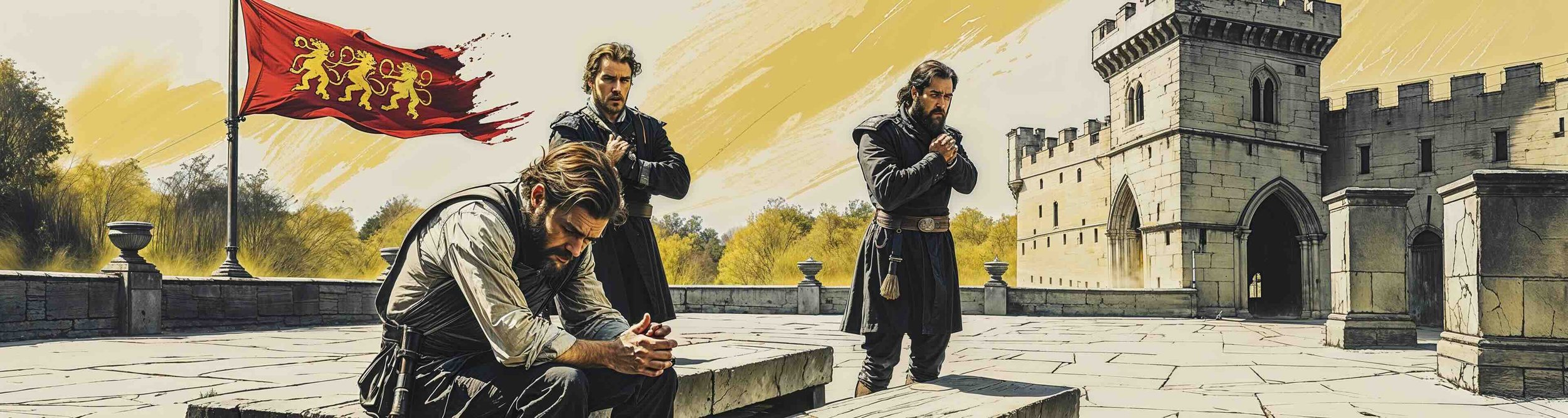
Scene Profile – At a Glance
- Location: England, before King Edward the Confessor's palace.
- What Happens: In exile, Malcolm tests Macduff's loyalty by pretending to be even more vicious than Macbeth. Convinced by Macduff's horror, he reveals his true virtue and the army waiting to free Scotland. Ross arrives and breaks the news that Macduff's wife and children have been slaughtered. Macduff vows revenge.
- Key Characters: Malcolm, Macduff, Ross, and the Doctor.
- Dramatic Function: The longest scene in the play. It restores a vision of true kingship against Macbeth's tyranny, tests and proves Macduff, and gives him a personal motive for revenge.
- Famous Quote:
But I must also feel it as a man:
I cannot but remember such things were,
That were most precious to me.
(Macduff, Act 4, Scene 3) - Why It Matters: It defines what a good king should be, turns Macduff's grief into the play's driving force, and sets the liberation of Scotland in motion.
Scene Summary
In England, Malcolm and Macduff meet in exile. Macduff urges action to save their "down-fall'n birthdom", but Malcolm is wary. He has seen good men turned, and he suspects Macduff may be working for Macbeth. To test him, Malcolm pretends he would be an even worse king than the tyrant they are fleeing – lustful, greedy and utterly without virtue.
At first Macduff tries to excuse each fault, but as Malcolm's self-portrait grows monstrous he breaks down in despair, crying that such a man is not fit to live, let alone rule, and that he can never return to Scotland. This honest grief is exactly what Malcolm needed to see. He retracts everything, declaring himself in truth chaste, faithful and loyal, and reveals that an English army under old Siward is ready to march.
A Doctor enters briefly, describing King Edward's miraculous power to heal the sick by touch, a portrait of holy kingship set against Macbeth's diseased rule. Then Ross arrives from Scotland. He describes a country drowning in grief, then, with painful reluctance, tells Macduff that his castle has been attacked and his wife and children savagely murdered.
Macduff is overwhelmed. Malcolm urges him to turn the grief into rage, but Macduff insists he must feel it as a man before he fights as one. He resolves to face Macbeth himself, sword to sword. The scene ends with the rebels united and ready, their cause armed by heaven and sharpened by Macduff's loss.
Macduff's Plea for Scotland
The scene opens on a note of national mourning. Macduff will not "weep our sad bosoms empty"; he wants action, and he paints Scotland as a wounded country crying out under Macbeth's rule. His grief is patriotic before it is personal, and the imagery of a bleeding, weeping nation runs through the whole scene.
Original
Bestride our down-fall'n birthdom: each new morn
New widows howl, new orphans cry, new sorrows
Strike heaven on the face...
(Macduff, Act 4, Scene 3)
Shakespeare Retold (Modern Verse)
Defend our suffering fatherland: each morning
New widows howl, new orphans cry, more sadness
Slaps heaven round the face...
The image of fresh widows and orphans every morning makes Macbeth's tyranny feel like a daily, grinding catastrophe rather than a single crime. Macduff speaks as a man whose loyalty is to the land itself, and there is a terrible irony in it: as he mourns Scotland's abstract orphans, his own children are already among the dead, a fact he does not yet know. Shakespeare lets the audience feel that gap, and it shadows everything he says.
Malcolm Tests Macduff
Malcolm's caution drives the central, and strangest, movement of the scene. Having seen how easily Macbeth deceived good men, he cannot simply trust Macduff. So he stages a trap: he claims that he himself would make a far worse king, listing vices until he seems a monster. It is an uncomfortable, even off-putting test, but its purpose is sound – Malcolm is learning the difference between appearance and reality the hard way.
Original
Angels are bright still, though the brightest fell;
Though all things foul would wear the brows of grace,
Yet grace must still look so.
(Malcolm, Act 4, Scene 3)
Shakespeare Retold (Modern Verse)
The angels shine, though Lucifer turned devil;
And though all bad things strive to look like good things,
Good things can still look good.
Malcolm's logic is the play's recurring lesson: foul things can wear the face of grace, just as Macbeth did. The reference to Lucifer, the brightest angel who fell, points straight at Macbeth, once a hero and now a devil. Malcolm has absorbed the play's hardest truth – that you cannot read virtue off a man's surface – and his test is the careful, almost paranoid response of a future king who refuses to be fooled twice.
The Catalogue of Vices
Malcolm's self-accusation builds in stages, each vice worse than the last: boundless lust, then bottomless greed, then a total absence of the "king-becoming graces". Macduff's responses are the real test. He tries to accommodate the lust and the avarice, reasoning that Scotland could survive them, but when Malcolm claims to have no virtue at all, Macduff can bear no more.
Original
But I have none: the king-becoming graces,
As justice, verity, temperance, stableness,
Bounty, perseverance, mercy, lowliness...
(Malcolm, Act 4, Scene 3)
Shakespeare Retold (Modern Verse)
But I have none. The goodwill of a king,
Like justice, ethics, moderation, peace,
Riches, perseverance, mercy, kindness...
This catalogue of royal virtues is the moral heart of the scene and of the play's vision of kingship. By listing exactly what a good king should be – just, truthful, temperate, merciful – Malcolm gives us the standard against which Macbeth is found wanting. The test works because Macduff loves these qualities more than he loves any claimant: he would rather have no king than a vicious one. His refusal to flatter a man he believes evil is precisely the integrity Malcolm was looking for.
Holy Kingship and the King's Evil
Between the test and the news from Scotland, Shakespeare inserts a quiet, strange interlude: a Doctor describes how King Edward the Confessor heals the sick by his touch. The passage interrupts the action, but it is doing important work, holding up a portrait of sacred, healing kingship directly against Macbeth's diseased tyranny.
Original
strangely-visited people,
All swoln and ulcerous, pitiful to the eye,
The mere despair of surgery, he cures...
(Malcolm, Act 4, Scene 3)
Shakespeare Retold (Modern Verse)
But folk with strange conditions,
All swollen, ulcerous, awful to look at,
Which surgeons do despair at, he can cure...
Edward is everything Macbeth is not: a king whose touch heals rather than kills, blessed with "a heavenly gift of prophecy" and grace. The contrast is pointed. Where Macbeth's reign spreads sickness through Scotland, Edward draws sickness out of his people. The passage also flattered Shakespeare's patron, King James, who practised the same royal healing ritual, but its dramatic function is to remind us what kingship ought to be just before we see the full cost of Macbeth's perversion of it.
The News from Scotland
Ross arrives carrying the worst news in the play. He first describes a Scotland so broken that it can hardly bear to look at itself, a grave rather than a country. Then, with agonising reluctance, he is forced to tell Macduff the truth about his family. Shakespeare draws the moment out, letting Ross delay and Macduff guess, so that the blow lands with full weight.
Original
Your castle is surprised; your wife and babes
Savagely slaughtered: to relate the manner,
Were, on the quarry of these murdered deer,
To add the death of you.
(Ross, Act 4, Scene 3)
Shakespeare Retold (Modern Verse)
Your castle was attacked; your wife and children
Were slaughtered savagely. To tell you how,
On top of all those dearest to you murdered,
Would make you die as well.
The understatement is unbearable: Ross cannot even describe the manner of the killings without fearing it would destroy Macduff to hear. The hunting image – the family as "murdered deer" run down by Macbeth – recalls the predator-and-prey world of the Fife scene. This is the moment the political and the personal collide. Macduff has come to England to save Scotland; now Scotland's tyrant has taken everything he had, and the war becomes his own.
Macduff's Grief and Resolve
Macduff's reaction is one of the most humane moments in Shakespeare. He does not leap straight to vengeance. When Malcolm urges him to "dispute it like a man", Macduff insists that he must first feel it like a man – that true manhood includes grief, not just rage. Only after he has mourned does he turn that pain into a vow.
Original
I shall do so;
But I must also feel it as a man:
I cannot but remember such things were,
That were most precious to me.
(Macduff, Act 4, Scene 3)
Shakespeare Retold (Modern Verse)
I will do so;
But I must also feel it like a man.
I cannot help but think about the things
That were most precious to me.
This is the play's answer to its own corrupted idea of masculinity. Where Lady Macbeth and Macbeth have equated manhood with ruthlessness and the killing of feeling, Macduff redefines it: a real man feels his loss fully and still acts. His grief does not weaken his resolve but fuels it. By the end he asks heaven to bring Macbeth "within my sword's length", and the scene closes with the rebellion armed and the long night promising day at last.
Language and Technique
- Sickness imagery: Scotland is repeatedly figured as a diseased, bleeding body – "it weeps, it bleeds" – set against King Edward's healing touch.
- The catalogue of graces: Malcolm's list of "king-becoming graces" defines true kingship and measures Macbeth's failure against it.
- Dramatic irony: Macduff mourns Scotland's widows and orphans without knowing his own family are already among the dead.
- Delayed revelation: Ross stalls and circles before naming the murders, drawing out the dread and the audience's anticipation of the blow.
- Redefinition of manhood: Macduff's "feel it as a man" reclaims masculinity as something that includes grief, countering the play's earlier equation of manhood with cruelty.
Key Quotes from Act 4, Scene 3
Quote 1This tyrant, whose sole name blisters our tongues,
Was once thought honest...
(Malcolm, Act 4, Scene 3)
Shakespeare Retold (Modern Verse)
This thug, whose name alone is hard to say,
Was once thought honest...
that, when they shall be opened, black Macbeth
Will seem as pure as snow, and the poor state
Esteem him as a lamb...
(Malcolm, Act 4, Scene 3)
Shakespeare Retold (Modern Verse)
That when I am compared with vile Macbeth,
He'll seem as pure as snow, and all poor Scotland
Will think he is a lamb when he's compared...
Alas, poor country!
Almost afraid to know itself. It cannot
Be called our mother, but our grave...
(Ross, Act 4, Scene 3)
Shakespeare Retold (Modern Verse)
Oh, our poor country!
It seems too scared to know itself. It cannot
Be called our home, but just our grave...
What, all my pretty chickens and their dam
At one fell swoop?
(Macduff, Act 4, Scene 3)
Shakespeare Retold (Modern Verse)
What, all my pretty children and their mother,
All killed in one fell swoop?
Be this the whetstone of your sword: let grief
Convert to anger; blunt not the heart, enrage it.
(Malcolm, Act 4, Scene 3)
Shakespeare Retold (Modern Verse)
Sharpen your sword upon this stone; let grief
Convert to wrath. Your heart must rage, not break.
Macbeth
Is ripe for shaking, and the powers above
Put on their instruments. Receive what cheer you may:
The night is long that never finds the day.
(Malcolm, Act 4, Scene 3)
Shakespeare Retold (Modern Verse)
Macbeth
Is ripe for picking, and the power of heaven
Has armed us. Seek relief from persecution,
For pain endures till you've got retribution.
Key Takeaways
- True kingship is defined here: Malcolm's "king-becoming graces" set the standard of good rule against which Macbeth is a tyrant.
- Malcolm tests before he trusts: Having seen Macbeth deceive everyone, Malcolm pretends to be worse than the tyrant to prove Macduff's honesty.
- Healing versus disease: King Edward's holy touch, which cures the sick, is the opposite of Macbeth's reign, which sickens Scotland.
- Grief becomes the engine of revenge: Ross's news of the murders gives Macduff a personal cause that will bring Macbeth down.
- Manhood is redefined: Macduff insists he must feel his loss as a man before he fights as one, countering the play's cruel idea of masculinity.
Study Questions and Analysis
Why does Malcolm pretend to be worse than Macbeth?
Malcolm's test seems baffling at first, but it follows from everything that has gone before. Macbeth was "once thought honest" and deceived the entire kingdom, including Malcolm's own father. Malcolm has learned that he cannot read a man's loyalty from his appearance, so before he trusts Macduff with his life and his cause, he sets a trap.
By claiming to be lustful, greedy and wholly without virtue, Malcolm offers Macduff a clear choice: flatter a would-be king to gain power, or reject a vicious ruler out of love for Scotland. When Macduff, in despair, declares that such a man is not fit to live, Malcolm has his proof. A spy or opportunist would have welcomed a pliable, sinful prince; only an honest patriot would refuse him. The test is uncomfortable to watch, but it shows a cautious, intelligent leader who refuses to be fooled as his father was.
What does the scene say about good kingship?
This scene contains the play's fullest vision of what a king should be, set in deliberate contrast to Macbeth. Malcolm lists the "king-becoming graces" – justice, truth, temperance, mercy, courage and more – and the list works as a checklist of everything Macbeth lacks.
As justice, verity, temperance, stableness,
Bounty, perseverance, mercy, lowliness,
Devotion, patience, courage, fortitude...
(Malcolm, Act 4, Scene 3)
Shakespeare Retold (Modern Verse)
Like justice, ethics, moderation, peace,
Riches, perseverance, mercy, kindness,
Devotion, patience, courage, fortitude...
King Edward of England embodies these virtues in action: his touch heals the sick, he has the gift of prophecy, and grace hangs about his throne. He is the living opposite of Macbeth, whose rule spreads sickness through Scotland. The scene thus stages a debate about legitimate authority that would have resonated strongly with King James I, who took a keen interest in the theory of kingship. True power, the scene argues, is defined not by force but by virtue, and a king who lacks the graces is no king but a tyrant.
Why does Shakespeare include the passage about the King's Evil?
The Doctor's description of King Edward healing the sick by touch – a condition known as the King's Evil, or scrofula – can feel like a digression, but it is carefully placed. It comes between Malcolm's test and the news of the murders, and its job is to hold up an image of sacred, healing kingship at the centre of the scene.
The contrast with Macbeth is total. Edward's touch cures "strangely-visited people" whom surgery cannot help; Macbeth's reign, by contrast, has turned Scotland into a body covered in fresh wounds. Where one king draws disease out of his people, the other infects his whole country. The passage also flattered Shakespeare's patron, King James I, who revived the royal healing ritual and claimed the same divine gift. Dramatically, it reminds the audience what kingship can be just before Ross arrives to show the full human cost of Macbeth's perversion of it.
How does Ross break the news of the murders?
Ross handles the worst news in the play with painful reluctance, and Shakespeare uses his delay to build almost unbearable tension. He first describes Scotland's general suffering, then, when Macduff asks directly after his wife and children, Ross tells a half-truth – they were "well" when he left – before the full horror has to come out.
When he finally speaks it, he does so in language that flinches from its own meaning, saying that to describe how they died would kill Macduff to hear. The slow approach is dramatically essential: it makes Macduff guess at the truth before it is confirmed, and it lets the audience share the dread of the moment. Ross's evident pain also tells us something about Scotland – that decent men are now reduced to carrying news they can hardly bear to speak, in a country where atrocity has become routine.
What does Macduff's reaction to the news reveal about him?
Macduff's response is one of the most humane moments in the play. He does not instantly convert his grief into a battle cry. Instead he is stunned, repeating "All my pretty ones?" and turning the loss over in disbelief, and he blames himself for having left them exposed: "Sinful Macduff, / They were all struck for thee!"
When Malcolm urges him to "dispute it like a man", Macduff refuses the narrow definition of manhood the play has so often pushed. He insists he must also "feel it as a man" – that true manhood includes the capacity to grieve, not just to fight. This is the play's direct answer to Lady Macbeth and Macbeth, who equated being a man with ruthlessness and the suppression of feeling. A. C. Bradley, in Shakespearean Tragedy (1904), admired Macduff as a figure of plain, deep human feeling set against the tortured inwardness of Macbeth. His grief does not unman him; it gives his revenge its moral weight.
How does the scene present masculinity?
Masculinity is contested throughout this scene, and Shakespeare uses it to separate true courage from mere cruelty. Malcolm twice frames the proper response to grief in terms of manhood – "dispute it like a man", "let grief / Convert to anger" – pushing Macduff towards rage and revenge. This echoes the play's earlier, poisoned version of manhood, in which Lady Macbeth shamed her husband into murder by questioning his courage.
But Macduff complicates it. He accepts that he must turn grief to action, yet insists that he must first "feel it as a man", refusing to pretend that a real man feels nothing. The scene thus holds two ideas of masculinity together: the soldierly drive to fight, and the deeper humanity that allows grief. Macduff embodies a manhood that contains both, and it is precisely this wholeness – courage rooted in love and loss – that makes him the fitting instrument of Macbeth's defeat.
What is the significance of the disease and healing imagery?
Sickness imagery runs all through the scene and structures its meaning. Scotland is repeatedly described as a wounded, bleeding body: it "weeps, it bleeds", and "each new day a gash / Is added to her wounds". Macbeth's tyranny is figured as an illness infecting the whole nation, a disease of the body politic.
Against this, Shakespeare sets King Edward, whose holy touch literally cures disease. The juxtaposition is deliberate and pointed: Edward heals the sick, while Macbeth sickens the healthy. Malcolm later picks up the same language when he tells Macduff to make "medicines of our great revenge, / To cure this deadly grief". The cure for Scotland's disease, the imagery insists, is the removal of Macbeth and the restoration of legitimate, virtuous rule. The scene asks the audience to see the coming war not as rebellion but as a kind of healing.
Why is this scene so long, and what does its structure achieve?
At well over six hundred lines it is the longest scene in the play, and its length is purposeful. Coming straight after the swift, shocking murder at Fife, it slows the action right down and pulls the audience out of Scotland's nightmare into the colder, more deliberate world of exile and politics.
Structurally it falls into three movements: Malcolm's long test of Macduff, the brief interlude of holy kingship, and the devastating news from Ross. The first two rebuild a vision of order and virtue – legitimate kingship, honest loyalty, divine grace – so that the play has something positive to set against Macbeth before the final act. The third then drives that restored order forward with personal urgency, as Macduff's grief becomes the spark of revenge. The scene's patience is its power: it lets the audience breathe, defines what is worth fighting for, and only then lights the fuse that will carry the play to its end.
How does the scene prepare for the play's ending?
This scene sets nearly all the pieces for Act 5. It establishes that an English army of ten thousand men under old Siward is ready to march, giving the rebellion the military strength it has so far lacked. It unites Malcolm and Macduff in a tested, trusted alliance, with Malcolm proven a worthy king and Macduff proven a loyal one.
Most importantly, it gives Macduff his personal reason to seek out Macbeth in single combat. His vow to bring Macbeth "within my sword's length" points directly to their final confrontation, and the audience now longs to see it. The scene's closing imagery – Macbeth "ripe for shaking", the long night that must find the day – turns the play decisively towards resolution. After the deepening darkness of the first four acts, Shakespeare promises dawn, and Act 5 will deliver it through the very alliance and the very grief this scene has forged.