Macbeth: Act 5, Scene 1 – Analysis
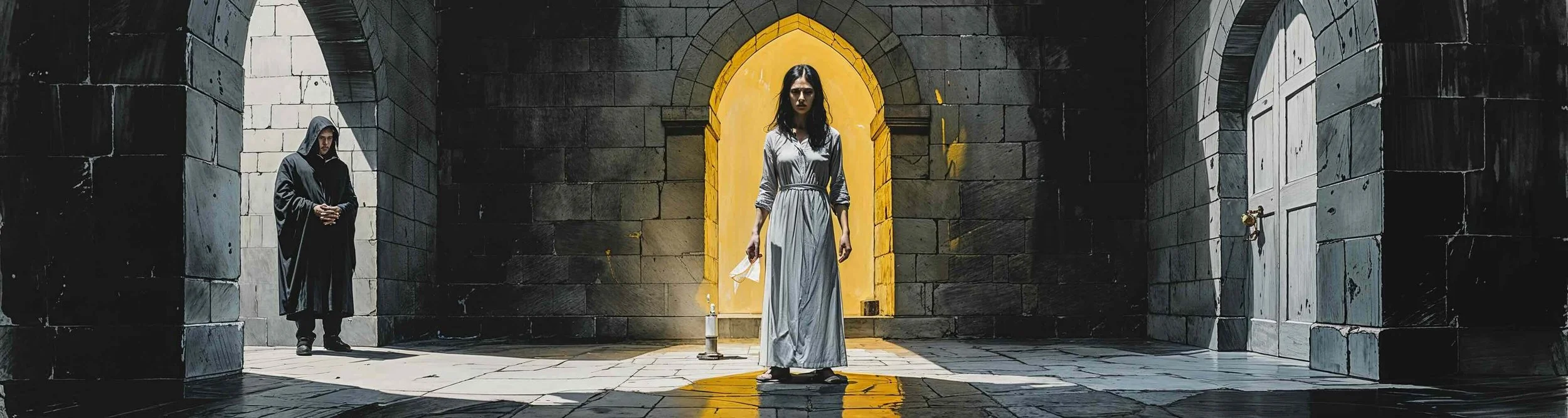
Scene Profile – At a Glance
- Location: An ante-room in the castle at Dunsinane, late at night.
- What Happens: A Doctor and a Waiting-Gentlewoman keep watch over Lady Macbeth, who walks in her sleep. She rubs her hands, tries to wash away an imaginary spot of blood, and lets slip the secrets of Duncan's murder, Banquo's death, and Lady Macduff.
- Key Characters: Lady Macbeth, the Doctor, and the Gentlewoman.
- Dramatic Function: The collapse of Lady Macbeth. The iron will of the early acts dissolves into guilt-ridden madness, and the murders are confessed aloud to witnesses.
- Famous Quote:
"Out, damned spot! Out, I say!"
(Lady Macbeth, Act 5, Scene 1) - Why It Matters: The "spot" of blood she once dismissed with "a little water clears us of this deed" now cannot be washed away. Guilt has done to her what it could not do by daylight.
Scene Summary
A Doctor has spent two nights watching with a Gentlewoman who serves Lady Macbeth, but has seen nothing to confirm her report. The Gentlewoman explains that ever since Macbeth went to war, she has seen her mistress rise from bed, throw on her nightgown, unlock her closet, take out paper, write on it, seal it, and return to bed – all while fast asleep. When the Doctor presses her to repeat what Lady Macbeth has said, the Gentlewoman refuses, having no witness to back her up.
Lady Macbeth then enters, carrying a candle, her eyes open but their sense shut. She rubs her hands as though washing them, a habit the Gentlewoman has watched continue for a quarter of an hour at a time. As she rubs, she speaks: she tries to scrub out a spot of blood, relives the night of Duncan's murder, refers to "the thane of Fife" and his wife, and despairs that all the perfumes of Arabia will not sweeten her hand.
The Doctor realises he is hearing things he should not know. Lady Macbeth, still asleep, soothes an imaginary Macbeth, insists Banquo is buried and cannot rise, hears a knocking at the gate, and finally takes the hand of a husband who is not there, repeating that what is done cannot be undone before going back to bed. Left alone, the Doctor concludes that the disease is beyond his skill: she needs a priest more than a physician. He orders the Gentlewoman to keep all means of harm away from her, and admits he dare not speak what he is thinking.
The Watchers and the Sleepwalker
Shakespeare frames the scene through two ordinary observers, and this framing does much of the work. The Doctor and the Gentlewoman speak in plain, nervous prose, swapping cautious half-sentences, neither willing to say aloud what they suspect. By making us eavesdrop alongside them, Shakespeare turns Lady Macbeth's private collapse into something witnessed and dangerous: her secrets are now leaking out to people who can repeat them. The Gentlewoman's refusal to report what she has heard, "having no witness to confirm my speech", is the caution of someone who knows that knowing too much in this castle is fatal.
Original
You see, her eyes are open.
(Doctor, Act 5, Scene 1)
Shakespeare Retold (Modern Verse)
You see, her eyes are open.
The detail of the open but unseeing eyes is the whole tragedy in miniature. Lady Macbeth, who once prided herself on clear-eyed command, now walks with her eyes open and their sense shut – awake to her guilt but blind to the room around her. The woman who told her husband to "look like the innocent flower, but be the serpent under't" can no longer control what her own body confesses.
"Out, Damned Spot"
The centre of the scene is Lady Macbeth's broken, sleepwalking speech, and Shakespeare writes it as prose – the controlled blank verse of her earlier scenes has gone. Her mind moves in fragments, leaping between the murders. She scrubs at a spot that will not come out, counts the hours before the killing of Duncan, and slips into the very night she once managed so coldly.
Original
Out, damned spot! Out, I say! – One: two: why, then, 'tis time to do't. – Hell is murky! – Fie, my lord, fie! A soldier, and afeard? What need we fear who knows it, when none can call our power to account? – Yet who would have thought the old man to have had so much blood in him.
(Lady Macbeth, Act 5, Scene 1)
Shakespeare Retold (Modern Verse)
Get off, damned spot! Get off, I say! One, two: well then It's time to do it. Hell is a dark place! Crap, my lord, crap! You call yourself a soldier, but you're scared? Why do we need to fear who knows of it, when no one has the proof that we are guilty? Yet who would have thought the old man would have so much blood in him.
The irony is devastating. By daylight, after Duncan's murder, she had scolded her husband for being unmanned by blood and assured him that "a little water clears us of this deed". Now it is she who cannot wash, she who is haunted by how much blood the "old man" held. Her contempt for fear has curdled into the thing she despised. The single image that fixes it is the smell that will not leave her: "all the perfumes of Arabia will not sweeten this little hand."
Language and Technique
- Prose for madness: Lady Macbeth, the Doctor, and the Gentlewoman all speak prose; the loss of her controlled blank verse signals the loss of her controlled mind. The Doctor's closing lines slip back into rhymed verse as order tries to reassert itself.
- The unwashable hand: The recurring gesture of hand-washing literalises guilt – blood that has soaked inward and cannot be scrubbed off, the exact reversal of "a little water clears us".
- Fragmented syntax: Her speech jumps between murders without joins, mimicking a mind no longer able to keep its secrets in separate rooms.
- Dramatic irony: The audience understands every reference – Duncan, Banquo, Lady Macduff – that the on-stage watchers can only half-grasp, making us the true confessors.
- Smell and sense imagery: "The smell of the blood" and "all the perfumes of Arabia" move guilt out of sight and into the body, where it cannot be argued away.
Key Quotes from Act 5, Scene 1
Quote 1The thane of Fife had a wife: where is she now? – What, will these hands ne'er be clean? – No more o' that, my lord, no more o' that: you mar all with this starting.
(Lady Macbeth, Act 5, Scene 1)
Shakespeare Retold (Modern Verse)
The thane of Fife had a wife: where is she now? What, will I never get these hands clean? No more of that, my lord, no more of that: you'll spoil everything by acting jumpy.
Here's the smell of the blood still: all the perfumes of Arabia will not sweeten this little hand. Oh, oh, oh!
(Lady Macbeth, Act 5, Scene 1)
Shakespeare Retold (Modern Verse)
My hands still smell of blood. All the perfumes of Arabia won't make my hand smell sweet. Oh, oh, oh!
To bed, to bed! There's knocking at the gate: come, come, come, come, give me your hand. What's done cannot be undone. – To bed, to bed, to bed!
(Lady Macbeth, Act 5, Scene 1)
Shakespeare Retold (Modern Verse)
To bed, to bed! There's knocking at the gate: come, come, come, come, give me your hand. What's done can't be undone. To bed, to bed, to bed!
Key Takeaways
- Lady Macbeth's collapse is complete: The commanding figure of the early acts is reduced to a sleepwalker confessing her crimes to strangers.
- Guilt wins by night: What she suppressed by daylight surfaces in sleep, when her will can no longer hold it down.
- The blood will not wash: "A little water clears us of this deed" is overturned; the stain has become permanent and internal.
- The murders are confessed aloud: Duncan, Banquo, and Lady Macduff all surface in her broken speech, witnessed by the Doctor and Gentlewoman.
- Beyond medicine: The Doctor judges her sickness spiritual, not physical – she needs the divine more than the physician.
Study Questions and Analysis
Why does Shakespeare write this scene in prose?
Throughout the play Lady Macbeth speaks in tightly controlled blank verse – the verse form is part of her power. Here, both she and the watching Doctor and Gentlewoman speak prose, and the change is deliberate. Prose marks the breakdown of order: her thoughts no longer move in measured lines but in fragments, jumping between crimes without logic or pause.
The effect is to make her madness audible in the very shape of her speech. A great soliloquy would suggest control she no longer has; instead we get scraps, repetitions, and groans. Tellingly, when the Doctor is left alone at the end, his lines slide back into rhymed verse, as if reason and order are reasserting themselves the moment the sleepwalker leaves the stage.
What does the imaginary "spot" of blood represent?
The spot she cannot wash away is guilt made physical. Earlier, after Duncan's murder, Lady Macbeth was the practical one: she took the daggers back, smeared the grooms with blood, and told her shaken husband that "a little water clears us of this deed". Her whole argument was that guilt was a matter of washing, easily dealt with.
Yet here's a spot.
(Lady Macbeth, Act 5, Scene 1)
Shakespeare Retold (Modern Verse)
There's still a spot here.
Now the water has failed her. The blood has soaked inward, and no amount of rubbing will shift it. A. C. Bradley, in Shakespearean Tragedy (1904), read Lady Macbeth as a woman who could suppress her conscience but never destroy it, so that what was forced down by day rises up in sleep. The spot is that buried conscience, finally surfacing where her will cannot reach it.
How has Lady Macbeth changed since the murder of Duncan?
The reversal is total. In the early acts she was the stronger partner: she steadied Macbeth, mocked his fear, and dealt coolly with the blood he could not face. She invoked spirits to "unsex" her and fill her with cruelty, and she seemed, for a time, to have succeeded.
Here every one of those positions is overturned. She is the one undone by blood now, the one who cannot stop washing, the one terrified by the dark she once dismissed with "Hell is murky". The contempt she poured on Macbeth – "a soldier, and afeard?" – is replayed in her sleep, but the fear it describes is now her own. The partnership that drove the murders has split apart: he is hardening into a tyrant on the battlefield while she dissolves into guilt at home, each now utterly alone.
Why does the Doctor say she needs "the divine" more than a physician?
The Doctor recognises that he is not looking at a bodily illness. Sleepwalking and hand-washing are only symptoms; the real disease is a guilty conscience, and that is beyond medicine. His conclusion that she "more needs the divine than the physician" frames her condition in spiritual terms – what she needs is confession and forgiveness, not a cure.
The line also carries a quiet warning. The Doctor has heard her confess to murders and knows that such knowledge is dangerous in Macbeth's castle; he admits he dare not speak what he is thinking and orders that all means of harming herself be kept away from her. That last instruction foreshadows her death: when she dies offstage in the next act, it is widely assumed to be by her own hand, the self-destruction the Doctor here tries, and fails, to prevent.