
Guilt and Paranoia
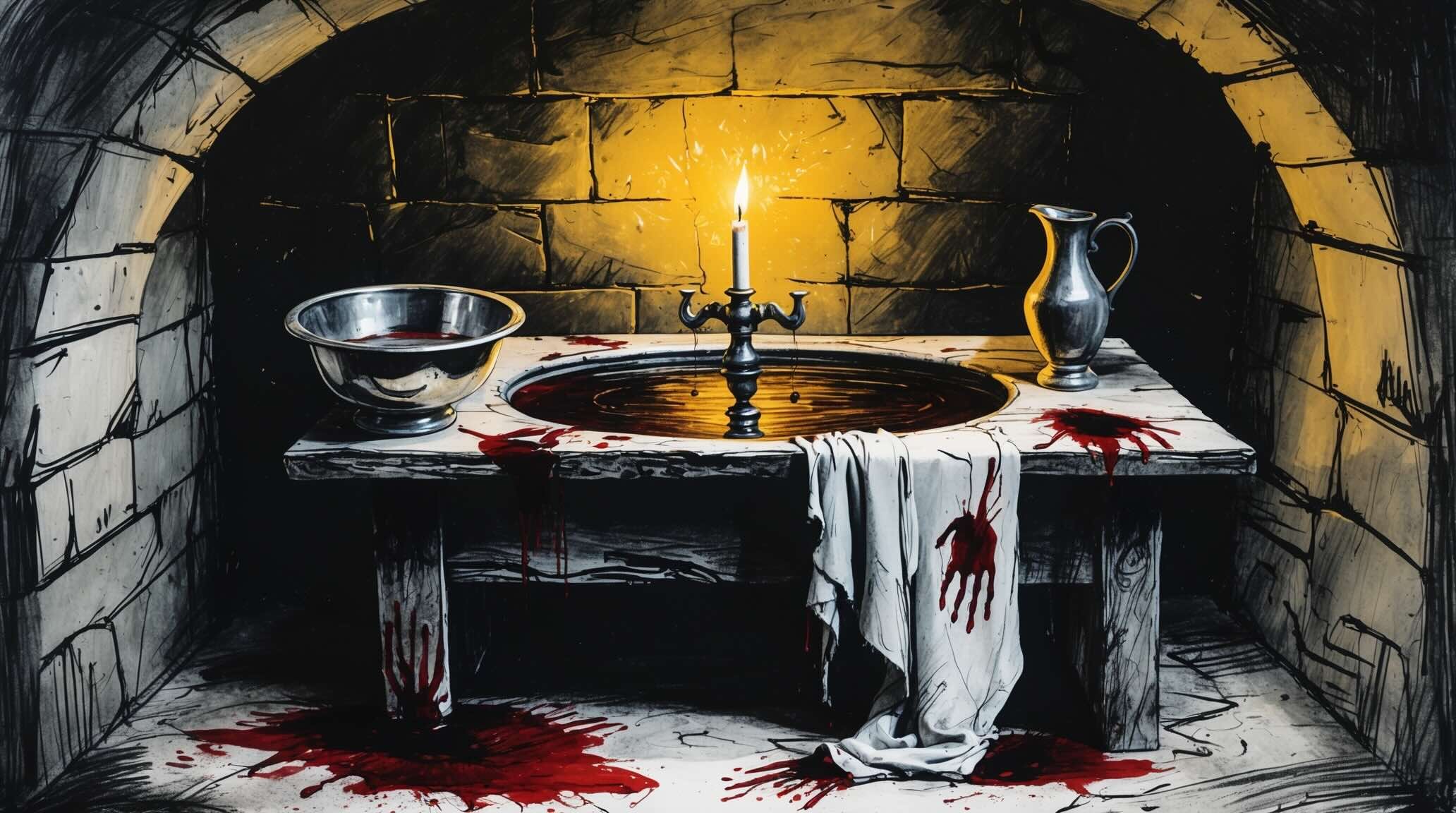
Theme Profile – At a Glance
- The Core Concept: The inescapable psychological and spiritual toll of committing murder, demonstrating that human conscience cannot be permanently silenced without destroying the mind.
- Key Characters: Macbeth and Lady Macbeth.
- Related Themes: The Supernatural, Appearance, and Ambition.
- Famous Quote:
"Will all great Neptune's ocean wash this blood
Clean from my hand?"
(Act 2, Scene 2)
The Immediate Stain of Regicide
The theme of guilt in Macbeth is most vividly represented through the recurring motif of blood. Following the assassination of King Duncan, the physical blood on the murderers' hands becomes a permanent symbol of their moral pollution. Macbeth’s immediate reaction to the murder is one of overwhelming spiritual panic. He is paralysed by the realisation that he could not say "Amen" when the guards said "God bless us," signalling his sudden, terrifying severance from divine grace.
Original
But wherefore could not I pronounce 'Amen'?
I had most need of blessing, and 'Amen'
Stuck in my throat.
(Act 2, Scene 2)
Shakespeare Retold (Modern Verse)
But how come I could not declare, 'Amen'?
I needed blessing most, but then 'Amen'
Got stuck within my throat.
While Lady Macbeth initially approaches the crime with chilling pragmatism, claiming that "A little water clears us of this deed," Macbeth’s poetic imagination understands the true nature of their crime. He recognises that the stain is indelible, believing his bloody hands could turn the entire world's oceans red. This establishes the play's central psychological argument: the human conscience is immensely powerful, and the guilt of shedding innocent blood cannot simply be washed away.
Hallucinations as Manifest Conscience
Because Macbeth attempts to suppress his moral understanding to achieve his ambition, his guilt finds alternative ways to express itself, frequently bleeding into the realm of the supernatural. His intense anxiety projects itself outward into terrifying hallucinations. The floating dagger he sees before Duncan's murder acts as a visual representation of his guilty intent leading him toward damnation.
Original
Prithee, see there!
Behold! Look! Lo! How say you?
Why, what care I? If thou canst nod, speak too.
(Act 3, Scene 4)
Shakespeare Retold (Modern Verse)
Please, look, there!
You see it, look! What do you say to that?
Why should I care? If you can nod, then speak, too.
The most profound manifestation of his guilt occurs at the royal banquet, where he is haunted by the gory ghost of Banquo. Because only Macbeth can see the apparition, it serves as a mirror reflecting his corrupted soul. He can hide his treason from the Scottish lords using a deceptive appearance, but he cannot hide it from his own subconscious, which actively terrorises him for his betrayals.
Repression and Somnambulism
The trajectory of guilt in Lady Macbeth operates as a mirror image to her husband's. While he is initially paralysed by conscience and later becomes numb to it, she begins with absolute, ruthless control and ends in total psychological collapse. To orchestrate the murder, she forcefully represses her natural humanity, demanding that dark spirits "unsex" her.
Original
Here's the smell of the blood still:
all the perfumes of Arabia will not sweeten this little hand.
Oh, oh, oh!
(Act 5, Scene 1)
Shakespeare Retold (Modern Verse)
My hands still smell of blood. All the
perfumes of Arabia won’t make my hand smell sweet.
Oh, oh, oh!
However, Shakespeare demonstrates that repression is ultimately unsustainable. When the waking mind refuses to acknowledge its crimes, the subconscious mind exacts its revenge during sleep. Her famous sleepwalking scene (somnambulism) is the physical breaking point of her guilt. The arrogant woman who once claimed a little water would wash away the deed is now reduced to frantically scrubbing her hands, haunted by the phantom smell of Duncan's blood, proving that her suppressed conscience has completely shattered her sanity.
The Eradication of Humanity
The ultimate tragedy of the play is not just that guilt destroys the mind, but what happens when a person successfully kills their own conscience. As Macbeth commits more murders—slaughtering Banquo and Lady Macduff's family—his acute guilt morphs into a horrifying desensitisation.
To escape the torment of his own conscience, he actively destroys his capacity to feel anything at all. He claims he has "supp'd full with horrors," meaning he is so saturated with violence that he can no longer feel fear or remorse. The cost of escaping his guilt is the complete eradication of his humanity, leaving him a hollow, isolated shell whose life "signifies nothing."
"In Macbeth, guilt is not merely an emotion; it is an active, punitive force of nature. It operates as an internal immune system of the soul, attacking the conscious mind with hallucinations and madness when the moral order has been violated."
— A.C. Bradley, Shakespearean Tragedy (1904)
Key Quotes
Quote 1
Methought I heard a voice cry 'Sleep no more!
Macbeth does murder sleep', the innocent sleep...
(Act 2, Scene 2)
Shakespeare Retold (Modern Verse)
I thought I heard a cry: “Don’t go to sleep!
Macbeth will murder sleepers!” Innocent folk...
Quote Analysis: Sleep in the play represents peace, innocence, and natural restoration. By murdering Duncan in his sleep, Macbeth has effectively destroyed his own ability to ever rest peacefully again. His guilt ensures he will suffer from "terrible dreams that shake us nightly," transforming sleep into a time of torture.
Quote 2
Thy bones are marrowless, thy blood is cold;
Thou hast no speculation in those eyes
Which thou dost glare with!
(Act 3, Scene 4)
Shakespeare Retold (Modern Verse)
Your bone marrow has gone, your blood is cold;
You have no way of reasoning with those eyes
Which you are glaring at me with!
Quote Analysis: Confronted by Banquo's ghost, Macbeth tries to reassure himself by stating biological facts—that the dead cannot physically harm him. However, his guilt defies logic and physics. The terror stems not from physical danger, but from the unbearable moral weight of having betrayed his closest friend.
Quote 3
To bed, to bed! there's knocking at the gate:
come, come, come, come, give me your hand. What's
done cannot be undone.—To bed, to bed, to bed!
(Act 5, Scene 1)
Shakespeare Retold (Modern Verse)
To bed, to bed! There’s knocking at the gate:
come, come, come, come, give me your hand.
What’s done can’t be undone. To bed, to bed, to bed!
Quote Analysis: In her final appearance, Lady Macbeth's speech devolves into fragmented, repetitive prose. She is trapped in a mental loop, reliving the horrific night of the murder. Her realisation that "what's done cannot be undone" is the tragic climax of her guilt, leading directly to her suicide.
Key Takeaways
- The Indelible Stain: Blood is the primary physical symbol of guilt, representing a moral stain that water cannot wash away.
- Psychological Manifestations: Unresolved conscience projects itself outward, creating vivid hallucinations like floating daggers and bloody ghosts.
- The Danger of Repression: Attempting to completely bury one's humanity and empathy, as Lady Macbeth does, inevitably results in catastrophic mental collapse.
- The Loss of Humanity: Macbeth's "cure" for his guilt is to become completely desensitised to violence, costing him his soul and his capacity to feel anything at all.
Study Questions and Analysis
Q1: How is guilt visually represented in the play? +
Guilt is predominantly visualised through the motif of blood. Macbeth sees it on his hands and on the hallucinated dagger, while Lady Macbeth constantly imagines a "damned spot" of blood on her hands that she cannot wash away, symbolising their permanent moral pollution.
Q2: Why can't Macbeth say "Amen" after killing Duncan? +
The inability to say "Amen" signifies Macbeth's immediate understanding that he has severed his connection to God. By committing regicide, he has aligned himself with demonic forces, and his spiritual guilt physically blocks him from participating in holy prayer.
Q3: How does Lady Macbeth's view of guilt change throughout the play? +
Initially, she is entirely dismissive, telling her husband that "a little water clears us of this deed." However, because she represses her natural conscience, the guilt festers in her subconscious, eventually driving her mad as she realises the moral stain is permanent.
Q4: Is Banquo's ghost real or a product of guilt? +
The text strongly suggests it is a psychological hallucination born from Macbeth's profound guilt over betraying his friend, as no one else at the banquet can see it. It serves as a visual manifestation of the conscience he is desperately trying to ignore.
Q5: Why does Macbeth's guilt seem to fade as the play progresses? +
It doesn't fade; it is violently repressed. To avoid the torturous anxiety he felt after his first murder, Macbeth commits a series of increasingly senseless atrocities to numb his own mind. He kills his conscience, which tragically results in the total loss of his humanity.
Q6: What role does sleep play in the theme of guilt? +
Sleep is the ultimate victim of guilt. Macbeth claims he has "murdered sleep," meaning his conscience will forever plague him with nightmares. For Lady Macbeth, sleep provides no rest, as it is the only time her waking defences fall, allowing her guilt to torture her through sleepwalking.
Q7: Does the play suggest guilt can ever be washed away? +
No. The play argues that the moral consequences of evil actions are permanent. Lady Macbeth's desperate scrubbing and Macbeth's vision of the oceans turning red both confirm that shedding innocent blood creates a spiritual stain that no earthly remedy can cleanse.
