Macbeth: Act 5, Scene 2 – Analysis
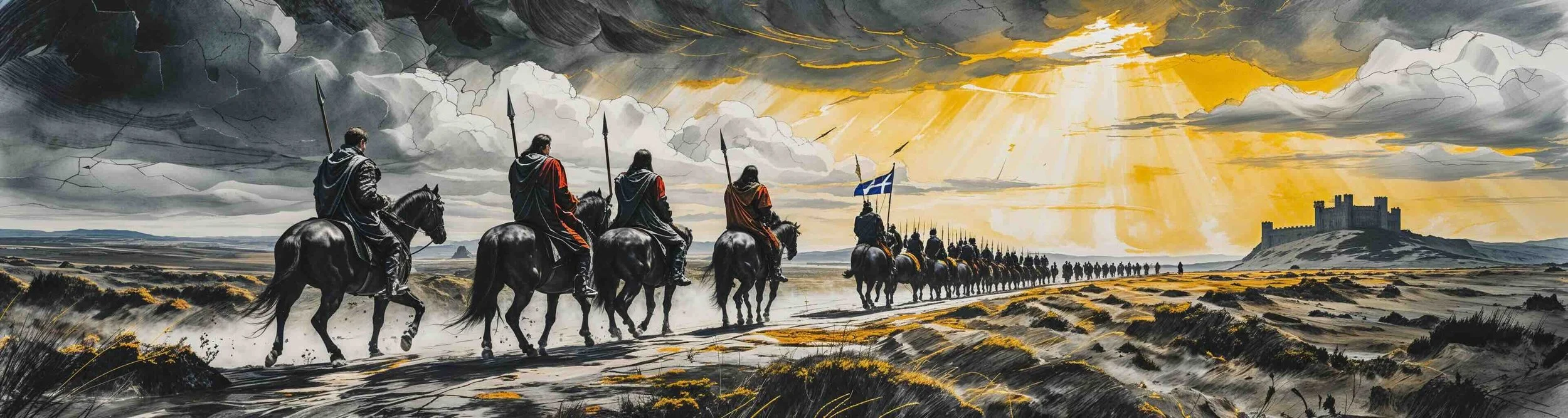
Scene Profile – At a Glance
- Location: The country near Dunsinane, as the rebel Scottish lords march to join the English army.
- What Happens: Menteith, Caithness, Angus, and Lennox lead their soldiers to meet Malcolm, Siward, and Macduff near Birnam Wood. They describe Macbeth's crumbling rule and resolve to give their loyalty to the rightful cause.
- Key Characters: Menteith, Caithness, Angus, and Lennox.
- Dramatic Function: A short, fast scene that gathers the opposition and frames the coming battle as a healing of a sick nation.
- Famous Quote:
"Now does he feel
His secret murders sticking on his hands..."
(Angus, Act 5, Scene 2) - Why It Matters: Seen from the outside, Macbeth is no longer a tyrant to be feared but a small man swallowed by an office too big for him.
Scene Summary
A group of Scottish lords – Menteith, Caithness, Angus, and Lennox – march with their soldiers towards Birnam Wood. The English army is near, led by Malcolm, his uncle Siward, and the "good Macduff", and the Scots mean to join them. Their cause is revenge, fierce enough to rouse even a dying man to fight. Lennox confirms that Malcolm's brother Donalbain is not with the army, but Siward's young son is, along with many beardless youths about to prove their manhood for the first time.
They turn to Macbeth. He is fortifying Dunsinane strongly; some call him mad, others give his fury a braver name, but all agree he can no longer hold his ruined cause within "the belt of rule". His secret murders cling to his hands, constant revolts rebuke his treachery, and the men he commands obey out of fear, not love. His kingship hangs on him like a giant's robe on a dwarfish thief. The lords resolve to march on and pour out their own blood, if need be, to cure the sickness of their country, and head for Birnam.
The Tyrant Seen from Outside
For most of the play we have watched Macbeth from the inside, sharing his terror and his soliloquies. This brief scene deliberately steps outside him, letting four ordinary lords describe how he looks to the country he rules. The portrait is pitiless and small. Angus reduces the whole reign to a single, withering image: a man wearing a title that does not fit.
Original
now does he feel his title
Hang loose about him, like a giant's robe
Upon a dwarfish thief.
(Angus, Act 5, Scene 2)
Shakespeare Retold (Modern Verse)
He feels his title
Is slipping from him, like a giant's robe
Slips off a looting dwarf.
The image of the "dwarfish thief" in a giant's robe captures the play's whole verdict on Macbeth. He stole the crown but was never large enough to fill it; the kingship he murdered for hangs ridiculous and loose around him. The clothing imagery has run through the play – "borrowed robes", garments that do not fit – and here it reaches its sourest conclusion. Power has not made him great; it has only exposed how small he is.
The Sickness of the Nation
The lords do not see this as a private war between rivals. They cast it as the curing of a diseased country, with Macbeth as the infection and Malcolm as the medicine. Caithness calls Malcolm "the medicine of the sickly weal", and the soldiers pledge their own blood as the cure.
Original
Meet we the medicine of the sickly weal,
And with him pour we in our country's purge
Each drop of us.
(Caithness, Act 5, Scene 2)
Shakespeare Retold (Modern Verse)
Let's meet the men who'll mend our sickly state,
And join to cure our country, pouring in it
Each drop of blood we have.
The language of medicine, sickness, and purging frames the rebellion as restoration rather than treason. Scotland is a body that has fallen ill under Macbeth, and the loyal lords are willing to bleed to heal it. Lennox finishes the thought with an image of flowers and weeds: their blood will water "the sovereign flower" and drown the weeds. The rightful order is natural and living; Macbeth's tyranny is a sickness or a weed to be removed.
Language and Technique
- Clothing imagery: The "giant's robe / Upon a dwarfish thief" continues the play's running picture of Macbeth wearing a kingship that does not fit him.
- Disease and medicine: Scotland is a "sickly weal" needing a "purge"; rebellion is recast as healing, not treason.
- Plant imagery: "The sovereign flower" against the "weeds" sets natural, rightful order against the choking growth of tyranny.
- Choral lords: The named but minor thanes function almost as a chorus, voicing the nation's judgement on a king we usually see from within.
- Movement towards Birnam: The scene ends pointing at Birnam Wood, quietly setting up the witches' prophecy that will be fulfilled there.
Key Quotes from Act 5, Scene 2
Quote 1Now does he feel
His secret murders sticking on his hands;
Now minutely revolts upbraid his faith-breach;
(Angus, Act 5, Scene 2)
Shakespeare Retold (Modern Verse)
He is aware now
He can't escape the consequence of murder;
Countless revolts berate his breach of faith;
Those he commands move only in command,
Nothing in love...
(Angus, Act 5, Scene 2)
Shakespeare Retold (Modern Verse)
His soldiers only act because he tells them,
They don't do it for love...
Key Takeaways
- The opposition gathers: The Scottish rebel lords march to join Malcolm, Siward, and Macduff near Birnam.
- Macbeth seen from outside: Stripped of his soliloquies, he appears small – a thief in a giant's robe.
- Rule by fear, not love: His soldiers obey under compulsion, and such loyalty cannot hold.
- Rebellion as healing: The lords frame the war as a purge that will cure a sick nation.
- Birnam in view: The scene drives towards Birnam Wood, setting up the prophecy's fulfilment.
Study Questions and Analysis
How does this scene change our view of Macbeth?
For most of the play we experience Macbeth from inside his own mind, through soliloquies that make even his crimes intimate and gripping. This scene pulls the camera back. We see him only as the loyal lords describe him – a fortifying, half-mad figure whose title hangs loose like a giant's robe on a dwarfish thief.
The shift matters because it strips away sympathy. From the outside there is no inner torment to share, only a tyrant whose murders cling to his hands and whose men obey out of fear. By withholding Macbeth's own voice here, Shakespeare prepares us to watch his fall as the nation watches it: as the overdue collapse of a usurper, not the suffering of a hero.
What is the effect of the disease and medicine imagery?
The lords repeatedly describe Scotland as ill and Macbeth as the cause. Malcolm is "the medicine of the sickly weal", the war is a "purge", and the loyal blood spilt will "dew the sovereign flower and drown the weeds". The cumulative effect is to recast rebellion as healing.
This is politically important. Killing a king was, in Shakespeare's England, a terrible act, and the play has to justify the rising against Macbeth. By framing it as medicine rather than murder – the removal of an infection so the body of the nation can live – Shakespeare makes the rebellion feel not just permitted but necessary. The imagery also chimes with the sick-room of the previous scene, linking the disease in Lady Macbeth's mind to the disease in the state.
Why does Shakespeare keep this scene so short?
Act 5 is built from a rapid succession of short scenes that cut between the advancing army and the besieged castle, and this is one of them. The brevity creates momentum: the audience feels events accelerating towards the inevitable collision at Dunsinane.
The scene's job is narrow and it does it efficiently – gather the rebel lords, voice the country's verdict on Macbeth, and point everyone towards Birnam. By keeping it lean, Shakespeare avoids slackening the pace just as the play drives towards its climax. The quick march on and off stage mirrors the soldiers' own movement, and the scene ends, like several others in this act, with a line pushing the action forward: "Make we our march towards Birnam."