Macbeth: Act 5, Scene 4 – Analysis
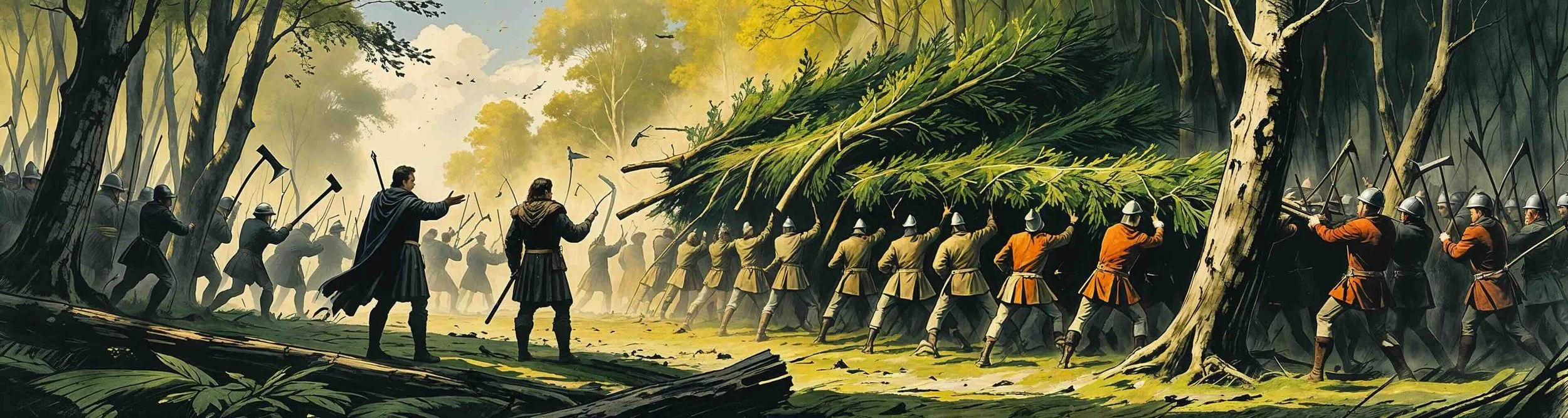
Scene Profile – At a Glance
- Location: The country near Birnam Wood, where the combined armies muster.
- What Happens: Malcolm orders every soldier to cut a bough from Birnam Wood and carry it as camouflage, to hide the size of his army. The leaders weigh Macbeth's position and march on to Dunsinane.
- Key Characters: Malcolm, Macduff, Siward, and the rebel lords.
- Dramatic Function: A very short scene whose single great purpose is to set in motion the literal fulfilment of the witches' prophecy – Birnam Wood coming to Dunsinane.
- Famous Quote:
"Let every soldier hew him down a bough
And bear't before him..."
(Malcolm, Act 5, Scene 4) - Why It Matters: A practical military order, given without a thought for prophecy, becomes the exact means by which Macbeth's "safety" is undone.
Scene Summary
The combined army has reached the country near Birnam Wood. Malcolm expresses hope that the days are near when people will once again be safe in their homes, and the lords agree. When Siward asks what wood lies before them and is told it is Birnam, Malcolm gives his order: every soldier is to cut down a branch and carry it in front of him, so the army's true numbers will be hidden and Macbeth's scouts will misreport their strength.
The soldiers agree at once. Siward notes that the "confident tyrant" remains shut up in Dunsinane, ready to endure a siege, and Malcolm observes that this is Macbeth's only real hope, since wherever men can desert him they do. Macduff urges them to hold their judgements until the fighting decides matters, and Siward agrees that talk and hope must now give way to action. They advance towards the war.
A Soldier's Order, a Prophet's Doom
The whole scene exists to deliver a single command, and Shakespeare lets it pass as pure military practicality. Malcolm wants to disguise the size of his force, so he tells each man to carry a branch. There is no mention of the witches, no sense that anyone on stage knows they are fulfilling a prophecy.
Original
Let every soldier hew him down a bough
And bear't before him: thereby shall we shadow
The numbers of our host and make discovery
Err in report of us.
(Malcolm, Act 5, Scene 4)
Shakespeare Retold (Modern Verse)
Have every soldier chop himself a branch down,
And hold it out in front of him, disguising
Our numbers so that their reconnaissance
Is wrong about us.
This is where the play's dramatic irony reaches its peak. The audience remembers the apparition's promise that Macbeth would never be vanquished "till Birnam Wood... shall come against him". Macbeth heard it as an impossibility, a guarantee of safety. Here we watch the impossibility arranged in a few plain words by a commander who has no idea he is sealing Macbeth's fate. Prophecy is fulfilled not by magic but by ordinary human cunning.
Language and Technique
- Dramatic irony: The audience alone connects Malcolm's camouflage order to the witches' "Birnam Wood" prophecy; the soldiers act in innocent ignorance.
- Equivocation fulfilled: The prophecy comes true in a literal, unexpected sense, exposing how the witches' promises "palter with us in a double sense".
- Plain command: Malcolm's brisk, practical verse contrasts with Macbeth's prophecy-soaked rhetoric, marking him as a leader who deals in action, not omens.
- Desertion imagery: "None serve with him but constrained things / Whose hearts are absent too" reinforces that Macbeth's power is hollow.
- Speculation versus action: Siward's closing couplet sets uncertain "thoughts speculative" against the decisive "strokes" of battle, driving the act towards its climax.
Key Quotes from Act 5, Scene 4
Quote 1We learn no other but the confident tyrant
Keeps still in Dunsinane, and will endure
Our setting down before't.
(Siward, Act 5, Scene 4)
Shakespeare Retold (Modern Verse)
We don't know much except the cocky tyrant
Is still in Dunsinane, set in his castle,
Awaiting our attack.
And none serve with him but constrained things
Whose hearts are absent too.
(Malcolm, Act 5, Scene 4)
Shakespeare Retold (Modern Verse)
And those that serve him now are forced to do so,
Although their hearts aren't in it.
Key Takeaways
- The prophecy is set in motion: Malcolm's order to carry boughs from Birnam will literally fulfil the witches' promise.
- Irony at its height: A practical military disguise becomes the supernatural-seeming doom Macbeth thought impossible.
- Malcolm leads by action: His brisk, practical orders contrast with Macbeth's reliance on omens.
- Macbeth's hollow army: His men serve under compulsion, their hearts already gone.
- From talk to battle: The scene ends turning hope and speculation into decisive action.
Study Questions and Analysis
How does this scene fulfil the witches' prophecy?
One of the apparitions in Act 4 told Macbeth he would never be beaten until Birnam Wood moved to Dunsinane – a condition he took to be impossible, since woods do not walk. Here, Malcolm orders every soldier to cut a branch from Birnam and carry it for camouflage. When the army advances, the wood will appear to move towards the castle.
The brilliance lies in the means. The prophecy is fulfilled not by witchcraft but by an ordinary tactical decision, given by a leader who knows nothing of the prophecy he is satisfying. This exposes how the witches' promises work: they "palter with us in a double sense", coming true in a literal way that mocks the comfort Macbeth took from them. What sounded like a guarantee of safety becomes the instrument of his downfall.
Why does Shakespeare contrast Malcolm's leadership with Macbeth's?
The scene quietly sets up Malcolm as the rightful king by showing how differently he leads. His orders are practical, clear, and obeyed willingly – the soldiers answer "It shall be done" at once. He listens to Macduff and Siward, holds his judgement until events decide, and relies on sound tactics rather than supernatural assurances.
Macbeth, by contrast, is shut in his castle clinging to prophecies and commanding men who would desert if they could. The play is careful to make Malcolm look like the embodiment of true kingship before his victory, so that the restoration at the play's end feels earned. Good order, loyalty freely given, and decisions grounded in reality are set against tyranny, fear, and dependence on omens.
What is the effect of the scene's brevity?
The scene is one of the shortest in the play, and its speed is deliberate. Act 5 cuts rapidly between the castle and the field, and this brisk scene keeps the army's advance moving while delivering the one crucial order that will decide the battle.
By making the camouflage command so quick and casual, Shakespeare heightens the irony: the doom Macbeth dreaded is arranged in a handful of lines, almost in passing. There is no ceremony, no sense of destiny on stage – only soldiers preparing to march. The brevity also builds momentum, propelling the audience towards the climax with the feeling that events are now unstoppable, gathering pace as the wood begins, in effect, to move.