Macbeth: Act 5, Scene 5 – Analysis
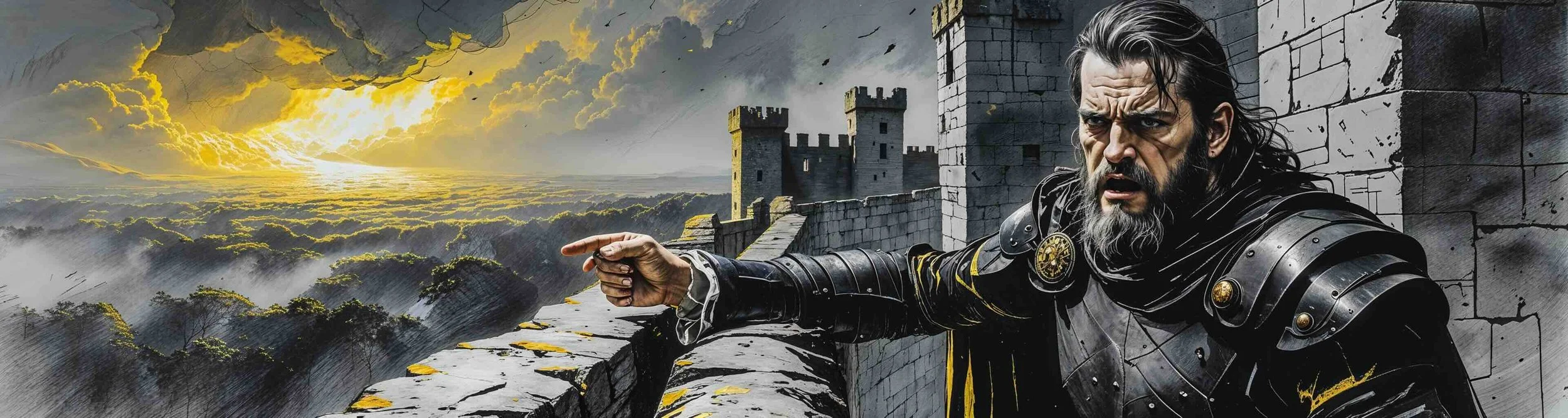
Scene Profile – At a Glance
- Location: Within the castle at Dunsinane, as the siege closes in.
- What Happens: Macbeth learns that Lady Macbeth is dead and responds with the great "Tomorrow, and tomorrow" soliloquy on the emptiness of life. A messenger then reports the unthinkable: Birnam Wood appears to be moving towards the castle.
- Key Characters: Macbeth, Seyton, and a Messenger.
- Dramatic Function: The emotional climax of Macbeth's fall – his wife's death, his despairing meditation on meaninglessness, and the collapse of his trust in the prophecies.
- Famous Quote:
"To-morrow, and to-morrow, and to-morrow,
Creeps in this petty pace from day to day..."
(Macbeth, Act 5, Scene 5) - Why It Matters: Macbeth's most famous speech is also his bleakest: life reduced to a brief, meaningless candle, a tale told by an idiot.
Scene Summary
Macbeth orders his banners hung on the castle walls and boasts that Dunsinane's strength will laugh the siege to scorn; he would have met the enemy in open battle had his own troops not deserted to them. A cry of women is heard within. Macbeth reflects that he has almost forgotten the taste of fear – once a night-shriek would have frozen him, but he has "supped full with horrors" until nothing can startle him.
Seyton returns to report that the queen is dead. Macbeth's response is the famous soliloquy. She would have died one day, he says; then he turns to the meaninglessness of time itself, "tomorrow, and tomorrow, and tomorrow" creeping on to "dusty death", life no more than a brief candle, a walking shadow, a poor actor strutting his hour, a tale told by an idiot, full of sound and fury, signifying nothing.
A messenger enters with news he can hardly tell: standing watch on the hill, he looked towards Birnam and saw the wood begin to move. Macbeth threatens to hang him for lying, but the man insists it is true and coming within three miles. Macbeth feels his certainty crack. He begins to doubt the "equivocation of the fiend that lies like truth", recognises the prophecy turning against him, and, weary of the sun and of life itself, calls for the alarm bell and resolves to die with his armour on.
Supped Full with Horrors
Before the news of his wife's death arrives, Shakespeare shows us how far Macbeth has travelled from the man who could not bear to look at his own bloody hands. The cry of women barely moves him, and he tells us why: he has so saturated himself in slaughter that fear no longer reaches him.
Original
I have supped full with horrors;
Direness, familiar to my slaughterous thoughts
Cannot once start me.
(Macbeth, Act 5, Scene 5)
Shakespeare Retold (Modern Verse)
I've seen such horror,
That gruesomeness caused by my thoughts of bloodshed
Don't startle me.
This is the deadened end-point of a long process. The Macbeth of Act 2 was terrified of a knock at the door; this Macbeth is numb. He has paid for his crimes not only in fear but in the loss of the capacity to feel – horror has become so "familiar" that it cannot touch him. That emotional emptiness is the ground on which the next speech is built: a man who can no longer feel is perfectly placed to conclude that nothing means anything.
"Tomorrow, and Tomorrow"
Into this numbness comes the news of Lady Macbeth's death, and it produces not grief but the play's most devastating meditation. Macbeth's first reaction is strangely flat – "she should have died hereafter" – as if there is no right time for such news. From that flatness the great soliloquy unfolds.
Original
To-morrow, and to-morrow, and to-morrow,
Creeps in this petty pace from day to day
To the last syllable of recorded time,
And all our yesterdays have lighted fools
The way to dusty death. Out, out, brief candle!
(Macbeth, Act 5, Scene 5)
Shakespeare Retold (Modern Verse)
Tomorrow or the next day or the next,
Each day creeps slowly by, from day to day
Until we reach the very end of time,
Where every day that's passed is lit with candles
That light the way to death. Put out this candle!
The repetition of "to-morrow" enacts its own meaning: the word crawls forward, identical and exhausting, leading nowhere but to "dusty death". For a man who killed to seize the future, this is the cruellest verdict – the future he grasped at is just an endless, empty procession of days. The "brief candle" he snuffs out is both his wife's life and all life, a small flame quickly gone. Whether Macbeth's bleakness is the truth of the play or the despair of a damned man is one of the questions the speech leaves open.
The Moving Wood
The soliloquy's despair is immediately tested by news that should be impossible. The messenger, barely able to speak, reports that Birnam Wood is moving, and Macbeth's whole structure of confidence begins to give way.
Original
I pull in resolution, and begin
To doubt the equivocation of the fiend
That lies like truth...
(Macbeth, Act 5, Scene 5)
Shakespeare Retold (Modern Verse)
I'm cancelling my plan, for I am starting
To doubt the vagueness of the witches' message
That twists the truth...
This is the moment Macbeth understands he has been deceived. The prophecy he treated as a guarantee was an "equivocation" – a double-talking promise that "lies like truth", true in a sense he never imagined. The witches kept "the word of promise to our ear" and broke it "to our hope". Yet notice what Macbeth does with this knowledge: he does not despair into surrender but turns to fight, calling for the alarm bell and choosing to die "with harness on our back". Even stripped of his false certainties, the soldier refuses to flee.
Language and Technique
- Repetition: "To-morrow, and to-morrow, and to-morrow" makes time itself sound monotonous and pointless, the form mirroring the meaning.
- Theatrical imagery: Life as a "poor player" who "struts and frets his hour upon the stage" turns existence into a brief, hollow performance – a striking image from a playwright.
- Light and dark: The "brief candle" and the "way to dusty death" set a tiny, failing light against vast darkness, the emblem of a meaningless life.
- Equivocation: "The equivocation of the fiend / That lies like truth" names the play's central trick – promises that are technically true but deliberately misleading.
- Anticlimax: "Signifying nothing" lands the soliloquy on emptiness, the bleakest possible full stop.
Key Quotes from Act 5, Scene 5
Quote 1She should have died hereafter;
There would have been a time for such a word.
(Macbeth, Act 5, Scene 5)
Shakespeare Retold (Modern Verse)
She would have died one day.
There'll always be a day to hear that news.
Life's but a walking shadow, a poor player
That struts and frets his hour upon the stage
And then is heard no more...
(Macbeth, Act 5, Scene 5)
Shakespeare Retold (Modern Verse)
Life's just a mirage, where a lousy actor
Will strut and fret his time upon the stage,
But then is heard no more of...
it is a tale
Told by an idiot, full of sound and fury,
Signifying nothing.
(Macbeth, Act 5, Scene 5)
Shakespeare Retold (Modern Verse)
It's a story
Told by an idiot, full of sound and anger
That has no meaning.
At least we'll die with harness on our back.
(Macbeth, Act 5, Scene 5)
Shakespeare Retold (Modern Verse)
At least we'll die armed, ready for the battle.
Key Takeaways
- Lady Macbeth's death: News of the queen's death prompts not grief but despair, the partnership ending on a numb note.
- The "Tomorrow" soliloquy: Macbeth reduces life to a brief candle, a walking shadow, and a tale signifying nothing.
- Emotional deadness: He has "supped full with horrors" until fear can no longer reach him.
- The prophecy turns: The moving wood exposes the witches' "equivocation", and Macbeth's false security cracks.
- Doomed courage: Stripped of comfort, he still resolves to die fighting, with his armour on.
Study Questions and Analysis
What does the "Tomorrow" soliloquy mean?
The speech is Macbeth's verdict on existence, delivered at the moment his wife's death and the collapse of his hopes leave him with nothing. Time, he says, merely "creeps" forward in a "petty pace" towards "dusty death"; life is a "brief candle", a "walking shadow", a "poor player" soon forgotten, and finally a tale told by an idiot, "full of sound and fury, signifying nothing".
It is a statement of complete nihilism – the conviction that human life has no meaning at all. What gives it such force is that it comes from a man who staked everything on the future and now finds that future empty. A. C. Bradley, in Shakespearean Tragedy (1904), saw this despair as the natural end of Macbeth's road: a once-imaginative man whose crimes have hollowed him out until he can feel and believe in nothing. Whether the speech voices the play's own view or only the bleakness of a damned soul is left for the audience to weigh.
How does Macbeth respond to news of his wife's death?
His reaction is striking for what it lacks: there is no obvious grief, no breaking down. He simply observes that she would have died one day, and that there would have been a time for such news – a response so flat it has puzzled readers for centuries.
I have almost forgot the taste of fears...
(Macbeth, Act 5, Scene 5)
Shakespeare Retold (Modern Verse)
I have almost forgotten what fear tastes like...
The flatness is the point. Macbeth has dulled himself so completely – he has "almost forgot the taste of fears" – that he can no longer feel even this loss as he should. The numbness is itself a kind of tragedy: the couple who once shared everything are now so far apart, and Macbeth so deadened, that her death registers only as a trigger for despair about life in general. Grief has been swallowed by the larger emptiness the soliloquy describes.
How does this scene shatter Macbeth's confidence in the prophecies?
Until now Macbeth has clung to the apparitions' promises, especially that he is safe until Birnam Wood comes to Dunsinane. When the messenger reports the wood moving, that certainty is destroyed in an instant. Macbeth realises the prophecy was an "equivocation of the fiend that lies like truth" – technically true, but designed to deceive.
The recognition is bitter. He sees that the witches "keep the word of promise to our ear, and break it to our hope", giving him exactly the false security that would lead him to his doom. Yet the scene does not end in collapse. Macbeth's response to losing his last comfort is to ring the alarm and prepare to fight, choosing to die as a soldier rather than flee or yield. The shattering of the prophecy strips away his illusions but not his defiance.
Why is this scene considered the climax of Macbeth's tragedy?
Several of the play's threads come together here. Macbeth's wife – his partner in the original crime – is dead; his belief in the prophecies that sustained him is destroyed; and in the great soliloquy he reaches the lowest point of his despair, declaring life itself meaningless. Emotionally, this is the bottom of his fall.
It is a climax of feeling rather than action: the battle is still to come, but the inner defeat is complete. Everything Macbeth gained – crown, power, security – has turned to ash, and he knows it. What remains is only the physical end, which the following scenes provide. By placing the despairing meditation just before the fighting, Shakespeare lets us see Macbeth's spirit broken before his body is, so that his death feels less like a shock than the final closing of a door already swinging shut.