Othello: Act 1, Scene 1 – Analysis
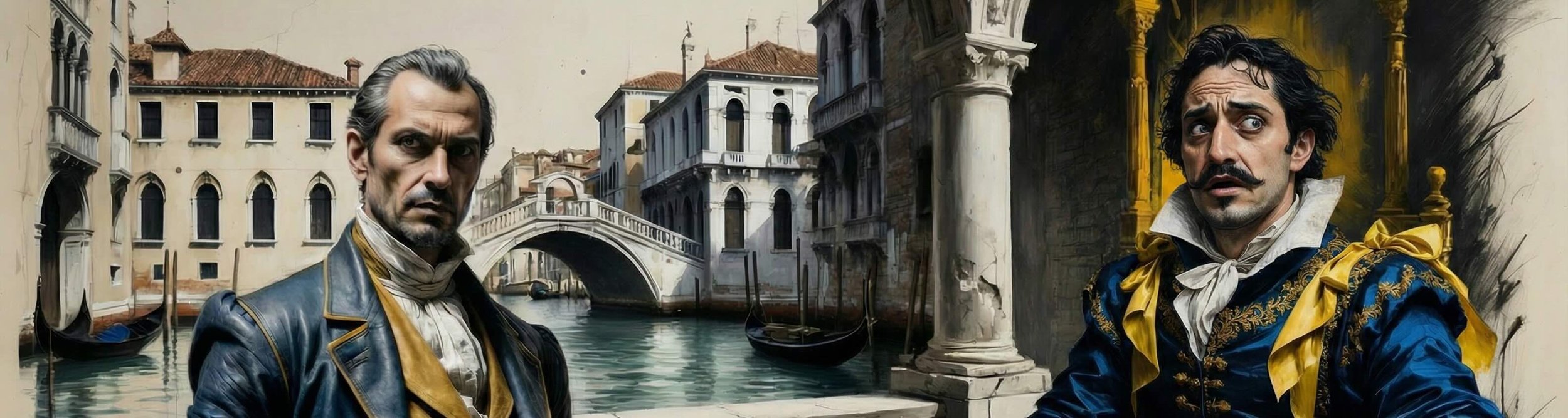
Scene Profile – At a Glance
- Location: A street in Venice, at night.
- What Happens: Iago tells Roderigo he hates Othello for promoting Cassio over him. The two men wake Senator Brabantio with the news that his daughter Desdemona has eloped with Othello, and Brabantio sets off to find them.
- Key Characters: Iago, Roderigo, and Brabantio.
- Dramatic Function: The play's opening move – it introduces Iago's grudge and his method, and lets us hear Venice's prejudice against Othello before we ever meet him.
- Famous Quote:
"I am not what I am."
(Iago, Act 1, Scene 1) - Why It Matters: Othello is talked about long before he appears, and almost every word is an insult. The scene plants Iago's lie at the root of the play and shows us exactly how he works.
Scene Summary
The play opens in the middle of an argument. Roderigo, a wealthy Venetian, has been paying Iago to help him win Desdemona, and he is angry to learn she has slipped away to marry Othello. Iago calms him by explaining that he hates Othello too: the general has just passed him over for promotion, making the inexperienced Michael Cassio his lieutenant instead.
Iago lays out his philosophy of service. He will go on following Othello, he says, but only to use him – wearing a show of loyalty while serving himself underneath. He sums up his whole nature in a single chilling line: "I am not what I am."
To get their revenge moving, the two men stop outside the house of Desdemona's father, the senator Brabantio, and shout up that he has been robbed. When Brabantio appears at his window, Iago tells him in the crudest, most racist terms that his daughter is in bed with Othello. Roderigo, more politely, confirms that Desdemona really has gone.
Brabantio searches the house, finds his daughter missing, and is horrified. Iago slips away before he can be seen siding against Othello, leaving Roderigo to lead the furious father out into the night to hunt the couple down.
Iago's Grievance Against the Moor
The first thing we learn about Iago is that he feels cheated. Three of the city's leaders lobbied Othello to make him lieutenant, but Othello chose Cassio – a man Iago dismisses as a bookish theorist who has never fought a real battle. Iago has been left as Othello's "ancient", his ensign or flag-carrier, a junior role he regards as an insult.
Original
And I – God bless the mark! – his Moorship's ancient.
(Iago, Act 1, Scene 1)
Shakespeare Retold (Modern Verse)
Whilst I – for goodness sake! – just wave his flag.
The sneer "his Moorship's" tells us as much as the grievance itself. Iago cannot mention Othello's rank without twisting it into a jibe at his race, fusing professional resentment and racial contempt in a single coined word. This is the engine of the whole play, and the scene is careful to show us that it starts small and petty – a promotion withheld – long before it grows monstrous. Whether the grudge is the real reason or merely the first excuse Iago reaches for is a question the play will keep open.
"I Am Not What I Am"
Having explained why he resents Othello, Iago explains how he intends to live with him: by faking loyalty. He draws a contrast between honest servants, who wear out their lives for nothing, and men like himself, who only pretend to serve while looking after their own interests. The speech ends with a line that turns him inside out.
Original
For daws to peck at: I am not what I am.
(Iago, Act 1, Scene 1)
Shakespeare Retold (Modern Verse)
The crows would peck it; I’m not who I seem.
"I am not what I am" is the closest Iago ever comes to confessing himself, and it is a riddle rather than a confession. It inverts God's words to Moses, "I am that I am" – where God is pure being, Iago is pure pretence, a man defined by the gap between his face and his heart. He says this to Roderigo, but really to us: from the first scene the audience is made his confidant, let in on a secret every character on stage is denied. That uneasy intimacy – knowing exactly what Iago is while everyone trusts "honest Iago" – is the source of the play's almost unbearable dramatic irony.
Rousing Brabantio
Talk turns to action when Iago decides to weaponise Brabantio's love for his daughter. They wake the senator not gently but with cries of fire and theft, and when he appears Iago assaults him with a stream of bestial, racist images designed to make the marriage sound like a violation.
Original
Even now, now, very now, an old black ram
Is topping your white ewe.
(Iago, Act 1, Scene 1)
Shakespeare Retold (Modern Verse)
For at this very moment, an old black ram
Is sleeping with your white ewe.
The image reduces Othello and Desdemona to animals – "an old black ram", a "white ewe" – setting black against white and age against youth to make a loving marriage sound like something obscene. Iago never says Othello's name here; he is "the Moor", "the devil", a "black ram", anything but a man. This is how Iago fights: not with arguments but with pictures planted in another person's mind, pictures that do their work long after he has gone. The same technique he uses on Brabantio tonight is the one he will later use, with deadlier effect, on Othello himself.
Language and Technique
- Animal imagery: Iago describes the marriage as a "black ram" and a "Barbary horse" mating, turning two people into livestock to disgust Brabantio and dehumanise Othello.
- Black and white: The scene repeatedly sets "black" against "white", loading the colours with prejudice before we have even seen Othello's face.
- Naming and not-naming: Othello is never named in this scene – only "the Moor", "the thicklips", "his Moorship" – so he is an insult before he is a person.
- Dramatic irony: "I am not what I am" lets the audience in on Iago's falseness while every character will go on calling him honest.
- Imagery of theft: Iago frames the elopement as a robbery – "Thieves! Thieves!" – quietly casting Desdemona as her father's stolen property.
Key Quotes from Act 1, Scene 1
Quote 1We cannot all be masters, nor all masters
Cannot be truly followed.
(Iago, Act 1, Scene 1)
Shakespeare Retold (Modern Verse)
Not everyone can lead, nor all those leading
Cannot lead everyone.
I am one, sir, that comes to tell you your daughter and the Moor are now making the beast with two backs.
(Iago, Act 1, Scene 1)
Shakespeare Retold (Modern Verse)
I am the man to tell you that your daughter and the Moor are currently laid down together, having sex.
What a full fortune does the thicklips owe
If he can carry't thus!
(Roderigo, Act 1, Scene 1)
Shakespeare Retold (Modern Verse)
How lucky old big-lips is then if he
Can carry this one off!
Fathers, from hence trust not your daughters' minds
By what you see them act.
(Brabantio, Act 1, Scene 1)
Shakespeare Retold (Modern Verse)
From now on, fathers, do not trust your daughters
Except by their behaviour.
Key Takeaways
- Iago's grudge: The play begins with Iago's anger at being passed over for promotion in favour of Cassio – his first stated motive.
- His method: "I am not what I am" reveals a man who hides his real self, and the audience is made his secret confidant from the start.
- Prejudice first: We hear Othello attacked in racist, animal terms before we ever meet him, so his reputation is poisoned in advance.
- Desdemona as property: Brabantio treats his daughter's marriage as a theft, revealing the patriarchal world the lovers have defied.
Study Questions and Analysis
Why does Iago hate Othello?
The reason Iago gives first is professional. Othello has promoted Michael Cassio to lieutenant and left Iago as his ensign, despite three city leaders recommending Iago for the post. He presents the snub as proof of a corrupt system in which promotion goes by favouritism rather than experience.
Preferment goes by letter and affection,
And not by old gradation, where each second
Stood heir to the first.
(Iago, Act 1, Scene 1)
Shakespeare Retold (Modern Verse)
Promotion comes through cronies’ favouritism
And not by rank, whereby subordinates
Reported to their master.
But the play is careful not to let any single motive settle. Iago will later add others – a suspicion that Othello has slept with his wife Emilia, even a flicker of desire for Desdemona – and the motives multiply rather than deepen, as if he is trying out reasons for a hatred that came first. Samuel Taylor Coleridge, in his lectures on Shakespeare around 1818, famously described Iago's soliloquising as "the motive-hunting of a motiveless malignity", suggesting the grievances are pretexts for a malice that needs none. A. C. Bradley, in Shakespearean Tragedy (1904), took the resentment more seriously, reading Iago as a man whose wounded vanity and need to feel superior drive him to destroy a happiness he cannot share. The scene supports both readings, and the gap between them is part of what makes Iago so disturbing.
What does "I am not what I am" reveal about Iago?
The line is Iago's self-definition, and it defines him as a contradiction: a man whose outward self is a deliberate disguise. He has just told Roderigo that if his face ever showed his true feelings he might as well "wear my heart upon my sleeve / For daws to peck at"; instead he keeps his heart hidden and shows the world only what serves his purpose.
The phrasing deliberately echoes and inverts God's declaration in Exodus, "I am that I am." Where God's words assert perfect, unchanging being, Iago's assert perfect duplicity – he is precisely not what he appears. Stephen Greenblatt, in Renaissance Self-Fashioning (1980), read Iago as a brilliant improviser who has no fixed self at all, only a talent for shaping himself to whatever a situation requires and feeding on the identities of others. The deeper unease is that the audience is taken into his confidence here while every character is shut out. We spend the play knowing the truth about "honest Iago" and being unable to warn anyone – the root of the tragedy's dramatic irony.
Why does Shakespeare open the play with Iago and Roderigo rather than Othello?
It is a deliberate and unsettling choice. The title character is the subject of the whole first scene but appears in none of it; we meet Othello only through the mouths of two men who despise him. By the time he finally walks on in the next scene, we have already heard him called "the Moor", "the thicklips", "an old black ram" and "the devil", and have been told he is lustful, thieving and dangerous.
The effect is to make the audience experience Venice's prejudice before they can judge Othello for themselves – and then to expose that prejudice as a lie the moment he speaks, calm and commanding, in Act 1, Scene 2. The structure stages the central theme of appearance versus reality: the gap between what Othello is said to be and what he is. It also gives Iago the opening position of power. He controls the story before the hero can speak, just as he will control the flow of information for the rest of the play, and our being trapped in his point of view first is part of how the tragedy works on us.
How does the scene use racist language, and what is its effect?
The scene's racism is relentless and physical. Iago and Roderigo never let Othello be simply a man: he is "an old black ram", a "Barbary horse", "the thicklips", "the devil". The images are overwhelmingly animal and sexual, designed to make a marriage between a black man and a white woman sound monstrous and unnatural rather than loving.
Critics have shown how deliberately this language works on Elizabethan fears. Karen Newman, in her essay "'And wash the Ethiop white'" (1987), argued that the play stages the period's anxieties about black masculinity and female desire, with Iago exploiting a culture that already coded blackness as monstrous. Ania Loomba, in Gender, Race, Renaissance Drama (1989), placed Othello at the intersection of racial and sexual prejudice, an outsider admired for his service yet never allowed to belong. The dramatic effect is to load the dice before Othello appears: the audience is handed a portrait built entirely from bigotry, so that the dignified man of the next scene becomes a living refutation of it – and a measure of how much Iago will have to destroy.
How does Iago manipulate Roderigo and Brabantio in this scene?
Iago handles the two men differently, and watching him do it is a masterclass in his technique. With Roderigo he plays the cynical confidant, agreeing that Othello deserves hatred and keeping the lovesick gull paying and obedient. With Brabantio he turns showman, staging a midnight emergency to panic a sleeping father into action.
Awake! What, ho, Brabantio! Thieves! Thieves! Thieves!
(Iago, Act 1, Scene 1)
Shakespeare Retold (Modern Verse)
Wake up! Oi, you, Brabantio! You’re being robbed!
By crying "Thieves!" Iago frames Desdemona's elopement as a robbery, casting her as stolen goods and her father as the victim of a crime – a clever appeal to Brabantio's sense of ownership. Throughout, Iago keeps himself out of view: he does the shouting in the dark, then leaves before dawn so that he is never seen to have turned against Othello. This is his signature pattern, established here in miniature – provoke others into doing the damage, supply the poisonous images, and preserve the reputation of "honest Iago" who was never really there.
How does Brabantio respond to the news, and what does it reveal?
Brabantio's reaction moves quickly from disbelief to horror to a sense of betrayal. He searches the house, finds Desdemona gone, and is overwhelmed not only by loss but by the feeling that his own blood has turned against him.
O heaven! How got she out? O treason of the blood!
(Brabantio, Act 1, Scene 1)
Shakespeare Retold (Modern Verse)
How did she leave the house? And cheat her family!
The word "treason" is telling: to Brabantio a daughter's free choice of husband is not just disappointing but a kind of crime against the family, almost against the state. Because he cannot accept that Desdemona would choose Othello of her own will, he reaches at once for the idea of witchcraft – the charge he will bring before the Senate in the next scene. His response reveals the patriarchal logic of his world, in which a daughter is property and her desire is unthinkable unless she has been "abused" or enchanted. It also makes him, for all his standing, exactly the kind of man Iago can play: proud, possessive, and easily inflamed.
How does this opening scene set up the rest of the play?
For a scene in which little physically happens – two men talk, then shout at a window – it is remarkably efficient at loading the gun the tragedy will later fire. It establishes Iago's grudge and, more importantly, his method: provocation, racist insinuation, and the careful management of how he is seen. It introduces Roderigo as the funded dupe Iago will keep using, and Brabantio as the first person he successfully manipulates.
It also sets the play's central machinery in motion. The theme of manipulation and deceit is announced in Iago's "I am not what I am", and the theme of prejudice and race in the torrent of insults aimed at an absent man. A. C. Bradley (Shakespearean Tragedy, 1904) noted that Iago's tragedy works by making the audience complicit, and the complicity begins here, in the dark, before the hero has said a word. Everything that follows – the trial of the marriage, the posting to Cyprus, the slow poisoning of Othello's mind – grows from the resentment and the technique this single scene puts on display.