Othello: Act 1, Scene 2 – Analysis
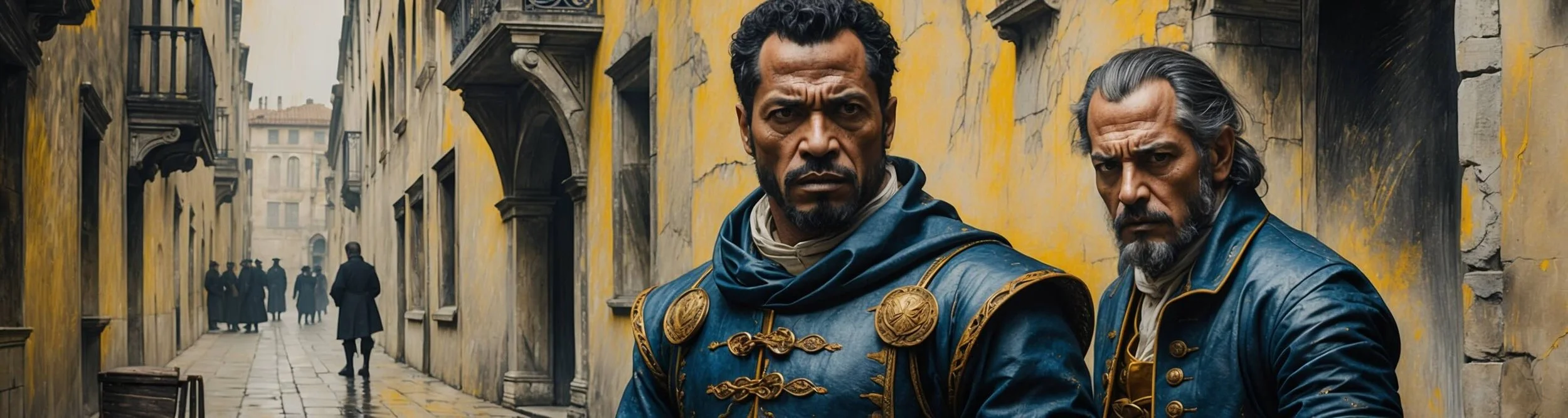
Scene Profile – At a Glance
- Location: Another street in Venice, at night, near Othello's lodging.
- What Happens: Othello appears for the first time, calm and dignified. Iago feigns loyalty and warns him Brabantio means him harm. Cassio brings an urgent summons from the Duke, and Brabantio arrives with armed men to accuse Othello of bewitching Desdemona.
- Key Characters: Othello, Iago, Cassio, and Brabantio.
- Dramatic Function: Othello finally speaks – and instantly refutes the racist caricature of Scene 1, replacing the "black ram" with a composed, self-possessed commander.
- Famous Quote:
"Keep up your bright swords, for the dew will rust them."
(Othello, Act 1, Scene 2) - Why It Matters: The man Venice slandered turns out to be the calmest figure on stage, and Brabantio's witchcraft charge exposes racism dressed up as law.
Scene Summary
The scene moves to another Venetian street, where we meet Othello for the first time. Iago, freshly returned from rousing Brabantio, now plays the loyal subordinate. He tells Othello he was so provoked by the senator's insults that he could barely restrain himself, and he warns the general that the powerful Brabantio will try to break the marriage. Othello is unmoved: his services to the state, and his own noble birth, will answer any complaint.
Torches approach. It is Cassio with officers, sent by the Duke. A crisis has broken out in Cyprus, and the Senate has been searching the city for Othello, dispatching group after group of messengers. Othello steps inside briefly, then prepares to go to the council. While he is gone, Cassio asks Iago why Othello is out so late; Iago hints, with a leer, that the general has "boarded a land carack" – married a fortune – but will not say to whom.
A second group arrives: Brabantio with Roderigo and armed officers, come to seize Othello. Swords are drawn on both sides, but Othello stills the confrontation with a single quiet line. Brabantio then accuses him openly of using witchcraft and drugs to seduce Desdemona, and moves to arrest him. Othello agrees to answer the charge – but reveals that the Duke has already summoned him on state business. Realising the council is sitting even at this hour, Brabantio insists they all go to the Senate, certain the law will take his side.
The Entrance That Refutes the Slander
Everything about Othello's first appearance contradicts the picture painted in Scene 1. The audience has been primed to expect a lustful, thieving "black ram"; instead they meet a measured commander who refuses even to hide from his accusers. When Iago urges him to go indoors and avoid Brabantio's men, Othello calmly declines.
Original
Not I, I must be found:
My parts, my title and my perfect soul
Shall manifest me rightly.
(Othello, Act 1, Scene 2)
Shakespeare Retold (Modern Verse)
No, let them find me.
My strengths, my married status, and my virtues
Will show that I am decent.
The contrast is the whole point of the scene. Where Iago hid in the dark and slipped away before he could be seen, Othello insists on being found, trusting his "title" and "perfect soul" to speak for him. His self-possession is not arrogance but the quiet confidence of a man who has earned his standing by service. Shakespeare stages the central irony of the play in miniature: the figure the city has demonised is, in person, the most honourable man on stage, and the gap between reputation and reality becomes the ground the tragedy will be fought on.
Iago's Two-Faced "Honesty"
Having spent Scene 1 turning Brabantio against Othello, Iago now stands at Othello's side pretending outrage on his behalf. He claims he was so angered by the senator's "scurvy and provoking terms" that he nearly came to violence, casting himself as the loyal protector of the very marriage he has just tried to wreck.
Original
Though in the trade of war I have slain men,
Yet do I hold it very stuff o' the conscience
To do no contrived murder...
(Iago, Act 1, Scene 2)
Shakespeare Retold (Modern Verse)
Although I have killed men fighting in battle,
I hold the firm belief one can’t commit
Premeditated murder...
The performance is brazen. Iago presents himself as a man of conscience, too scrupulous for "contrived murder", at the exact moment he is contriving Othello's ruin. The audience, already let in on his "I am not what I am", watches him build the mask of "honest Iago" in real time – and watches Othello, and later everyone else, accept it. This is the engine of the tragedy: Iago's reputation for blunt honesty is itself his best disguise, and the scene shows him assembling it.
Keeping Up the Bright Swords
The confrontation everyone expects – the enraged father, the armed officers, the "thief" Moor – arrives, and Othello defuses it without raising his voice. As both sides draw their weapons, he stops the violence with a line of almost amused authority.
Original
Keep up your bright swords, for the dew will rust them.
Good signior, you shall more command with years
Than with your weapons.
(Othello, Act 1, Scene 2)
Shakespeare Retold (Modern Verse)
Put down your swords; the dew will make them rusty.
Good sir, your wisdom is more powerful than
Your weapons are.
The control is total. Faced with drawn swords, Othello does not threaten or plead; he tells the men to sheathe their blades before the night dew spoils them, treating an armed mob as a passing inconvenience. The cool understatement marks him as a soldier so sure of his own authority that violence seems beneath him. Against this calm, Brabantio's furious accusation of witchcraft sounds all the more like prejudice flailing for a respectable name – the charge a Venetian father reaches for because he cannot accept that his daughter chose a black man of her own free will.
Language and Technique
- Dramatic contrast: Othello's calm, formal speech is set directly against the animal slurs of Scene 1, refuting the caricature the moment he opens his mouth.
- Understatement: "the dew will rust them" treats an armed standoff as a trivial nuisance, dramatising Othello's effortless authority.
- Dramatic irony: Iago protests his horror of "contrived murder" while contriving Othello's destruction, so every word of his "honesty" curdles for the audience.
- Language of witchcraft: Brabantio's "chains of magic", "foul charms" and "drugs or minerals" dress racial suspicion as a legal charge of sorcery.
- Imagery of rank and worth: Othello answers slander with "my parts, my title and my perfect soul" and "men of royal siege", grounding his dignity in service and birth.
Key Quotes from Act 1, Scene 2
Quote 1My services which I have done the signiory
Shall out-tongue his complaints.
(Othello, Act 1, Scene 2)
Shakespeare Retold (Modern Verse)
The service that I’ve done for those in power
Speaks louder than his gripes.
It is Brabantio. General, be advised;
He comes to bad intent.
(Iago, Act 1, Scene 2)
Shakespeare Retold (Modern Verse)
It is Brabantio. Sir, I have to warn you:
He comes with bad intentions.
O thou foul thief, where hast thou stowed my daughter?
Damned as thou art, thou hast enchanted her...
(Brabantio, Act 1, Scene 2)
Shakespeare Retold (Modern Verse)
You bloody thief, where have you put my daughter?
Because you’re damned, you’ve cast a spell on her.
Key Takeaways
- Othello refutes the slander: His calm, dignified entrance overturns the racist "black ram" caricature of the opening scene the instant he speaks.
- Reputation through service: Othello grounds his worth in what he has done for Venice, not in birth alone – the confidence that will later be his weakness.
- Iago's mask: Iago plays the loyal friend who "warns" Othello of Brabantio, building the false honesty that hides his guilt.
- Witchcraft as prejudice: Brabantio accuses Othello of bewitching Desdemona because he cannot accept she chose a black man freely.
Study Questions and Analysis
How does Othello's first appearance change our view of him?
The shock of the scene is how thoroughly Othello contradicts everything Scene 1 told us to expect. We have heard him called "the Moor", "the thicklips", "an old black ram" and "the devil" – lustful, thieving, monstrous. The man who walks on is none of these things. He is calm, courteous and entirely in control, refusing even to hide from the men coming to arrest him.
Not I, I must be found:
My parts, my title and my perfect soul
Shall manifest me rightly.
(Othello, Act 1, Scene 2)
Shakespeare Retold (Modern Verse)
No, let them find me.
My strengths, my married status, and my virtues
Will show that I am decent.
By staging the slander first and the man second, Shakespeare makes the audience feel the force of Venice's prejudice and then watch it exposed as a lie. G. Wilson Knight, in The Wheel of Fire (1930), described the grand, separate quality of Othello's speech – what he called "the Othello music" – and it is heard here for the first time, in the stately confidence with which Othello trusts his "perfect soul" to speak for him. The dignity is real, and the tragedy lies in how completely Iago will dismantle it.
What does "Keep up your bright swords" show about Othello?
It shows authority so secure it never needs to raise its voice. When Brabantio's officers and Othello's own men draw their weapons, a lesser figure might threaten or fight; Othello simply tells everyone to put their swords away before the night dew rusts the blades.
Keep up your bright swords, for the dew will rust them.
Good signior, you shall more command with years
Than with your weapons.
(Othello, Act 1, Scene 2)
Shakespeare Retold (Modern Verse)
Put down your swords; the dew will make them rusty.
Good sir, your wisdom is more powerful than
Your weapons are.
The line works through understatement: by treating an armed standoff as a trivial inconvenience, Othello reveals a soldier so practised in command that violence seems beneath him. It is also a sign of his maturity, gently reminding Brabantio that "years" and judgement carry more weight than steel. A. C. Bradley, in Shakespearean Tragedy (1904), stressed Othello's natural nobility and the fact that he is not, by temperament, a jealous or violent man – a reading this moment of effortless calm strongly supports. The pathos of the play is that this poise will be destroyed not by an army but by a whisper.
How is Iago two-faced in this scene?
The scene is a masterclass in Iago's duplicity. Having spent Scene 1 inciting Brabantio against Othello, he now stands at Othello's side as the loyal ensign, claiming he could barely keep himself from striking the senator who insulted his general. He even parades a tender conscience, protesting his horror of "contrived murder" while contriving Othello's downfall, and helpfully "warns" Othello that Brabantio "comes to bad intent" – danger he himself created.
This is the foundation of "honest Iago", the reputation that lets him work undetected for the rest of the play. W. H. Auden, in The Dyer's Hand (1962), saw Iago as a kind of practical joker and experimenter, manipulating people for the cold pleasure of seeing what he can make them do; the relish with which he performs loyalty here fits that reading. Stephen Greenblatt, in Renaissance Self-Fashioning (1980), described him as an improviser who shapes himself to whatever each situation requires – protector to Othello one moment, tormentor of Brabantio the next. The audience, already in on the secret, watches the mask being fitted into place.
Why does Brabantio accuse Othello of witchcraft?
Because he cannot imagine any other explanation for his daughter's choice. To Brabantio, a "tender, fair and happy" girl who had refused "the wealthy curled darlings of our nation" could never freely run to "the sooty bosom" of a black man – so she must have been drugged or enchanted.
O thou foul thief, where hast thou stowed my daughter?
Damned as thou art, thou hast enchanted her...
(Brabantio, Act 1, Scene 2)
Shakespeare Retold (Modern Verse)
You bloody thief, where have you put my daughter?
Because you’re damned, you’ve cast a spell on her.
The witchcraft charge is racism given a legal shape. Unable to accept that Desdemona desired Othello, Brabantio converts his prejudice into an accusation the Senate might actually try. Ania Loomba, in Gender, Race, Renaissance Drama (1989), read Othello as an admired outsider hemmed in by exactly this kind of suspicion – valued for his service yet never fully accepted – while Karen Newman, in "'And wash the Ethiop white'" (1987), showed how the period coded a union of black man and white woman as "monstrous", the very assumption Brabantio voices. The charge will not survive contact with Othello's calm account before the Senate, which is precisely Shakespeare's point.
What is the significance of Cassio's arrival with the Duke's summons?
Cassio's entrance does two things at once. First, it raises the stakes of the whole play: a military crisis has erupted in Cyprus, and the Senate is so desperate for Othello that it has sent "a dozen sequent messengers" and three separate search parties to find him in the middle of the night. The state's urgent need for Othello sits in pointed contrast to Brabantio's attempt to arrest him – the same man is, on the same night, both a wanted criminal and an indispensable general.
Second, it tilts the confrontation in Othello's favour before it even reaches the Senate. When Brabantio discovers the Duke is already in council and that Othello has been summoned, his confidence that the law will simply side with him begins to look misplaced. The arrival also lets Iago perform once more, teasing Cassio about the "land carack" Othello has "boarded" without naming Desdemona – reducing the marriage to a bawdy joke about plunder even as he plays the affable comrade.
How does this scene develop the theme of appearance versus reality?
The scene is built on the gap between what people are said to be and what they are. Othello has been described as a monster; he turns out to be the calmest, most dignified man on stage. Iago is trusted as an honest friend; he is the source of every lie. Brabantio frames a legal charge of witchcraft; it is really wounded prejudice. Nothing in the scene is quite what its surface claims.
This is the theme of appearance versus reality that runs through the whole tragedy, and it is bound up with reputation and honour: Othello stakes his identity on his good name and his service, which makes him fatally exposed to a man who can poison reputations at will. F. R. Leavis, in The Common Pursuit (1952), argued controversially that the flaw lies in Othello himself – in a self-dramatising pride visible even in these noble speeches – while A. C. Bradley defended his essential nobility. The scene gives both critics their evidence: the dignity is genuine, but so is the dependence on how he is seen, and that dependence is the crack through which Iago will work.