Othello: Act 1, Scene 3 – Analysis
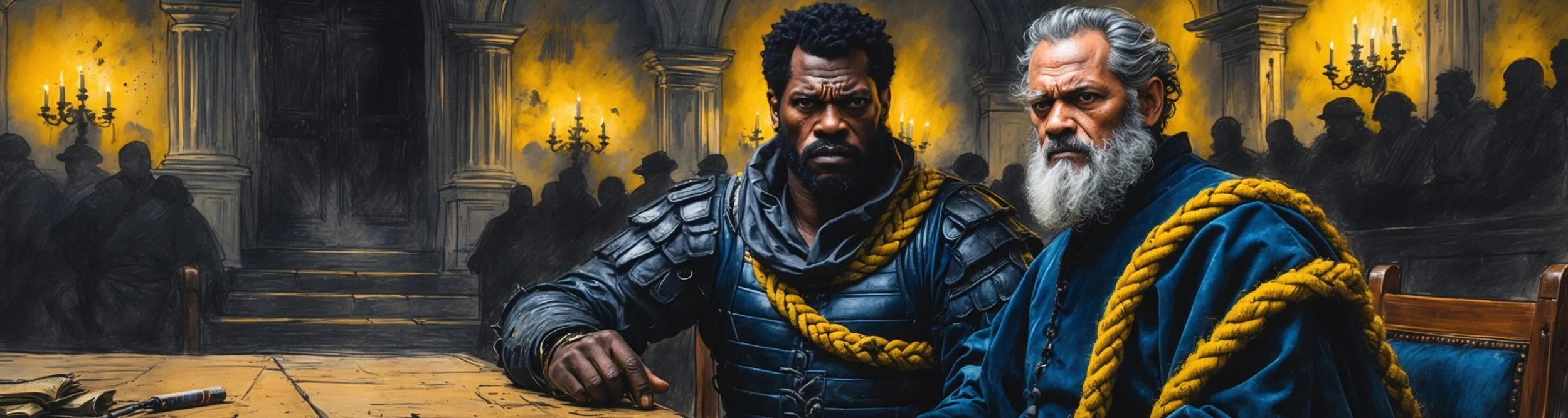
Scene Profile – At a Glance
- Location: A council-chamber in Venice, at night.
- What Happens: The Duke and senators meet over the Turkish threat to Cyprus when Brabantio bursts in accusing Othello of bewitching his daughter. Othello defends the marriage, Desdemona affirms her free choice, and the Duke sends Othello to Cyprus. Left alone, Iago plots.
- Key Characters: Othello, Desdemona, Brabantio, Iago, and Roderigo, with the Duke of Venice.
- Dramatic Function: The marriage is tried and approved in public, the lovers are sent to Cyprus, and Iago is left alone to hatch the plot that drives the rest of the play.
- Famous Quote:
"She loved me for the dangers I had passed,
And I loved her that she did pity them."
(Othello, Act 1, Scene 3) - Why It Matters: Othello and Desdemona win their case but lose their safety. The scene shows their love at its most articulate and plants the seeds – Brabantio's warning, Iago's hatred – that the tragedy will grow from.
Scene Summary
The scene opens in the Venetian council-chamber, where the Duke and his senators are trying to make sense of conflicting reports about a Turkish fleet. The numbers in their letters disagree, but they agree on the essential point: the Turks are bearing down on the Venetian colony of Cyprus. A feint towards Rhodes is quickly seen through, and the Duke prepares to send Othello to defend the island.
Into this emergency bursts Brabantio, too consumed by private grief to care about the war. He accuses Othello of stealing and corrupting his daughter by witchcraft, demanding justice. The Duke, before he realises the accused is his own general, promises Brabantio the full force of the law – then has to listen as the charge is laid against the very man Venice needs.
Othello answers with calm dignity. Admitting only that he has married Desdemona, he asks leave to tell the story of his courtship: how Brabantio himself often invited him to recount his life of battles, slavery and travel, how Desdemona listened with a "greedy ear", and how she came to love him for his sufferings. "She loved me for the dangers I had passed," he explains, "And I loved her that she did pity them." This, he says, is the only witchcraft he used.
Desdemona is summoned and confirms it. Standing before her father and the Senate, she acknowledges a "divided duty": she owes Brabantio her life and upbringing, but now owes obedience to her husband as her mother once did to him. Brabantio, defeated, bitterly gives her up – and fires a parting shot: "She has deceived her father, and may thee."
The Duke confirms Othello's posting to Cyprus, and Desdemona insists on going with him rather than being left behind. With the couple sent ahead, the public business closes. Left alone with Roderigo, Iago talks the despairing suitor out of suicide and into bankrolling his schemes – "Put money in thy purse" – before, alone at last, he turns to the audience and lays out his plan to destroy them all.
The Senate and the Turkish Threat
The scene opens not with the lovers but with affairs of state, and the contrast matters. Where Brabantio will arrive choked with private emotion, the Duke and senators are cool, sceptical men weighing evidence. They notice that their reports disagree and refuse to panic, reasoning their way through a Turkish feint towards Rhodes to the real target, Cyprus. Shakespeare gives Venice a working political brain before he tests it with a marriage it cannot understand.
Original
'Tis oft with difference – yet do they all confirm
A Turkish fleet, and bearing up to Cyprus.
(Second Senator, Act 1, Scene 3)
Shakespeare Retold (Modern Verse)
These differences occur – yet all agree
A Turkish fleet is bearing down on Cyprus.
The senators' method – sift the conflicting accounts, discount the numbers, trust the pattern – is exactly the rational judgement the scene will deny Brabantio and, later, Othello himself. It is a quiet irony that Venice can read a fleet correctly but cannot read a daughter's heart, and that the general trusted to defend the state will be undone by a manipulator whose evidence is far thinner than these letters. The state's competence here only sharpens the private catastrophe to come.
Brabantio's Accusation of Witchcraft
Brabantio cannot conceive that Desdemona chose Othello freely, and so he reaches for the only explanation his world allows: she must have been drugged or enchanted. His grief is genuine, but it is shaped entirely by the assumption that a quiet, obedient daughter could never desire a black foreigner without supernatural interference.
Original
She is abused, stol'n from me, and corrupted
By spells and medicines bought of mountebanks;
(Brabantio, Act 1, Scene 3)
Shakespeare Retold (Modern Verse)
She’s been abused, corrupted, stolen from me
By magic spells a witchdoctor has cast;
The language of theft – "stol'n from me" – treats Desdemona as property rather than a person with a will of her own, while "witchcraft" lets Brabantio avoid the unbearable truth that she acted by choice. The charge also activates a real Elizabethan fear: a black man accused of using sorcery to seduce a white woman taps directly into the period's anxieties about race and sexuality. Brabantio is both a wounded father and a mouthpiece for those prejudices, and the scene's drama lies in watching Othello dismantle the accusation not with a counter-charge but with a story.
Othello's Defence: Wooing by Storytelling
Othello's answer to the charge of witchcraft is one of the great set-piece speeches in Shakespeare. Instead of denying that he won Desdemona by enchantment, he redefines enchantment as narrative: he tells the Senate how he told Desdemona the story of his life, and how the telling itself was the spell. The speech is poised, grand and self-aware – the "Othello music" critics hear throughout the play.
Original
She loved me for the dangers I had passed,
And I loved her that she did pity them.
(Othello, Act 1, Scene 3)
Shakespeare Retold (Modern Verse)
She loved me for the dangers I had faced,
And I loved her for pitying my plight.
The couplet is beautifully balanced – her love mirrors his, pity answered by gratitude – and it sounds like the perfect account of their union. Yet it also exposes a fault line the tragedy will widen. Their love is built on a story: she loves the dangers he has survived, and he loves her response to them, which means the bond rests on Othello's image of himself as a hero and on Desdemona's admiration for it. A man who has wooed by self-narration is a man whose love can be unsettled if that narrative is poisoned – which is exactly what Iago will do.
Desdemona's Divided Duty
When Desdemona speaks, she does not deny her father but reframes her obligation. Borrowing the very logic of duty that Brabantio uses against her, she points out that his own wife transferred her allegiance from father to husband – and that she is simply doing the same. It is a calm, unanswerable piece of reasoning delivered in public by a young woman the scene has been told is shy and still.
Original
I do perceive here a divided duty:
To you I am bound for life and education;
(Desdemona, Act 1, Scene 3)
Shakespeare Retold (Modern Verse)
I see my obligations are divided.
I owe you both my life and education;
"Divided duty" is the precise phrase for Desdemona's situation and for the play's view of a wife's place: she does not reject obedience, only redirects it from father to husband. Her self-possession here is striking – she is articulate, decisive and quietly defiant – and it makes her later helplessness all the more tragic. The same Desdemona who can face down the Senate will be unable to defend herself against a charge she cannot even understand. Her honesty is total, and in this world that openness is a vulnerability waiting to be exploited.
Iago's Plot Takes Shape
With the public scene over, the stage empties to leave Iago alone with Roderigo, and the register drops from the verse of the Senate to scheming prose. Iago talks the suicidal Roderigo back from the edge with a cynical lecture on self-control – we are masters of our own gardens, love is just lust – and a refrain that becomes the scene's drumbeat: keep paying me.
Original
I hate the Moor: my cause is hearted; thine hath no less reason. Let us be conjunctive in our revenge against him...
(Iago, Act 1, Scene 3)
Shakespeare Retold (Modern Verse)
I hate the Moor with all my heart; you have no less reason to hate him. Let’s work together to reap our revenge against him...
Once Roderigo is gone, Iago turns to the audience and assembles his scheme aloud: he will use Roderigo as a purse, exploit a rumour that Othello has slept with his wife, and frame the handsome Cassio to make Othello jealous. The plan is improvised in front of us – "Let me see now" – which is part of what makes Iago so disturbing: he does not have a finished plot so much as a talent for inventing one. The soliloquy closes the act on an image of monstrous birth, the plot conceived in darkness and waiting to be delivered into the world.
Language and Technique
- The "Othello music": Othello's defence speech is grand, measured and full of exotic detail – "antres vast and deserts idle" – a distinctive heroic style that critics call the Othello music and that Iago will later work to destroy.
- Verse versus prose: The Senate speaks in dignified blank verse; Iago and Roderigo drop into scheming prose, marking the shift from public ceremony to private plotting.
- Imagery of witchcraft and magic: "Spells", "medicines", "drugs" and "charms" recur as Brabantio insists love must be sorcery, and Othello pointedly reclaims the word: "This only is the witchcraft I have used."
- The language of duty: Desdemona's "divided duty" turns the patriarchal vocabulary of obedience against her father, redirecting it rather than rejecting it.
- Rhyming couplets: The Duke's consoling "sentences" and Brabantio's bitter reply fall into rhyme, giving proverbial weight to the scene's debate about grief and acceptance.
- Soliloquy and dramatic irony: Iago's closing soliloquy lets the audience watch the plot being invented, so that we know more than any character on stage.
Key Quotes from Act 1, Scene 3
Quote 1Rude am I in my speech,
And little blessed with the soft phrase of peace:
(Othello, Act 1, Scene 3)
Shakespeare Retold (Modern Verse)
I use course words when speaking
And am not gifted with tenacity:
She'ld come again, and with a greedy ear
Devour up my discourse...
(Othello, Act 1, Scene 3)
Shakespeare Retold (Modern Verse)
And then return, inquisitively listening
To gobble up my stories...
Look to her, Moor, if thou hast eyes to see:
She has deceived her father, and may thee.
(Brabantio, Act 1, Scene 3)
Shakespeare Retold (Modern Verse)
Beware of her, Moor; if your eyes can view,
You’ll see she tricked me, and she will trick you.
The Moor is of a free and open nature,
That thinks men honest that but seem to be so,
(Iago, Act 1, Scene 3)
Shakespeare Retold (Modern Verse)
The Moor is unsuspecting, open-minded,
And thinks all honest-looking men are honest,
I have't. It is engendered. Hell and night
Must bring this monstrous birth to the world's light.
(Iago, Act 1, Scene 3)
Shakespeare Retold (Modern Verse)
I’ve got it; it will happen. Merry hell
Must help my heinous plan occur as well.
Key Takeaways
- A public trial of the marriage: The Senate scene puts Othello and Desdemona's union on trial and, for the moment, vindicates it before the highest authority in Venice.
- Love built on a story: Othello wins Desdemona by telling the tale of his life, a bond rooted in narrative that leaves the relationship open to a rival storyteller.
- Desdemona's agency: Far from a passive victim, Desdemona defends her free choice with composure, redirecting duty from father to husband.
- The seed of suspicion: Brabantio's warning that Desdemona may deceive her husband as she deceived him plants the idea Iago will later exploit.
- The plot is born: Iago closes the act by stringing Roderigo along and inventing, in soliloquy, the scheme that will destroy them all.
Study Questions and Analysis
How does Othello defend himself against the charge of witchcraft?
Othello does not deny that he won Desdemona by something like enchantment; instead he redefines what the enchantment was. He admits openly that he has married her, calls that the whole "head and front" of his offence, and then asks leave to tell the Senate how the courtship actually happened. His defence is a story: Brabantio himself often invited him home and asked to hear his life, and Desdemona, listening, fell in love with the man those stories revealed.
She loved me for the dangers I had passed,
And I loved her that she did pity them.
This only is the witchcraft I have used:
(Othello, Act 1, Scene 3)
Shakespeare Retold (Modern Verse)
She loved me for the dangers I had faced,
And I loved her for pitying my plight.
This is the only witchcraft I have used.
By reclaiming the word "witchcraft" and applying it to nothing more sinister than honest storytelling, Othello turns the accusation inside out. The Duke is convinced – "I think this tale would win my daughter too" – and the marriage is effectively endorsed by the state. G. Wilson Knight, in The Wheel of Fire (1930), heard in such speeches a distinctive grandeur he called the "Othello music": a spacious, ceremonial style that sets Othello apart and whose later collapse measures the depth of his fall. The very eloquence that saves him here is part of what makes his disintegration so terrible to watch.
What does Desdemona's "divided duty" speech reveal about her character?
It reveals a young woman far stronger and more self-possessed than the shy, fearful girl her father has described. Summoned to declare where her loyalty lies, Desdemona does not waver or apologise. She acknowledges a genuine obligation to her father, then calmly argues that marriage transfers that obligation to her husband, exactly as her own mother transferred hers from her father to Brabantio.
I am hitherto your daughter: but here's my husband,
And so much duty as my mother showed
To you, preferring you before her father,
So much I challenge that I may profess
Due to the Moor my lord.
(Desdemona, Act 1, Scene 3)
Shakespeare Retold (Modern Verse)
To you for I’m your daughter. But here’s my husband,
And like the duty that my mother showed
To you, by putting you before her father,
Although you will not like it, I’m obliged
To serve the Moor, my husband.
The argument is unanswerable because it uses Brabantio's own values against him: she is not rejecting duty but fulfilling it in its proper, adult form. Critics have long noted the gap between this Desdemona – eloquent, decisive, publicly defiant – and the one who later seems unable to defend herself. The point is not inconsistency but tragedy: the same honesty and openness that make her so admirable here become, in Iago's hands, the qualities that doom her. A woman who speaks the plain truth has no defence against a world that has been persuaded she is lying.
Why does Shakespeare begin the scene with the Senate and the Turkish threat?
The opening debate about the Turkish fleet does more than supply plot. It establishes Venice as a rational, functioning state and gives the audience a standard of clear-headed judgement against which the private drama can be measured. The senators notice that their letters disagree, refuse to be alarmed by the numbers, and reason their way to the truth that Cyprus, not Rhodes, is the target.
This competence sets up a series of ironies. The same state that can read a military deception cannot comprehend a love-match that crosses lines of race and age, and the general it trusts to defend its empire will be undone by a deceiver running a far cruder bluff than the Turks. The Cyprus posting is also structurally vital: it removes Othello and Desdemona from the relative safety of Venice, with its courts and senators, to an isolated island where Iago can work on Othello unobserved. The war that opens the scene is the mechanism that strands the lovers within reach of their destroyer.
How does the scene present race and prejudice?
The scene stages a collision between two views of Othello. To Brabantio, his blackness is proof that the marriage is unnatural: a quiet, well-bred Venetian girl could not possibly love a black foreigner unless she had been drugged or bewitched. His accusation draws on a real Elizabethan association between blackness, sorcery and dangerous sexuality, and the witchcraft charge is inseparable from his racism.
Against this, the scene gives us an Othello of immense dignity, valued by the state and eloquent in his own defence, whose nobility refutes the prejudice point by point. Yet even his vindication is double-edged. Ania Loomba, in Gender, Race, Renaissance Drama (1989), argued that Othello is admired precisely as an exotic outsider – useful, fascinating, but never quite allowed to belong – so that his acceptance is always conditional. Karen Newman, in "'And wash the Ethiop white'" (1987), read the union of black man and white woman as the "monstrous" image the play both stages and interrogates. Even the Duke's well-meant compliment that Othello is "more fair than black" reveals the assumption it tries to soften: that fairness is good and blackness something to be excused.
How is the love between Othello and Desdemona presented in this scene?
At its high point and at its most vulnerable, both at once. The scene gives the lovers their fullest, most articulate expression: Othello's account of the courtship is tender and generous, Desdemona's defence of her choice is brave and clear, and their mutual devotion is publicly affirmed and officially blessed. For one moment the marriage stands triumphant, endorsed by the Duke against a father's objection.
I saw Othello's visage in his mind,
And to his honour and his valiant parts
Did I my soul and fortunes consecrate.
(Desdemona, Act 1, Scene 3)
Shakespeare Retold (Modern Verse)
I came to know Othello’s character,
And for his decency and bravery
I wed my soul and fortune to this man.
Yet the very basis of the love hints at its fragility. Desdemona loves Othello for his "honour" and "valiant parts" – for his heroic self-image – and Othello loves her for loving that image back. It is a bond built on story and reputation rather than on long, ordinary intimacy, which is part of why love and betrayal become so closely entwined: a love founded on a man's account of himself can be shaken when that account is corrupted. The theme of reputation and honour is woven into the romance from the start.
What is the significance of "Put money in thy purse"?
The repeated command "Put money in thy purse" is Iago's manipulation in miniature. Roderigo, despairing of ever winning Desdemona, threatens to drown himself; Iago talks him out of it not with comfort but with cynicism, insisting that love is merely "a lust of the blood and a permission of the will" and that Desdemona will soon tire of Othello. The cure for heartbreak, he says, is cash.
Put money in thy purse; follow thou the wars; defeat thy favour with an usurped beard; I say, put money in thy purse.
(Iago, Act 1, Scene 3)
Shakespeare Retold (Modern Verse)
Put some money aside in your wallet; follow what is happening in the wars; change how you look by wearing a false beard; I tell you, stash some cash.
The phrase, hammered home again and again, keeps Roderigo paying for a hope Iago knows is false – "Thus do I ever make my fool my purse." It shows Iago's contempt for the man he flatters and his method of binding people to him through their own desires. W. H. Auden, in The Dyer's Hand (1962), saw Iago as a kind of practical joker and nihilist experimenter, manipulating others for the pleasure of the game as much as for any goal; the casual cruelty of using a grieving fool as a wallet is exactly that pleasure in action.
What does Iago's closing soliloquy tell us about his motives and method?
The soliloquy is where Iago invents his plot in front of us, and its most striking feature is how little settled motive lies behind it. He states his hatred plainly – "I hate the Moor" – then gropes for reasons: a rumour that Othello has slept with his wife Emilia, which he admits he does not even believe, and the simple usefulness of Cassio as bait. The reasons feel assembled after the fact, in support of a malice that came first.
The Moor is of a free and open nature,
That thinks men honest that but seem to be so,
And will as tenderly be led by the nose
As asses are.
(Iago, Act 1, Scene 3)
Shakespeare Retold (Modern Verse)
The Moor is unsuspecting, open-minded,
And thinks all honest-looking men are honest,
And will be gently led on by the nose
Just like a donkey.
Samuel Taylor Coleridge, in his lectures on Shakespeare around 1818, famously described this kind of speech as "the motive-hunting of a motiveless malignity": Iago casting about for justifications that never quite explain him. The phrase "Let me see now" captures how the plot is improvised rather than premeditated, and Stephen Greenblatt, in Renaissance Self-Fashioning (1980), read Iago as exactly this kind of opportunist, an improviser who shapes a scheme out of whatever materials a situation offers. What the soliloquy makes unmistakable is the theme of manipulation and deceit: we now know the plan, and must watch it unfold on characters who do not.
Why is Brabantio's warning "She has deceived her father, and may thee" so important?
It is the single most consequential line Brabantio speaks, because it hands Iago his weapon. Defeated and embittered, Brabantio leaves with a curse disguised as a warning: a daughter who deceived her father by marrying secretly will deceive her husband too. He reframes Desdemona's one act of independent choice as evidence of a deceitful nature.
Look to her, Moor, if thou hast eyes to see:
She has deceived her father, and may thee.
(Brabantio, Act 1, Scene 3)
Shakespeare Retold (Modern Verse)
Beware of her, Moor; if your eyes can view,
You’ll see she tricked me, and she will trick you.
Othello brushes it off – "My life upon her faith!" – but the idea has been spoken, and Iago will retrieve it at the crucial moment, reminding Othello that Desdemona deceived her father and so might deceive him. The line shows how the patriarchal anxiety running through the play – the fear of female independence read as female treachery – supplies the raw material for the tragedy. It connects directly to the theme of appearance versus reality: Brabantio insists that Desdemona's loving appearance hides a deceiver, the very lie Iago will spend the play persuading Othello to believe.
How does this scene set up the tragedy that follows?
Almost every thread the tragedy will pull is laid in this scene. The marriage is publicly tested and approved, which makes its later destruction all the more devastating; the lovers are sent to Cyprus, isolating them where Iago can operate freely; and Iago's plot, complete with its central tactic of poisoning Othello against Cassio and Desdemona, is announced to the audience in soliloquy. We leave the act knowing exactly what is coming while every sympathetic character remains in the dark.
The scene also plants the psychological seeds. Othello's love rests on storytelling and on his heroic self-image, both of which Iago will corrupt; Desdemona's frank, public honesty becomes the openness a slanderer can exploit; and Brabantio's parting warning gives Iago a ready-made argument. A. C. Bradley, in Shakespearean Tragedy (1904), stressed that Othello is not by nature a jealous man but a noble and trusting one, so that the catastrophe requires the extraordinary skill this scene shows Iago possessing. The tragedy works precisely because the love here is real and the man is admirable: the higher the marriage is raised in Act 1, the further it has to fall.