Othello: Act 2, Scene 1 – Analysis
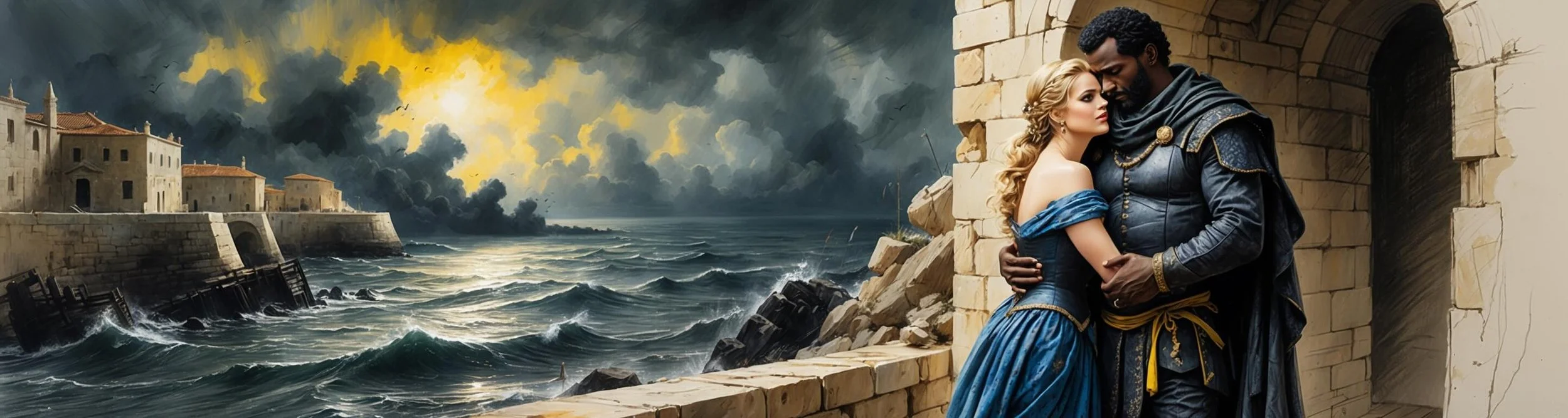
Scene Profile – At a Glance
- Location: A seaport in Cyprus, near the quay, after a storm.
- What Happens: A tempest destroys the Turkish fleet, ending the war before it starts. Cassio, Desdemona and Othello land safely and reunite in joy. Iago, left with Roderigo, begins planting the lie that Desdemona loves Cassio.
- Key Characters: Othello, Desdemona, Cassio, Iago, Emilia, and Roderigo.
- Dramatic Function: The war evaporates and the play turns inward – from public danger to private destruction. It marks the peak of Othello's happiness and the moment Iago's plot against it begins in earnest.
- Famous Quote:
"O my fair warrior!"
(Othello, Act 2, Scene 1) - Why It Matters: We see the marriage at its highest point precisely so that we feel its fall. Iago's closing vow to "pour this pestilence" sets the tragedy in motion.
Scene Summary
The scene opens on the coast of Cyprus, where Montano, the island's governor, and two gentlemen watch a violent storm batter the sea. Word soon arrives that the tempest has scattered and wrecked the Turkish fleet, so the war the Venetians sailed to fight is over before it begins. The danger now is the weather itself, which has separated the ships carrying Othello and his party.
Cassio lands first, anxious for his general's safety, and greets the arrival of Desdemona with elaborate courtesy. While they wait for Othello, Iago entertains the company with cynical, mocking talk about women, sparring with his wife Emilia and trading wit with Desdemona. Cassio takes Desdemona's hand and speaks gallantly, and Iago, watching, decides he can use this innocent courtesy against him.
Othello arrives last, and his reunion with Desdemona is a moment of pure rapture: he calls her his "fair warrior" and says that if he were to die now he could not be happier. The lovers go up to the castle, leaving Iago alone with Roderigo. Iago sets to work, insisting that Desdemona is already tired of Othello and is falling for Cassio, and persuading Roderigo to provoke Cassio into a brawl that night.
Left alone, Iago turns to the audience. He admits he half believes his own slander, confesses his hatred of the Moor, hints darkly at his own lust and his suspicion that Othello has slept with Emilia, and resolves to drive Othello mad with jealousy. The scene that began in storm and survival ends with a man calmly planning ruin.
The Storm and the Vanished War
The act opens not with armies but with weather. Montano and the gentlemen strain to see through a tempest so fierce it seems to assault the heavens themselves, and the language gives the storm an almost cosmic violence – waves that reach for the stars and shake the fixed pole. Then the news comes that the Turkish fleet is destroyed, and the whole military plot simply dissolves.
Original
News, lads! Our wars are done.
(Third Gentleman, Act 2, Scene 1)
Shakespeare Retold (Modern Verse)
I’ve got some news, lads! Our war is over.
By disposing of the war in a single line, Shakespeare clears the stage of every external threat. There will be no battle, no siege, no enemy to fight; the only danger left is the one already on shore. The storm has done its work, and from here the play turns inward, away from Venice and the public world and towards the private, domestic destruction that Iago will engineer. The grandeur of the opening only sharpens the irony: the great fleet is undone by weather, while a marriage will be undone by a whisper.
Iago on Women
While they wait for Othello, Iago fills the time with a performance of comic misogyny, ranking women by beauty and wit and finding every type wanting. The banter is light on the surface and ugly underneath, reducing all women to creatures who are decorative in public and dangerous at home. When Desdemona presses him to praise her, he can only manage a sour, dismissive verdict.
Original
She was a wight, if ever such wight were, –
(Iago, Act 2, Scene 1)
Shakespeare Retold (Modern Verse)
That is the woman, if such woman offers…
The whole set-piece matters because of what it reveals and what it conceals. It exposes Iago's settled contempt for women, the cast of mind that will let him believe, and make Othello believe, that Desdemona is false. Yet to the company on stage it is just bluff soldierly humour, and Desdemona's amused sparring shows how easily his poison passes for harmless fun. Cassio reads it correctly – he warns that Iago speaks "home", more soldier than scholar – but no one suspects that the man joking about women's faithlessness is already plotting to prove a faithful wife false.
The Reunion and Iago's Aside
Othello's entrance transforms the scene. His greeting to Desdemona is ecstatic, and his great speech reaches a height of contentment so complete that he would happily die in it rather than risk that the future holds anything less.
Original
If it were now to die,
’Twere now to be most happy; for, I fear,
(Othello, Act 2, Scene 1)
Shakespeare Retold (Modern Verse)
If I just died now,
I’d die completely happy; and I fear
It is the emotional summit of the play, and Shakespeare places it here deliberately so that everything after it can be a fall. Even Othello's own words carry a tremor of dread – he fears no joy can ever match this one – and the audience, who have just watched Iago at work, hears the warning he cannot. The point is hammered home by Iago's aside, in which he promises to loosen the very strings that make this music. The lovers' harmony becomes, in his mouth, an instrument he intends to put out of tune. Joy and the plot to destroy it share the same stage, the same breath.
Language and Technique
- Storm imagery: The opening describes waves that "cast water on the burning bear", giving the tempest a cosmic scale that dwarfs the human action and clears away the war.
- Dramatic irony: Othello's "If it were now to die" is spoken at the peak of joy, but the audience, already in Iago's confidence, hears it as a death sentence.
- Music as metaphor: Iago vows to "set down the pegs" that make the lovers' music, casting their harmony as an instrument he will deliberately put out of tune.
- Prose and verse: The misogynistic banter drops into witty prose, marking it as casual sport, before Othello's arrival lifts the scene back into soaring blank verse.
- Soliloquy: Iago's closing speech lets the audience hear motives he hides from everyone on stage – jealousy, lust, and a hatred that hunts for reasons.
Key Quotes from Act 2, Scene 1
Quote 1The desperate tempest hath so banged the Turks,
That their designment halts: a noble ship of Venice...
(Third Gentleman, Act 2, Scene 1)
Shakespeare Retold (Modern Verse)
This awful storm lambasted Turkish ships
So much, their mission’s stopped: a noble ship from Venice...
You are pictures out of doors,
Bells in your parlours, wild-cats in your kitchens,
(Iago, Act 2, Scene 1)
Shakespeare Retold (Modern Verse)
You’re picture-perfect out in public,
Belle-of-the-ball, but screech like cats in kitchens,
O my soul’s joy!
If after every tempest come such calms,
(Othello, Act 2, Scene 1)
Shakespeare Retold (Modern Verse)
I’m delighted!
If after every storm comes such delight,
O, you are well tuned now!
But I’ll set down the pegs that make this music,
(Iago, Act 2, Scene 1)
Shakespeare Retold (Modern Verse)
Your life’s in tune now,
But I’ll untune the strings upon your lute,
The Moor, howbeit that I endure him not,
Is of a constant, loving, noble nature,
(Iago, Act 2, Scene 1)
Shakespeare Retold (Modern Verse)
The Moor, although I utterly despise him,
Is loyal, loving, and a decent man, and,
Key Takeaways
- The war ends: A storm destroys the Turkish fleet, so the play loses its public conflict and turns inward to private destruction.
- The peak of joy: Othello and Desdemona reunite in rapture, and Shakespeare places their happiest moment here so that the fall hurts more.
- Iago at work: He twists Cassio's courtesy into evidence and plants the lie that Desdemona loves him, beginning the plot in earnest.
- Misogyny rehearsed: Iago's mocking talk about women previews the contempt that will let him believe, and prove, a faithful wife false.
- A motiveless malice: Alone, Iago admits Othello is noble yet vows to ruin him anyway, exposing his motives as excuses.
Study Questions and Analysis
What is the significance of the storm in Act 2, Scene 1?
The storm is both a literal event and a structural device. It destroys the Turkish fleet offstage, which means the war the Venetians sailed to fight never happens, and the entire military plot of the first act simply vanishes. The gentlemen describe the tempest in vast, cosmic terms, as though the heavens themselves are at war.
I never did like molestation view
On the enchafed flood.
(Second Gentleman, Act 2, Scene 1)
Shakespeare Retold (Modern Verse)
I’ve never seen it more tempestuous
Out on the angry sea.
By clearing away the external enemy so quickly, Shakespeare strips the play of any public danger and forces the action inward, into the marriage and into Iago's mind. The grandeur of the storm also functions ironically: the great Turkish fleet is undone by mere weather, while the far smaller, more intimate threat – one man's whisper – will undo the far greater thing, a love and a life. Critics have noted that the storm marks the play's shift from a tragedy of state to a domestic tragedy, the field of battle moving from the sea to the bedroom.
Why is Othello's reunion with Desdemona so important?
It is the high-water mark of the play's happiness, and Shakespeare positions it with great care. Othello lands last, having survived the storm, and greets Desdemona with a joy so total that he says he could die content rather than risk a future that holds anything less.
That not another comfort like to this
Succeeds in unknown fate.
(Othello, Act 2, Scene 1)
Shakespeare Retold (Modern Verse)
That I will never be as happy as this
Whatever is to come.
The speech is shadowed by its own foreboding – Othello half fears that such joy cannot last – and the audience, who have just watched Iago plotting, hears the fear as prophecy. G. Wilson Knight, in The Wheel of Fire (1930), called the hero's grand, separate style "the Othello music", and this reunion is one of its purest moments; the tragedy will be the slow collapse of exactly this music into chaos. By giving us the marriage at its most radiant here, Shakespeare ensures that every later cruelty is measured against it.
How does Iago manipulate Roderigo in this scene?
Iago works on Roderigo by exploiting his desperate, gullible love for Desdemona. He flatly asserts that Desdemona is already in love with Cassio, then constructs a plausible-sounding argument: she only married Othello for his exotic stories, she will soon tire of him, and her eye will naturally turn to a younger, handsomer man like Cassio. When Roderigo protests that Desdemona is virtuous, Iago brushes it aside and points to the innocent moment when Cassio took her hand as proof of a budding affair.
Having convinced him, Iago gives Roderigo a task: to provoke Cassio into a fight that night, which will discredit the lieutenant and clear the way for Roderigo's own hopes. The manipulation follows a pattern the audience already recognises from the first scene – Iago supplies a story, attaches it to something the dupe already wants to believe, and then turns belief into action. Roderigo does the dangerous work while Iago keeps his hands clean. The handling of Roderigo here is a rehearsal, on a smaller scale, of the technique he will use on Othello himself.
What does Iago's talk about women reveal about him?
The banter looks like harmless entertainment, but it exposes the misogyny that underpins his whole plot. Pressed to praise the women in front of him, Iago can only produce backhanded verdicts in which every woman is fundamentally two-faced or trivial, fit only to "suckle fools and chronicle small beer".
If she be fair and wise, fairness and wit,
The one’s for use, the other useth it.
(Iago, Act 2, Scene 1)
Shakespeare Retold (Modern Verse)
A smart and gorgeous woman has the brains
To leverage her looks for personal gains.
Beneath the wit lies a fixed conviction that women are manipulative and unfaithful by nature, and that conviction is precisely what makes Iago able to imagine Desdemona's betrayal and to sell it to Othello. The scene also shows how easily such talk is normalised: Desdemona spars with him good-humouredly, treating it as a game. The theme of gender and misogyny runs through the whole play, and here it is given an almost comic airing just before it turns deadly serious.
How does Cassio's courtesy become dangerous?
Cassio is a Florentine gentleman with the polished, courtly manners of his class, and he greets Desdemona with elaborate gallantry – kissing his hand, taking hers, speaking of her in near-worshipful terms. To Desdemona and the company this is simply good breeding; Cassio himself says as much, calling it the manners of his upbringing. But Iago, watching, sees an opportunity and narrates it to the audience as he goes.
With as little a web as this will I
Ensnare as great a fly as Cassio.
(Iago, Act 2, Scene 1)
Shakespeare Retold (Modern Verse)
With a plan like a small spider’s web I will
Trap a fly as large as Cassio.
The image of the spider's web is central to how Iago operates: he does not invent evidence so much as reframe innocent behaviour, letting the smallest gestures become the threads that will trap his victims. Cassio's courtesy is genuinely innocent, which is exactly what makes it so usable – Iago can build a story of adultery out of perfectly real, perfectly harmless actions. The scene shows the theme of appearance versus reality from Iago's side: he is the one who decides what appearances will be made to mean.
What does Iago's closing soliloquy tell us about his motives?
The soliloquy is one of the most revealing – and most slippery – speeches in the play. Iago piles up motives: he half believes Cassio loves Desdemona, he suspects Othello has slept with his wife Emilia, he even admits a desire for Desdemona himself. Yet he also concedes that Othello is a "constant, loving, noble nature", which undercuts the very grievances he is reciting. The reasons multiply without ever quite convincing.
This is the speech that prompted Samuel Taylor Coleridge, in his lectures on Shakespeare around 1818, to describe Iago's reasoning as "the motive-hunting of a motiveless malignity" – a malice that exists first and then searches for justifications. A. C. Bradley, in Shakespearean Tragedy (1904), took the motives more seriously, reading Iago as driven by wounded pride and a craving to assert his superiority. W. H. Auden, in The Dyer's Hand (1962), offered another angle, seeing Iago as a kind of practical joker or nihilist experimenter who destroys for the interest of seeing what will happen. The speech supports all three, and its refusal to settle on a single reason is part of what makes Iago so frightening.
How does this scene develop the theme of jealousy?
Although the famous jealousy of Othello is still to come, this scene quietly lays its foundations. The jealousy here is Iago's own: in his closing soliloquy he confesses a gnawing suspicion that Othello has slept with his wife Emilia, and his plan, fittingly, is to give the Moor the very same disease.
At least into a jealousy so strong
That judgment cannot cure.
(Iago, Act 2, Scene 1)
Shakespeare Retold (Modern Verse)
Have such a raging jealousy, he loses
All sense of judgement.
Iago describes his own jealousy as a "poisonous mineral" gnawing his insides, a corrosive, self-consuming thing – and it is significant that he suffers it on the flimsiest of grounds, with no evidence at all. Now he resolves to manufacture the same poison in Othello, deliberately and from nothing. The theme of jealousy and trust is thus introduced first in the manipulator, who understands the emotion intimately because he is consumed by it, before he transfers it to his victim.
How does Act 2, Scene 1 set up the rest of the play?
The scene is a hinge. It closes off the play's public, military story – the war is over in a line – and opens its private, domestic tragedy. Everything that follows depends on the pieces it puts in place: the lovers shown at the peak of their happiness, Cassio's courtesy marked out as the raw material of the plot, Roderigo set to provoke the brawl, and Iago's intention to drive Othello mad declared outright.
That intention is sealed in the soliloquy's final movement, where Iago names the destruction he intends.
And practising upon his peace and quiet
Even to madness.
(Iago, Act 2, Scene 1)
Shakespeare Retold (Modern Verse)
Destroying all his peaceful, quiet life,
Then turned him mad.
The theme of manipulation and deceit now has its full design, and the theme of love and betrayal is set on its collision course: the marriage we have just seen at its most loving is the thing Iago has resolved to betray. Stephen Greenblatt, in Renaissance Self-Fashioning (1980), described Iago as a brilliant improviser who shapes a story and then traps others inside it, and this scene is where the improvisation finds its plot. From the rapture of the reunion to the cold patience of the final couplet, the act gives us both what the tragedy will destroy and the man who will destroy it.