Romeo and Juliet: Act 1, Prologue – Analysis
Scene Profile – At a Glance
- Location: None within the story – the Chorus speaks directly to the audience, outside the action.
- What Happens: A single figure, the Chorus, delivers a fourteen-line sonnet that introduces the feud between two Verona families and reveals that a pair of doomed young lovers will die, ending the quarrel.
- Key Characters: The Chorus.
- Dramatic Function: Frames the whole play, summarises the plot in advance, and fixes its tone – feud, fate, and the lovers' deaths – before the action begins.
- Famous Quote:
"A pair of star-crossed lovers take their life..."
(The Chorus, Act 1, Prologue) - Why It Matters: It gives away the ending before the beginning, turning the play into a study of how and why the lovers die, and coining the phrase "star-crossed lovers".
Scene Summary
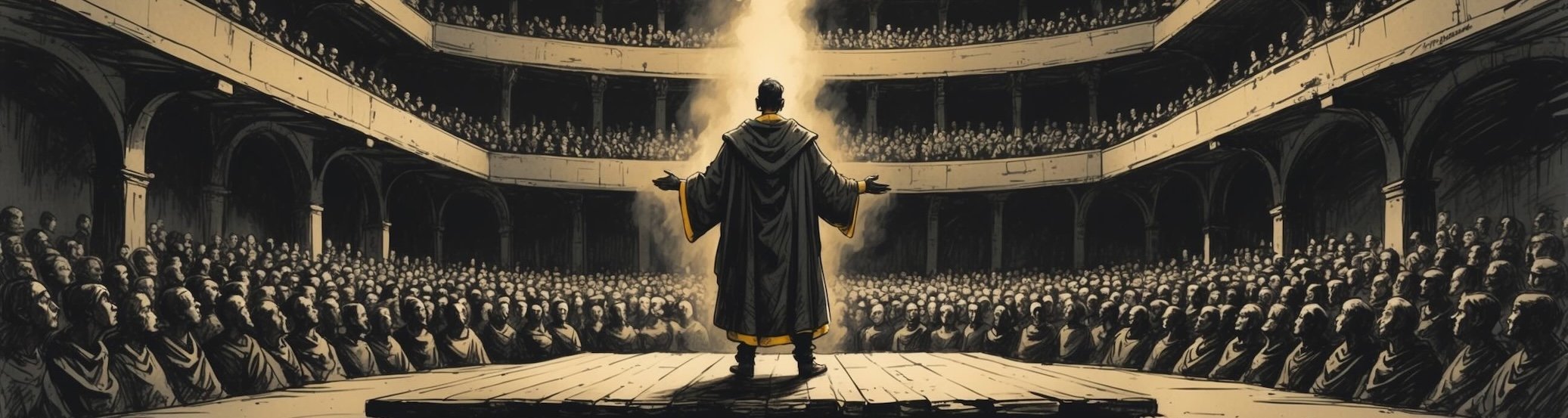
Before any of the action begins, a single figure called the Chorus steps forward and speaks straight to the audience. In fourteen lines, he explains that two powerful families in Verona have long been locked in a bitter feud, and that the old hatred has broken out into violence yet again.
He then reveals the whole story in advance: a pair of young lovers, one from each family, will fall in love, and their deaths will finally end the quarrel. The Chorus asks the audience to listen patiently, and the play begins.
Two Households, One Ancient Grudge
Romeo and Juliet begins not with a character but with a narrator. The Chorus sets the scene in a few broad strokes: two families of equal standing in Verona, divided by a hatred so old that its cause is long forgotten. The quarrel is not a private matter between two households – it spills into the streets and stains the whole city.
Original
From ancient grudge break to new mutiny,
Where civil blood makes civil hands unclean.
(the Chorus, Act 1, Prologue)
Shakespeare Retold (Modern Verse)
Where ancient hatred reignites a siege,
And civil conduct turns to civil rage.
The line "civil blood makes civil hands unclean" does a great deal of work in very little space. "Civil" means both "between citizens" and "civilised", so the phrase catches the play's central irony: the orderly, public world of the city is being turned against itself, and ordinary hands are dirtied by a feud they should have no part in. Before a single character has appeared, Shakespeare has established the feud as a kind of public disease – the backdrop against which the private love story will be destroyed.
Star-Crossed Lovers
Having drawn the feud, the Chorus turns to the lovers – and, astonishingly, tells us exactly what will become of them. They are "star-crossed", thwarted by the heavens themselves, and their love is doomed from the very start.
Original
From forth the fatal loins of these two foes
A pair of star-crossed lovers take their life...
(the Chorus, Act 1, Prologue)
Shakespeare Retold (Modern Verse)
Two offspring of ill-fated enemies,
That, jinxed by love, both die by suicide...
This is one of the boldest openings in Shakespeare: the ending is handed over before the beginning. The lovers will "take their life", and only their deaths will be enough to end their parents' feud. The effect is not to spoil the story but to change the way we watch it. We are not waiting to learn whether the lovers survive; we already know they will not. Every hopeful moment that follows is shadowed by the knowledge the Chorus plants here, and the play becomes a study of how, and why, the disaster arrives. The theme of fate and destiny is announced in the play's very first speech.
Language and Technique
- The sonnet form: The Prologue is a sonnet – fourteen lines of the kind normally used for love poetry. Using a love-poem to introduce a tragedy ties love and death together from the very first words.
- Direct address: The Chorus speaks straight to the audience, not to other characters. Stepping outside the story lets Shakespeare frame the play and steer how we watch it.
- Dramatic irony: By revealing the ending in advance, the Prologue makes the audience know more than the characters ever will – the source of the play's constant sense of doom.
- Wordplay on "civil": "civil blood... civil hands" puns on "civil" as both "between citizens" and "polite, orderly", capturing how the feud corrupts the whole city.
- Love-and-death imagery: The "fearful passage of their death-marked love" yokes love and death into a single phrase – the pairing the rest of the play will explore.
Key Quotes from the Prologue
Quote 1Two households, both alike in dignity,
In fair Verona, where we lay our scene...
(the Chorus, Act 1, Prologue)
Shakespeare Retold (Modern Verse)
Two families, both equal in prestige,
In beautiful Verona, set our stage...
Whose misadventured piteous overthrows
Do with their death bury their parents' strife.
(the Chorus, Act 1, Prologue)
Shakespeare Retold (Modern Verse)
Whose tragedy each family finally sees
That, by their deaths, their feuding’s set aside.
Which, but their children's end, nought could remove,
Is now the two hours' traffic of our stage...
(the Chorus, Act 1, Prologue)
Shakespeare Retold (Modern Verse)
Until their deaths, could not be pacified,
Will, for the next two hours, be re-enacted.
Key Takeaways
- The whole plot, in advance: The Prologue is a sonnet that tells us the lovers die and the families reconcile – before the play has started.
- A feud comes first: The opening establishes the Montague–Capulet quarrel as a public danger, the force that will destroy the lovers.
- "Star-crossed" lovers: The lovers are doomed by fate from the outset; their love is "death-marked" from the very first speech.
- Knowing changes the watching: Because we know how it ends, the play becomes about how and why – every hopeful moment shadowed by doom.
Study Questions and Analysis
Why does the Prologue tell the audience how the play ends?
It can seem strange that Shakespeare gives away his entire plot in the first fourteen lines – the lovers die, the families reconcile – before a single scene has played. But the move is deliberate. The story was not new: Elizabethan audiences would already have known the tale from Arthur Brooke's popular poem The Tragicall Historye of Romeus and Juliet (1562), so there was little suspense to protect. Freed from the question of what happens, the audience can attend instead to how and why it happens.
The technique is dramatic irony on the largest possible scale. Because we know the lovers are doomed, every hopeful step they take – the meeting, the secret marriage, the Friar's plan – is shadowed by a fate we can see and they cannot. The Prologue turns the play into something closer to a ritual: a death we watch approach. That is a large part of why the sense of fate hangs so heavily over everything that follows.
What does "star-crossed lovers" mean?
"Star-crossed" means thwarted or doomed by the stars. The Elizabethans took astrology seriously: the position of the stars at a person's birth was widely believed to shape their destiny, and to be "star-crossed" was to be opposed by the heavens themselves. By calling Romeo and Juliet "star-crossed lovers", and their love "death-marked", the Chorus presents their tragedy as written into the cosmos before they ever meet.
The phrase frames a question the play keeps returning to: are the lovers destroyed by fate, or by the choices and accidents of the people around them? The Prologue leans towards fate, and Romeo will echo it later when he cries out against the stars, but the action shows plenty of human causes too – the feud, reckless haste, a letter that fails to arrive. The tension between the two is central to the theme of fate and destiny, and "star-crossed" has since become one of the most famous phrases in English.
Why is the Prologue written as a sonnet?
The Prologue is a Shakespearean sonnet: fourteen lines of iambic pentameter, rhymed as three quatrains and a closing couplet. The choice is meaningful, because the sonnet was the fashionable form for love poetry. Shakespeare uses the shape of a love poem to introduce a story about love – but a love that ends in death, so the elegant form carries a dark content.
Harry Levin, in his classic essay 'Form and Formality in Romeo and Juliet' (1960), drew attention to how deliberately the play is patterned around such formal structures: the Prologue is a sonnet, the Chorus returns with a second sonnet before Act 2, and – most strikingly – when Romeo and Juliet first meet, their shared dialogue forms a perfect sonnet between them. The form is not decoration. It links the framing voice of the Chorus to the lovers themselves and signals from the outset that this is a play deeply concerned with the conventions of love.
What themes does the Prologue introduce?
For only fourteen lines, the Prologue is remarkably dense with the play's major concerns. It introduces the feud – the "ancient grudge" between two households – and presents it not as a private squabble but as "civil" violence that dirties the hands of the whole city, raising the themes of family and honour and public disorder.
It binds love and violence together in a single phrase, "death-marked love", so that the lovers' passion and their deaths arrive as one inseparable event. It foregrounds fate and destiny through the image of the "star-crossed" lovers, doomed from birth. And it even sounds the play's preoccupation with time, describing the whole tragedy as the "two hours' traffic of our stage" – a story compressed, like the romance itself, into a startlingly short span.